


The Open Group OGEA-101 - TOGAF Enterprise Architecture Part 1 Exam (English)
Consider the following ADM phases objectives.
Objective:
1.Develop the Target Data Architecture that enables the Business Architecture and the Architecture Vision
2.Develop the Target Business Architecture that describes how the enterprise needs to operate to achieve the business goals
3.Develop a high-level aspirational vision of the capabilities and business value to be delivered as a result of the proposed Enterprise Architecture
4.Identify candidate Architecture Roadmap components based upon gaps between the Baseline and Target Technology Architectures
Which phase does each objective match?
Full Question:
Consider the following description of the purpose of an ADM Phase:
To develop a domain architecture approved by the stakeholders for the problem being addressed, together with a set of gaps, and work to clear the gaps understood by the stakeholders.
Which ADM Phase does this describe?
Consider the following descriptions of deliverables consumed and produced across the TOGAF ADM cycle.
General rules and guidelines, intended to be enduring and seldom amended, that inform and support the way in which an organization sets about fulfilling its mission.
The joint agreements between development partners and sponsors on the deliverables, quality, and fitness-for-purpose of an architecture.
A document that is sent from the sponsoring organization to the architecture organization to trigger the start of an architecture development cycle.
A set of quantitative statements that outline what an implementation project must do in order to comply with the architecture.
Complete the sentence.
Deliverable 3 is an output of ________, and deliverable 4 can form ________.
Complete the sentence The purpose of the Preliminary Phase is to_____________.
Which of the following statements about architecture partitioning is correct?
Refer to the table below:
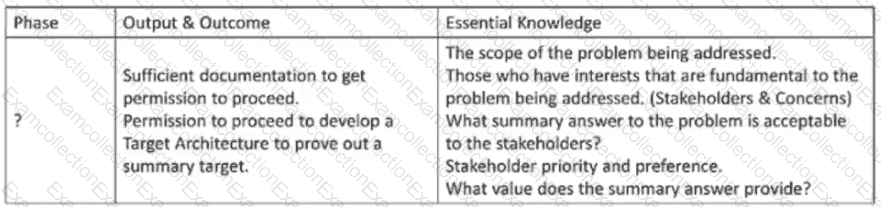
Which ADM Phase does this describe?
According to the TOGAF standard, what term describes an individual with an interest in a system?
Which of the following best describes the purpose of the Architecture Requirements Specification?
Consider the following chart:
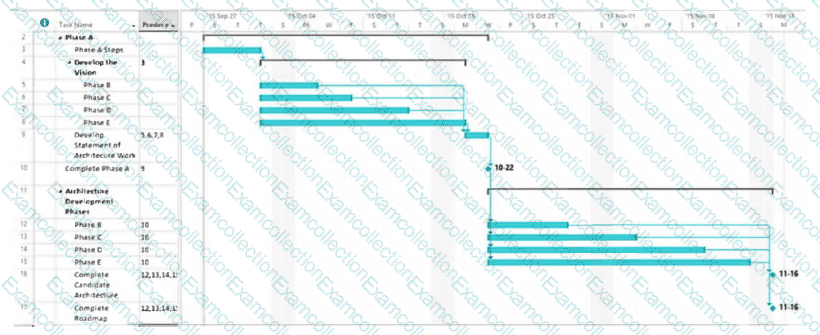
Which important concept for Enterprise Architecture Practitioners does it illustrate?
Complete the sentence. Actions arising from the Business Transformation Readiness Assessment technique should be incorporated in the