

New Year Sale Special Limited Time 70% Discount Offer - Ends in 0d 00h 00m 00s - Coupon code: xmas50

The Open Group OGEA-101 - TOGAF Enterprise Architecture Part 1 Exam (English)

Page: 1 / 5
Total 145 questions

Consider the following descriptions of deliverables consumed and produced across the TOGAF ADM cycle.

    General rules and guidelines, intended to be enduring and seldom amended, that inform and support the way in which an organization sets about fulfilling its mission

    A set of quantitative statements that outline what an implementation project must do in order to comply with the architecture.

    A document that is sent from the sponsoring organization to the architecture organization to trigger the start of an architecture development cycle

    The scope and approach that will be used to complete an architecture development cycle

Complete the sentence. Deliverable 3 is the, deliverable 4 is a deliverable from

A.

Architecture Definition Document, Phase H

B.

Request for Architecture Work, Phase A

C.

Stakeholder Map, Phase G

D.

Architecture Requirements Specification, Preliminary Phase

Consider the following extract of the purpose of an ADM Phase:

Phase Output & Outcome / Essential Knowledge

? — “A set of work packages that address the set of gaps, with an indication of value produced and effort required, and dependencies between the work packages to reach the adjusted target.”

What ADM Phase is this?

A.

Phase B

B.

Phase C

C.

Phase E

D.

Phase A

Which of the following statements about the Enterprise Continuum is correct?

A.

It provides guidance for organizations implementing their architecture within a tool.

B.

It contains general rules and guidelines relating to architecture work.

C.

It is a structural framework for an Architecture Repository.

D.

It provides a classification for artifacts as they evolve from generic to organization-specific.

What are the four architecture domains that the TOGAF standard deals with?

A.

Business, Data, Application, Technology

B.

Capability, Segment, Enterprise, Federated

C.

Baseline, Candidate, Transition, Target

D.

Application, Data, Information, Knowledge

Consider the following statements:

    A whole corporation or a division of a corporation

    A government agency or a single government department

    A chain of geographically distant organizations linked together by common ownershipComplete the sentence. The TOGAF Standard considers these to be examples of:

A.

Business Units

B.

Architecture Contexts

C.

Enterprises

D.

Organizations

Complete the following sentence. In the ADM, documents which are under development and have not undergone any formal review and approval process are called______ Documents which have been reviewed and approved are called ______

A.

"draft"- "finalized"

B.

"draft" - "approved"

C.

"concept" - "deliverable"

D.

"Version 0.1" - "Version 1.0"

Complete the sentence. The purpose of Enterprise Architecture is to

A.

take major improvement decisions.

B.

guide effective change.

C.

govern the stakeholders.

D.

control the bigger changes.

According to the TOGAF standard, what term describes an individual with an interest in a system?

A.

stakeholder

B.

consumer

C.

lead architect

D.

sponsor

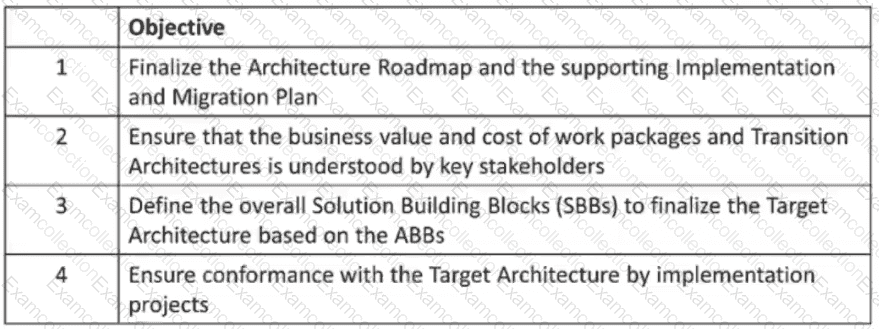
What is an objective of the ADM Implementation Governance Phase?

A.

To provide continual monitoring of the governance framework

B.

To ensure conformance for the target architecture

C.

To finalize the Implementation and Migration Plan

D.

To establish the resources for architecture governance

Complete the following sentence:

Presenting different_________and_________to stakeholders helps architects to extract hidden agendas principles and requirements that could impact the final Target Architecture

A.

Alternatives Trade-offs

B.

Solutions Applications

C.

Architecture Views Architecture Viewpoints

D.

Business Scenarios Business Models