


The Open Group OGEA-103 - TOGAF Enterprise Architecture Combined Part 1 and Part 2 Exam
What are the three levels of the Architecture Landscape?
Which section of the TOGAF template for Architecture Principles should highlight the requirements for carrying out the principle?
Full Scenario
You are employed as an Enterprise Architect within the Enterprise Architecture (EA) team at a clinical research and health technologies company. The company has multiple divisions. Your team works within the healthcare division.
The healthcare division is always creating new products and needs to show the effectiveness and safety of the products. This happens in a set of clinical trials that satisfy the legal requirements of the relevant health authorities. The clinical trials are undertaken by the division’s research laboratories at multiple facilities worldwide. At any time, there are many clinical trials happening. In addition to internal research and development activities, the healthcare division is also involved in publicly funded research projects with industrial and academic partners.
Your team is working on an architecture project to develop a secure system that will allow the healthcare researchers to share information more easily about their clinical trials. It will make working together easier across the organization. This system will also allow secured collaboration with external partners.
The EA team uses the TOGAF Architecture Development Method with adaptations required to support healthcare production methods and laboratory procedures. Due to the highly sensitive nature of the information that is managed, special care has been taken to ensure that each architecture domain considers the privacy and safety concerns.
The EA team has been instructed to minimize disruptions to the trials and to gradually introduce the new system.
The company has an established EA practice and has adopted the TOGAF standard for use in its architecture work. The EA practice is federated, which allows some interoperability and information sharing between the divisions yet permits partially independent activity. The Vice President of the healthcare division is the sponsor of the Enterprise Architecture activity for your EA team.
Question:
As part of introducing the new system, how would you go about breaking down the project into work packages?
Based on the TOGAF standard which of the following is the best answer?
Please read this scenario prior to answering the question
You are working as the Chief Enterprise Architect within a law firm specializing in personal injury cases. Many of the firm ' s competitors have improved their litigation strategies, and efficiency by streamlining their processes using Artificial Intelligence {Al).
The CIO has approved a Request for Architecture Work to examine the use of Machine Learning in defining a new Al-driven litigation and finance process for the firm. This process would instruct the lawyers and analysts as to what tasks and portfolio they should work on. The key objectives are to increase task profitability, maximize staff utilization, and increase individual profitability.
The CIO has emphasized that the architecture should enable the fast implementation of continuous Machine Learning. The solution will need to be constantly measured for delivered value and be quickly iterated to success.
Some of the partners have expressed concerns about letting the Al make the decisions, others about the risks associated with use of it for the type of service they deliver. The CIO wants to know if these concerns can be addressed, and how risks will be covered by a new architecture enabling Al and Machine Learning.
Refer to the scenario
You have been asked to respond to the CIO recommending an approach that would enable the development of an architecture that addresses the concerns of the CIO and the concerns of the partners.
Based on the TOGAF standard which of the following is the best answer?
You are working as an Enterprise Architect at a large company. The company runs many retail stores as well as an online marketplace that allows hundreds of brands to partner with the company. The company has a mature Enterprise Architecture (EA) practice and uses the TOGAF standard for its architecture development method. The EA practice is involved in all aspects of the business, with oversight provided by an Architecture Board with representatives from different parts of the business. The EA program is sponsored by the Chief Information Officer (CIO).
Many of the stores remain open all day and night. Each store uses a standard method to track sales and inventory, which involves sending accurate, timely sales data to a central AI-based inventory management system that can predict demand, adjust stock levels, and automate reordering. The central inventory management system is housed at the company’s central data center.
The company has acquired a major rival. The Chief Executive Officer (CEO) believes that the merger will enable growth through combined offerings and cost savings. The decision has been made to fully integrate the two organizations, including merging retail operations and systems. Duplicated systems will be replaced with one standard retail management system. The CIO expects significant savings from these changes across the newly merged company.
The rival company has successfully implemented the use of hand-held devices within stores for both customers and staff, which has increased satisfaction due to time savings. The CIO has approved the rollout of these devices to all stores but has stated that training should be brief, as there are many part-time employees.
You have been asked to confirm the most relevant architecture principles for this transformation. Based on the TOGAF Standard, which of the following is the best answer?
Scenario:
You are working as an Enterprise Architect at a large company. The company runs a chain of home improvement stores, as well as a website for selling products. The website lets many brands work with the company.
The stores open seven days a week and use a standard method to track sales and inventory. This involves sending accurate and timely sales data to a central inventory management system that can predict demand, adjust stock levels, and automate reordering. The website is supported by regional fulfillment centers and also uses the central inventory management system. The central inventory management system is housed at the company’s central data center.
The company has agreed to merge with a major competitor. The leadership teams of both organizations have said they are committed to a smooth transition for customers. All stores will keep their own brand names. They will combine the systems of the organizations, which includes merging retail operations and systems. Duplicated systems will be replaced with one standard retail management system. Additionally, they will reduce the number of applications being used. The CIO expects that these changes will lead to substantial cost savings for the newly merged company.
An enterprise plan for both organizations has been created. The aim is to set priorities for the transition, especially in terms of information management and application development. It is crucial to make decisions that will create long-term value.
The company has a mature Enterprise Architecture (EA) practice and uses the TOGAF standard for its architecture development method. The EA program is sponsored by the Chief Information Officer (CIO).
The Request for Architecture Work to oversee the transition has been approved. The project has been scoped, and you have been assigned to work on it.
You have been asked to confirm the most relevant architecture principles for the transition.
Based on the TOGAF Standard, which of the following is the best answer?
Complete the sentence. When considering agile development, Architecture to Support Portfolio will identify what products the Enterprise needs, the boundary of the products, and what constraints a product owner has; this defines the Enterprise ' s
What is used to structure architectural information in an orderly way so that it can be processed to meet stakeholder needs?
Which of the following does the TOGAF standard describe as a package of functionality defined to meet business needs across an organization?
Consider the illustration.
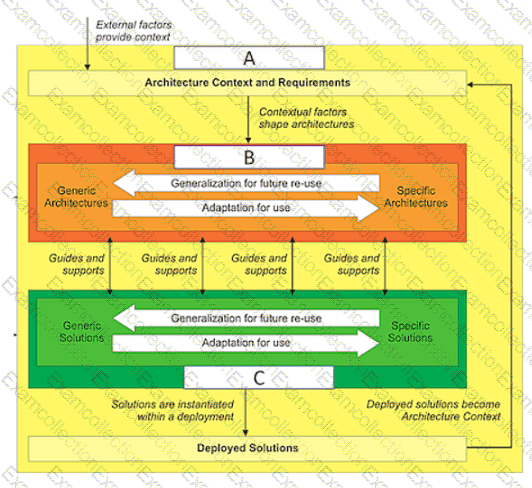
What are the items labelled A, B and C?
