


Microsoft SC-401 - Administering Information Security in Microsoft 365
Note: This question is part of a series of questions that present the same scenario. Each question in the series contains a unique solution that might meet the stated goals. Some question sets might have more than one correct solution, while others might not have a correct solution.
After you answer a question in this section, you will NOT be able to return to it. As a result, these questions will not appear in the review screen.
You recently discovered that the developers at your company emailed Azure Storage Account keys in plain text to third parties.
You need to ensure that when Azure Storage Account keys are emailed, the emails are encrypted.
Solution: You configure a mail flow rule that matches a sensitive info type.
Does this meet the goal?
You have Microsoft 365 E5 tenant that has a domain name of 86s40q.ofimicrosoft.com. The tenant contains the users shown in the following table.
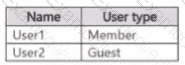
You have a published sensitivity label.
The Access control settings for the sensitivity label are configured as shown in the exhibit (Click the Exhibit tab.)
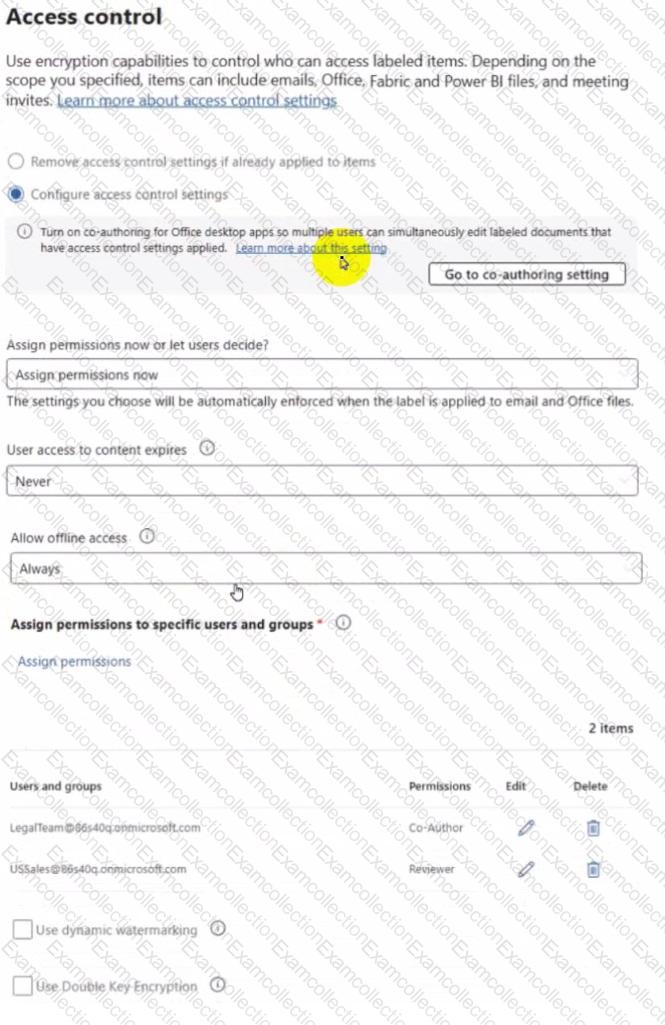
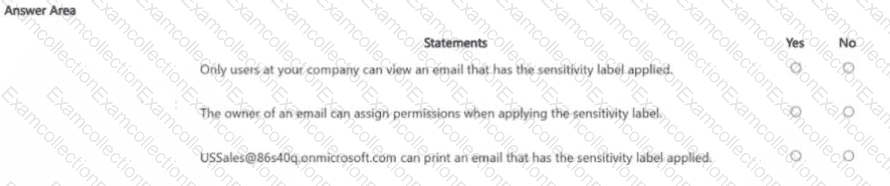
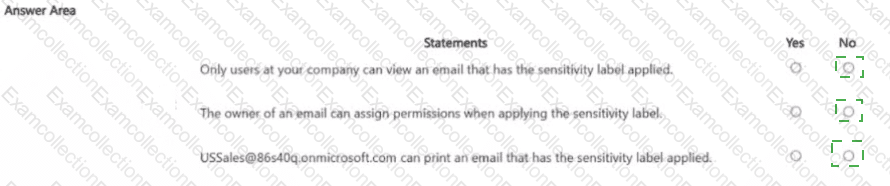
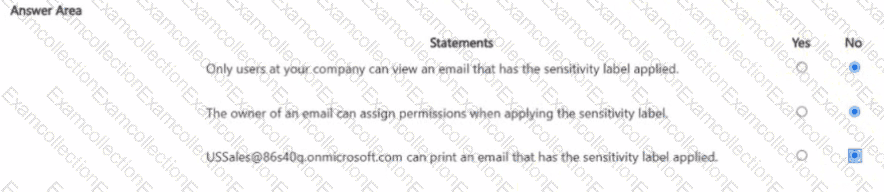
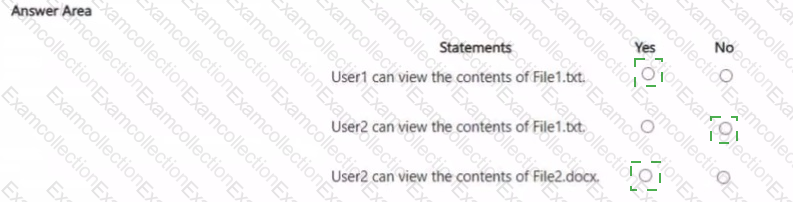
For each of the following statements, select Yes if the statement is true. Otherwise, select No.
You have a Microsoft 365 E5 subscription that contains two users named User1 and User2.
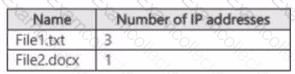
You have a Microsoft SharePoint site named Site1. Site1 stores files that contain IP addresses as shown in the following table.
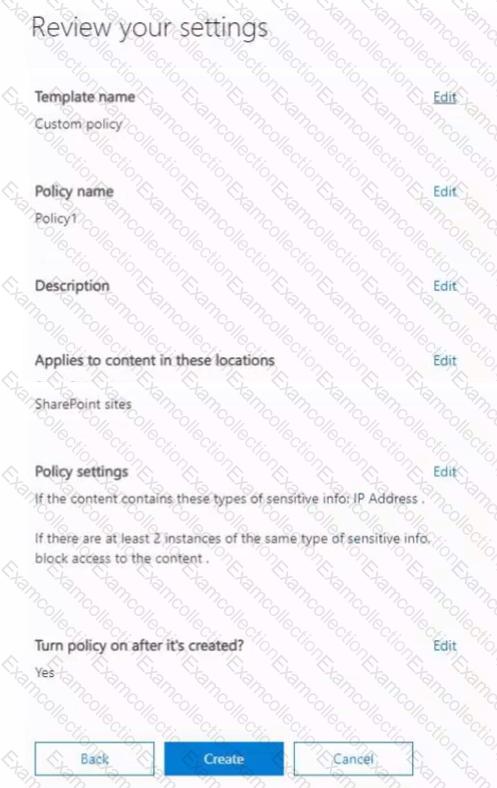
User1 is assigned the SharePoint admin role for Site1. User2 is a member of Site1. You create the data loss prevention (DLP) policy shown in the following exhibit.
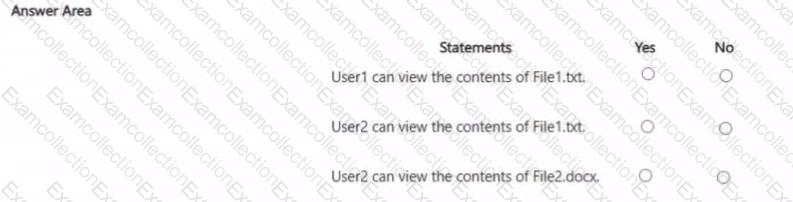
For each of the following statements, select Yes if the statement is true. Otherwise, select No.
NOTE: Each correct selection is worth one point.
You have a Microsoft 365 E5 subscription.
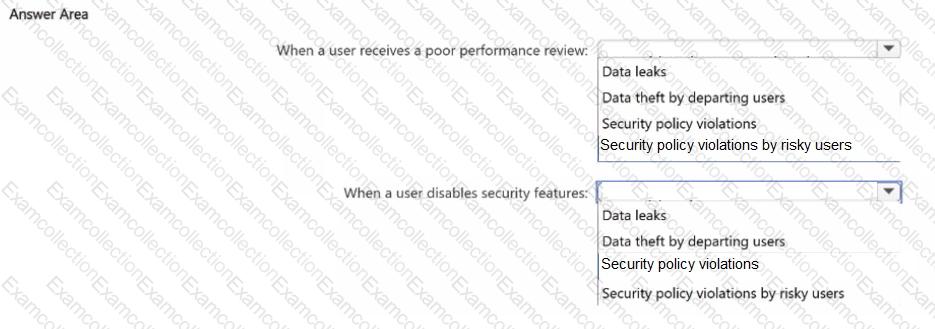
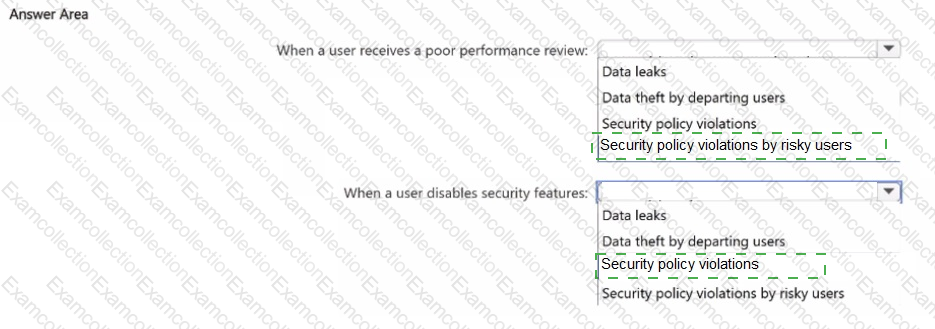
You plan to implement Microsoft Purview insider risk management.
You need to recommend policy templates that meet the following requirements:
• Contain risk indicators and scoring for when a user receives a poor performance review
• Contain risk indicators and scoring for when a user disables security features on a device.
Which template should you use for each requirement? To answer, select the appropriate options in the answer area.
NOTE: Each correct selection is worth one point.
You have a Microsoft 365 E5 tenant that has devices onboarded to Microsoft Defender for Endpoint as shown in the following table.
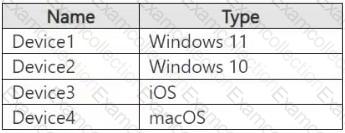
You plan to start using Microsoft 365 Endpoint data loss protection (Endpoint DLP).
Which devices support Endpoint DLP?
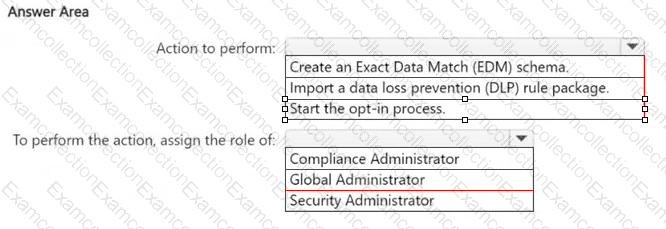
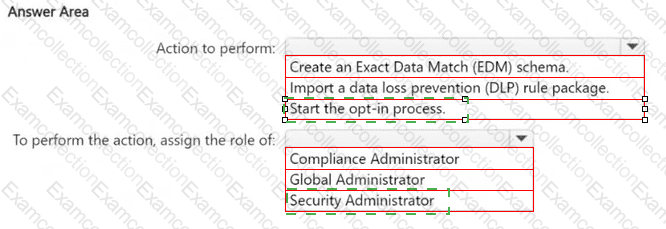
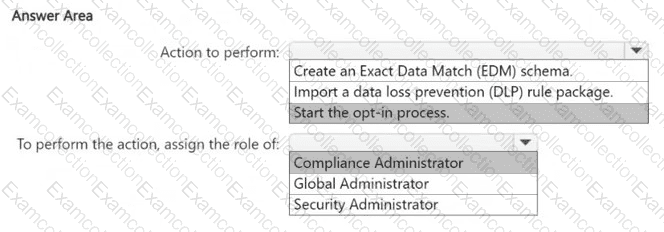
You have a new Microsoft 365 E5 tenant.
You need to create a custom trainable classifier that will detect product order forms. The solution must use the principle of least privilege.
What should you do first? To answer, select the appropriate options in the answer area.
NOTE: Each correct selection is worth one point.
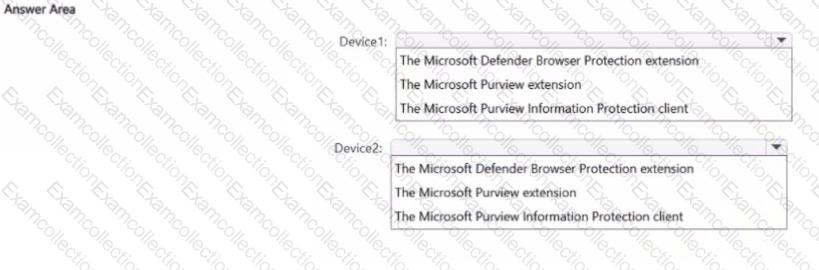
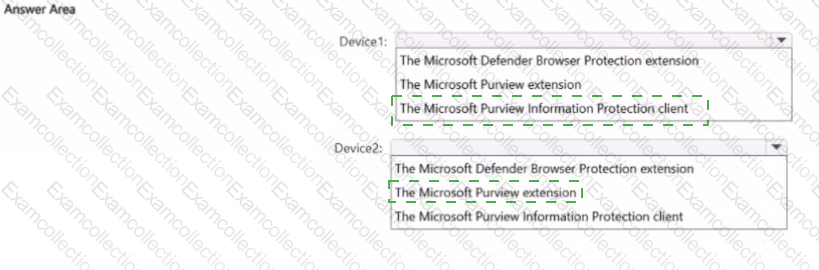
You have a Microsoft 36S ES subscription that contains two Windows devices named Devicel1and Device2 Device1 has the default browser set to Microsoft Edge. Devke2 has the default browser set to Google Chrome.
You need to ensure that Microsoft Purview insider risk management can collect signals when a user copies files to a USB device by using their default browser.
What should you deploy to each device? To answer, select the appropriate options in the answer area.
NOTE: Each correct selection is worth one point.

You have a Microsoft OneDrive folder that contains the files shown in the following table.
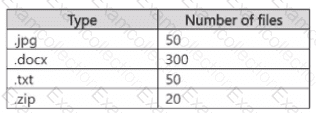
In Microsoft Defender for Cloud Apps, you create a file policy to automatically apply a classification. What is the effect of applying the policy?
You have a Microsoft 365 E5 subscription.
You need to create static retention policies for the following locations:
â— Teams chats
â— Exchange email
â— SharePoint sites
â— Microsoft 365 Groups
â— Teams channel messages
What is the minimum number of retention policies required?
You implement Microsoft 365 Endpoint data loss prevention (Endpoint DLP).
You have computers that run Windows 11 and have Microsoft 365 Apps installed. The computers are joined to a Microsoft Entra tenant.
You need to ensure that Endpoint DLP policies can protect content on the computers.
Solution: You enroll the computers in Microsoft Intune.
Does this meet the goal?
