

SAVE International VMA - Value Methodology Associate
Which is the correct order of steps involved in risk management?
Risk Management Planning, Risk Analysis, Risk Identification, Risk Response Planning, Risk Monitoring and Control
Risk Identification, Risk Management Planning, Risk Analysis, Risk Response Planning, Risk Monitoring and Control
Risk Management Planning, Risk Identification, Risk Analysis, Risk Response Planning, Risk Monitoring and Control
Risk Management Planning, Risk Identification, Risk Response Planning, Risk Analysis, Risk Monitoring and Control
The Answer Is:
CExplanation:
Risk management is a critical aspect of Implementation Planning in Value Methodology (VM), ensuring that VM proposals are feasible and sustainable, as taught in the VMF 1 course (Core Competency #8: Implementation Planning). According to SAVE International’s Value Methodology Standard, risk management in the context of VM follows a standard process aligned with project management best practices, such as those in the Project Management Institute (PMI) framework, which VM adopts for implementation. The correct order of steps in risk management is:
Risk Management Planning: Define how risks will be managed, including methodologies, roles, and tools.
Risk Identification: Identify potential risks that could impact the VM study or its implementation (e.g., cost overruns, delays).
Risk Analysis: Analyze the likelihood and impact of identified risks (qualitative and quantitative analysis).
Risk Response Planning: Develop strategies to mitigate, avoid, transfer, or accept risks.
Risk Monitoring and Control: Monitor risks throughout implementation and control them as needed.
The VMF 1 course emphasizes this sequence in the Development and Presentation Phases, where risks associated with VM proposals are assessed and mitigated to ensure successful implementation. This order ensures a systematic approach, starting with planning, followed by identification and analysis, then response planning, and finally monitoring.
Option A (Risk Management Planning, Risk Analysis, Risk Identification, Risk Response Planning, Risk Monitoring and Control) is incorrect because Risk Identification must precede Risk Analysis— you cannot analyze risks before identifying them.
Option B (Risk Identification, Risk Management Planning, Risk Analysis, Risk Response Planning, Risk Monitoring and Control) is incorrect because Risk Management Planning must come first to establish the framework for the process.
Option C (Risk Management Planning, Risk Identification, Risk Analysis, Risk Response Planning, Risk Monitoring and Control) is correct, as it follows the standard risk management process.
Option D (Risk Management Planning, Risk Identification, Risk Response Planning, Risk Analysis, Risk Monitoring and Control) is incorrect because Risk Analysis must precede Risk Response Planning to inform the response strategies.
The VM is defined by SAVE International as a:
Structured process
Specialized process
Systematic process
Sequential process
The Answer Is:
CExplanation:
Value Methodology (VM) is defined by SAVE International in its Value Methodology Standard as “asystematic processthat uses a structured Job Plan to improve the value of projects, products, or processes by analyzing their functions and identifying opportunities to achieve required functions at the lowest total cost without compromising quality or performance.†The term “systematic†emphasizes the methodical, disciplined approach of VM, which follows a defined sequence of phases (the VM Job Plan) and uses specific tools like Function Analysis and cost modeling to ensure consistency and effectiveness.
Option A (Structured process) is partially correct, as VM is structured, but “systematic†is the precise term used by SAVE International to describe the methodology’s comprehensive and methodical nature.
Option B (Specialized process) is incorrect because VM is a general methodology applicable across industries, not limited to a specific domain.
Option C (Systematic process) is correct, directly matching SAVE International’s definition of VM.
Option D (Sequential process) is incorrect because, while the VM Job Plan is sequential, the definition of VM focuses on its systematic nature, not just the sequence.
The original VM Job Plan was based on a problem-solving approach. Which is the correct order of the four steps comprising this approach?
Hypothesis, Observation, Experimentation, Conclusion
Observation, Experimentation, Hypothesis, Conclusion
Hypothesis, Experimentation, Observation, Conclusion
Observation, Hypothesis, Experimentation, Conclusion
The Answer Is:
DExplanation:
The original Value Methodology (VM) Job Plan, developed by Lawrence D. Miles in the 1940s, was rooted in a problem-solving approach inspired by the scientific method. As outlined in the VMF 1 course (Core Competency #1: Value Methodology Overview), Miles adapted a systematic problem-solving framework to create the VM Job Plan, which later evolved into the six-phase process used today (Information, Function Analysis, Creative, Evaluation, Development, Presentation). The original problem-solving approach, as described in SAVE International’s historical documentation of VM, follows the scientific method’s four steps: Observation, Hypothesis, Experimentation, and Conclusion.
Observation: Observe the problem or system (e.g., high costs, inefficiencies) to understand the current state, aligning with the Information Phase.
Hypothesis: Form a hypothesis about how to improve value (e.g., identifying key functions or alternatives), similar to Function Analysis and Creative Phases.
Experimentation: Test the hypothesis by developing and evaluating alternatives, akin to the Evaluation and Development Phases.
Conclusion: Draw conclusions and implement solutions, corresponding to the Presentation Phase.
This order—Observation, Hypothesis, Experimentation, Conclusion—is the standard sequence of the scientific method, which Miles used as the foundation for VM’s systematic approach to problem-solving.
Option A (Hypothesis, Observation, Experimentation, Conclusion) is incorrect because observation must come first to identify the problem.
Option B (Observation, Experimentation, Hypothesis, Conclusion) is incorrect because hypothesizing should precede experimentation.
Option C (Hypothesis, Experimentation, Observation, Conclusion) is incorrect because observation must come before forming a hypothesis.
Option D (Observation, Hypothesis, Experimentation, Conclusion) is correct, as it matches the scientific method’s order, which underpins the original VM Job Plan.
The unique aspect of the value methodology is its application to anything that:
includes an activity.
performs a function.
is goal-oriented.
is a subject of study.
The Answer Is:
BExplanation:
Value Methodology (VM) is a versatile methodology, as taught in the VMF 1 course (Core Competency #1: Value Methodology Overview). According to SAVE International’s Value Methodology Standard, “the unique aspect of the Value Methodology is its focus on function analysis, making it applicable to anything that performs a function—whether a product, process, system, or service.†VM’s core principle is to improve value (function/cost) by analyzing what something does (its functions) and finding better ways to achieve those functions at lower cost without sacrificing performance. This focus on functions (e.g., “mark surface†for a pen, Question 38; “contain liquid†for a teacup, Question 44) allows VM to be applied universally to anything with a definable function, distinguishing it from other methodologies like Lean or Six Sigma, which focus on process efficiency or quality.
Option A (includes an activity) is incorrect because, while activities describe how functions are performed, VM’s unique aspect is its focus on functions, not activities.
Option B (performs a function) is correct, as VM’s defining feature is its application to anything with a function, per SAVE International’s standards.
Option C (is goal-oriented) is incorrect because many methodologies are goal-oriented; VM’s uniqueness lies in its function-based approach.
Option D (is a subject of study) is incorrect because being a subject of study is too broad; VM specifically targets subjects that perform functions.
Which of the following best defines an activity?
A task, action, or operation that describes why a function is performed
A specific task, action, or operation that is generic and changes viewpoints
A task, action, or operation that describes how a function is performed
A specific task, action, or operation with a high level of abstraction
The Answer Is:
CExplanation:
In Value Methodology’s Function Analysis, the concepts of functions and activities are distinct but related, as taught in the VMF 1 course (Core Competency #2: Function Analysis). According to SAVE International’s Value Methodology Standard, “a function is defined as what a product, process, or system does, expressed in a verb-noun format (e.g., ‘contain liquid’), while an activity is a task, action, or operation that describes how a function is performed.†For example, the function of a teacup might be “contain liquid,†and the activity to achieve that function could be “holding the liquid in a ceramic structure.†Activities are the actionable steps or processes that enable the function, often identified during the creation of a FAST diagram or Random Function Identification table (as noted in Question 19). The “how†aspect aligns with the How-Why logic of FAST diagrams, where activities detail the practical execution of a function.
Option A (A task, action, or operation that describes why a function is performed) is incorrect because “why†relates to the higher-order function or purpose (e.g., Question 20), not the activity, which focuses on “how.â€
Option B (A specific task, action, or operation that is generic and changes viewpoints) is incorrect because activities are not about changing viewpoints; they are specific actions to perform a function.
Option C (A task, action, or operation that describes how a function is performed) is correct, as it aligns with the definition of an activity in VM.
Option D (A specific task, action, or operation with a high level of abstraction) is incorrect because activities are practical and specific, not abstract; functions are more abstract (e.g., verb-noun format).
Which phase of the VM Job Plan is considered the heart of the Value Methodology?
Implementation
Function Analysis
Creativity
Presentation
The Answer Is:
BExplanation:
The Value Methodology (VM) Job Plan consists of six phases, as taught in the VMF 1 course (Core Competency #3: Value Methodology Job Plan). According to SAVE International’s Value Methodology Standard, “the Function Analysis Phase is considered the heart of the Value Methodology because it establishes the foundation for value improvement by identifying, classifying, and analyzing the functions of the system, which drives all subsequent phases.†Function Analysis (the second phase) defines what the system does (e.g., using verb-noun combinations, FAST diagrams) and sets the stage for generating ideas (Creativity), evaluating them (Evaluation), and developing solutions (Development). Without understanding functions, the VM process cannot effectively improve value (function/cost), making this phase central to the methodology’s success. This was alluded to in questions like 37 (FAST diagram logic) and 44 (defining functions).
Option A (Implementation) is incorrect because Implementation is a post-study activity, not a formal phase of the VM Job Plan, and not the heart of VM.
Option B (Function Analysis) is correct, as it is the foundational phase that drives the entire VM process, per SAVE International’s standards.
Option C (Creativity) is incorrect because, while important, Creativity relies on the functions identified in Function Analysis to generate ideas.
Option D (Presentation) is incorrect because Presentation is the final phase, focused on communicating results, not the core of the methodology.
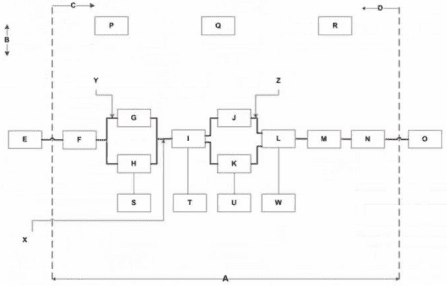
Y is pointing to the
"AND" Gate
Minor Logic Path
Critical Logic Path
"OR" Gate
The Answer Is:
CExplanation:
The diagram provided is a Function Analysis System Technique (FAST) diagram, a key tool in Value Methodology’s Function Analysis phase, as taught in the VMF 1 course. FAST diagrams map the relationships between functions of a system, showing “how†and “why†relationships to identify the critical logic path (the primary sequence of functions that achieve the system’s basic function) and minor logic paths (supporting functions). In FAST diagramming, functions are represented by boxes (e.g., G, H, J, K), and their relationships are shown with arrows.
Yis a red arrow connecting function G to function J, running horizontally across the diagram. In FAST diagrams, the horizontal path from left to right represents thecritical logic path, which answers the question “how†each function is achieved to fulfill the system’s primary purpose. Here, the path from E to F to G to J to L to M to N to O is the main sequence of functions, indicating the critical logic path.
Z(another red arrow) points to a vertical connection between J and K, which represents a minor logic path—supporting functions that occur simultaneously or are secondary to the main path.
Option A ("AND" Gate) and Option D ("OR" Gate) are incorrect because FAST diagrams use logic gates to show relationships between functions (e.g., AND for concurrent functions, OR for alternatives), but Y is an arrow on the main path, not a gate. Gates are typically symbols (e.g., triangles or diamonds) at junctions, not arrows.
Option B (Minor Logic Path) is incorrect because minor logic paths are vertical connections in FAST diagrams (e.g., Z pointing to J-K), not the horizontal path that Y indicates.
Option C (Critical Logic Path) is correct because Y lies on the main horizontal path, which represents the critical sequence of functions in a FAST diagram.
Which phase enables the VM team to select viable ideas?
Function Analysis
Presentation
Evaluation
Development
The Answer Is:
CExplanation:
The Value Methodology (VM) Job Plan, as outlined in the VMF 1 course and SAVE International’s Value Methodology Standard, consists of six phases, one of which is the Evaluation Phase, where the VM team selects viable ideas. In the Evaluation Phase, the team assesses ideas generated during the Creative Phase to determine their feasibility, cost impact, and alignment with project goals. According to the VMF 1 Core Competency #3 (Value Methodology Job Plan), the Evaluation Phase involves “evaluating the ideas for their potential to improve value, using criteria such as cost savings, performance, quality, and feasibility, to select the most viable alternatives for further development.†Tools like weighted evaluation matrices may be used to rank ideas systematically.
Option A (Function Analysis) is incorrect because this phase focuses on identifying and analyzing functions, not selecting ideas.
Option B (Presentation) is incorrect because this phase involves communicating recommendations to stakeholders, after ideas have already been selected and developed.
Option C (Evaluation) is correct, as it is the phase where the VM team filters and selects viable ideas based on defined criteria.
Option D (Development) is incorrect because this phase involves refining selected ideas into actionable proposals, which happens after the Evaluation Phase.