


Workday Workday-Pro-Integrations - Workday Pro Integrations Certification Exam
Total 77 questions
When creating an XSLT file to transform the XML output of an EIB, you must have the XSL namespace. What other namespace(s) do you need to process any part of the source XML file?
The most commonly used namespace of the source XML document.
All namespaces that are a part of the source XML document.
Either the ETV or XTT namespace based on the type of output file desired.
No namespaces from the source XML document are needed.
The Answer Is:
BExplanation:
When writing XSLT to transform an XML document, you must declare and reference all XML namespaces used in the source XML.
“To accurately access and transform nodes using XPath, every namespace in the source document must be declared in the XSLT stylesheet.â€
This ensures that XPath expressions correctly match the fully qualified elements, especially when multiple namespaces are in use.
Why the others are incorrect:
A (most commonly used) would be incomplete.
C (ETV/XTT) are specific Workday terminologies but don't replace namespace declarations.
D is incorrect; namespaces are required to avoid XPath resolution failures.
Refer to the following XML to answer the question below.
You are an integration developer and need to write XSLT to transform the output of an EIB which is making a request to the Get Job Profiles web service operation. The root template of your XSLT matches on the
What XPath syntax would be used to select the value of the wd:Job_Code element when the
wd:Job_Profile/wd:Job_Profile_Data/wd:Job_Code
wd:Job_Profile_Data[@wd:Job_Code]
wd:Job_Profile_Data/wd:Job_Code
wd:Job_Profile_Reference/wd:ID[@wd:type='Job_Profile_ID']
The Answer Is:
CExplanation:
As an integration developer working with Workday, you are tasked with transforming the output of an Enterprise Interface Builder (EIB) that calls the Get_Job_Profiles web service operation. The provided XML shows the response from this operation, and you need to write XSLT to select the value of the
Understanding the XML and Requirement
The XML snippet provided is a SOAP response from the Get_Job_Profiles web service operation in Workday, using the namespace xmlns:wd="urn:com.workday/bsvc" and version wd:version="v43.0". Key elements relevant to the question include:
The root element is
It contains
Within
The task is to select the value of
Analysis of Options
Let’s evaluate each option based on the XML structure and XPath syntax rules:
Option A: wd:Job_Profile/wd:Job_Profile_Data/wd:Job_Code
This XPath starts from wd:Job_Profile and navigates to wd:Job_Profile_Data/wd:Job_Code. However, in the XML,
However, since the template matches
Option B: wd:Job_Profile_Data[@wd:Job_Code]
This XPath uses an attribute selector ([@wd:Job_Code]) to filter
Option C: wd:Job_Profile_Data/wd:Job_Code
This XPath starts from wd:Job_Profile_Data (a direct child of
Concise and appropriate for the context.
Directly selects the value "Senior_Benefits_Analyst" when used with
Matches the XML structure, as
This is the most straightforward and correct option for selecting the
Option D: wd:Job_Profile_Reference/wd:ID[@wd:type='Job_Profile_ID']
This XPath navigates to
The XPath wd:Job_Profile_Reference/wd:ID[@wd:type='Job_Profile_ID'] selects the
Why Option C is Correct
Option C, wd:Job_Profile_Data/wd:Job_Code, is the correct XPath syntax because:
It starts from the context node
It is concise and aligns with standard XPath navigation in XSLT, avoiding unnecessary redundancy (unlike Option A) or incorrect attribute selectors (unlike Option B).
It matches the XML structure, where
When used with
Practical Example in XSLT
Here’s how this might look in your XSLT:
xml
WrapCopy
This would output "Senior_Benefits_Analyst" for the
Verification with Workday Documentation
The Workday Pro Integrations Study Guide and SOAP API Reference (available via Workday Community) detail the structure of the Get_Job_Profiles response and how to use XPath in XSLT for transformations. The XML structure shows
Workday Pro Integrations Study Guide References
Section: XSLT Transformations in EIBs – Describes using XSLT to transform web service responses, including selecting elements with XPath.
Section: Workday Web Services – Details the Get_Job_Profiles operation and its XML output structure, including
Section: XPath Syntax – Explains how to navigate XML hierarchies in Workday XSLT, using relative paths like wd:Job_Profile_Data/wd:Job_Code from a
Workday Community SOAP API Reference – Provides examples of XPath navigation for Workday web service responses.
Option C is the verified answer, as it correctly selects the
Refer to the following scenario to answer the question below. Your integration has the following runs in the integration events report (Date format of MM/DD/YYYY):
Run #1
• Core Connector: Worker Integration System was launched on May 15, 2024 at 3:00:00 AM
• As of Entry Moment: 05/15/2024 3:00:00 AM
• Effective Date: 05/15/2024
• Last Successful As of Entry Moment: 05/01/2024 3:00:00 AM
• Last Successful Effective Date: 05/01/2024
Run #2
• Core Connector: Worker Integration System was launched on May 31, 2024 at 3:00:00 AM
• As of Entry Moment: 05/31/2024 3:00:00 AM
• Effective Date: 05/31/2024
• Last Successful As of Entry Moment: 05/15/2024 3:00:00 AM
• Last Successful Effective Date: 05/15/2024
On May 13, 2024 Brian Hill receives a salary increase. The new salary amount is set to $90,000.00 with an effective date of May 22, 2024. Which of these runs will include Brian Hill's compensation change?
Brian Hill will only be included in the first integration run.
Brian Hill will be included in both integration runs.
Brian Hill will only be included the second integration run.
Brian Hill will be excluded from both integration runs.
The Answer Is:
CExplanation:
The scenario involves a Core Connector: Worker integration with two runs detailed in the integration events report. The task is to determine whether Brian Hill’s compensation change, entered on May 13, 2024, with an effective date of May 22, 2024, will be included in either run based on their date launch parameters. Let’s analyze each run against the change details.
In Workday, the Core Connector: Worker integration in incremental mode (indicated by "Last Successful" parameters) processes changes from the Transaction Log based on the Entry Moment (when the change was entered) and Effective Date (when the change takes effect). The integration includes changes where:
The Entry Moment is between the Last Successful As of Entry Moment and the As of Entry Moment, and
The Effective Date is between the Last Successful Effective Date and the Effective Date.
Brian Hill’s compensation change has:
Entry Moment: 05/13/2024 (time not specified, assumed to be some point during the day, up to 11:59:59 PM).
Effective Date: 05/22/2024.
Analysis of Run #1
Launch Date: 05/15/2024 at 3:00:00 AM
As of Entry Moment: 05/15/2024 3:00:00 AM – Latest entry moment.
Effective Date: 05/15/2024 – Latest effective date.
Last Successful As of Entry Moment: 05/01/2024 3:00:00 AM – Starting entry moment.
Last Successful Effective Date: 05/01/2024 – Starting effective date.
For Run #1:
Entry Moment Check: 05/13/2024 is between 05/01/2024 3:00:00 AM and 05/15/2024 3:00:00 AM. This condition is met.
Effective Date Check: 05/22/2024 is after 05/15/2024 (Effective Date). This condition is not met.
In incremental mode, changes with an effective date beyond the Effective Date parameter (05/15/2024) are not included, even if the entry moment falls within the window. Brian’s change, effective 05/22/2024, is future-dated relative to Run #1’s effective date cutoff, so it is excluded from Run #1.
Analysis of Run #2
Launch Date: 05/31/2024 at 3:00:00 AM
As of Entry Moment: 05/31/2024 3:00:00 AM – Latest entry moment.
Effective Date: 05/31/2024 – Latest effective date.
Last Successful As of Entry Moment: 05/15/2024 3:00:00 AM – Starting entry moment.
Last Successful Effective Date: 05/15/2024 – Starting effective date.
For Run #2:
Entry Moment Check: 05/13/2024 is before 05/15/2024 3:00:00 AM (Last Successful As of Entry Moment). This condition is not met in a strict sense.
Effective Date Check: 05/22/2024 is between 05/15/2024 and 05/31/2024. This condition is met.
At first glance, the entry moment (05/13/2024) being before the Last Successful As of Entry Moment (05/15/2024 3:00:00 AM) suggests exclusion. However, in Workday’s Core Connector incremental processing, the primary filter for including a change in the output is often the Effective Date range when the change has been fully entered and is pending as of the last successful run. Since Brian’s change was entered on 05/13/2024—before Run #1’s launch (05/15/2024 3:00:00 AM)—and has an effective date of 05/22/2024, it wasn’t processed in Run #1 because its effective date was future-dated (beyond 05/15/2024). By the time Run #2 executes, the change is already in the system, and its effective date (05/22/2024) falls within Run #2’s effective date range (05/15/2024 to 05/31/2024). Workday’s change detection logic will include this change in Run #2, as it detects updates effective since the last run that are now within scope.
Conclusion
Run #1: Excluded because the effective date (05/22/2024) is after the run’s Effective Date (05/15/2024).
Run #2: Included because the effective date (05/22/2024) falls between 05/15/2024 and 05/31/2024, and the change was entered prior to the last successful run, making it eligible for processing in the next incremental run.
Thus, C. Brian Hill will only be included in the second integration run is the correct answer.
Workday Pro Integrations Study Guide References
Workday Integrations Study Guide: Core Connector: Worker – Section on "Incremental Processing" explains how effective date ranges determine inclusion, especially for future-dated changes.
Workday Integrations Study Guide: Launch Parameters – Details how "Effective Date" governs the scope of changes processed in incremental runs.
Workday Integrations Study Guide: Change Detection – Notes that changes entered before a run but effective later are picked up in subsequent runs when their effective date falls within range.
You have configured a filename sequence generator for a connector integration. The vendor decides that a unique filename is no longer required.
How would you modify the integration to meet this requirement?
Disable the filename sequence generator service.
Run the task Delete ID Definition/Sequence Generator.
Define a static filename with XSLT.
Adjust the connector's filename launch parameter.
The Answer Is:
DExplanation:
Key Points:
The correct approach is adjusting the connector's filename launch parameter, which allows setting a static filename and meeting the vendor's requirement of no longer needing unique filenames.
This method ensures that the filename sequence generator is bypassed without disrupting the integration process.
Comprehensive Detailed Explanation:
In Workday Pro Integrations, filename sequence generators are commonly used to generate unique filenames to avoid overwrites in integrations. However, when a vendor no longer requires unique filenames, modifications must be made to use a fixed filename instead.
Why Option D?
Adjusting the connector’s filename launch parameter lets you set a static filename at runtime, effectively overriding any sequence generator settings.
Unlike deleting the sequence generator (which could cause errors), this method ensures smooth execution of the integration with a fixed filename.
This aligns with Workday's best practices for integration configurations, particularly in External Integration Business (EIB) and other Workday connector integrations.
Steps to Implement:
Access the integration’s configuration in Workday.
Locate the filename launch parameter for the connector.
Set it to a static value (e.g., "data.txt") to ensure consistent naming.
Supporting Documentation:
Workday documentation on integration configurations, particularly for EIB systems, confirms that filename settings can be adjusted via launch parameters.
The "Get_Sequence_Generators Operation Details" in Workday API documentation supports modifying filename configurations through launch parameters​.
Refer to the following scenario to answer the question below.
You have been asked to build an integration using the Core Connector: Worker template and should leverage the Data Initialization Service (DIS). The integration will be used to export a full file (no change detection) for employees only and will include personal data.
What configuration is required to ensure that when outputting phone number only the home phone number is included in the output?
Configure an integration map to map the phone type.
Include the phone type integration field attribute.
Configure the phone type integration attribute.
Configure an integration field override to include phone type.
The Answer Is:
BExplanation:
The scenario involves a Core Connector: Worker integration using DIS to export a full file of employee personal data, with the requirement to output only the home phone number when including phone data. Workday’s "Phone Number" field is multi-instance, meaning a worker can have multiple phone types (e.g., Home, Work, Mobile). Let’s determine the configuration:
Requirement:Filter the multi-instance "Phone Number" field to include only the "Home" phone number in the output file. This involves specifying which instance of the phone data to extract.
Integration Field Attributes:In Core Connectors, Integration Field Attributes allow you to refine how multi-instance fields are handled in the output. For the "Phone Number" field, you can set an attribute like "Phone Type" to "Home" to ensure only home phone numbers are included. This is a field-level configuration that filters instances without requiring a calculated field or override.
Option Analysis:
A. Configure an integration map to map the phone type: Incorrect. Integration Maps transform field values (e.g., "United States" to "USA"), not filter multi-instance data like selecting a specific phone type.
B. Include the phone type integration field attribute: Correct. This configures the "Phone Number" field to output only instances where the phone type is "Home," directly meeting the requirement.
C. Configure the phone type integration attribute: Incorrect. "Integration attribute" refers to integration-level settings (e.g., file format), not field-specific configurations. The correct term is "integration field attribute."
D. Configure an integration field override to include phone type: Incorrect. Integration Field Overrides are used to replace a field’s value with a calculated field or custom value, not to filter multi-instance data like phone type.
Implementation:
Edit the Core Connector: Worker integration.
Navigate to the Integration Field Attributes section for the "Phone Number" field.
Set the "Phone Type" attribute to "Home" (or equivalent reference ID for Home phone).
Test the output file to confirm only home phone numbers are included.
References from Workday Pro Integrations Study Guide:
Core Connectors & Document Transformation: Section on "Integration Field Attributes" explains filtering multi-instance fields like phone numbers by type.
Integration System Fundamentals: Notes how Core Connectors handle multi-instance data with field-level attributes.
What is the purpose of declaring and defining the namespace in an XSLT stylesheet?
To specify the version of XML being used in the source document.
To distinguish XSLT elements from other XML elements.
To specify the encoding type for the document.
To provide a URL where additional transformation rules can be downloaded.
The Answer Is:
BExplanation:
In an XSLT stylesheet, the purpose of declaring the XSLT namespace is to differentiate XSLT instructions (like
“XSLT uses XML syntax, so to avoid confusion with the actual data, all XSLT elements must be associated with the XSL namespace xmlns:xsl="http://www.w3.org/1999/XSL/Transform ".â€
This ensures the processor interprets
Why others are incorrect:
A. XML version is declared separately ()
C. Encoding is set in the XML declaration, not in namespaces.
D. Namespaces are not used to retrieve external transformation rules.
Refer to the following XML data source to answer the question below.
You need the integration file to format the ps:Position_ID field to 10 characters, truncate the value if it exceeds, and align everything to the left.
How will you start your template match on ps:Position to use Document Transformation (DT) to do the transformation using XTT?


The Answer Is:
AExplanation:
In Workday integrations, Document Transformation (DT) using XSLT with Workday Transformation Toolkit (XTT) attributes is used to transform XML data, such as the output from a Core Connector or EIB, into a specific format for third-party systems. In this scenario, you need to transform the ps:Position_ID field within the ps:Position element to a fixed length of 10 characters, truncate the value if it exceeds 10 characters, and align the output to the left. The template must match the ps:Position element and apply these formatting rules using XTT attributes.
Here’s why option A is correct:
Template Matching: The
XTT Attributes:
xtt:fixedLength="10" specifies that the Pos_ID field should be formatted to a fixed length of 10 characters. If the ps:Position_ID value exceeds 10 characters, it will be truncated (by default, XTT truncates without raising an error unless explicitly configured otherwise), meeting the requirement to truncate if the value exceeds.
xtt:align="left" ensures that the output is left-aligned within the 10-character field, aligning with the requirement to align everything to the left.
XPath Selection: The
Output Structure: The
Why not the other options?
B.
xml
WrapCopy
This applies xtt:align="left" to the xsl:template element instead of the Pos_ID element. XTT attributes like fixedLength and align must be applied directly to the element being formatted (Pos_ID), not the template itself, making this incorrect.
C.
xml
WrapCopy
This applies xtt:fixedLength="10" to the Position element and xtt:align="left" to Pos_ID. However, XTT attributes like fixedLength and align should be applied to the specific field being formatted (Pos_ID), not the parent element (Position). This misplacement makes it incorrect.
D.
xml
WrapCopy
This applies xtt:fixedLength="10" to the xsl:template element and xtt:align="left" to Pos_ID. Similar to option B, XTT attributes must be applied to the specific element (Pos_ID) being formatted, not the template itself, making this incorrect.
To implement this in XSLT for a Workday integration:
Use the template from option A to match ps:Position, apply xtt:fixedLength="10" and xtt:align="left" to the Pos_ID element, and extract the ps:Position_ID value using the correct XPath. This ensures the ps:Position_ID (e.g., "P-00030") is formatted to 10 characters, truncated if necessary, and left-aligned, meeting the integration file requirements.
Workday Pro Integrations Study Guide: Section on "Document Transformation (DT) and XTT" – Details the use of XTT attributes like fixedLength and align for formatting data in XSLT transformations, including truncation behavior.
Workday Core Connector and EIB Guide: Chapter on "XML Transformations" – Explains how to use XSLT templates with XTT attributes to transform position data, including fixed-length formatting and alignment.
Workday Integration System Fundamentals: Section on "XTT in Integrations" – Covers the application of XTT attributes to specific fields in XML for integration outputs, ensuring compliance with formatting requirements like length and alignment.
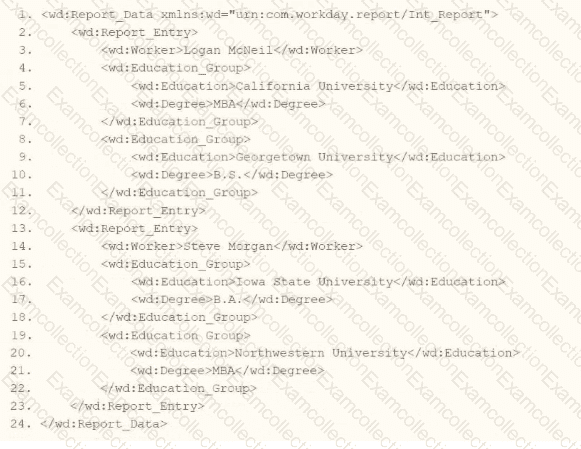
Refer to the following XML to answer the question below.
You are an integration developer and need to write XSLT to transform the output of an EIB which is using a web service enabled report to output worker data along with their dependents. You currently have a template which matches on wd:Dependents_Group to iterate over each dependent. Within the template which matches on wd:Dependents_Group you would like to output a relationship code by using an
What XSLT syntax would be used to output SP when the dependent relationship is spouse, output CH when the dependent relationship is child, otherwise output OTHER?


The Answer Is:
CExplanation:
In Workday integrations, XSLT is used to transform XML data, such as the output from an Enterprise Interface Builder (EIB) or a web service-enabled report, into a desired format for third-party systems. In this scenario, you need to write XSLT to process wd:Dependents_Group elements and output a relationship code based on the value of the wd:Relationship attribute or element. The requirement is to output "SP" for a "Spouse" relationship, "CH" for a "Child" relationship, and "OTHER" for any other relationship, using an
Here’s why option C is correct:
XSLT
Relationship as an Attribute: Based on the provided XML snippet, wd:Relationship is an attribute (e.g.,
Condition Matching:
The first
The second
The
Context in Template: Since the template matches on wd:Dependents_Group, the test conditions operate on the current wd:Dependents_Group element and its attributes, ensuring the correct relationship code is output for each dependent. The XML snippet shows wd:Relationship as an element, but Workday documentation and integration practices often standardize it as an attribute in XSLT transformations, making @wd:Relationship appropriate.
Why not the other options?
A.
xml
WrapCopy
This assumes wd:Relationship is a child element of wd:Dependents_Group, not an attribute. The XML snippet shows wd:Relationship as an element, but in Workday integrations, XSLT often expects attributes for efficiency and consistency, especially in report outputs. Using wd:Relationship without @ would not match the attribute-based structure commonly used, making it incorrect for this context.
B.
xml
WrapCopy
This correctly uses @wd:Relationship for an attribute but has a logical flaw: if wd:Relationship='Child', the second
D.
xml
WrapCopy
This uses an absolute path (/wd:Relationship), which searches for a wd:Relationship element at the root of the XML document, not within the current wd:Dependents_Group context. This would not work correctly for processing dependents in the context of the template matching wd:Dependents_Group, making it incorrect.
To implement this in XSLT:
Within your template matching wd:Dependents_Group, you would include the
Workday Pro Integrations Study Guide: Section on "XSLT Transformations for Workday Integrations" – Details the use of
Workday EIB and Web Services Guide: Chapter on "XML and XSLT for Report Data" – Explains the structure of Workday XML (e.g., wd:Dependents_Group, @wd:Relationship) and how to use XSLT to transform dependent data, including attribute-based conditions.
Workday Reporting and Analytics Guide: Section on "Web Service-Enabled Reports" – Covers integrating report outputs with XSLT for transformations, including examples of conditional logic for relationship codes.
Refer to the following scenario to answer the question below.
You are implementing a Core Connector: Worker integration to send employee data to a third-party active employee directory. The external vendor requires the following:
The Employee's Active Directory User Principal Name.
A mapping from Worker Type values to external worker type codes.
A specific filename format that includes a timestamp and sequence number.
You also need to ensure the document transformation occurs before the file is delivered to the endpoint. The connector's output must be transformed before the file is delivered to the vendor.
What step must be taken to ensure this occurs correctly?
Schedule the Document Transformation connector to run after the Core Connector: Worker completes.
Configure the business process to run the Document Delivery Service before the Document Transformation step.
Configure the business process to run the Document Transformation step before the Document Delivery Service step.
Schedule the Document Transformation connector in a separate integration system from the business process delivery step.
The Answer Is:
CExplanation:
The requirement states that the connector output must be transformed before the file is delivered to the endpoint. This means the Document Transformation step must run first, followed by the Document Delivery step.
In Workday, this is managed through the Business Process (BP) attached to the integration system.
From Workday documentation:
“To transform an integration file before delivery, configure the Business Process to run the Document Transformation step before the Document Delivery Service step.â€
This ensures that:
The file is converted (via XSLT) to the correct format (e.g., CSV or flat XML)
Only the final, transformed file is sent to the endpoint
Why the others are incorrect:
A. Scheduling separately does not ensure correct sequence.
B. Delivery before transformation would send the wrong file.
D. A separate integration system is unnecessary and not best practice for chained transformations.
What is the purpose of granting an ISU modify access to the Integration Event domain via an ISSG?
To have the ISU own the integration schedule.
To let the ISU configure integration attributes and maps.
To log into the user interface as the ISU and launch the integration.
To build the integration system as the ISU.
The Answer Is:
BExplanation:
Understanding ISUs and Integration Systems in Workday
Integration System User (ISU): An ISU is a specialized user account in Workday designed for integrations, functioning as a service account to authenticate and execute integration processes. ISUs are created using the "Create Integration System User" task and are typically configured with settings like disabling UI sessions and setting long session timeouts (e.g., 0 minutes) to prevent expiration during automated processes. ISUs are not human users but are instead programmatic accounts used for API calls, EIBs, Core Connectors, or other integration mechanisms.
Integration Systems: In Workday, an "integration system" refers to the configuration or setup of an integration, such as an External Integration Business (EIB), Core Connector, or custom integration via web services. Integration systems are defined to handle data exchange between Workday and external systems, and they require authentication, often via an ISU, to execute tasks like data retrieval, transformation, or posting.
Assigning ISUs to Integration Systems: ISUs are used to authenticate and authorize integration systems to interact with Workday. When configuring an integration system, you assign an ISU to provide the credentials needed for the integration to run. This assignment ensures that the integration can access Workday data and functionalities based on the security permissions granted to the ISU via its associated Integration System Security Group (ISSG).
Limitation on Assignment: Workday’s security model imposes restrictions to maintain control and auditability. Specifically, an ISU is designed to be tied to a single integration system to ensure clear accountability, prevent conflicts, and simplify security management. This limitation prevents an ISU from being reused across multiple unrelated integration systems, reducing the risk of unintended access or data leakage.
Evaluating Each Option
Let’s assess each option based on Workday’s integration and security practices:
Option A: An ISU can be assigned to five integration systems.
Analysis: This is incorrect. Workday does not impose a specific numerical limit like "five" for ISU assignments to integration systems. Instead, the limitation is more restrictive: an ISU is typically assigned to only one integration system to ensure focused security and accountability. Allowing an ISU to serve multiple systems could lead to confusion, overlapping permissions, or security risks, which Workday’s design avoids.
Why It Doesn’t Fit: There’s no documentation or standard practice in Workday Pro Integrations suggesting a limit of five integration systems per ISU. This option is arbitrary and inconsistent with Workday’s security model.
Option B: An ISU can be assigned to an unlimited number of integration systems.
Analysis: This is incorrect. Workday’s security best practices do not allow an ISU to be assigned to an unlimited number of integration systems. Allowing this would create security vulnerabilities, as an ISU’s permissions (via its ISSG) could be applied across multiple unrelated systems, potentially leading to unauthorized access or data conflicts. Workday enforces a one-to-one or tightly controlled relationship to maintain auditability and security.
Why It Doesn’t Fit: The principle of least privilege and clear accountability in Workday integrations requires limiting an ISU’s scope, not allowing unlimited assignments.
Option C: An ISU can be assigned to only one integration system.
Analysis: This is correct. In Workday, an ISU is typically assigned to a single integration system to ensure that its credentials and permissions are tightly scoped. This aligns with Workday’s security model, where ISUs are created for specific integration purposes (e.g., an EIB, Core Connector, or web service integration). When configuring an integration system, you specify the ISU in the integration setup (e.g., under "Integration System Attributes" or "Authentication" settings), and it is not reused across multiple systems to prevent conflicts or unintended access. This limitation ensures traceability and security, as the ISU’s actions can be audited within the context of that single integration.
Why It Fits: Workday documentation and best practices, including training materials and community forums, emphasize that ISUs are dedicated to specific integrations. For example, when creating an EIB or Core Connector, you assign an ISU, and it is not shared across other integrations unless explicitly reconfigured, which is rare and discouraged for security reasons.
Option D: An ISU can only be assigned to an ISSG and not an integration system.
Analysis: This is incorrect. While ISUs are indeed assigned to ISSGs to inherit security permissions (as established in Question 26), they are also assigned to integration systems to provide authentication and authorization for executing integration tasks. The ISU’s role includes both: it belongs to an ISSG for permissions and is linked to an integration system for execution. Saying it can only be assigned to an ISSG and not an integration system misrepresents Workday’s design, as ISUs are explicitly configured in integration systems (e.g., EIB, Core Connector) to run processes.
Why It Doesn’t Fit: ISUs are integral to integration systems, providing credentials for API calls or data exchange. Excluding assignment to integration systems contradicts Workday’s integration framework.
Final Verification
The correct answer is Option C, as Workday limits an ISU to a single integration system to ensure security, accountability, and clarity in integration operations. This aligns with the principle of least privilege, where ISUs are scoped narrowly to avoid overexposure. For example, when setting up a Core Connector: Job Postings (as in Question 25), you assign an ISU specifically for that integration, not multiple ones, unless reconfiguring for a different purpose, which is atypical.
Supporting Documentation
The reasoning is based on Workday Pro Integrations security practices, including:
Workday Community documentation on creating and managing ISUs and integration systems.
Tutorials on configuring EIBs, Core Connectors, and web services, which show assigning ISUs to specific integrations (e.g., Workday Advanced Studio Tutorial).
Integration security overviews from implementation partners (e.g., NetIQ, Microsoft Learn, Reco.ai) emphasizing one ISU per integration for security.
Community discussions on Reddit and Workday forums reinforcing that ISUs are tied to single integrations for auditability (r/workday on Reddit).
This question focuses on the purpose of granting an Integration System User (ISU) modify access to the Integration Event domain via an Integration System Security Group (ISSG) in Workday Pro Integrations. Let’s analyze the role of the ISU, the Integration Event domain, and evaluate each option to determine the correct answer.
Understanding ISUs, ISSGs, and the Integration Event Domain
Integration System User (ISU): As described in previous questions, an ISU is a service account for integrations, used to authenticate and execute integration processes in Workday. ISUs are assigned to ISSGs to inherit security permissions and are linked to specific integration systems (e.g., EIBs, Core Connectors) for execution.
Integration System Security Group (ISSG): An ISSG is a security group that defines the permissions for ISUs, controlling what data and functionalities they can access or modify. ISSGs can be unconstrained (access all instances) or constrained (access specific instances based on context). Permissions are granted via domain security policies, such as "Get," "Put," "View," or "Modify," applied to Workday domains.
Integration Event Domain: In Workday, the Integration Event domain (or Integration Events security domain) governs access to integration-related activities, such as managing integration events, schedules, attributes, mappings, and logs. This domain is critical for integrations, as it controls the ability to create, modify, or view integration configurations and runtime events.
"Modify" access to the Integration Event domain allows the ISU to make changes to integration configurations, such as attributes (e.g., file names, endpoints), mappings (e.g., data transformations), and event settings (e.g., schedules or triggers).
This domain does not typically grant UI access or ownership of schedules but focuses on configuration and runtime control.
Purpose of Granting Modify Access: Granting an ISU modify access to the Integration Event domain via an ISSG enables the ISU to perform configuration tasks for integrations, ensuring the integration system can adapt or update its settings programmatically. This is essential for automated integrations that need to adjust mappings, attributes, or event triggers without manual intervention. However, ISUs are not designed for UI interaction or administrative ownership, as they are service accounts.
Evaluating Each Option
Let’s assess each option based on Workday’s security and integration model:
Option A: To have the ISU own the integration schedule.
Analysis: This is incorrect. ISUs do not "own" integration schedules or any other integration components. Ownership is not a concept applicable to ISUs, which are service accounts for execution, not administrative entities. Integration schedules are configured within the integration system (e.g., EIB or Core Connector) and managed by administrators or users with appropriate security roles, not by ISUs. Modify access to the Integration Event domain allows changes to schedules, but it doesn’t imply ownership.
Why It Doesn’t Fit: ISUs lack administrative control or ownership; they execute based on permissions, not manage schedules as owners. This misinterprets the ISU’s role.
Option B: To let the ISU configure integration attributes and maps.
Analysis: This is correct. Granting modify access to the Integration Event domain allows the ISU to alter integration configurations, including attributes (e.g., file names, endpoints, timeouts) and mappings (e.g., data transformations like worker subtype mappings from Question 25). The Integration Event domain governs these configuration elements, and "Modify" permission enables the ISU to update them programmatically during integration execution. This is a standard use case for ISUs in automated integrations, ensuring flexibility without manual intervention.
Why It Fits: Workday’s documentation and training materials indicate that the Integration Event domain controls integration configuration tasks. For example, in an EIB or Core Connector, an ISU with modify access can adjust mappings or attributes, as seen in tutorials on integration setup (Workday Advanced Studio Tutorial). This aligns with the ISU’s role as a service account for dynamic configuration.
Option C: To log into the user interface as the ISU and launch the integration.
Analysis: This is incorrect. ISUs are not intended for UI interaction. When creating an ISU, a best practice is to disable UI sessions (e.g., set "Allow UI Sessions" to "No") and configure a session timeout of 0 minutes to prevent expiration during automation. ISUs operate programmatically via APIs or integration systems, not through the Workday UI. Modify access to the Integration Event domain enables configuration changes, not UI login or manual launching.
Why It Doesn’t Fit: Logging into the UI contradicts ISU design, as they are service accounts, not user accounts. This option misrepresents their purpose.
Option D: To build the integration system as the ISU.
Analysis: This is incorrect. ISUs do not "build" integration systems; they execute or configure existing integrations based on permissions. Building an integration system (e.g., creating EIBs, Core Connectors, or web services) is an administrative task performed by users with appropriate security roles (e.g., Integration Build domain access), not ISUs. Modify access to the Integration Event domain allows configuration changes, not the creation or design of integration systems.
Why It Doesn’t Fit: ISUs lack the authority or capability to build integrations; they are for runtime execution and configuration, not development or design.
Final Verification
The correct answer is Option B, as granting an ISU modify access to the Integration Event domain via an ISSG enables it to configure integration attributes (e.g., file names, endpoints) and maps (e.g., data transformations), which are critical for dynamic integration operations. This aligns with Workday’s security model, where ISUs handle automated tasks within defined permissions, not UI interaction, ownership, or system building.
For example, in the Core Connector: Job Postings from Question 25, an ISU with modify access to Integration Event could update the filename pattern or worker subtype mappings, ensuring the integration adapts to vendor requirements without manual intervention. This is consistent with Workday’s design for integration automation.
Supporting Documentation
The reasoning is based on Workday Pro Integrations security practices, including:
Workday Community documentation on ISUs, ISSGs, and domain security (e.g., Integration Event domain permissions).
Tutorials on configuring EIBs and Core Connectors, showing ISUs modifying attributes and mappings (Workday Advanced Studio Tutorial).
Integration security overviews from implementation partners (e.g., NetIQ, Microsoft Learn, Reco.ai) detailing domain access for ISUs.
Community discussions on Reddit and Workday forums reinforcing ISU roles for configuration, not UI or ownership (r/workday on Reddit).
