


Spring Sale Special Limited Time 70% Discount Offer - Ends in 0d 00h 00m 00s - Coupon code: xmas50

Cisco 200-201 - Understanding Cisco Cybersecurity Operations Fundamentals (CBROPS)
Page: 3 / 15
Total 476 questions

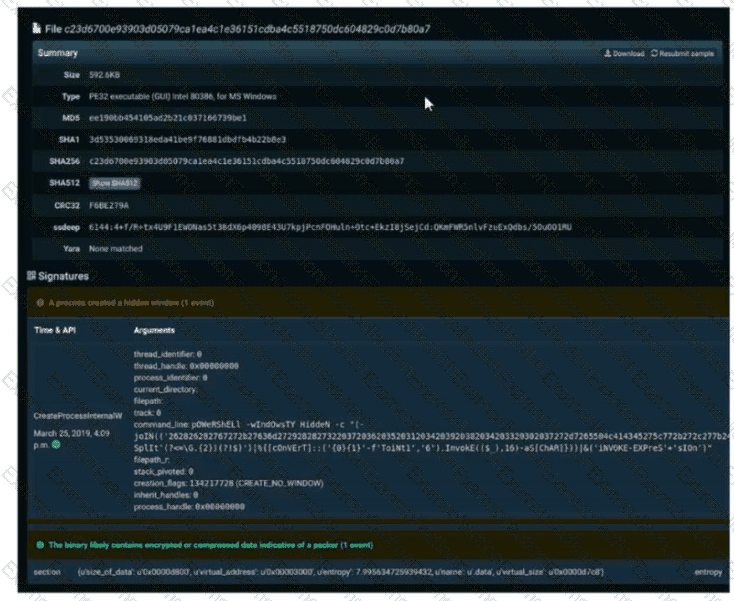
Refer to the exhibit. A SOC engineer is analyzing Cuckoo Sandbox report for a file that has been identified as suspicious by the endpoint security system. What is the state of the file?

A.

The file was identified as PE32 executable with a high level of entropy to bypass AV via encryption.

B.

The file was detected as an executable binary file, but no suspicious activity was detected and it is false positive.

C.

The file was detected as executable and was marked by the SSDeep hashing algorithm as suspicious.

D.

The file identified as an executable binary for Microsoft Word with macros creating hidden process via PowerShell.

What is the difference between deep packet inspection and stateful inspection?

A.

Deep packet inspection is more secure than stateful inspection on Layer 4

B.

Stateful inspection verifies contents at Layer 4 and deep packet inspection verifies connection at Layer 7

C.

Stateful inspection is more secure than deep packet inspection on Layer 7

D.

Deep packet inspection allows visibility on Layer 7 and stateful inspection allows visibility on Layer 4

An organization has recently adjusted its security stance in response to online threats made by a known hacktivist group.

What is the initial event called in the NIST SP800-61?

A.

online assault

B.

precursor

C.

trigger

D.

instigator

An engineer is sharing folders and files with different departments and got this error: "No such file or directory". What must the engineer verify next?

A.

memory allocation

B.

symlinks

C.

permission

D.

disk space

Refer to the exhibit.

An analyst received this alert from the Cisco ASA device, and numerous activity logs were produced. How should this type of evidence be categorized?

A.

indirect

B.

circumstantial

C.

corroborative

D.

best

An employee of a company receives an email with an attachment. They notice that this email is from a suspicious source, and they decide not to open the attached file. After further investigation, a security analyst concludes that this file is malware. To which category of the Cyber Kill Chain model does this event belong?

A.

Weaponization

B.

Installation

C.

Exploitation

D.

Delivery

What is the practice of giving employees only those permissions necessary to perform their specific role within an organization?

A.

least privilege

B.

need to know

C.

integrity validation

D.

due diligence

How does the approach of a behavioral detection system to identifying security threats compare to that of a rule-based detection system?

A.

Rule-based detection is effective with fewer false positives, and behavioral adapts over time.

B.

Behavioral detection is easier to deploy without rules, and rule-based needs historical data.

C.

Behavioral detection is adaptive to deviations, and rule-based detection uses static rules.

D.

Rule-based detection excels at APT hunts with updates, and behavioral focuses on anomalies.

Which of these describes SOC metrics in relation to security incidents?

A.

time it takes to detect the incident

B.

time it takes to assess the risks of the incident

C.

probability of outage caused by the incident

D.

probability of compromise and impact caused by the incident

Why is encryption challenging to security monitoring?

A.

Encryption analysis is used by attackers to monitor VPN tunnels.

B.

Encryption is used by threat actors as a method of evasion and obfuscation.

C.

Encryption introduces additional processing requirements by the CPU.

D.

Encryption introduces larger packet sizes to analyze and store.
