


VMware 3V0-25.25 - VMware Certified Advanced Professional - VMware Cloud Foundation 9.0 Networking
How should the Global Managers (GMs) and Local Managers (LMs) be distributed to ensure high availability and optimal performance in a multi-site NSX Federation deployment comprised of three sites? (Choose two.)
An NSX Manager cluster has failed. The administrator deployed a new NSX Manager using the latest version and attempted to restore from a backup, but the restore operation failed. What would an administrator do to recover the cluster?
An administrator is troubleshooting why workloads in NSX cannot reach the external network 10.100.0.0/16. The Tier-0 Gateway is in Active/Active mode and has the following configuration:
• Uplink-1 (VLAN 100): 192.168.100.0/24 -> router R1 at 192.168.100.1
• Uplink-2 (VLAN 101): 192.168.101.0/24 -> router R2 at 192.168.101.1
• A static route for 10.100.0.0/16 was added with both next-hops (192.168.100.1 and 192.168.101.1).
• The Scope of this route is set to Uplink-1.
Symptoms:
• Virtual Machines (VMs) cannot reach 10.100.0.0/16
• Traceroute from the VM stops at the Tier-0 gateway with "Destination Net Unreachable"
• Pings from the Edge nodes to both 192.168.100.1 and 192.168.101.1 are success
What explains why workloads in NSX cannot reach the external network?
An administrator is responsible for managing a VMware Cloud Foundation (VCF) Private Cloud consisting of a single VCF Fleet with a single Workload Domain.
The administrator has been tasked with configuring NSX to support the new Virtual Desktop Infrastructure (VDI) solution that allows users to securely access a mainframe-
based application located on the physical network. The VDI solution will use a dedicate DHCP solution for each of the the desktop pool segments and static addresses for all
VDI management components.
The administrator completes the following steps towards configuring DHCP:
1. Creates a new tier-1 gateway (vdi-tier-1) and links it to the tier-0 gateway (gw-tier-0).
2. Creates one new segment for vdi management (vdi-seg-01) and connects it to vdi-tier-1.
3. Creates two new segments for virtual desktops (vdi-seg-02 and vdi-seg-03) and connects them to vdi-tier-1.
Drag and drop the six steps from the list of Possible Steps on the left and place them in order in to the Solution Steps. (Choose six.)


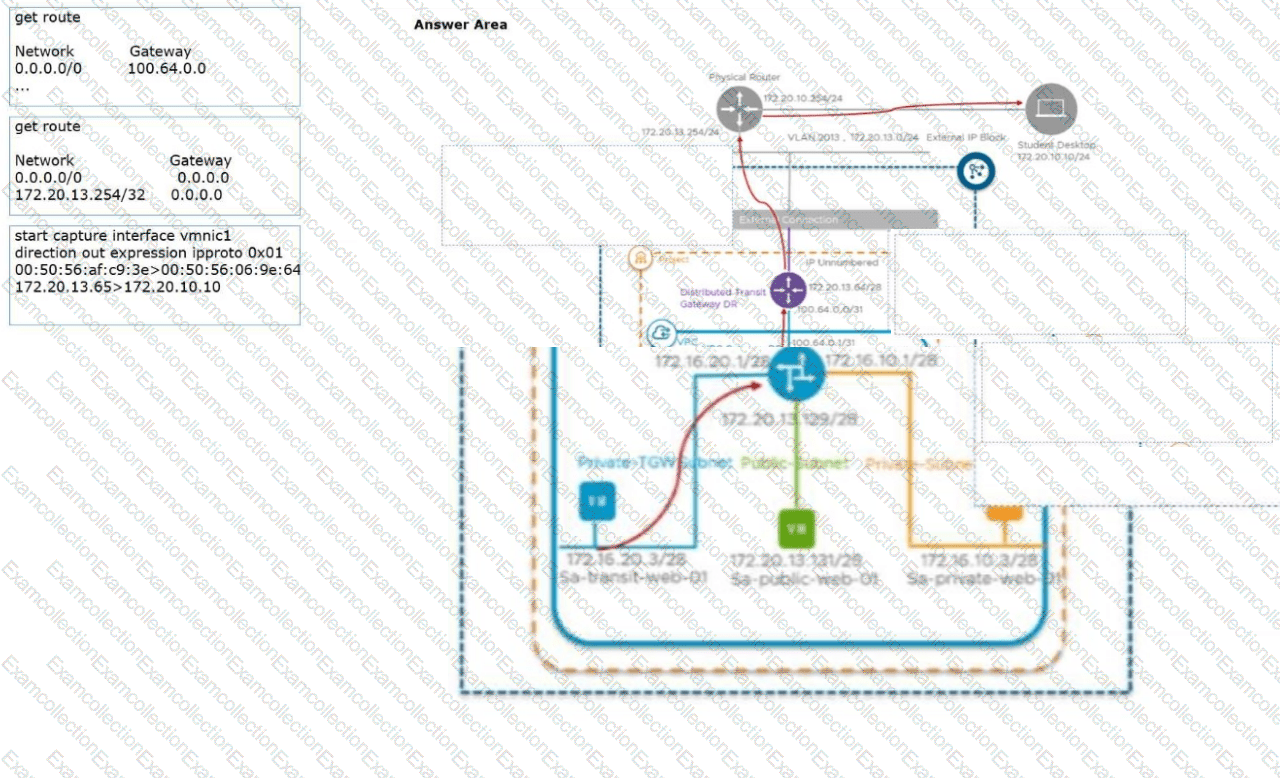
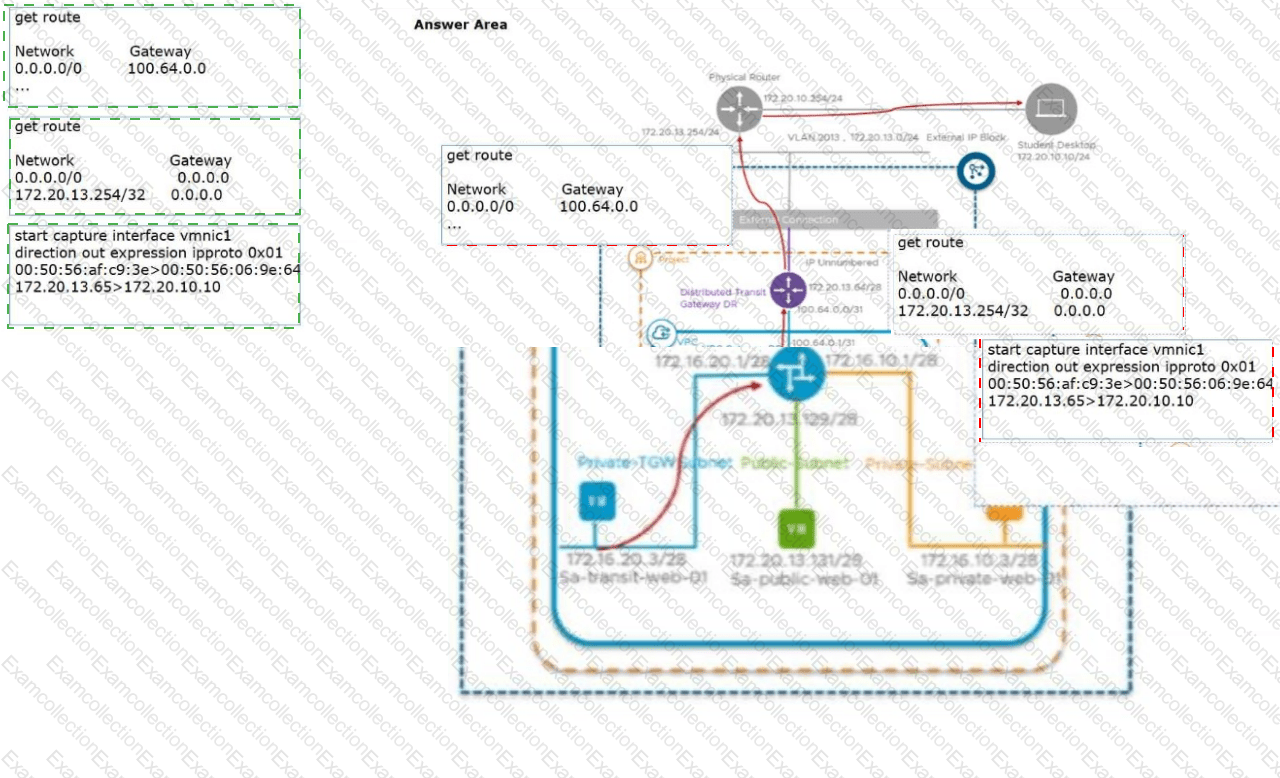
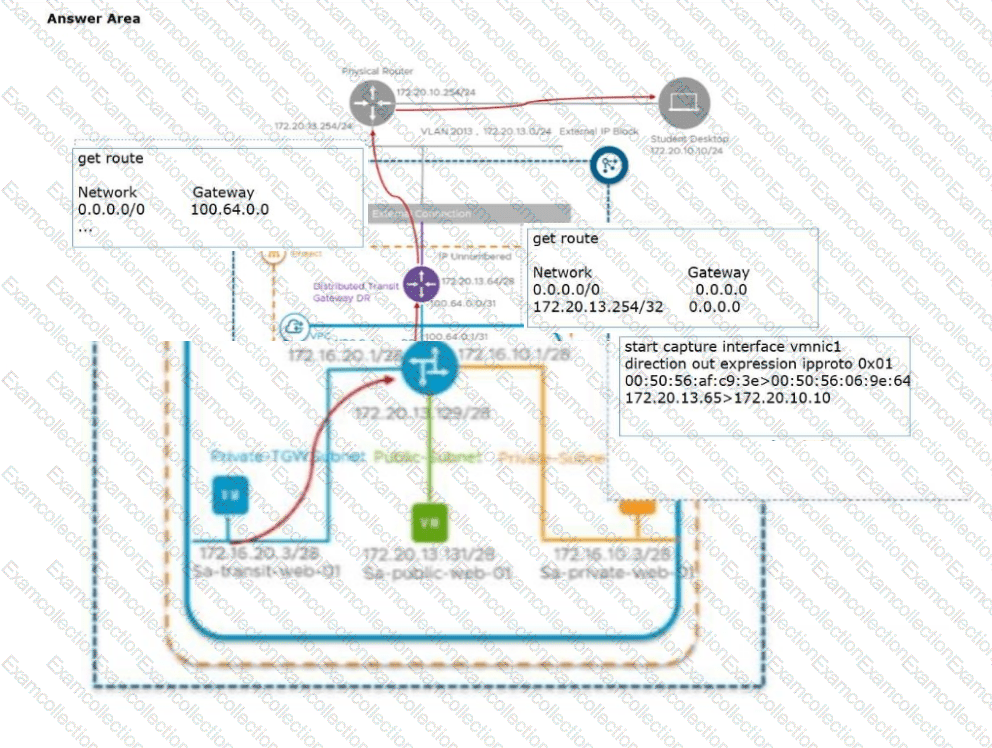
An administrator is attempting to confirm the successful transmission between an internal VM to an external destination.
An ICMP request packet is being sent from Sa-transit-web-01 to the Student Desktop in the diagram.
Drag and Drop the commands output into their appropriate originating NSX object.
An administrator is preparing to deploy a new workload domain that will host vSphere Kubernetes Service (VKS) clusters. Before configuring the network for the Kubernetes clusters, the administrator needs to create a Tier-0 Gateway to handle North/South connectivity. What is the requirement for creating a Tier-0 Gateway for use with a workload domain that is running the vSphere Kubernetes service (VKS) with VPC?
A cloud service provider runs VPCs with differing traffic patterns:
• Some VPCs are generating high, large North/South flows.
• Most of the VPCs generate very little traffic.
The architect needs to optimize Edge dataplane resource consumption while ensuring that noisyVPCs do not impact others.
Which optimization satisfies the requirement?
An administrator has a VMware Cloud Foundation (VCF) instance. A critical NSX security update has been released by Broadcom. How can the administrator install the NSX update?