New Year Sale Special Limited Time 70% Discount Offer - Ends in 0d 00h 00m 00s - Coupon code: xmas50

ARDMS AE-Adult-Echocardiography - AE Adult Echocardiography Examination

Page: 4 / 5
Total 137 questions

Which maneuver aids in uncovering potential diastolic dysfunction while performing pulsed wave Doppler of the mitral valve?

A.

Valsalva

B.

Hand grip

C.

Leg air cycling

D.

Squatting

Which type of valvular lesion most commonly requires further evaluation with a non-imaging transducer?

A.

Aortic stenosis

B.

Mitral regurgitation

C.

Tricuspid regurgitation

D.

Pulmonic stenosis

Which view is best used to evaluate a bicuspid aortic valve?

A.

Right sternal border

B.

Apical five-chamber

C.

Apical long axis

D.

Parasternal short axis

Which technique best determines a trileaflet aortic valve from a bicuspid aortic valve?

A.

Visualize all three leaflets simultaneously during systole

B.

Visualize all three leaflets simultaneously during diastole

C.

Use pulsed wave Doppler to demonstrate normal flow velocity

D.

Use continuous wave Doppler to demonstrate normal flow velocity

Which region of the aorta is being measured to assess the critical finding in this image?
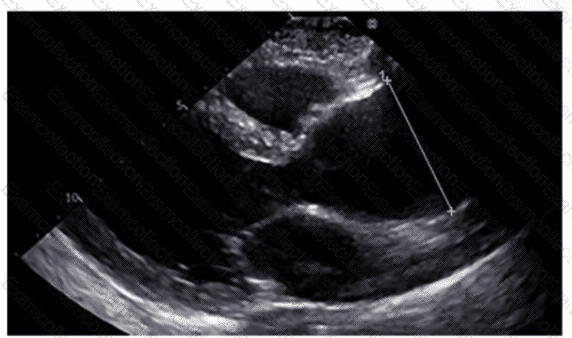
A.

Sinus of Valsalva

B.

Descending aorta

C.

Aortic root

D.

Ascending aorta

Which method is appropriate for measuring the left atrial diameter in parasternal long axis?

A.

Inner edge to inner edge, perpendicular to the aortic root, at end-diastole

B.

Inner edge to inner edge, parallel to the aortic root, at end-diastole

C.

Inner edge to inner edge, perpendicular to the aortic root, at end-systole

D.

Outer edge to outer edge, perpendicular to the aortic root, at end-systole

Which hepatic vein flow pattern signals severe tricuspid regurgitation?

A.

Flow reversal in systole

B.

Flow reversal in diastole

C.

Atrial flow reversal in systole

D.

Biphasic flow reversal in diastole

Which finding is indicated by the arrow on this image?
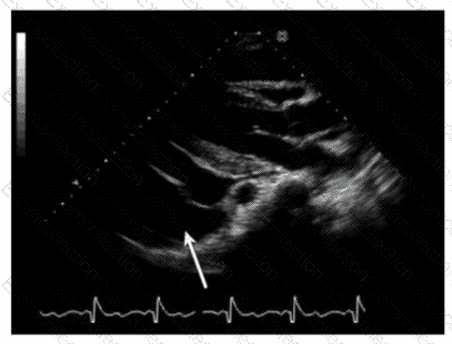
A.

Pericardial effusion

B.

Hiatal hernia

C.

Left pleural effusion

D.

Ascites

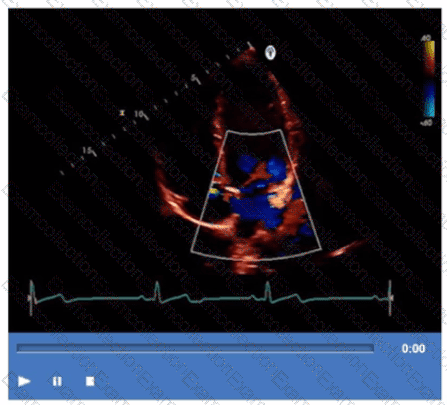
A.

Sinus venosus atrial septal defect

B.

Secundum atrial septal defect

C.

Coronary sinus atrial septal defect

D.

Primum atrial septal defect

A patient presents in the emergency room with a history of chronic high Wood pressure and new onset severe back pain. A physical exam reveals a new diastolic murmur. Which would be the most likely finding?

A.

Aortic aneurysm

B.

Aortic dissection

C.

Left ventricular rupture

D.

Ruptured papillary muscle