


CSI AFP-Exam-1 - Applied Financial Planning Certification Exam 1 (AFP)
Bill was recently declined for a loan application at his financial institution, and he is concerned that a liability has been added to his credit bureau that does not belong to him. He asks his financial planner to review his credit bureau with him to help him identify why he may have been declined. Which area of the credit bureau might his financial planner advise Bill to review?
Maya, a financial planner, is meeting with a new client who was recently referred to her. In determining the client's overall risk tolerance, what qualitative data should Maya capture as part of her process?
Owen and Lina are looking to purchase a home in the next few months. Owen is the primary income earner for the family. His credit history is weak with several recently paid collections Lina has a perfect credit record but limited income and irregular employment. What will their financial planner advise them about the impact their credit ratings will have on their ability to secure a mortgage?
Jimi and Macy, both age 26, consider themselves risk averse. After reviewing their budget with their financial planner, they discovered that they have a negative cash flow every couple of months due to their discretionary spending habits. What would be an appropriate strategy for their financial planner to recommend to the couple to manage their negative cash flow?
Justis, age 62, and his wife Jen, age 58, are meeting with their financial planner, Luke. They are both planning to retire by age 65. Their goals are to minimize debt and reduce taxes. The couple's financial situation is outlined below.
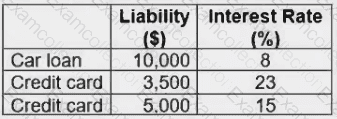
Justis' annual income is $25,000. He has a $15,000 RRSP, $30,000 single non-registered account and a $25,000 TFSA. Jen's annual income is $60,000, and she has a $150,000 RRSP, $50,000 single non-registered account and a $20,000 TFSA.
Jen's marginal tax rate is 35%, and Justis' is 25%. Assuming all investments are making interest income of 10%, what would be the most appropriate strategy for Luke to recommend for the couple?
