


ASCP ASCP-MLT - MEDICAL LABORATORY TECHNICIAN - MLT(ASCP)
Micro - Matching
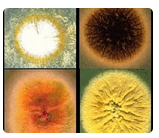
1. Upper left image
Multi-celled, rough walled macroconidia with a tapered terminal cell
2. Upper right image
Dense aggregates of echinulate, brown-black conidia
3. Lower left image
Loose clusters of elliptical conidia arranged in a "diphtheroid" pattern
4. Lower right image
Chains of large, lemon-shaped annelloconidia
An automated method for measuring chloride which generates silver ions in the reaction is called:
Most anticoagulants in blood collectiong tubes prevent clotting by:
Question options:
Blood bank
Once the seal on a unit of packed red cells is broken, how long can the unit be stored refrigerated prior to administration:
No HLA matching is performed for corneal tissue transplants as the cornea occupies a privileged site not usually seen by the immune system. This term has been coined "immune privileged".
Corneal tissue may be transplanted successfully from one patient to another because:
A quality control program is to be set up for the following tests:
Phenylalanine deaminase (PAD)
Indole production
Voges-Proskauer (V-P)
Which pair of stock culture organisms would be MOST suitable to verify the performance of these three tests?
A young man is experiencing difficult breathing after fainting. The physician orders a blood gas analysis which shows the following results:
pH = 7.25
pCO2 = 62 mmHg
pO2 = 70 mmHg
HCO3 = 23 mEq/L
Which condition is most likely afflicting this patient?
Whole blood glucose values are lower than plasma glucose values. For this reason, point-of-care whole blood glucose meters are programmed to correct the value before presenting the result; therefore, the whole blood glucose meter result correlates to serum or plasma results.
Whole blood glucose values are ____________ plasma glucose values.
Beta-thalassemia major, also known as Cooley's anemia, has inherited two genes for beta thalassemia without a normal beta-chain gene. This disease is assoicated with a marked deficiency in beta chain production and in the production of normal Hb A. These patients exhibit increased amounts of iron due to the mutliple transfusions that keep them alive. There is also a striking increase in hemoglobin F and an elevation in hemoglobin A2.
Hematology
A 5-year-old African American child with hepato-splenomegaly and skeletal abnormalities has the following lab results:
WBC = 4,800/cu.mm
20 NRBC/100 WBC
RBC = 2.70 X 10⁶
HGB = 6.2 g/dL
Many target cells
Marked hypochromasia, anisocytosis & poikilocytosis
Serum Iron = 200 µg/dL (elevated)
Sickle Solubility = negative
Hemoglobin F = elevated
What is the PROBABLE cause of these findings?
The document designed to protect phlebotomists from contacting hepatitis is the:
Bicarbonate and Chloride form an exchanger to help regulate and buffer the body's pH.
The buffering capacity of blood is maintained by a reversible exchange process between bicarbonate and:
The Clinical Laboratory and Standards Institure (CLSI) recommends that all patient specimens are delivered to the laboratory no more than 2 hours after collection to reduce pre-examination variables caused by cellular action and the effects of prolonged exposure of specimens to room temperatures, such as:
Question options:
In order to perform a venipuncture on a newly admitted hospital patient, a phlebotomist needs to
Caffeine benzoate solution is used to split the unconjugated bilirubin protein complex releasing the bilirubin so that it can react with diazotised sulphanilic acid. The tartrate buffer creates an alkaline solution and converts the red acid bilirubin to a green coloured compound which can be measured spectrophotometrically.
Which substance is used in the Jendrassik-Grof method to accelerate the reaction of unconjugated bilirubin with the diazo reagent?
Leptin signals the hypothalamus that there are changes in fat stores.
Resistin increases insulin resistance and enhances adhesion molecules present on endothelial cells.
IL-6 responds to tissue injury. IL-6 increases insulin resistance by inhibiting insulin receptor signal transduction in liver cells. It also increases other inflammatory cytokines, interleukin-1 (IL-1) and TNF-a, and stimulates the liver to produce C-reactive protein (CRP).
Adipose tissue and liver cells produce angiotensinogen, a precursor of angiotensin II. Besides increasing blood pressure, angiotensin II may stimulate adipose cell formation and thus increase adipose mass.
Which one of the following adipocyte products is an important messenger in metabolism, signaling the hypothalamus that there are changes in fat stores?