

PMI CAPM - Certified Associate in Project Management (CAPM)
A project manager has the task of determining the deliverables for a six-month project using a predictive approach. How should the project manager determine which processes to include in the project management plan?
Discuss the processes and deliverables needed to meet the project objectives with the team.
Integrate hybrid approach processes and deliverables to meet the short delivery time line.
Identify the processes and deliverables for only the current phase first.
Follow organizational methodology and produce all required deliverables.
The Answer Is:
AExplanation:
In the PMBOK® Guide, the act of deciding which processes are appropriate for a specific project is known as Tailoring. Even in a Predictive approach, the project manager does not blindly follow every possible process; instead, they select the most relevant tools and techniques based on the project’s unique context.
Why Choice A is correct:
Collaboration: The Project Manager (PM) should not work in a vacuum. Engaging the project team allows the PM to leverage the specialized expertise of team members to identify which processes are necessary to create the specific deliverables required.
Value-Driven: By focusing on the " project objectives, " the team ensures that every process included in the management plan adds value and contributes to the final goal, rather than just adding administrative overhead.
Buy-in: Involving the team early in the planning process (specifically during the Develop Project Management Plan process) fosters a sense of ownership and clarity regarding their roles and responsibilities.
Analysis of other options:
B (Integrate hybrid approach): The question specifically states this is a " predictive approach. " Forcing a hybrid model solely due to a six-month timeline is a change in strategy that may not be appropriate if the scope is stable and well-defined.
C (Identify processes for only current phase): While this describes Rolling Wave Planning, the question asks about determining the processes for the Project Management Plan (the master document). A PM plan must define the overall methodology for the entire project lifecycle, even if certain details are elaborated later.
D (Follow organizational methodology for all deliverables): This is " rigid " project management. Organizations provide a methodology as a framework, but PMI emphasizes that the PM must still tailor that framework. Producing " all " deliverables without considering necessity leads to waste.
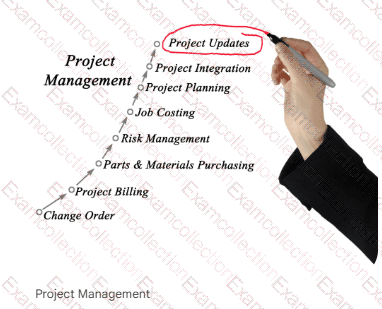
Tailoring Considerations: The PM and the team should consider the project’s size, complexity, and regulatory environment. For a six-month project, " Lean " predictive management might be preferred over a heavy, documentation-intensive process. Choice A ensures the resulting plan is " fit for purpose. "
When cost variance is negative and schedule variance is positive, the project is:
under budget and behind schedule.
over budget and ahead of schedule.
on schedule.
complete; all planned values have been earned.
The Answer Is:
BExplanation:
According to the PMBOK® Guide, Earned Value Management (EVM) uses specific formulas to determine the health of a project regarding cost and schedule. To answer this question, we must look at the definitions of Cost Variance (CV) and Schedule Variance (SV).
The formula for Cost Variance is:
$$CV = EV - AC$$
(Where EV = Earned Value and AC = Actual Cost)
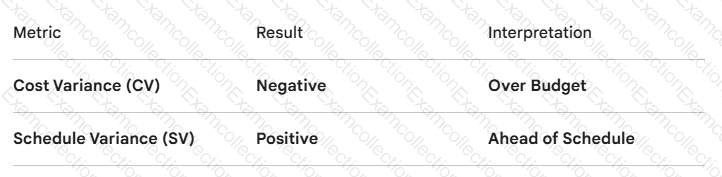
Positive CV ( > 0): The project is under budget (you spent less than the value of the work performed).
Negative CV ( < 0): The project is over budget (you spent more than the value of the work performed).
Zero CV: The project is exactly on budget.
The formula for Schedule Variance is:
$$SV = EV - PV$$
(Where EV = Earned Value and PV = Planned Value)
Positive SV ( > 0): The project is ahead of schedule (you have completed more work than was planned for this point in time).
Negative SV ( < 0): The project is behind schedule (you have completed less work than planned).
Zero SV: The project is exactly on schedule.
Analysis of Other Options:
A. under budget and behind schedule: This would require a Positive CV and a Negative SV.
C. on schedule: This would require an SV of zero (where $EV = PV$).
D. complete; all planned values have been earned: A project is complete when $EV = BAC$ (Budget at Completion). While a positive SV suggests progress, it does not inherently mean the project is finished; it just means it is moving faster than planned.
What is the process of determining the stakeholders impacted by a business problem or opportunity?
Stakeholder requirements
Stakeholder identification
Stakeholder analysis
Stakeholder characteristics
The Answer Is:
CExplanation:
In the PMBOK® Guide and the PMI Guide to Business Analysis, understanding the human landscape of a project is critical. While identifying who the stakeholders are is the first step, determining how they are impacted requires a deeper dive.
Why Choice C is correct:
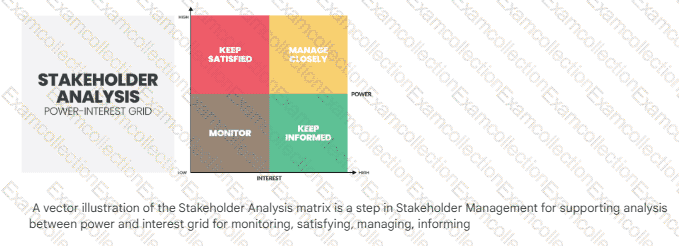
Defining the Impact: Stakeholder Analysis is the technique used to systematically gather and analyze quantitative and qualitative information to determine whose interests should be taken into account throughout the project.
Evaluating Influence and Interest: It involves identifying the stakeholders ' goals, expectations, and levels of influence. Crucially, it assesses how the business problem or the proposed solution will affect their daily work, power dynamics, or specific business units.
Output: This analysis typically results in a Stakeholder Register or models such as the Power/Interest Grid, which categorize stakeholders so the project manager can develop appropriate engagement strategies.
Analysis of other options:
A (Stakeholder requirements): These are the specific needs or conditions that a stakeholder requires to be met by a product or service. Requirements are the result of discussions with stakeholders; they are not the process of determining who is impacted by a problem.
B (Stakeholder identification): This is the initial process of simply listing the people, groups, or organizations that could be involved. While it precedes analysis, " Identification " is about finding the names, whereas " Analysis " (Choice C) is the specific process of determining the impact and relationship to the business problem.
D (Stakeholder characteristics): This refers to the traits or attributes of a stakeholder (such as their location, attitude, or knowledge level). Like requirements, these are data points gathered during the analysis, not the name of the process itself.
Key Concept: The Project Management Institute (PMI) teaches that Stakeholder Analysis (Choice C) is an ongoing activity. As a business problem evolves or a new opportunity is defined, the project manager must re-analyze the stakeholder landscape to ensure that those who are most impacted are properly engaged and that their potential resistance or support is managed effectively.
While implementing an approved change, a critical defect was introduced. Removing the defect will delay the product delivery. What is the MOST appropriate approach to managing this situation?
Utilize the change control process.
Crash the schedule to fix the defect.
Leave the defect in and work around it.
Fast-track the remaining development.
The Answer Is:
AExplanation:
According to the PMBOK® Guide, specifically within the Perform Integrated Change Control process, any event that impacts the project baselines (Scope, Schedule, or Cost) must be managed through a formal process to ensure the project remains aligned with stakeholder expectations and organizational goals.
Impact on Baselines: The introduction of a critical defect and the subsequent delay in product delivery constitute a significant variance from the Schedule Baseline. In professional project management, you cannot unilaterally change a baseline without formal authorization.
The Role of Change Control: Even though the defect resulted from an already approved change, the " fix " itself is a new action that consumes time and potentially budget. The project manager must document this impact and submit a Change Request for defect repair.
Stakeholder Transparency: Utilizing the change control process ensures that the Sponsor and Customer are aware of the delay. It allows the Change Control Board (CCB) to evaluate the trade-offs: Is the delivery date more critical than the defect? Should the project be delayed, or should the defect be managed as a " known issue " for a later release?
Data-Driven Decision Making: This approach prevents " Gold Plating " or unauthorized schedule slippage. It ensures that the impact is analyzed, recorded in the Change Log, and that the Project Management Plan is updated to reflect the new reality.
Comparison with other options:
B. Crash the schedule to fix the defect: Crashing (adding resources) is a schedule compression technique that typically increases Cost. This should only be done after the change control process has evaluated the options and authorized the additional spend.
C. Leave the defect in and work around it: Since the defect is described as critical, ignoring it would likely violate the Quality Management Plan and result in a failure to meet acceptance criteria during Validate Scope.
D. Fast-track the remaining development: Fast-tracking (performing tasks in parallel) increases Risk. Like crashing, this is a tactical response that should only be implemented after the impact of the defect has been formally processed and the strategy has been approved.
The project has a current cost performance index of 0.80. Assuming this performance wi continue, the new estimate at completion is $1000. What was the original budget at completion for the project?
$800
$1000
$1250
$1800
The Answer Is:
AExplanation:
According to the PMBOK® Guide, specifically within the Control Costs process, Earned Value Management (EVM) is used to forecast the project ' s financial outcome based on current performance.
The Scenario: The question provides a Cost Performance Index (CPI) and an Estimate at Completion (EAC), while stating that the current performance is expected to continue for the remainder of the project.
The Formula: When the current $CPI$ is expected to continue, the formula for $EAC$ is:
$$EAC = \frac{BAC}{CPI}$$
Solving for BAC: To find the original budget (Budget at Completion or $BAC$), we must rearrange the formula:
$$BAC = EAC \times CPI$$
The Calculation:
$$BAC = \$1000 \times 0.80$$
$$BAC = \$800$$
This result indicates that the project was originally budgeted for $\$800$, but because it is performing inefficiently (spending $\$1.00$ to get $\$0.80$ worth of work), it is now expected to cost $\$1000$ to complete.
Analysis of Other Options:
B. $1000: This is the $EAC$ (the forecasted total cost), not the $BAC$ (the original budget).
C. $1250: This would be the result if you incorrectly divided $EAC$ by $CPI$ ($\$1000 / 0.80 = \$1250$), which does not align with the standard EVM mathematical relationships for this scenario.
D. $1800: This number has no mathematical basis in the provided EVM data.
Which is the tool or technique that is used to obtain the list of activities from the work packages?
Data analysis
Leads and lags
Precedence diagramming method
Decomposition
The Answer Is:
DExplanation:
According to the PMBOK® Guide (6th Edition), specifically within the Define Activities process (Project Schedule Management), Decomposition is the primary tool and technique used to divide and subdivide the project scope and project deliverables into smaller, more manageable parts called activities.
While decomposition is also used in the Create WBS process to break down the project into work packages, in the Define Activities process, it goes one step further. It takes those work packages (the lowest level of the WBS) and breaks them down into the specific actions required to produce the deliverable.
Key Characteristics of Decomposition in this context:
Granularity: It transforms " deliverables " (nouns) into " activities " (verbs).
Result: The final output of this technique in this process is the Activity List, which provides a basis for estimating, scheduling, executing, monitoring, and controlling the project work.
Involvement: The project team members who will perform the work usually participate in this decomposition to ensure accuracy.
Analysis of Distractors:
A (Data analysis): This is a broad category of techniques (like alternative analysis) used to evaluate different ways to meet requirements, but it is not the specific mechanical process of breaking down work packages into activities.
B (Leads and lags): These are used during the Develop Schedule process to adjust the timing of activities that have already been identified and sequenced.
C (Precedence diagramming method): This is a technique used in the Sequence Activities process to create a logical schedule network diagram. It determines the relationship between activities, but it is not used to generate the activities from work packages.
In an adaptive or agile life cycle, how are the customer and sponsor involved in the project scope management activities?
Involvement is needed only during project initiation.
Minimal involvement of stakeholders is sufficient.
They should be continuously engaged.
They should be involved only during phase or deliverable reviews.
The Answer Is:
CExplanation:
According to the PMBOK® Guide and the Agile Practice Guide, the involvement of stakeholders in adaptive (agile) environments differs significantly from predictive (waterfall) environments. In agile projects, requirements are discovered and evolved throughout the life cycle, making stakeholder proximity a critical success factor.
Continuous Engagement: In an adaptive life cycle, the customer, sponsor, and other stakeholders provide ongoing feedback on functional prototypes and increments of the product. This ensures that the product being built continues to align with business needs, even as those needs change.
Scope Management: Because the scope is not " frozen " at the start, the Product Owner (representing the customer/business) must be continuously engaged to prioritize the backlog, clarify requirements during iteration planning, and provide immediate feedback during daily stand-ups or informal reviews.
Validation: Formal validation of scope occurs at the end of every iteration (e.g., Sprint Review), but the " continuous " nature of their engagement prevents the team from drifting away from the customer ' s true requirements.
Analysis of other options:
A. Involvement only during initiation: This is incorrect for any methodology, but especially agile. Scope in agile is refined throughout the project, not just at the beginning.
B. Minimal involvement: Agile thrives on " Customer Collaboration over Contract Negotiation " (Agile Manifesto). Minimal involvement is often a leading cause of project failure in adaptive environments.
D. Only during phase or deliverable reviews: While reviews are formal touchpoints, limiting engagement only to these events mimics a predictive approach and loses the " adaptive " advantage of real-time course correction.
Per PMI standards, continuous engagement reduces the risk of scope creep and ensures that the most valuable features are delivered to the customer as early as possible.
A project manager needs to tailor the Project Cost Management process. Which considerations should the project manager apply?
Diversity background
Stakeholder ' s relationships
Technical expertise
Knowledge management
The Answer Is:
DExplanation:
According to the PMBOK® Guide, specifically in the introduction to the Project Cost Management knowledge area, the project manager is responsible for tailoring the processes to fit the unique needs of the project. This is because each project is different, and the rigor of cost management should be commensurate with the project ' s size, complexity, and importance.
One of the key considerations for tailoring identified by PMI for Cost Management is Knowledge Management. The project manager should consider:
Organizational Knowledge: Does the organization have a formal knowledge management and financial database that the project manager is required to use and that is readily accessible?
Lessons Learned: How will the project ' s cost data and financial outcomes be captured and shared to benefit future projects?
Tools and Software: What specific cost-tracking tools or knowledge repositories are available to manage and report on financial performance?
Other Tailoring Considerations for Cost Management include:
Estimating and Budgeting: Does the organization have formal or informal cost estimating and budgeting-related policies, procedures, and guidelines?
Earned Value Management (EVM): Will EVM be used to measure performance?
Governance: What are the specific audit and reporting requirements for the project?
Analysis of other options:
A. Diversity background: While diversity and inclusion are important for team management and leadership, they are not listed as a specific tailoring consideration for the technical process of Cost Management.
B. Stakeholder ' s relationships: While stakeholder engagement is a knowledge area, the formal tailoring of " Cost Management " focuses more on financial systems and governance rather than the personal relationships between stakeholders.
C. Technical expertise: Technical expertise is generally a requirement for the project team members but is not a defined " consideration " for how to tailor the cost management methodology itself.
Per PMI standards, tailoring ensures that the approach to managing costs is efficient and aligned with the Knowledge Management practices of the performing organization.
Which tasks should a project manager perform in order to manage the project schedule effectively?
Plan Schedule Management, Define Activities, Sequence Activities, Estimate Activity Durations, Define Quality of Activities. Develop Schedule
Plan Schedule Management. Define Activities, Sequence Activities, Estimate Activity Durations, Develop Schedule. Control Schedule
Plan Schedule Management. Define Activities, Sequence Activities, Estimate Activity Durations, Estimate Cost of Activities. Develop Schedule
Define Activities. Sequence Activities, Estimate Activity Durations. Define Quality of Activities. Estimate Cost of Activities, Develop Schedule
The Answer Is:
BExplanation:
According to the PMBOK® Guide, specifically the Project Schedule Management knowledge area, there is a defined sequence of six processes required to ensure the timely completion of a project.
Plan Schedule Management: Establishing the policies, procedures, and documentation for planning, developing, managing, executing, and controlling the project schedule.
Define Activities: Identifying and documenting the specific actions to be performed to produce the project deliverables.
Sequence Activities: Identifying and documenting relationships (dependencies) among the project activities.
Estimate Activity Durations: Estimating the number of work periods needed to complete individual activities with estimated resources.
Develop Schedule: Analyzing activity sequences, durations, resource requirements, and schedule constraints to create the project schedule model for project execution and monitoring.
Control Schedule: The ongoing process of monitoring the status of project activities to update project progress and manage changes to the schedule baseline to achieve the plan.
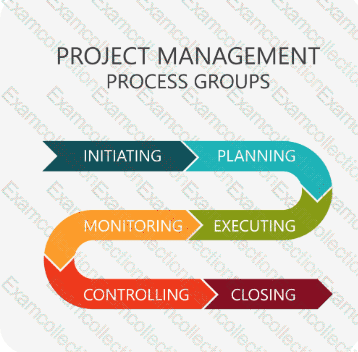
Analysis of other options:
A. Define Quality of Activities: This is not a standard process in Schedule Management. Quality considerations are managed within Project Quality Management.
C. Estimate Cost of Activities: This process belongs to Project Cost Management, not Schedule Management. While costs and schedules are linked, they are distinct knowledge areas with separate processes.
D. Combined Errors: This option incorrectly includes both " Define Quality of Activities " and " Estimate Cost of Activities, " and it also omits the critical " Plan Schedule Management " and " Control Schedule " processes.
Per PMI standards, effective schedule management requires the full lifecycle from Planning through Developing to Controlling to ensure the project remains on track.
Which of the following is an input to the Direct and Manage Project Execution process?
Approved change requests
Approved contract documentation
Work performance information
Rejected change requests
The Answer Is:
AExplanation:
According to the PMBOK® Guide, the Direct and Manage Project Work process (historically referred to as Direct and Manage Project Execution) is the process of leading and performing the work defined in the project management plan and implementing approved changes to achieve the project ' s objectives.
Role of Approved Change Requests: These are a critical input to this process. Once a change request is processed and approved through the Perform Integrated Change Control process, it is sent back to the project team to be implemented.
Implementation: This implementation may include a corrective action, a preventive action, or a defect repair. Without the " Approved " status, the project team should not be executing the requested change.
Process Flow:
Direct and Manage Project Work (Execution) identifies a need for change.
Perform Integrated Change Control (Monitoring and Controlling) reviews and approves the change.
Approved Change Requests flow back into Direct and Manage Project Work for actual implementation.
Comparison with Other Options:
Approved contract documentation (B): While contracts exist, they are generally part of the project management plan or procurement documentation, not a specific primary input named for the daily direction of work in the same way change requests are.
Work performance information (C): This is typically an Output of the monitoring and controlling processes (like Control Scope or Control Schedule), which is derived from Work Performance Data (an output of Execution).
Rejected change requests (D): These are recorded in the change log but are not acted upon or " executed " by the project team.
A Project manager is failing to secure critical equipment on time, and this resulting in delays in the manufacturing of the final product. Which knowledge area is the project manager handling?
Project Resource Management
Project Quality Management
Project Schedule Management
Project integration Management
The Answer Is:
BExplanation:
According to the PMBOK® Guide, the management of physical resources—including equipment, materials, facilities, and infrastructure—is a core function of Project Resource Management.
Physical Resource Management: While many people associate " resources " only with team members (human resources), the Resource Management knowledge area specifically covers the identification, acquisition, and management of the physical resources necessary for project completion.
Acquire Resources Process: The scenario describes a failure in the Acquire Resources process. This process involves securing the physical resources (equipment) needed to complete project work. Failure to secure these on time directly impacts the project ' s ability to proceed with manufacturing.
Control Resources: The project manager is also responsible for the Control Resources process, which ensures that the physical resources assigned and allocated to the project are available as planned, and monitoring the planned versus actual utilization of those resources.
Why other options are incorrect:
Option B: Project Quality Management: This knowledge area focuses on the standards and criteria the product must meet. While faulty equipment might affect quality, the act of securing the equipment is a resource logistics issue.
Option C: Project Schedule Management: While the failure results in a delay (a schedule impact), the root cause of the problem lies in the management of resources. Schedule management is where the impact is felt, but Resource Management is the area being " handled " (or mishandled) in this context.
Option D: Project Integration Management: This area involves coordinating all other knowledge areas. While everything eventually rolls up to integration, the specific task of securing equipment is a specialized function of the Resource Management knowledge area.
Which type of managers do composite organizations involve?
Functional managers and manager of project managers
Functional managers only
Project managers only
Technical managers and project managers
The Answer Is:
AExplanation:
According to the PMBOK® Guide, a Composite Organization (also referred to as a Hybrid Structure) is an organizational framework that involves a combination of functional, matrix, and projectized characteristics.
In a composite organization, the structure typically includes:
Functional Managers: Who manage the traditional permanent departments (e.g., HR, Engineering, Finance).
Manager of Project Managers: Often residing within a Project Management Office (PMO) or a projectized division, this role oversees a group of project managers who may be assigned to specific high-priority projects full-time, even within a functional environment.
Key Characteristics of Composite Organizations:
They allow for the coexistence of different structures to meet specific strategic needs. For example, a functional organization may create a special project team to handle a critical project, granting that team a projectized structure and a dedicated project manager while the rest of the company remains functional.
Choice A is correct because it reflects the duality of authority present in these structures, involving both departmental leaders and those who specifically oversee project management personnel.
Choice B and C are incorrect as they describe specialized " siloed " structures (Functional or Projectized), rather than the blended nature of a composite system.
Choice D is incorrect as " Technical Manager " is not a standard organizational classification used by PMI to define composite reporting structures.
A project manager is formalizing acceptance of the completed project deliverables. What is an input to this process?
Verified deliverables
Validated deliverables
Accepted deliverables
Completed change requests
The Answer Is:
AExplanation:
According to the PMBOK® Guide, the process described—formalizing acceptance of the completed project deliverables—is Validate Scope. It is critical to distinguish between the internal quality check and the external customer acceptance.
Verified Deliverables (The Input): These are project deliverables that have been completed and checked for correctness through the Control Quality process. Before you can ask the customer to formally accept a deliverable, the project team must first verify internally that it meets the technical specifications. Therefore, " Verified Deliverables " are a primary input to Validate Scope.
Accepted Deliverables (The Output): These are deliverables that meet the acceptance criteria and are formally signed off by the customer or sponsor. This is the output of the Validate Scope process.
Analysis of the process flow:
Control Quality: Internal check. Input: Deliverables. Output: Verified Deliverables.
Validate Scope: External check. Input: Verified Deliverables. Output: Accepted Deliverables.
Analysis of other options:
B. Validated deliverables: This term is often used interchangeably with " Accepted Deliverables " in general conversation, but in PMI terminology, the process is called " Validate Scope, " and the result is " Accepted. "
D. Completed change requests: While change requests are processed throughout the project, they are not the specific object being formalized for acceptance in this process; the physical or functional deliverable is.
Per PMI standards, the Validate Scope process is primarily concerned with receptivity (the customer ' s acceptance), whereas Control Quality is concerned with correctness (meeting technical requirements). Therefore, you must have a " Verified " deliverable before it can become an " Accepted " one.
A company has implemented an adaptive project management framework for a new project. When planning for an iteration, how should risks be addressed? Choose two.
Risks should be considered when selecting the content of each iteration.
Risks should be tailored for each iteration.
Risks should be identified, analyzed, and managed during each iteration.
Risks should be documented prior to each iteration.
Risks should be reviewed only once during each iteration.
The Answer Is:
A, CExplanation:
According to the PMBOK® Guide and the Agile Practice Guide, risk management in adaptive (Agile) environments is not a one-time event but is integrated into every aspect of the iterative cycle.
A. Risks should be considered when selecting the content of each iteration: In adaptive frameworks, the Product Backlog is often prioritized based on a " Risk-Adjusted " approach. High-risk items that provide high value are often pulled into early iterations to prove technical feasibility or " fail fast. " When the team and Product Owner select User Stories for an iteration during Iteration Planning, they evaluate the risks associated with those specific items.
C. Risks should be identified, analyzed, and managed during each iteration: In Agile, risk management is ongoing. Risks are identified during Daily Stand-ups, analyzed during Iteration Planning, and managed throughout the execution of the iteration. Furthermore, the Iteration Review and Retrospective provide formal opportunities to identify new risks and adjust the management approach based on the evolving environment.
Analysis of other options:
B. Risks should be tailored for each iteration: While the response to a risk might be tailored, the risks themselves are identified or discovered. " Tailoring " usually refers to the project management methodology or process, not the individual risk events.
D. Risks should be documented prior to each iteration: While some risks are known beforehand, a core tenet of adaptive frameworks is that many risks emerge during the work. Restricting risk management to a " prior to " documentation step ignores the dynamic nature of Agile.
E. Risks should be reviewed only once during each iteration: This contradicts the Agile principle of continuous improvement and transparency. Risks are often discussed daily to ensure impediments are cleared quickly.
Per PMI standards, adaptive environments use frequent reviews and cross-functional team involvement to ensure that risks are handled in real-time rather than waiting for a formal phase gate.
What is the name of the statistical method that helps identify which factors may influence specific variables of a product or process under development or in production?
Failure modes and effects analysis
Design of experiments
Quality checklist
Risk analysis
The Answer Is:
BExplanation:
According to the PMBOK® Guide, specifically within the Plan Quality Management process, Design of Experiments (DOE) is a statistical method used to identify which factors may influence specific variables of a product or process under development or in production.
Key Functionality: DOE provides a statistical framework for systematically changing all of the important factors rather than changing the factors one at a time. It allows the project manager and team to statistically determine the " optimal " settings for various parameters.
Problem Solving and Optimization: It is an analytical technique used to determine the relationship between various product or process variables and the resulting output. This helps in optimizing products or processes by identifying which variables have the greatest impact on the final result.
Application in Project Management: In a project context, DOE can be used to reduce the sensitivity of product performance to variations caused by environmental or manufacturing differences. For example, an automotive engineer might use DOE to determine which combination of suspension settings and tire types provides the best ride quality under different road conditions.
Comparison with other options:
A. Failure modes and effects analysis (FMEA): This is an analytical procedure used to identify the potential failure modes for a process or product and the effects of those failures. While it identifies risks and impacts, it is not a statistical method for identifying variable influences during development.
C. Quality checklist: A checklist is a structured tool used to verify that a set of required steps has been performed. It is a tool for Control Quality, not a statistical method for variable identification.
D. Risk analysis: This is a broad term for the processes of Perform Qualitative Risk Analysis and Perform Quantitative Risk Analysis. While it involves statistics (especially in quantitative analysis), it focuses on the impact of uncertainty on project objectives rather than identifying influencing factors of a product ' s physical or process variables.
Organizational planning impacts projects by means of project prioritization based on risk, funding, and an organizations:
Budget plan
Resource plan
Scope plan
Strategic plan
The Answer Is:
DExplanation:
According to the PMBOK® Guide, specifically within the sections on Project Management and Strategy, projects are the primary means by which an organization achieves its strategic goals. Organizational planning dictates how projects are selected and prioritized.
Strategic Alignment: Projects are typically authorized as a result of one or more strategic considerations. The Strategic Plan serves as the highest-level roadmap for the organization, and any potential project must be evaluated against how well it aligns with these long-term goals.
Prioritization Factors: When an organization conducts its planning, it looks at several variables to decide which projects to fund and initiate:
Risk: The potential for negative impacts or failure.
Funding: The availability of capital and expected Return on Investment (ROI).
Strategic Goals: Market demand, technological advance, legal requirements, or social need as defined in the Strategic Plan.
Portfolio Management: This is the level where organizational planning most directly impacts projects. Portfolio managers use the Strategic Plan to ensure that the " right " work is being done to move the company toward its vision.
Analysis of other choices:
Choice A (Budget plan): While funding is a constraint mentioned in the question, the " Budget Plan " is usually a subset of the broader strategic and operational plans. It tells you if you can afford a project, but the Strategic Plan tells you why you should do it.
Choice B (Resource plan): Resource planning (human and physical) is a critical operational component, but prioritization is driven by the value the project brings to the organization ' s strategy, not just the availability of staff.
Choice C (Scope plan): Scope planning is project-specific. It defines what the project will do once it has already been selected. It does not drive the organizational-level prioritization process.
What organizational process asset (OPA) might impact a project ' s outcome?
Processes, polices, and procedures
Legal restrictions
Infrastructure, resource availability. and employee capability
Financial considerations
The Answer Is:
AExplanation:
According to the PMBOK® Guide, a project manager must navigate two primary types of internal and external factors: Organizational Process Assets (OPAs) and Enterprise Environmental Factors (EEFs).
Understanding OPAs: Organizational Process Assets are the plans, processes, policies, procedures, and knowledge bases specific to and used by the performing organization. These are internal to the organization and include:
Processes and Procedures: Standardized guidelines, work instructions, proposal evaluation criteria, and performance measurement criteria.
Corporate Knowledge Base: Historical information, lessons learned repositories, and project files from previous initiatives.
Why it impacts outcomes: OPAs provide a " head start " for projects. By following established processes and policies, the project manager ensures consistency, complies with organizational governance, and avoids " reinventing the wheel. " Conversely, if these assets are outdated or poorly followed, they can negatively impact the project ' s efficiency and success.
Analysis of other options:
Legal restrictions (Option B): These are Enterprise Environmental Factors (EEFs). They are typically external constraints (laws, regulations) that the project must follow but does not own or control.
Infrastructure, resource availability, and employee capability (Option C): These are internal EEFs. They represent the " conditions " under which the project operates (e.g., the quality of the building, the skills of the available staff), rather than documentation or knowledge assets.
Financial considerations (Option D): These are also considered EEFs. Market conditions, currency exchange rates, and regional price fluctuations are environmental factors that influence project success from the outside.
Per PMI standards, the key differentiator is that OPAs are typically the " tools and documentation " the organization provides to help you, while EEFs are the " circumstances and constraints " you must work within.
A project manager providing information to the right audience, in the right format, at the right time is an example of which type of communication?
Efficient
Effective
Push
Pull
The Answer Is:
BExplanation:
According to the PMBOK® Guide, specifically within the Project Communications Management knowledge area, PMI distinguishes between two fundamental dimensions of successful communication: Effectiveness and Efficiency.
Effective Communication: This is defined as providing the information in the right format, at the right time, to the right audience, and with the right impact. The focus is on the quality and relevance of the communication to ensure the message is understood and achieves its intended purpose.
Efficient Communication: This refers to providing only the information that is needed. The focus here is on minimizing the waste of resources (such as time or budget) by avoiding " information overload " or sending unnecessary data.
Why the other options are incorrect:
A. Efficient: While a project manager should strive to be efficient, efficiency is about the quantity and resource usage (providing " only " what is needed). The specific criteria mentioned in the question (right audience, format, and time) are the literal definition of " Effective " communication in PMI standards.
C. Push: This is a Communication Method where information is sent to specific recipients who need to receive the information (e.g., emails, memos, reports). It does not guarantee that the information reached the right audience at the right time in the right format.
D. Pull: This is a Communication Method used for very large volumes of information or very large audiences. It requires the recipients to access the communication content at their own discretion (e.g., intranet sites, e-learning, lessons learned databases). Like push communication, it is a method, not a qualitative description like " effective. "
In which Process Group are lessons learned documented?
Planning
Closing
Executing
Initiating
The Answer Is:
BExplanation:
According to the PMBOK® Guide, specifically within the Close Project or Phase process, the formal documentation and archiving of Lessons Learned is a critical requirement of the Closing Process Group.
The Purpose of Lessons Learned: The objective is to identify project successes and failures, as well as opportunities for improvement. This information is gathered so that the performing organization can improve the management of future projects.
The Lessons Learned Register vs. Repository:
Throughout the project (specifically in the Manage Project Knowledge process within the Executing group), the team creates and updates a Lessons Learned Register.
During the Closing Process Group, this register is finalized and transferred to the Lessons Learned Repository, which is part of the organization ' s Organizational Process Assets (OPAs).
Closing Activities: The closing group involves administrative tasks such as confirming the formal acceptance of deliverables, handovers to operations, and the finalization of the project report. Archiving lessons learned ensures that the knowledge gained during the project is not lost.
Comparison with Other Options:
Planning (A): While you might review historical lessons learned during planning to avoid past mistakes, you do not document the current project ' s final lessons in this group.
Executing (C): In modern PMI standards, knowledge is managed and the register is updated during execution (Manage Project Knowledge). However, the formal, finalized documentation and archival of these lessons as a project-wide completion requirement is the hallmark of the Closing group.
Initiating (D): This group focuses on authorizing the project and identifying stakeholders. It is too early in the project life cycle to document lessons learned for the current endeavor.
Inputs to the Plan Schedule Management process include:
Organizational process assets and the project charter,
Enterprise environmental factors and schedule tools.
Time tables and Pareto diagrams.
Activity attributes and resource calendars.
The Answer Is:
AExplanation:
According to the PMBOK® Guide and the Standard for Project Management, the Plan Schedule Management process is the first process in the Project Schedule Management Knowledge Area. It establishes the policies, procedures, and documentation for planning, developing, managing, executing, and controlling the project schedule.
As per PMI standards, the inputs to this process are:
Project Charter: Provides the summary milestone schedule and project approval requirements that will influence the management of the project schedule.
Project Management Plan: Specifically the Scope Management Plan and Development Approach, which help define how the schedule will be developed.
Enterprise Environmental Factors (EEF): Includes organizational culture, resource availability, and scheduling software.
Organizational Process Assets (OPA): Includes historical information, schedule control-related policies, and templates.
The other options are incorrect based on the following PMI classifications:
B. Enterprise environmental factors and schedule tools: While EEFs are an input, Schedule tools (like MS Project or Primavera) are categorized as part of the Tools and Techniques (specifically Data Analysis or the Scheduling System), not a primary input.
C. Time tables and Pareto diagrams: These are not inputs to this process. Pareto diagrams are a quality management tool used in the Manage Quality and Control Quality processes. Time tables are generally an output of schedule development (the schedule itself).
D. Activity attributes and resource calendars: These are inputs to the Estimate Activity Durations and Develop Schedule processes, which occur after the Schedule Management Plan has been created.
As per the PMI Lexicon of Project Management Terms, the Plan Schedule Management process ensures that the " how-to " of scheduling is decided before the actual work of identifying and sequencing activities begins.
Project management processes ensure the:
alignment with organizational strategy
efficient means to achieve the project objectives
performance of the project team
effective flow of the project throughout its life cycle
The Answer Is:
DExplanation:
According to the PMBOK® Guide (Project Management Body of Knowledge), specifically in the chapters covering Project Management Processes, the core purpose of these processes is to manage the project ' s progression:
Effective Flow (Option D): PMI defines project management as the application of knowledge, skills, tools, and techniques to project activities to meet project requirements. This application is accomplished through the effective integration of the project management processes. The processes are grouped into Process Groups (Initiating, Planning, Executing, Monitoring and Controlling, and Closing) specifically to ensure the effective flow of the project throughout its life cycle. This ensures that the transition between phases is structured and that the project moves logically from a concept to a finalized result.
Efficient Means (Option B): While processes certainly aim for efficiency, the primary definition provided by PMI focuses on the flow and integration of the project rather than just being a " means " to an objective.
Alignment with Strategy (Option A): This is primarily the function of Portfolio Management and the Project Charter. While project management supports this, the processes themselves are the mechanical engine that moves the project forward.
Performance of the Team (Option C): This is managed through the Project Resource Management knowledge area (specifically the " Develop Team " and " Manage Team " processes), but it is only one aspect of the overall project management process framework.
In the PMI framework, the Project Management Processes are iterative and linked by the outputs they produce. The output of one process generally becomes an input to another process or is a deliverable of the project, creating the " flow " necessary for project success.
A new project was approved by the project management office (PMO), and the scope of the project is to build a new detachable classroom. What delivery method and artifacts should the project manager use to deliver this project?
Linear project management; project schedule and project backlog
Adaptive project management; project schedule and work breakdown structure
Linear project management; project schedule and work breakdown structure (WBS)
Adaptive project management; project schedule and project backlog
The Answer Is:
CExplanation:
According to the PMBOK® Guide and the Agile Practice Guide, the choice of delivery method (development life cycle) depends heavily on the nature of the project deliverables and the stability of the requirements.
Linear (Predictive) Project Management: This method is also known as Waterfall. It is used when the scope is well-defined and the product is a physical deliverable with low levels of change expected. Building a physical structure, such as a detachable classroom, follows a clear, sequential path (design, foundation, assembly, finishing). In construction, changes are costly, so a predictive approach is standard to minimize risk.
Artifacts - Project Schedule and WBS:
Work Breakdown Structure (WBS): This is the foundational artifact for linear projects. It is a deliverable-oriented hierarchical decomposition of the work. For a classroom, the WBS would break the project down into physical components (roof, walls, electrical, etc.).
Project Schedule: In linear management, a detailed schedule (often a Gantt chart) is used to track the sequential activities and dependencies required to reach the completion date.
Why not Adaptive?: Adaptive (Agile) methods are best suited for software or intangible products where requirements evolve. Building a physical classroom requires " Big Up-Front Planning " because you cannot easily change the dimensions of a wall once it has been manufactured and delivered.
Analysis of other options:
Option A: This combines a linear method with a Project Backlog. A backlog is an Agile artifact; linear projects use a WBS and a Scope Baseline instead.
Option B: Adaptive management is typically not the primary choice for standard physical construction. Furthermore, while Adaptive projects can use a WBS, it is much more characteristic of Linear management.
Option D: This is a purely Agile (Adaptive) configuration. It is unsuitable for a construction project with a fixed, physical scope like a detachable classroom.
Per PMI standards, physical engineering and construction projects are typically managed using a Linear (Predictive) delivery method, utilizing a WBS to define scope and a Project Schedule to manage the execution of that scope.
Which tool or technique is used in the Plan Scope Management process?
Document analysis
Observations
Product analysis
Expert judgment
The Answer Is:
DExplanation:
According to the PMBOK® Guide, the Plan Scope Management process is the process of creating a scope management plan that documents how the project and product scope will be defined, validated, and controlled. This process occurs early in the Planning Process Group.
Expert Judgment: This is a standard tool and technique for the Plan Scope Management process. It involves input from individuals or groups with specialized knowledge or training in similar projects, the specific industry, or the technical area. Experts help define how the scope will be managed based on organizational culture, complexity, and historical information.
Other Tools for this Process: In addition to Expert Judgment, this process utilizes Data Analysis (specifically alternatives analysis) and Meetings.
Why the other options are incorrect:
A. Document analysis: This is a tool and technique used in the Collect Requirements process, not Plan Scope Management. It involves reviewing existing documentation to identify requirements.
B. Observations: Also known as " job shadowing, " this is a tool and technique used in Collect Requirements to understand business processes or requirements that users may find difficult to articulate.
C. Product analysis: This is a tool and technique used in the Define Scope process. It involves defining the product and its requirements in more detail through techniques like systems engineering or value engineering.
A project in which the scope, time, and cost of delivery are determined as early as possible is following a life cycle that is:
Adaptive
Predictive
Incremental
Iterative
The Answer Is:
BExplanation:
According to the PMBOK® Guide, specifically in the section detailing Project Life Cycles, a Predictive life cycle (also known as " waterfall " ) is one in which the project scope, time, and cost are determined in the early phases of the life cycle.
Plan-Driven Approach: In a predictive life cycle, the project team focuses on defining the product and project scope as clearly as possible at the start of the project. Any changes to the scope are carefully managed through a formal change control process.
Sequential Phases: This life cycle follows a linear sequence where one phase must be completed before the next begins (e.g., requirements, then design, then build).
Certainty and Stability: This approach is preferred when the project requirements are well-understood, the product is well-defined, and there is a high level of certainty regarding the technical execution. The goal is to " predict " the outcome and manage the project against that set baseline.
Why the other options are incorrect:
A. Adaptive: Also known as change-driven or Agile methods. In these life cycles, the detailed scope is defined and approved before the start of an iteration. They are intended to respond to high levels of change and ongoing stakeholder involvement.
C. Incremental: This approach provides deliverables through a series of cycles that successively add functionality within a predetermined timeframe. The focus is on speed of delivery rather than defining all parameters upfront.
D. Iterative: In this life cycle, project scope is generally determined early, but time and cost estimates are routinely modified as the project team ' s understanding of the product increases. Iterations develop the product through repeated cycles.
Which type of management focuses on ensuring that projects and programs are reviewed to prioritize resource allocation?
Project
Functional
Program
Portfolio
The Answer Is:
DExplanation:
According to the Standard for Portfolio Management by PMI, Portfolio Management is the centralized management of one or more portfolios to achieve strategic objectives. It focuses on ensuring that projects, programs, and other related work are reviewed to prioritize resource allocation and align with the organization ' s strategic goals.
Strategic Alignment: The primary goal of a portfolio is to ensure that the " right " work is being done. This involves identifying, prioritizing, authorizing, managing, and controlling projects and programs to ensure they align with the business strategy.
Resource Prioritization: Unlike project or program management, which focus on execution and " doing the work right, " portfolio management focuses on resource optimization across the entire organization. It ensures that limited resources (financial, human, and material) are allocated to the highest-priority initiatives that provide the most value.
Performance Review: Portfolio management involves continuous monitoring of the aggregate performance of all components. If a project no longer aligns with the shifting strategic goals of the company, portfolio management provides the framework to de-prioritize or terminate it to reallocate those resources elsewhere.
Comparison with Other Options:
Project Management (A): Focuses on achieving specific project objectives and deliverables within constraints like time, cost, and scope.
Functional Management (B): Focuses on providing oversight to a specific administrative or functional area of the business (e.g., Human Resources, Finance, or Engineering).
Program Management (C): Focuses on managing a group of related projects in a coordinated way to obtain benefits and control not available from managing them individually. While it involves resource coordination, it does not have the broad strategic prioritization authority of a portfolio.
What should the project manager use to evaluate the politics and power structure among stakeholders inside and outside of the organization?
Expert judgment
Interpersonal skills
Team agreements
Communication skills
The Answer Is:
AExplanation:
According to the PMBOK® Guide, specifically within the Identify Stakeholders and Plan Stakeholder Engagement processes, the project manager must understand the complex environment in which the project operates.
Expert Judgment for Stakeholder Analysis: Evaluating the " politics and power structure " is a specific application of Expert Judgment. The project manager seeks input from individuals or groups with specialized knowledge or training in the organizational culture, politics, and the power dynamics both inside and outside the organization.
Why Expert Judgment?: Power structures are often informal and not documented in official org charts. To understand who holds the " real " power or how political alliances might affect the project, the project manager relies on:
Senior management.
Other project managers who have worked in the same area.
Subject matter experts (SMEs) in the industry or specialized consultants.
Functional managers within the organization.
Application: This judgment helps in creating a more accurate Stakeholder Register and developing strategies in the Stakeholder Engagement Plan to navigate potential political roadblocks or leverage influential supporters.
Analysis of Other Options:
B. Interpersonal skills: While " Political Awareness " is an interpersonal and team skill used to manage stakeholders, the initial evaluation and identification of the existing power structure (the " landscape " ) is categorized under Expert Judgment in the PMI toolkit.
C. Team agreements: These (also known as a Team Charter) are used to establish ground rules and expectations for the project team members ' behavior. They do not help in evaluating the power structures of external stakeholders or the broader organization.
D. Communication skills: These are the tools used to exchange information with stakeholders once they have been identified. They are not the primary tool used to analyze or evaluate the underlying political hierarchy of the organization.
What is the probability of occurrence if the risk rating is 0.56 and the impact if the risk does occur is very high (0.80)?
0.45
0.56
0.70
1.36
The Answer Is:
CExplanation:
According to the PMBOK® Guide, specifically within the Perform Qualitative Risk Analysis process, the risk rating (also known as the Risk Score) is determined by the combination of a risk ' s probability of occurrence and its impact on the project objectives if it does occur.
The Risk Formula: The standard formula used to calculate the risk rating is:
$$\text{Risk Rating} = \text{Probability} \times \text{Impact}$$
The Calculation:
Given Risk Rating = $0.56$
Given Impact = $0.80$ (Very High)
To find the Probability ($P$):
$$0.56 = P \times 0.80$$
$$P = \frac{0.56}{0.80}$$
$$P = 0.70$$
Application: This mathematical approach allows project managers to prioritize risks on a numerical scale. In a Probability and Impact Matrix, a risk with a probability of $0.70$ and an impact of $0.80$ would typically fall into the " High Risk " (red) zone, requiring aggressive response strategies and proactive monitoring.
Comparison with other options:
A. 0.45: This value is incorrect. Multiplying $0.45$ by $0.80$ would result in a risk rating of $0.36$.
B. 0.56: This is the risk rating itself, not the probability.
D. 1.36: This value is mathematically incorrect and impossible for a probability. In project management risk scales, probability is always expressed as a value between $0.0$ and $1.0$ (or $0\%$ to $100\%$). A value of $1.36$ would imply a likelihood greater than $100\%$.
Which type of analysis would be used for the Plan Quality process?
Schedule
Checklist
Assumption
Cost-Benefit
The Answer Is:
DExplanation:
According to the PMBOK® Guide, specifically in the Plan Quality Management process, the project manager must determine the standards and requirements for the project and its deliverables. One of the primary data analysis techniques used to achieve this is Cost-Benefit Analysis.
Cost-Benefit Analysis in Quality: This technique involves comparing the cost of the quality level (the investment in quality activities) against the expected benefit. The primary benefits of meeting quality requirements include less rework, higher productivity, lower costs, increased stakeholder satisfaction, and increased profitability.
The Goal of the Process: The analysis helps the project manager and team determine if the planned quality activities are cost-effective. In project management, the " optimal " level of quality is reached when the marginal improvement in benefits equals the marginal cost to achieve that improvement.
Cost of Quality (COQ): Closely related to cost-benefit analysis, COQ consists of all costs incurred over the life of the product by investment in preventing nonconformance to requirements, appraising the product or service for conformance to requirements, and failing to meet requirements (rework).
Decision Support: By performing this analysis during the planning phase, the team ensures that the project does not " over-engineer " a solution where the costs of high quality outweigh the actual business value, while also ensuring that the project does not " under-engineer " and incur high failure costs.
Comparison with other options:
A. Schedule: While schedule constraints affect quality planning, " Schedule Analysis " is a technique used in Develop Schedule or Control Schedule, not a specific tool for defining quality standards.
B. Checklist: A checklist is a data gathering tool used to verify that a set of required steps has been performed. While used in Manage Quality and Control Quality, the question asks for a " type of analysis " used for planning.
C. Assumption: Assumption and constraint analysis is a technique typically used during Identify Risks or Define Scope to explore the validity of assumptions and their impact on the project. It is not the primary analysis tool for quality planning.
The features and functions that characterize a result, product, or service can refer to:
project scope
product scope
service scope
product breakdown structure
The Answer Is:
BExplanation:
According to the PMBOK® Guide, it is critical to distinguish between " Project Scope " and " Product Scope, " as they represent two different aspects of the work to be performed.
Product Scope: This refers specifically to the features and functions that characterize a product, service, or result. It is measured against the product requirements to determine if the product is complete and functional. For example, if the project is to build a smartphone, the product scope includes the screen resolution, battery life, and operating system features.
Project Scope: This refers to the work performed to deliver a product, service, or result with the specified features and functions. It includes all the management and technical activities required. It is measured against the project management plan.
Relationship: The product scope is a subset of the project scope. You define what the product is (Product Scope) so that you can define the work required to build it (Project Scope).
Analysis of Other Options:
A. project scope: This is the " work " required to deliver the product. While it encompasses the product scope, it specifically refers to the actions and processes taken by the team, rather than the features of the end result itself.
C. service scope: While a result can be a service, " Service Scope " is not a formal term used in the PMBOK® Guide to define features and functions. These are universally covered under the umbrella of " Product Scope. "
D. product breakdown structure: An RBS or PBS is a hierarchical structure that breaks down the physical components of a product. While it helps visualize the product, it is a tool for decomposition, not the definition of the features and functions themselves.
Taking out insurance in relation to risk management is called what?
Transference
Avoidance
Exploring
Mitigation
The Answer Is:
AExplanation:
According to the PMBOK® Guide, specifically within the Plan Risk Responses process, Transference (or Risk Transfer) is a response strategy designed to deal with threats (negative risks).
Definition: Risk transference involves shifting the impact of a threat to a third party, together with ownership of the response. It does not eliminate the risk; it simply gives another party the responsibility for managing its financial impact or execution.
The Role of Insurance: Buying an insurance policy is the most classic and common example of risk transference. In this scenario, the project or organization pays a premium to an insurance company. In exchange, the insurance company takes on the financial liability should the specified risk event occur.
Contractual Transfer: Besides insurance, transference can be achieved through performance bonds, warranties, guarantees, or specific contract types (such as a Fixed-Price contract, which transfers the risk of cost overruns from the buyer to the seller).
Cost Factor: Transferece nearly always involves a payment of a risk premium to the party taking on the risk (e.g., the insurance premium or the higher cost of a fixed-price contract).
Comparison with other options:
B. Avoidance: This involves changing the project management plan to eliminate the threat entirely (e.g., changing the scope to avoid a dangerous task). Taking out insurance doesn ' t stop the event from happening; it only manages the financial fallout.
C. Exploring: This is not a standard PMI risk response term. The term for positive risks is Exploit, which involves ensuring an opportunity definitely happens.
D. Mitigation: This involves taking action to reduce the probability or impact of a risk. While insurance deals with the financial " impact, " PMI distinguishes " Transference " as the specific act of moving that impact to a third party, whereas mitigation usually refers to internal actions taken to make the risk less severe.
Which type of dependency used in the Sequence Activities process is sometimes referred to as preferred logic, preferential logic, or soft logic?
Internal
External
Discretionary
Mandatory
The Answer Is:
CExplanation:
According to the PMBOK® Guide, specifically the Sequence Activities process within Project Schedule Management, there are four types of dependencies used to define the logical relationship between activities.
Discretionary Dependencies: These are established based on knowledge of best practices within a particular application area or some unusual aspect of the project where a specific sequence is desired, even though there may be other acceptable sequences. They are also known as preferred logic, preferential logic, or soft logic.
Application: Project teams typically document discretionary dependencies because they can create arbitrary total float and may limit later scheduling options. During the process of Fast Tracking, these are the first dependencies to be reviewed for potential overlap or removal to shorten the schedule.
Source of Logic: These often come from " lessons learned " or specific technical preferences of the project team rather than a physical or legal requirement.
Comparison with other options:
A. Internal: This involves a precedence relationship between project activities and is generally within the project team ' s control (e.g., a team cannot test a machine until they assemble it).
B. External: This involves a relationship between project activities and non-project activities (e.g., a software project waiting for a government environmental hearing). These are usually outside the project team ' s control.
D. Mandatory: Also known as hard logic or hard dependencies. These are legally or contractually required or inherent in the nature of the work (e.g., you cannot build a roof until the foundation is set). Unlike discretionary logic, these cannot be moved or bypassed easily during schedule compression.
Which of the seven basic quality tools is especially useful for gathering attributes data while performing inspections to identify defects?
Histograms
Scatter diagrams
Flowcharts
Checksheets
The Answer Is:
DExplanation:
According to the PMBOK® Guide, specifically within the Control Quality process, Checksheets (also known as tally sheets) are one of the seven basic quality tools used to organize data in a format that yields effective information about a specific quality problem.
Definition and Purpose: A checksheet is a structured, prepared form for collecting and analyzing data. It is especially useful for gathering attributes data while performing inspections to identify defects.
Attributes Data: This refers to qualitative data that can be categorized (e.g., " Pass/Fail, " " Yes/No, " or " Type of Error " ). When a project team inspects a deliverable, they use the checksheet to mark the frequency or location of specific defects they find.
Application:
Data Collection: It provides a consistent way for different inspectors to record data.
Trend Identification: Once the data is gathered on a checksheet, it is often used as an input for other tools, such as creating a Pareto diagram to determine which defects are occurring most frequently.
Example: In a software project, a checksheet might list common bug types (e.g., " UI Glitch, " " Logic Error, " " Security Vulnerability " ). As testers find bugs, they place a tally mark next to the corresponding attribute.
Comparison with other options:
A. Histograms: These are bar charts used to show the graphical representation of numerical data distribution. They show the central tendency and dispersion of a data set, but they are a method for displaying data rather than the primary tool for gathering attribute data during an inspection.
B. Scatter diagrams: These are used to plot data points on a horizontal and vertical axis to show how much one variable is affected by another (correlation). They do not collect raw attribute data during inspections.
C. Flowcharts: Also known as process maps, these display the sequence of steps and the branching possibilities that exist for a process. They help in understanding how a process works and where quality issues might occur, but they are not data collection forms for defects.
Stakeholders can be identified in later stages of the project because the Identify Stakeholders process should be:
Continuous
Discrete
Regulated
Arbitrary
The Answer Is:
AExplanation:
According to the PMBOK® Guide (Project Management Body of Knowledge), specifically within the Project Stakeholder Management knowledge area, the nature of stakeholder identification is a dynamic and evolving activity throughout the project life cycle.
Continuous (Option A): The Identify Stakeholders process is defined by PMI as a process that is performed periodically throughout the project as needed. Stakeholders may change, or new stakeholders may be identified, as the project moves through its different phases (e.g., transitioning from design to construction or from development to testing). Therefore, the process must be continuous and iterative to ensure that all individuals, groups, or organizations that could impact or be impacted by the project are captured in the Stakeholder Register.
Discrete (Option B): A discrete process would imply that stakeholder identification happens once (likely at the beginning) and is then finished. This is incorrect in the PMI framework, as missing a stakeholder who emerges mid-project can lead to significant risks or scope creep.
Regulated (Option C): While the process follows specific standards and organizational process assets (OPAs), " regulated " does not describe the timing or frequency of the activity in the way that " continuous " does.
Arbitrary (Option D): This implies that the process is based on random choice or personal whim rather than a systematic approach. PMI processes are structured and deliberate, never arbitrary.
In the PMI framework, the Stakeholder Register is a living document. By treating identification as a continuous process, the Project Manager can adjust engagement strategies to account for the shifting landscape of project influence and interest.
A project manager is reviewing a few techniques that can be used to evaluate solution results. The intent is to uncover whether the solution responds properly to unintended cases.
Which evaluation technique should be used here?
Exploratory testing
Integration testing
User acceptance testing
Day-in-the-life testing
The Answer Is:
AExplanation:
In both the PMI Guide to Business Analysis and the Agile Practice Guide, software and solution evaluation techniques are categorized based on their intent—whether they are checking against known requirements or searching for unknown risks.
Why Choice A is correct:
Defining Exploratory Testing: This is an unscripted testing technique where the tester " explores " the solution without following a predetermined set of test cases.
Unintended Cases: The specific goal of exploratory testing is to find " edge cases " or " unintended behaviors " that documented requirements and automated scripts might have missed. It relies on the tester’s intuition and experience to try to " break " the system in ways the developers didn ' t anticipate.
Adaptive Learning: As the tester discovers how the system handles weird inputs or unexpected sequences, they learn more about the solution ' s limits, making it the perfect tool for uncovering hidden defects in complex logic.
Analysis of other options:
B (Integration testing): This focuses on the interfaces between modules to ensure they communicate correctly. It is usually scripted and technical, aimed at data flow rather than testing " unintended " user scenarios.
C (User acceptance testing): UAT is conducted to confirm the system meets the agreed-upon requirements (the " Happy Path " ). It is used to prove the system works as intended for the end-user, not necessarily to investigate how it fails under unintended conditions.
D (Day-in-the-life testing): This is a form of observational testing where the solution is tested in a real-world environment following a typical workday. While it tests the flow, it is generally focused on " normal " operations rather than intentionally probing for " unintended cases. "
Key Concept: The Project Management Institute (PMI) emphasizes that while scripted testing ensures the product does what it should do, Exploratory Testing (Choice A) ensures the product doesn ' t do what it shouldn ' t do. It is an essential risk-mitigation technique for complex solutions where the range of user inputs is vast and unpredictable.
What type of project structure is a hierarchically organized depiction of the resources by type?
Organizational breakdown structure (OBS)
Resource breakdown structure (RBS)
Work breakdown structure (WBS)
Project breakdown structure (PBS)
The Answer Is:
BExplanation:
According to the PMBOK® Guide, specifically within the Estimate Activity Resources and Plan Resource Management processes, the Resource Breakdown Structure (RBS) is a hierarchical representation of resources by category and type.
Structure and Purpose: The RBS is a type of project structure that organizes the resources needed for the project in a vertical, tree-like format. Each descending level represents an increasingly detailed description of the resource until it is small enough to be used in conjunction with the Work Breakdown Structure (WBS) to plan and monitor the work.
Categorization: Resources are typically categorized by Type (e.g., labor, material, equipment, and supplies) and then further broken down by Category or specialty (e.g., Senior Engineer, Grade A Concrete, or Excavator).
Utility: The RBS is helpful in tracking project costs and can be aligned with the organization ' s accounting system. It also assists the project manager in identifying the total number of resources required and managing resource assignments more effectively.
Analysis of other choices:
Choice A (Organizational breakdown structure - OBS): While also hierarchical, the OBS is organized according to an organization ' s existing departments, units, or teams, with the project activities or work packages listed under each department. It shows which department is responsible for which work.
Choice C (Work breakdown structure - WBS): This is a hierarchical decomposition of the total scope of work to be carried out by the project team. It focuses on deliverables rather than the resources needed to create them.
Choice D (Project breakdown structure - PBS): This is a term sometimes used interchangeably with the WBS in certain industries (like aerospace or defense) to define the physical components of a product, but it is not the standard PMI term for a resource hierarchy.
Which is an enterprise environmental factor?
Marketplace conditions
Policies and procedures
Project files from previous projects
Lessons learned from previous projects
The Answer Is:
AExplanation:
According to the PMBOK® Guide (Project Management Body of Knowledge), specifically in the chapter regarding the Environment in which Projects Operate, there is a clear distinction between Enterprise Environmental Factors (EEFs) and Organizational Process Assets (OPAs):
Marketplace Conditions (Option A): This is a classic example of an External EEF. EEFs refer to conditions, not under the control of the project team, that influence, constrain, or direct the project. Marketplace conditions include brand recognition, market share, and competitors ' products/services. Other EEFs include organizational culture, infrastructure, and resource availability.
Policies and Procedures (Option B): These are OPAs. Specifically, they fall under the category of " Processes, Policies, and Procedures. " They are internal to the organization and are used to conduct the work of the project.
Project Files from Previous Projects (Option C): These are OPAs that fall under the " Organizational Knowledge Bases " category. They are kept for historical reference and to help with current project planning.
Lessons Learned from Previous Projects (Option D): These are also OPAs (specifically, historical information). They are considered a key asset that the organization gains from its experience in project management.
In the PMI framework, identifying Enterprise Environmental Factors is essential during the Initiating and Planning phases, as these factors often act as constraints that the Project Manager must navigate to ensure project success.
Which Process Group contains those processes performed to define a new project?
Initiating
Planning
Executing
Closing
The Answer Is:
AExplanation:
According to the PMBOK® Guide, the Initiating Process Group consists of those processes performed to define a new project or a new phase of an existing project by obtaining authorization to start the project or phase.
Purpose of Initiating: The primary goal is to align the stakeholders ' expectations with the project ' s purpose, give them visibility into the scope and objectives, and show how their participation in the project and its associated phases can ensure that their expectations are met.
Key Processes: There are two core processes within this group:
Develop Project Charter: The process of developing a document that formally authorizes the existence of a project and provides the project manager with the authority to apply organizational resources to project activities.
Identify Stakeholders: The process of identifying the people, groups, or organizations that could impact or be impacted by a decision, activity, or outcome of the project.
Outcome: Within the Initiating processes, the business case is reviewed, the project manager is usually assigned, and the initial scope is defined. Once the charter is approved, the project becomes " officially " authorized.
Comparison with Other Options:
Planning (B): This group consists of those processes required to establish the scope of the project, refine the objectives, and define the course of action required to attain the objectives. It happens after the project has been defined and authorized in Initiating.
Executing (C): This group consists of those processes performed to complete the work defined in the project management plan to satisfy the project requirements. It is the " doing " phase of the project.
Closing (D): This group consists of those processes performed to formally complete or close the project, phase, or contract. It is the final stage of the project life cycle.
When calculating the cost of quality (COQ) for a product or service, money spent for cost of conformance would include the areas of:
training, testing, and warranty work.
equipment, rework, and scrap.
training, document processes, and inspections.
inspections, rework, and warranty work.
The Answer Is:
CExplanation:
According to the PMBOK® Guide, the Cost of Quality (COQ) is divided into two primary categories: the Cost of Conformance and the Cost of Nonconformance.
Cost of Conformance: This is the money spent during the project to avoid failures. it is considered a " proactive " investment in quality. It is further subdivided into:
Prevention Costs: Money spent to build a quality product. This includes training the team, documenting processes, equipment for production, and time to do it right.
Appraisal Costs: Money spent to assess the quality of the product. This includes inspections, destructive testing loss, and laboratory testing.
Cost of Nonconformance: This is the money spent during and after the project because of failures. This includes internal failures (rework, scrap) and external failures (warranty work, liabilities, lost business).
In option C, training and documenting processes represent prevention costs, while inspections represent appraisal costs. Together, these form the total Cost of Conformance.
Comparison with Other Options:
A. training, testing, and warranty work: While training and testing are conformance costs, warranty work is an external failure cost (Nonconformance).
B. equipment, rework, and scrap: While equipment can be a conformance cost, rework and scrap are internal failure costs (Nonconformance).
D. inspections, rework, and warranty work: While inspections are conformance costs (appraisal), rework and warranty work are both nonconformance costs.
What can increase the complexity of the Manage Stakeholder Engagement process?
The project must be of high quality.
The stakeholders are from different countries.
The project must comply with strict local government regulations.
The project has a tight budget and timeline.
The Answer Is:
BExplanation:
According to the PMBOK® Guide, the Manage Stakeholder Engagement process involves communicating and working with stakeholders to meet their needs/expectations and foster appropriate stakeholder involvement. Several factors can increase the complexity of this process, but geographic and cultural diversity are among the most significant.
When stakeholders are from different countries, the project manager must navigate:
Cultural Diversity: Differences in communication styles, decision-making processes, and business etiquette.
Communication Barriers: Differences in primary languages and nuances in interpretation.
Time Zone Differences: Challenges in scheduling real-time interactions and maintaining a consistent information flow.
Global Virtual Teams: The added complexity of managing engagement through technology rather than face-to-face interaction.
The PMI Lexicon and 7th Edition Standard emphasize that " Complexity " is often a result of human behavior and ambiguity. Diverse stakeholder groups increase the number of communication channels and the potential for misunderstood expectations.
Analysis of Distractors:
A (High Quality): Quality requirements are a technical constraint. While they require careful management, they do not inherently make the engagement process of stakeholders more complex in the same way that cultural and geographic barriers do.
C (Local Government Regulations): While strict regulations add complexity to the Compliance and Risk domains, they often provide a clear, documented framework for what must be done. Stakeholder engagement complexity usually stems from the unpredictability of human variables.
D (Tight Budget and Timeline): These are standard project constraints (the " Iron Triangle " ). While they increase the pressure on the project manager, they represent a lack of resources rather than an increase in the complexity of the interpersonal engagement process itself.
Analyzing activity sequences, durations, resource requirements, and schedule constraints for project execution and monitoring and controlling relates to which process?
Develop Schedule
Control Schedule
Estimate Activity Durations
Define Activities
The Answer Is:
AExplanation:
According to the PMBOK® Guide, the process of Develop Schedule is the iterative task of analyzing activity sequences, durations, resource requirements, and schedule constraints to create the project schedule model for project execution and monitoring and controlling.
Purpose: This process integrates all previous time-management data—such as the activity list (Define Activities), the network diagram (Sequence Activities), and resource needs (Estimate Activity Resources) — to generate a schedule model with planned dates for completing project activities.
Key Tools: This process often utilizes techniques like Critical Path Method (CPM), Resource Leveling, and Schedule Compression (Crashing or Fast Tracking) to ensure the schedule is realistic and aligns with project constraints.
Output: The primary output is the Schedule Baseline and the Project Schedule.
Analysis of other options:
B. Control Schedule: This is the process of monitoring the status of the project to update the project schedule and manage changes to the schedule baseline. It happens during execution, not when initially analyzing sequences and durations to build the model.
C. Estimate Activity Durations: This is a prerequisite process where you estimate the number of work periods needed to complete individual activities. It provides data to the Develop Schedule process but does not perform the final integration of constraints and sequences.
D. Define Activities: This is the very first step where you identify and document the specific actions to be performed to produce project deliverables. It does not involve analyzing sequences or constraints.
Per PMI standards, Develop Schedule is the " culmination " of the planning activities for the Schedule Management knowledge area, as it pulls all variables together into a finalized timeline.
The Identify Stakeholders process is found in which Process Group?
Initiating
Monitoring and Controlling
Planning
Executing
The Answer Is:
AExplanation:
According to the PMBOK® Guide and the Standard for Project Management, the Identify Stakeholders process is one of only two processes located within the Initiating Process Group (the other being Develop Project Charter).
As per PMI standards, identifying stakeholders as early as possible is critical for project success. This process involves identifying all people, groups, or organizations that could impact or be impacted by a decision, activity, or outcome of the project. By placing this in the Initiating Phase, the project manager can:
Analyze and document relevant information regarding stakeholder interests, involvement, interdependencies, influence, and potential impact on project success.
Establish the foundation for the subsequent Planning process, " Plan Stakeholder Engagement. "
Ensure alignment between the project ' s goals and the expectations of key influencers from the very start.
The other options are incorrect based on the PMI Process Group and Knowledge Area Mapping:
Planning: This group contains the Plan Stakeholder Engagement process, where the strategies for managing stakeholders are developed.
Executing: This group contains the Manage Stakeholder Engagement process, where the project manager communicates and works with stakeholders to meet their needs.
Monitoring and Controlling: This group contains the Monitor Stakeholder Engagement process, which involves monitoring overall project stakeholder relationships and tailoring strategies for engaging stakeholders.
As per the PMI Lexicon of Project Management Terms, the Initiating Process Group consists of those processes performed to define a new project or a new phase of an existing project by obtaining authorization to start the project or phase.
The project manager has following information about duration for an activity:
* Most likely [tM] - 15 days
* Pessimistic [tP] - 20 days
* Optimistic [tO] - 10 days
What is the estimated duration of this activity, according to the triangular distribution technique?
10 days
15 days
12.5 days
5 days
The Answer Is:
BExplanation:
According to the PMBOK® Guide, specifically within the Estimate Activity Durations process, project managers use Three-Point Estimating to improve the accuracy of activity duration estimates. This technique considers uncertainty and risk by using three estimates:
Optimistic ($t_O$): The best-case scenario (10 days).
Most Likely ($t_M$): The most realistic scenario (15 days).
Pessimistic ($t_P$): The worst-case scenario (20 days).
There are two common formulas used for three-point estimating. The question specifically asks for the Triangular Distribution:
The Formula:
$$E = \frac{t_O + t_M + t_P}{3}$$
The Calculation:
$$E = \frac{10 + 15 + 20}{3}$$
$$E = \frac{45}{3}$$
$$E = 15 \text{ days}$$
Why other options are incorrect:
Option A (10 days): This is simply the Optimistic estimate ($t_O$), which ignores the most likely and pessimistic scenarios.
Option C (12.5 days): This value does not correspond to any standard PMBOK duration estimation formula based on the numbers provided.
Option D (5 days): This is significantly lower than even the optimistic estimate and has no mathematical basis in this context.
Note on Beta Distribution (PERT):
It is important to distinguish this from the Beta Distribution (often used in PERT), which gives more weight to the " Most Likely " estimate. If the question had asked for the Beta distribution, the calculation would be:
$$E = \frac{t_O + 4t_M + t_P}{6} = \frac{10 + (4 \times 15) + 20}{6} = \frac{90}{6} = 15 \text{ days}$$
How can a project manager represent a contingency reserve in the schedule?
Additional weeks of work to account for unknown-unknowns risks
Task duration estimates of the best case scenarios
Addition Duration estimates in response to identified risks that have been accepted
Milestones representing the completion of deliverables
The Answer Is:
CExplanation:
According to the PMBOK® Guide, specifically within the Develop Schedule and Estimate Activity Durations processes, reserves are essential for maintaining a realistic schedule baseline.
Contingency Reserve (Choice C): This is the amount of time (or cost) allocated for " known-unknowns. " These are identified risks for which a response has been planned or which have been accepted. In a schedule, this is often represented as a " buffer " or a specific duration added to individual activities or as a separate work package at the end of a sequence of activities. It is part of the Schedule Baseline.
Unknown-Unknowns (Choice A): This refers to Management Reserve, not Contingency Reserve. Management reserves are held for unforeseen risks that were not identified during risk management. They are not part of the schedule baseline but are included in the total project duration/budget.
Best Case Scenarios (Choice B): Using only best-case scenarios leads to an unrealistic schedule. Contingency reserves are specifically designed to account for the uncertainty and potential delays (the " worst-case " or " most likely " adjustments) identified during risk analysis.
Milestones (Choice D): While milestones mark significant events or the completion of deliverables, they have zero duration. They cannot " hold " a reserve of time; they simply indicate a point in time.
By explicitly including Contingency Reserves, the project manager ensures the schedule is robust enough to handle the impact of identified risks without needing to constantly request formal changes to the baseline every time a predicted risk occurs.
Expected monetary value (EMV) is computed by which equation?
Value of each possible outcome multiplied by probability of occurrence
Value of each possible outcome multiplied by probability of non-occurrence
Multiplying the value of each possible outcome by the probability of occurrence and adding the products together
Multiplying the value of each possible outcome by the probability of non-occurrence and adding the products together
The Answer Is:
CExplanation:
According to the PMBOK® Guide, specifically within the Perform Quantitative Risk Analysis process, Expected Monetary Value (EMV) is a statistical concept that calculates the average outcome when the future includes scenarios that may or may not happen (i.e., analysis under uncertainty).
The Concept: EMV is used to quantify risks (both threats and opportunities) to determine the overall contingency reserve or to choose between different project paths using a Decision Tree.
The Formula:
$$EMV = \sum (P \times I)$$
Where:
$P$ = Probability of the outcome occurring.
$I$ = Impact (the monetary value of the outcome).
Calculation Method: You identify every possible outcome, multiply the monetary value (Impact) of that outcome by its probability of occurrence, and then sum all the results together.
Opportunities are expressed as positive values.
Threats are expressed as negative values.
Analysis of Other Options:
A. Value of each... multiplied by probability: This describes the calculation for a single risk event, but it does not account for the total EMV of a project or a decision node, which requires the sum of all potential outcomes.
B and D. Probability of non-occurrence: These are incorrect. Risk management calculations focus on the probability of the event actually happening ($P$). While the probability of non-occurrence ($1 - P$) exists, it is not the multiplier used to determine the expected value of the risk itself.
Which item is a cost of conformance?
Training
Liabilities
Lost business
Scrap
The Answer Is:
AExplanation:
According to the PMBOK® Guide (Project Management Body of Knowledge), specifically within the Project Quality Management knowledge area and the Cost of Quality (COQ) framework, costs are divided into Cost of Conformance and Cost of Nonconformance.
Cost of Conformance (Option A): This represents the money spent during the project to avoid failures. It is subdivided into Prevention Costs (building a quality product) and Appraisal Costs (assessing quality). Training is a primary example of a Prevention Cost. By educating the team on the correct processes and standards, the project reduces the likelihood of errors occurring in the first place. Other examples include document processes, equipment maintenance, and quality audits.
Scrap (Option D): This is a Cost of Nonconformance (specifically an Internal Failure Cost). It represents the cost of work that must be discarded because it does not meet quality standards before it reaches the customer.
Liabilities (Option B) and Lost Business (Option C): These are Costs of Nonconformance (specifically External Failure Costs). These are costs incurred after the product has reached the customer, such as warranty work, legal penalties (liabilities), and damage to the organization ' s reputation resulting in lost future revenue.
In the PMI framework, it is generally considered more cost-effective to invest in the Cost of Conformance (like Training) early in the project to minimize the much higher and more damaging Costs of Nonconformance later on.
Which of the following are processes associated with Project Cost Management?
Develop Costs. Estimate Costs, Determine Budget. Control Costs
Develop Budget, Determine Budget, Determine Risks, Control Costs
Plan Cost Management, Estimate Costs. Determine Budget. Control Costs
Plan Budget Management. Determine Budget, Create Cost Accounts. Control Costs
The Answer Is:
CExplanation:
According to the PMBOK® Guide (6th Edition), the Project Cost Management knowledge area is concerned with the processes involved in planning, estimating, budgeting, financing, funding, managing, and controlling costs so that the project can be completed within the approved budget.
There are exactly four processes within this knowledge area:
Plan Cost Management: The process of defining how the project costs will be estimated, budgeted, managed, monitored, and controlled.
Estimate Costs: The process of developing an approximation of the monetary resources needed to complete project work.
Determine Budget: The process of aggregating the estimated costs of individual activities or work packages to establish an authorized cost baseline.
Control Costs: The process of monitoring the status of the project to update the project costs and managing changes to the cost baseline.
Analysis of Distractors:
A (Develop Costs): " Develop Costs " is not a recognized PMI process name. The correct term is " Estimate Costs. "
B (Determine Risks): This process belongs to the Project Risk Management knowledge area. Additionally, " Develop Budget " is not a formal process name (it is " Determine Budget " ).
D (Plan Budget Management / Create Cost Accounts): While cost accounts exist within the Work Breakdown Structure (WBS), " Create Cost Accounts " is not a standalone process. " Plan Budget Management " is also incorrect; the process is " Plan Cost Management. "
Key Document Reference: Section 7.0 of the PMBOK® Guide introduces these four processes as the standard framework for ensuring financial integrity throughout the project life cycle.
Product requirements specify a functionality that depends upon expertise that is unavailable internally. What process should be implemented to generate a make-or-buy decision?
Conduct Procurements B Plan Procurement Management
Plan Risk Responses
Plan Risk Management
The Answer Is:
AExplanation:
According to the PMBOK® Guide, specifically the Project Procurement Management knowledge area, the Plan Procurement Management process is the stage where the project team determines whether to acquire goods and services from outside the organization or to perform the work internally.
Make-or-Buy Analysis: This is a key Tool and Technique of the Plan Procurement Management process. It involves evaluating the costs, risks, and organizational capabilities associated with both options.
Trigger for Decision: In this scenario, the " functional requirement depending on unavailable expertise " is a direct trigger for a make-or-buy analysis. Since the expertise is unavailable internally, the analysis will likely lead to a " buy " decision to mitigate the risk of project failure.
Output: The primary output of this process is the Procurement Management Plan and the Make-or-Buy Decisions document, which outlines the strategy for engaging external vendors to provide the missing expertise.
Why other options are incorrect:
Option B (labeled incorrectly as B/Plan Risk Responses): While choosing to " buy " is a way to transfer risk, the specific formal process for generating a make-or-buy decision is Procurement Management, not Risk Response. Risk Response planning follows the decision to procure.
Option C (Conduct Procurements): This process occurs after the plan is finalized. It involves receiving seller responses, selecting a seller, and awarding a contract. You cannot conduct procurements until you have already made the " buy " decision in the planning phase.
Option D (Plan Risk Management): This process defines how to conduct risk management activities for a project. It does not address specific technical gaps or procurement decisions directly.
Which type of organizational structure is displayed in the diagram provided?
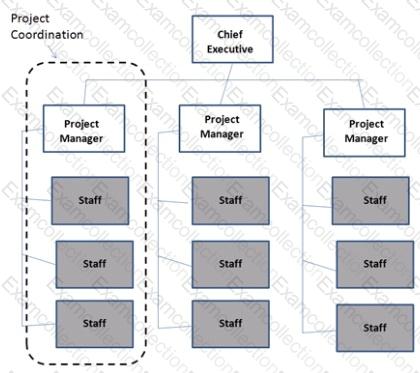
Balanced matrix
Projectized
Strong matrix
Functional
The Answer Is:
BExplanation:
Based on the PMBOK® Guide regarding Organizational Systems and Project Governance, the provided diagram illustrates a Projectized Organizational Structure.
Characteristics of a Projectized Structure: In this model, the organization is arranged by projects. The Project Manager has a high to almost total level of authority. As shown in the diagram, staff members (the gray boxes) report directly to a Project Manager, who in turn reports to the Chief Executive.
Resource Dedication: Most of the organization ' s resources are involved in project work. Unlike a functional or matrix structure, there are no " Functional Managers " (e.g., Head of Engineering, Head of Marketing) depicted as intermediaries for the staff.
Project Coordination: The diagram explicitly shows " Project Coordination " occurring vertically within the project silo, rather than horizontally across departments.
Organizational Loyalty: In this structure, team members are often co-located and their loyalty is to the project rather than a functional department.
Comparison with other options:
A and C. Balanced and Strong Matrix: In any matrix structure, you would typically see a dual reporting relationship where staff report to both a Project Manager and a Functional Manager. This diagram shows a direct, single line of command to the Project Manager.
D. Functional: In a functional organization, the hierarchy would show staff reporting to a Functional Manager (e.g., " Engineering Manager " ). Project coordination in a functional structure happens between functional managers, and the Project Manager role is often part-time or acts as a coordinator/expeditor with little to no formal authority.
Which schedule compression technique has phases or activities done in parallel that would normally have been done sequentially?
Crashing
Fast tracking
Leads and lags adjustment
Parallel task development
The Answer Is:
BExplanation:
According to the PMBOK® Guide, specifically within the Develop Schedule process, Fast Tracking is a schedule compression technique used to shorten the project duration without reducing the project scope.
Mechanism: Fast tracking involves taking activities or phases that were originally planned to be performed in sequence (one after the other) and performing them in parallel for at least a portion of their duration.
Example: Starting the construction of a building ' s foundation before the final detailed architectural drawings for the upper floors are 100% complete.
Risk vs. Cost:
Unlike crashing, fast tracking typically does not result in increased costs because it doesn ' t necessarily require more resources.
However, it significantly increases risk and can lead to rework. If the activities being done in parallel are dependent on one another, a change in the first activity may require the second (already started) activity to be redone.
Critical Path: This technique is only effective if it is applied to activities on the critical path. Shortening non-critical activities will not reduce the overall project duration.
Analysis of other choices:
Choice A (Crashing): This is another schedule compression technique, but it works by adding resources to critical path activities to shorten their duration. This almost always results in increased costs (e.g., overtime, additional staff) but does not necessarily involve changing the sequence of work to be parallel.
Choice C (Leads and lags adjustment): While adjusting leads (advancing a successor) or lags (delaying a successor) can influence the schedule, it is a tool used during the Sequence Activities or Develop Schedule process to refine relationships. It is not the formal definition of the compression technique that puts sequential phases into parallel.
Choice D (Parallel task development): This is a descriptive phrase for what is happening, but it is not a formal PMI term or recognized " Schedule Compression Technique " in the PMBOK® Guide.
What tools or techniques can be used in all cost management processes ' ?
Decision making and expert judgment
Expert judgment and data analysis
Data analysis and meetings
Meetings and cost aggregation
The Answer Is:
BExplanation:
According to the PMBOK® Guide, specifically within the Project Cost Management knowledge area, there are four primary processes: Plan Cost Management, Estimate Costs, Determine Budget, and Control Costs.
To identify tools and techniques that span the entire lifecycle of cost management, we look at the commonalities across these processes:
Expert Judgment: This is a fundamental tool used in every cost process. It involves input from individuals or groups with specialized knowledge in finance, accounting, industry-specific cost estimation, or previous similar projects. It is required to establish the plan, validate estimates, finalize the budget, and interpret variances during control.
Data Analysis: This is a broad category of techniques that appears in all cost processes. In Plan Cost Management, it includes alternative analysis; in Estimate Costs, it involves reserve analysis and cost of quality; in Determine Budget, it includes reserve analysis; and in Control Costs, it is critical for Earned Value Analysis (EVA), trend analysis, and variance analysis.
Analysis of other options:
Decision making: While used in planning and estimating, it is not a primary tool listed for every single process in the cost management suite (specifically within the standard Determine Budget process).
Meetings: While meetings occur frequently, they are formally listed as a tool for planning and control, but the core technical work of " Estimating " and " Determining Budget " relies more heavily on analytical tools.
Cost aggregation: This is a specific tool used only in the Determine Budget process to roll up activity cost estimates into work packages and eventually the cost baseline. It is not used in Plan Cost Management or Control Costs.
Therefore, per PMI standards, Expert Judgment and Data Analysis are the most pervasive tools that support the integrity of cost management from inception through completion.