

PMI CAPM - Certified Associate in Project Management (CAPM)
Which of the following projects is a quality candidate for adaptive approaches?
Installing new computers across offices
Retrofitting an old building
Upgrading an information system
Designing a new suspension bridge
The Answer Is:
CExplanation:
According to the Agile Practice Guide and the PMBOK® Guide, adaptive (Agile) approaches are most effective for projects characterized by high uncertainty, high complexity, and a high rate of change.
Why Choice C is correct: Information system upgrades typically involve software integration, evolving user requirements, and technical unknowns. Because software can be developed and tested in increments, it allows for frequent feedback and iterative refinement. This " upgrading " process is a prime candidate for adaptive lifecycles where the team can deliver value in small batches, adjust to technical debt, and pivot based on stakeholder feedback during the execution.
Analysis of other options:
A (Installing new computers): This is a repetitive, straightforward deployment project with low uncertainty. It is best handled via a Predictive (Waterfall) approach because the steps are well-defined and do not require iterative design.
B and D (Retrofitting a building / Designing a bridge): These are " heavy " engineering and construction projects. In these fields, the cost of change is extremely high once execution begins (e.g., you cannot easily " iterate " on the foundation of a bridge once the concrete is poured). These are typically managed using Predictive or Hybrid lifecycles where extensive planning precedes any execution.
As per the Stacey Matrix used in PMI literature, projects that are " Far from Certainty " (technical) and " Far from Agreement " (requirements) are the best candidates for adaptive approaches. Software and IT systems (Choice C) consistently fall into this category compared to traditional physical infrastructure projects.
A risk that arises as a direct result of implementing a risk response is called a:
contingent risk
residual risk
potential risk
secondary risk
The Answer Is:
DExplanation:
According to the PMBOK® Guide (Project Management Body of Knowledge), specifically within the Project Risk Management knowledge area and the Plan Risk Responses process, risks are categorized based on their relationship to the response strategies:
Secondary Risk (Option D): This is defined by PMI as a risk that arises as a direct result of implementing a risk response. For example, if a project team decides to mitigate the risk of a schedule delay by hiring an outside contractor, a " secondary risk " might emerge regarding the contractor ' s lack of familiarity with internal company standards. These risks must be identified and planned for just like primary risks.
Residual Risk (Option B): This is a risk that is expected to remain after the planned risk response has been implemented. It is the " leftover " risk that the project team decides to accept because it falls within acceptable risk thresholds.
Contingent Risk (Option A): This refers to a " Contingency Response Strategy, " which is a risk response that is executed only if certain predefined trigger conditions occur (also known as " fallback plans " ).
Potential Risk (Option C): This is a general term for any identified risk that has not yet occurred; it is not a technical classification within the PMI risk response framework.
In the PMI framework, the Plan Risk Responses process is iterative. When a response is chosen, the project manager must evaluate whether that response introduces new secondary risks or leaves behind residual risks that require further monitoring or a contingency reserve.
Which tool or technique of Plan Quality involves comparing actual or planned practices to those of other projects to generate ideas for improvement and provide a basis by which to measure performance?
Histogram
Quality audits
Benchmarking
Performance measurement analysis
The Answer Is:
CExplanation:
According to the PMBOK® Guide, specifically within the Plan Quality Management process, Benchmarking is a primary data gathering technique used to establish quality standards and identify improvements.
Definition: Benchmarking involves comparing actual or planned project practices or the project ' s quality standards to those of comparable projects to identify best practices, generate ideas for improvement, and provide a basis for measuring performance.
Source of Comparison: The projects used for benchmarking can be within the same organization, from another organization, or within the same application area. They can even be from a different industry (e.g., a construction project benchmarking its logistics against a retail company).
Objective: The goal is to set a " benchmark " or a standard of excellence. By seeing how others achieve high quality, the project team can adopt those methods to improve their own processes and deliverables.
Comparison with other options:
A. Histogram: This is a data representation tool (a bar chart) used to show the central tendency, dispersion, and shape of a statistical distribution. It is used to visualize data but not to compare practices against external projects for improvement ideas.
B. Quality audits: This is a tool used in the Manage Quality process (Executing phase). An audit is a structured, independent process to determine if project activities comply with organizational and project policies, processes, and procedures. It is an internal check of compliance rather than a comparison against external " best practices. "
D. Performance measurement analysis: This is a general term often associated with Control Costs or Control Schedule. It involves comparing the baseline to actual performance to determine if a variance exists. It does not inherently involve looking at other projects to generate new improvement ideas.
If the most likely duration of an activity is five weeks, the best-case duration is two weeks, and the worst-case duration is 14 weeks, how many weeks is the expected duration of the activity?
One
Five
Six
Seven
The Answer Is:
CExplanation:
According to the PMBOK® Guide, specifically within the Estimate Activity Durations process, the Three-Point Estimating technique is used to improve the accuracy of activity duration estimates by considering estimation uncertainty and risk.
There are two commonly used formulas for three-point estimating. Unless otherwise specified, the PERT (Program Evaluation and Review Technique) or Beta Distribution is typically used in PMP exams:
Optimistic ($O$): 2 weeks (best-case scenario)
Most Likely ($M$): 5 weeks (realistic scenario)
Pessimistic ($P$): 14 weeks (worst-case scenario)
The Beta Distribution (PERT) Formula:
$$E = \frac{O + 4M + P}{6}$$
Step-by-Step Calculation:
Multiply the Most Likely duration by 4: $4 \times 5 = 20$
Add the Optimistic and Pessimistic durations: $2 + 20 + 14 = 36$
Divide the total by 6: $36 / 6 = 6$
The expected duration ($E$) is 6 weeks.
Note on Triangular Distribution:
If the question had asked for a simple average (Triangular Distribution), the formula would be $(O + M + P) / 3$.
Calculation: $(2 + 5 + 14) / 3 = 21 / 3 = 7$ (Choice D). However, PMP standards favor the weighted Beta/PERT average because it places more weight on the " Most Likely " outcome, making it more statistically accurate for most projects.
Analysis of choices:
Choice A (One): Incorrect calculation.
Choice B (Five): This is just the " Most Likely " value, not the weighted expected duration.
Choice C (Six): Correct based on the PERT formula.
Choice D (Seven): Incorrect as it represents the simple Triangular average rather than the standard PERT estimate.
The cost baseline and project funding requirements are outputs of which process in Project Cost Management?
Estimate Costs
Control Costs
Plan Cost Management
Determine Budget
The Answer Is:
DExplanation:
According to the PMBOK® Guide (Project Management Body of Knowledge), specifically within the Project Cost Management knowledge area:
Determine Budget (Option D): This is the process of aggregating the estimated costs of individual activities or work packages to establish an authorized cost baseline. The two primary outputs of this process are the Cost Baseline (the approved version of the time-phased project budget, excluding any management reserves) and the Project Funding Requirements (total funding and periodic funding requirements, which include the cost baseline plus management reserves).
Estimate Costs (Option A): This process involves developing an approximation of the monetary resources needed to complete project work. Its primary outputs are Activity Cost Estimates and Basis of Estimates. It does not produce the baseline itself.
Control Costs (Option B): This is the process of monitoring the status of the project to update the project costs and managing changes to the cost baseline. Its outputs include Work Performance Information, Cost Forecasts, and Change Requests.
Plan Cost Management (Option C): This is the initial process that defines how the project costs will be estimated, budgeted, managed, monitored, and controlled. Its sole output is the Cost Management Plan.
In the PMI framework, the Cost Baseline is used as a basis for comparison to actual results. The Project Funding Requirements are often derived from the cost baseline but may include " step-increases " or management reserves to ensure the organization has sufficient cash flow to support project expenditures at various milestones.
One of the outputs of the project schedule is a detailed plan. What is the main purpose of that detailed plan?
It represents how and when the project will deliver the products, services, and results defined in the project scope
It creates a formal record of the project and shows the organizational commitment to the project
It describes how the scope will be defined, developed, monitored, controlled and validated
It provides the needs of a stakeholder or stakeholder group
The Answer Is:
AExplanation:
Based on the PMBOK® Guide, specifically the Develop Schedule process, the resulting schedule (the detailed plan) serves as a communication tool and a model for executing the project.
Primary Purpose (Choice A): The Project Schedule is an output of the schedule model that presents linked activities with planned dates, durations, milestones, and resources. Its core function is to provide a timeline that demonstrates how and when the project will deliver the objectives and scope defined in the project scope statement. It acts as a roadmap for the project team and a baseline for tracking progress.
Project Charter (Choice B): This description refers to the Project Charter. The charter is the document that formally authorizes the existence of a project and provides the project manager with the authority to apply organizational resources to project activities.
Scope Management Plan (Choice C): This describes the Scope Management Plan. This plan is a component of the project management plan that establishes how the scope will be defined, developed, monitored, controlled, and validated.
Requirements Documentation (Choice D): This describes Requirements Documentation, which captures the business, stakeholder, and solution requirements necessary to meet the project objectives.
The Project Schedule is distinct from the Schedule Management Plan. While the plan dictates how the schedule will be managed, the schedule itself (the output of Develop Schedule) provides the specific dates and sequences required for delivery.
Which baselines make up the performance measurement baseline?
Scope baseline, cost baseline, and schedule baseline
Scope baseline, project management baseline, and quality baseline
Cost baseline, schedule baseline, and risk baseline
Cost baseline, project management baseline, and schedule baseline
The Answer Is:
AExplanation:
According to the PMBOK® Guide, the Performance Measurement Baseline (PMB) is an integrated scope-schedule-cost plan for the project work against which project execution is compared to measure and manage performance.
Components of the PMB: The PMB is formed by the integration of three specific baselines:
Scope Baseline: Includes the Project Scope Statement, WBS, and WBS Dictionary.
Schedule Baseline: The approved version of the schedule model used to compare actual results to the plan.
Cost Baseline: The approved version of the time-phased project budget, excluding management reserves.
Earned Value Management (EVM): The PMB is the fundamental reference point for EVM. When project managers calculate variances (like CV or SV) and indices (like CPI or SPI), they are measuring the project ' s current status against this integrated baseline.
Change Control: Once established, the PMB can only be changed through formal change control procedures. It is used throughout the Monitoring and Controlling process group to identify deviations from the original plan.
Analysis of Other Options:
B. Scope baseline, project management baseline, and quality baseline: " Project management baseline " is not a standard term for a specific baseline, and while quality is planned, a " quality baseline " is not a component of the PMB.
C. Cost baseline, schedule baseline, and risk baseline: There is no such thing as a " risk baseline " in official PMI terminology. Risk is managed via the Risk Register and Risk Management Plan.
D. Cost baseline, project management baseline, and schedule baseline: This option incorrectly replaces the Scope Baseline with the non-standard term " project management baseline. " Scope is a mandatory pillar of performance measurement.
Which of the following is a conflict resolution technique that emphasizes areas of agreement rather than areas of difference?
Compromising
Collaborating
Smoothing
Problem Solving
The Answer Is:
CExplanation:
According to the PMBOK® Guide, specifically within the Manage Team process, there are five general techniques for resolving conflict. Smoothing (also known as Accommodating) is the specific technique that emphasizes areas of agreement rather than areas of difference.
Definition of Smoothing/Accommodating: This technique involves de-emphasizing or avoiding the areas of conflict and instead focusing on the points where the parties agree. It is often used to maintain harmony in a relationship or when the issue is more important to the other party than to oneself.
The Goal: The primary objective is to maintain a friendly atmosphere and reduce the emotional intensity of the conflict. It is a " conceding " position where one party may sacrifice their own concerns to satisfy the concerns of the other.
Result: While it can provide temporary relief and keep the project moving, it is often a lose-win scenario. Because the underlying conflict is not actually addressed or solved, the issue may resurface later.
Comparison with Other Options:
Compromising (A): Also known as Reconcile. This involves searching for solutions that bring some degree of satisfaction to all parties in order to temporarily or partially resolve the conflict. It is a " give-and-take " approach (lose-lose).
Collaborating (B): Also known as Problem Solving. This involves incorporating multiple viewpoints and insights from differing perspectives. it requires a cooperative attitude and open dialogue that typically leads to consensus and commitment (win-win).
Problem Solving (D): As noted above, this is synonymous with Collaborating. It treats the conflict as a problem to be solved by examining alternatives; it does not simply " smooth over " differences but works through them.
What estimating technique is used when there is limited information?
Analogous estimating
Parametric estimating
Bottom-up estimating
Three-point estimating
The Answer Is:
AExplanation:
According to the PMBOK® Guide, Analogous Estimating is a technique for estimating the duration or cost of an activity or a project using historical data from a similar activity or project.
Limited Information: It is the most appropriate technique when there is a limited amount of detailed information about the project (e.g., in the early phases of a project). It uses the values of parameters—such as scope, cost, budget, and duration—or measures of scale from a previous, similar project as the basis for estimating the same parameter or measure for a current project.
Accuracy vs. Speed: While it is generally less costly and time-consuming than other techniques, it is also generally less accurate. It is most reliable when the previous projects are similar in fact and not just in appearance, and the project team members preparing the estimates have the needed expertise.
Analysis of other options:
Parametric Estimating (Option B): This uses a statistical relationship between historical data and other variables (e.g., square footage in construction) to calculate an estimate. It requires a higher level of data and a reliable mathematical model.
Bottom-up Estimating (Option C): This is a method of estimating project duration or cost by aggregating the estimates of the lower-level components of the WBS. It is the most accurate but requires a high level of detail, which is not available when information is limited.
Three-point Estimating (Option D): This uses three estimates (most likely, optimistic, and pessimistic) to define an approximate range for an activity ' s cost or duration. While it helps account for uncertainty, it still requires enough detail to form those three distinct perspectives.
Per PMI standards, Analogous Estimating is often used to provide a " Rough Order of Magnitude " (ROM) estimate during the initiating or early planning stages of a project life cycle.
Documented identification of a flaw in a project component together with a recommendation is termed a:
corrective action.
preventive action.
non-conformance report,
defect repair.
The Answer Is:
DExplanation:
According to the PMBOK® Guide, specifically within the Direct and Manage Project Work and Perform Integrated Change Control processes, a Defect Repair is the formally documented identification of a non-conformity in a project component with a recommendation to either repair the component or replace it.
Nature of Defect Repair: Unlike actions taken to align future performance, a defect repair is reactive and addresses a specific, existing failure in a deliverable or a component that does not meet quality requirements.
The Change Control Process: Even though it involves " fixing " something that is broken, a defect repair must still be processed through Perform Integrated Change Control if it affects the project baselines or requires a formal change to the project documentation.
Verification: Once a defect repair is implemented, the component must be re-inspected through the Control Quality process to ensure the flaw has been corrected and the component now conforms to the original requirements.
Comparison with Other Options:
Corrective action (A): This is an intentional activity that realigns the performance of the project work with the project management plan. It focuses on the project ' s performance (e.g., getting back on schedule) rather than fixing a specific " flaw " in a physical component.
Preventive action (B): This is an intentional activity that ensures the future performance of the project work is aligned with the project management plan. It is proactive and taken before a flaw or error occurs.
Non-conformance report (C): While this is a document used in many industries to record a flaw, it is not the term the PMBOK® Guide uses to define the category of change or the recommendation to fix the component. The official PMI term for the recommended action is " Defect Repair. "
Given the following information, what is the schedule variance (SV) for this project?
Early start date (ES): 16 weeks
Actual time: 12 weeks
Schedule performance index (SPI): 1.3
5
2
3
4
The Answer Is:
DExplanation:
This question utilizes the Earned Schedule (ES) method, which is an extension of the traditional Earned Value Management (EVM) framework. While traditional EVM measures schedule variance in currency (dollars/units), Earned Schedule measures it in units of time.
According to the PMI Practice Standard for Earned Value Management and references in the PMBOK® Guide:
Identify the Variables:
Earned Schedule (ES): 16 weeks. (Note: In this specific calculation context, " ES " refers to Earned Schedule—the duration that should have been taken to achieve the current earned value—rather than " Early Start " ).
Actual Time (AT): 12 weeks.
Schedule Performance Index (SPI): 1.3 (given).
Formula for Schedule Variance (Time):
The formula for Schedule Variance in terms of time ($SV_t$) is:
$$SV_t = ES - AT$$
Substituting the given values:
$$SV_t = 16 - 12 = 4$$
Validation with SPI:
The formula for the Schedule Performance Index in terms of time ($SPI_t$) is:
$$SPI_t = ES / AT$$
Substituting the values:
$$SPI_t = 16 / 12 = 1.33...$$
This matches the provided SPI of 1.3 (rounded to one decimal place), confirming that the interpretation of the variables is correct.
Conclusion:
A positive Schedule Variance of 4 indicates that the project is 4 weeks ahead of schedule. This is consistent with an SPI greater than 1.0 (1.3), which denotes efficient schedule performance.
What type of change requires the submission of a change request?
Changes in assigned resources
Changes in a technical solution
Changes in status reporting
Changes in the project ' s scope
The Answer Is:
DExplanation:
According to the PMBOK® Guide, specifically within the Perform Integrated Change Control process, any change to a project baseline (Scope, Schedule, or Cost) must be formally documented and processed through a change request.
Formal Change Control: The Scope Baseline consists of the Project Scope Statement, the WBS, and the WBS Dictionary. Because this baseline represents the approved version of the project work, any modification to it—whether it is adding a new feature or removing a requirement—requires a formal Change Request (CR).
The Process:
Impact Analysis: The project manager evaluates how the scope change affects cost, time, quality, and risk.
Submission: A formal change request is submitted to the Change Control Board (CCB) or the Project Sponsor.
Approval/Rejection: The change is either approved, deferred, or rejected.
Update: If approved, the Scope Baseline and Project Management Plan are updated to reflect the new reality.
Preventing Scope Creep: Requiring formal change requests for scope modifications is the primary defense against Scope Creep, which is the uncontrolled expansion of product or project scope without adjustments to time, cost, and resources.
Analysis of Other Options:
A. Changes in assigned resources: Minor shifts in resource assignments are often handled by the project manager within the Manage Team or Acquire Resources processes. Unless the change impacts the budget or schedule baseline, it typically does not require a formal CR.
B. Changes in a technical solution: While a technical solution change might eventually lead to a scope change, the technical " how-to " is often managed by the project team or experts. If the technical change stays within the existing scope and budget, a formal baseline change request may not be necessary.
C. Changes in status reporting: Changing how or when status is reported is a change to the Communications Management Plan. While the plan might be updated, this is generally considered a management adjustment rather than a formal change to a project baseline requiring CCB intervention.
Labor, materials, equipment, and supplies are examples of:
Resource attributes.
Resource types.
Resource categories.
Resource breakdown structures (RBS).
The Answer Is:
CExplanation:
According to the PMBOK® Guide, specifically within the Estimate Activity Resources process, labor (people), materials, equipment, and supplies are the primary examples of Resource Categories.
Definition: Resource categories are high-level groupings of resources. Identifying these categories helps the project manager ensure that all necessary components for a task are accounted for beyond just human labor.
The Difference between Category and Type:
Resource Category: The broad group (e.g., Labor, Equipment, Material).
Resource Type: The specific skill level or technical specification within that category (e.g., Senior Engineer, 5-ton Crane, Grade-A Steel).
Resource Requirements: The output of this process is the Resource Requirements document, which identifies the quantity and type of resources required for each activity in a work package. This information is then used to build the Resource Breakdown Structure.
Comparison with Other Options:
Resource Attributes (A): These are the specific characteristics associated with each resource, such as its location, availability, technical skills, or cost rate. They provide more detail than the category.
Resource Types (B): As noted above, this is the level of detail within a category (e.g., " Electrician " is a type within the " Labor " category).
Resource Breakdown Structures (D): The RBS is a hierarchical representation of resources by category and type. While labor and materials are found in an RBS, they themselves are the categories that form the structure.
The project manager and the project team are in the process of documenting procurement decisions. Which of the following will be the procurement strategy?
Payment types, delivery methods, and procurement phases
Procurement metrics, make-or-buy decisions, and procurement statement of work
Vendor selection criteria, stakeholder roles and responsibilitys, and prequalified sellers
Timetable procurement activities, product cost, and knowledge transfer schedule
The Answer Is:
AExplanation:
According to the PMBOK® Guide, the Plan Procurement Management process involves documenting project procurement decisions, specifying the approach, and identifying potential sellers. A key output of this process is the Procurement Strategy.
Once the make-or-buy analysis is complete and the organization decides to procure goods or services from an external source, the project manager must define how the procurement will be executed. The procurement strategy typically includes:
Delivery Methods: For professional services, this might involve specifying whether the work is a " turnkey " project, a design-build approach, or a sub-contracting arrangement. For construction, it defines the relationship between the owner, designer, and contractor.
Contract Payment Types: This defines how the risk is shared between the buyer and the seller. Common types include Fixed-Price (FP), Cost-Reimbursable (CR), and Time and Material (TandM).
Procurement Phases: This defines the sequencing of the procurement, such as whether there will be a pre-qualification phase, a formal bidding phase, and how the procurement is integrated into the overall project schedule.
Why other options are incorrect:
Option B: Make-or-buy decisions and the Procurement Statement of Work (SOW) are separate, high-level outputs or components of the procurement documentation. The " Procurement Strategy " specifically refers to the methods of delivery and payment.
Option C: Vendor selection criteria and stakeholder roles are part of the broader Procurement Management Plan. While important, they describe the selection process and governance, rather than the strategic structure of the procurement itself.
Option D: A timetable is a schedule-related document, and product cost is a budget/estimate factor. These are constraints or data points but do not constitute the " strategy " for how the procurement contract and delivery will be managed.
Which of the following does a portfolio combine?
Projects, programs, and operations
Operations, strategies, and business continuity
Projects, programs, and risks
Projects, change management, and operations
The Answer Is:
AExplanation:
According to the PMBOK® Guide and The Standard for Portfolio Management, a portfolio is defined by its relationship to the organization ' s strategic goals rather than just the shared work between individual components.
Why Choice A is correct:
The Definition: A Portfolio is a collection of projects, programs, subsidiary portfolios, and operations managed as a group to achieve strategic objectives.
Strategic Alignment: While projects and programs focus on " doing things right " (execution), portfolio management focuses on " doing the right things " (selection).
Inclusion of Operations: Unlike programs, which generally consist of related projects, a portfolio includes ongoing operations (such as maintenance or recurring business activities) to ensure that the organization’s total resource capacity is balanced between new initiatives and sustaining the business.
Analysis of other options:
B (Operations, strategies, and business continuity): While a portfolio is guided by strategy, " strategy " and " business continuity " are organizational functions or goals, not the components that make up the portfolio itself. A portfolio is the container for the work that realizes those strategies.
C (Projects, programs, and risks): Risk management is a process applied to all levels of management, but " risks " are not a constituent component of a portfolio in the same way that projects or programs are.
D (Projects, change management, and operations): Change management is a critical discipline used within projects and portfolios to ensure transitions are successful, but it is not a structural component (like a program or project) that a portfolio " combines. "
Key Concept: The Project Management Institute (PMI) emphasizes that the purpose of a Portfolio (Choice A) is to provide high-level visibility. By combining Projects, Programs, and Operations, senior leadership can see how all organizational resources are being used and make informed decisions about where to invest to best achieve the company ' s long-term vision.
A tool or technique in Perform Quality Control that a project manager would use is:
quality audits.
process analysis.
benchmarking.
inspection.
The Answer Is:
DExplanation:
According to the PMBOK® Guide, specifically within the Control Quality process (formerly known as Perform Quality Control), Inspection is a primary tool and technique used to determine if work and deliverables conform to requirements and product acceptance criteria.
Definition of Inspection: An inspection involves examining a work product to determine if it conforms to documented standards. The results of an inspection generally include measurements and may be called reviews, peer reviews, audits, or walkthroughs in some application areas.
Focus: While quality assurance (Manage Quality) focuses on the processes used in the project, Control Quality (and specifically Inspection) focuses on the physical deliverables themselves.
Application: Inspections can be conducted at any level of the project. For example, the inspection of a single activity or the inspection of the final product of the project.
Comparison with Other Options:
Quality audits (A): This is a tool and technique of the Manage Quality (Quality Assurance) process. It is a structured, independent process to determine if project activities comply with organizational and project policies, processes, and procedures.
Process analysis (B): This is also a tool and technique of Manage Quality. It follows the steps outlined in the process improvement plan to identify needed improvements from an environmental and continuous improvement perspective.
Benchmarking (C): This is a tool and technique used in Plan Quality Management. it involves comparing actual or planned project practices to those of comparable projects to identify best practices and generate ideas for improvement.
What process group establishes project scope: refines objectives, and defines the actions necessary to attain project objectives ' ?
Executing
Planning
Initiating
Monitoring and Controlling
The Answer Is:
BExplanation:
According to the PMBOK® Guide, the Planning Process Group consists of those processes required to establish the scope of the effort, refine the objectives, and define the course of action required to attain the objectives that the project was undertaken to achieve.
The Planning process group is characterized by the following key activities:
Developing the Project Management Plan: Integrating all subsidiary plans and baselines.
Defining Scope: Creating a detailed description of the project and product.
Refining Objectives: Taking the high-level goals from the Project Charter (Initiating) and breaking them down into specific, measurable project deliverables.
Developing the Schedule and Budget: Determining the timeline and cost constraints necessary to meet the project objectives.
Analysis of other Process Groups:
Initiating (Option C): Processes performed to define a new project or a new phase by obtaining authorization. While objectives are mentioned here at a high level, they are not " refined " or translated into detailed actions until the Planning phase.
Executing (Option A): Processes performed to complete the work defined in the project management plan. This is the " doing " phase.
Monitoring and Controlling (Option D): Processes required to track, review, and regulate progress. This group focuses on identifying variances from the plan created during the Planning phase.
Per PMI standards, the Planning process group is iterative. As new information is discovered (often referred to as Progressive Elaboration), the project team may need to return to the Planning processes to further refine the scope or objectives.
In an interactive communication model, how is the sender ensured that the message was understood by the receiver?
The receiver decodes the message
The receiver responds to the message with feedback.
The receiver transmits the message
The receiver acknowledges their receipt of the message
The Answer Is:
BExplanation:
According to the PMBOK® Guide, specifically within the Project Communications Management knowledge area, the Interactive Communication Model (also known as the Basic Communication Model) defines how information is sent, received, and confirmed.
Feedback Loop: In this model, simply receiving or decoding the message is not enough to ensure understanding. The sender only knows the message was understood when the receiver responds with feedback. This feedback allows the sender to verify that the message was interpreted correctly and to clarify any misunderstandings.
Decode vs. Feedback: While the receiver must decode the message to read it, the sender has no visibility into that internal process. Feedback is the active " closing of the loop " that confirms the mental model of the receiver matches the intent of the sender.
Ensuring Accuracy: This model is essential in project management to prevent errors, especially when communicating complex technical requirements or project changes.
Why other options are incorrect:
Option A: The receiver decodes the message: Decoding is the internal process of translating the message into meaningful thoughts. The sender cannot " see " this happen and therefore cannot be ensured of understanding through this step alone.
Option C: The receiver transmits the message: Transmission refers to the act of sending. If a receiver merely re-transmits a message (like forwarding an email), it does not prove they understood the content.
Option D: The receiver acknowledges their receipt of the message: Acknowledgment (e.g., " I received your email " ) only confirms that the message was delivered. It does not confirm that the receiver understood the information contained within the message.
A new business analyst has joined the team in the middle of a project and the requirements traceability matrix has been updated. What should the business analyst do next?
Review the project management plan.
Share the requirements traceability matrix the same way it was shared previously.
Consult the business analysis communications management plan.
Ask the project manager to share the updated requirements traceability matrix at the next meeting.
The Answer Is:
CExplanation:
According to the PMI Guide to Business Analysis and the PMBOK® Guide, when a critical project artifact like the Requirements Traceability Matrix (RTM) is updated, the process for distributing that information is governed by established communication protocols.
Communication Standards: The Business Analysis Communication Management Plan (or the broader Project Communications Management Plan) outlines who needs to receive specific information, the format in which they should receive it, the frequency of updates, and the specific channels (e.g., email, repository, or meeting) to be used.
Onboarding and Consistency: For a new business analyst joining mid-project, it is vital to follow the existing project governance. By consulting the communications plan, the analyst ensures they are reaching the right stakeholders and following the " rules of engagement " established during the planning phase.
Stakeholder Expectations: Different stakeholders may have different needs regarding the RTM. For example, a developer may only need to see technical mappings, while a sponsor may only want a high-level summary. The communications plan specifies these preferences to avoid information overload or missed communication.
Analysis of other options:
Option A: While the Project Management Plan is a useful reference for overall project context, it is too broad. The analyst needs specific instructions on how to handle the distribution of business analysis artifacts, which is found in the more granular communication plan.
Option B: While consistency is good, " sharing it the same way " assumes the new analyst already knows what that way was. Consulting the formal plan is the professional way to verify the correct procedure rather than relying on hearsay or assumptions.
Option D: While the Project Manager (PM) is a key partner, the Business Analyst is typically responsible for managing their own artifacts. Relying on the PM to share the RTM at a meeting may not align with the frequency or method required by the stakeholders (e.g., they might need it immediately via a shared portal).
Per PMI standards, whenever information needs to be disseminated, the first step is to consult the Communications Management Plan to ensure the right information reaches the right people at the right time.
Which Define Activities output extends the description of the activity by identifying the multiple components associated with each activity?
Project document updates
Activity list
Activity attributes
Project calendars
The Answer Is:
CExplanation:
In accordance with the PMBOK® Guide (Project Schedule Management), specifically within the Define Activities process, Activity Attributes serve as an extension of the activity list. While the activity list provides the names of the tasks, the activity attributes provide the detailed information required for scheduling and resource management.
Function and Components: Activity attributes identify the multiple components associated with each activity. This includes, but is not limited to:
Activity Identifiers (IDs) and codes.
Predecessor and Successor activities, including leads and lags.
Resource requirements and constraints.
Logical relationships (Finish-to-Start, Start-to-Start, etc.).
Imposed dates and assumptions.
Evolution of Detail: During the initial stages of the project, these attributes are limited. As the project progresses through Progressive Elaboration, the attributes become more detailed, providing the necessary data for the Sequence Activities and Develop Schedule processes.
Relationship to Activity List: The activity list is a documented tabulation of schedule activities, whereas the attributes provide the " meta-data " or descriptive depth for each item on that list.
Analysis of Distractors:
A. Project document updates: While the Define Activities process can result in updates to various project documents (such as the risk register), this is a general category of output and does not specifically describe the detailed components of an activity.
B. Activity list: This is a primary output of Define Activities, but it is merely a list of the schedule activities. It does not " extend the description " with multiple components in the way that the Activity Attributes do.
D. Project calendars: These are typically an output of the Develop Schedule process. They identify working days and shifts available for scheduled activities and are not a description of the activities themselves.
Managing procurement relationships and monitoring contract performance are part of which process?
Conduct Procurements
Plan Procurements
Administer Procurements
Close Procurements
The Answer Is:
CExplanation:
According to the PMBOK® Guide, the process of managing procurement relationships, monitoring contract performance, and making changes and corrections as appropriate is defined as Administer Procurements (referred to as Control Procurements in more recent editions).
Core Functions: This process ensures that both the seller’s and buyer’s performance meets the procurement requirements according to the terms of the legal agreement.
Key Activities:
Monitoring Contract Performance: Verifying that the vendor is delivering what was promised within the agreed timeline and budget.
Managing Relationships: Maintaining a professional and functional working relationship between the buyer and the seller.
Financial Management: Managing payments to the seller (accounts payable).
Change Control: Processing contract amendments or change requests through the project’s integrated change control system.
Risk Monitoring: Identifying new risks arising from the procurement and monitoring existing ones.
Analysis of Other Options:
A. Conduct Procurements: This is the process of obtaining seller responses, selecting a seller, and awarding a contract. It is the " execution " of the procurement plan but occurs before administration/monitoring begins.
B. Plan Procurements: This is the initial planning process where the team decides what to buy, how to buy it, and identifies potential sellers.
D. Close Procurements: This is the process of completing each project procurement, including resolving open claims and finalizing the administrative aspects of the contract. It occurs after the administration/monitoring phase is complete.
A functional manager is delegating a key project to a project team without a project manager. Which communication method will be most effective?
Interactive
Push
Verbal
Oral
The Answer Is:
AExplanation:
According to the PMBOK® Guide and the Standard for Project Management, effective communication is a critical pillar of project success, especially when a formal leadership structure (like a dedicated project manager) is missing.
The three primary communication methods recognized by PMI are Interactive, Push, and Pull. In the scenario described:
Interactive Communication: This method involves a multidimensional exchange of information in real-time. It includes meetings, phone calls, video conferencing, and instant messaging. It is the most effective way to ensure a common understanding among all participants on a given topic. Because the team lacks a project manager to coordinate activities, the functional manager must ensure that the delegation is fully understood, expectations are clear, and the team can provide immediate feedback or ask clarifying questions.
Comparison with other options:
Push Communication: This involves sending information to specific recipients who need to know it (e.g., emails, memos, reports). While this ensures the information is distributed, it does not guarantee that it reached or was understood by the intended audience. Without a PM to follow up, " Push " communication risks leaving the team misaligned.
Verbal/Oral Communication: These are types of communication, but they are not categorized as " methods " in the same way Interactive, Push, and Pull are in the Communication Management Plan. Furthermore, " Verbal " and " Oral " are often used interchangeably in general conversation, but in a PMI context, Interactive is the formal method that encompasses these while focusing on the bidirectional flow of information.
In a self-managing team environment (or one where the PM role is absent), Interactive communication is essential to resolve conflicts, foster collaboration, and verify that the project ' s strategic objectives are correctly interpreted by the team members.
An input to the Plan Stakeholder Management process is:
The project charter.
The stakeholder analysis.
A communication management plan.
A stakeholder register.
The Answer Is:
DExplanation:
According to the PMBOK® Guide, the Plan Stakeholder Engagement process (referred to as Plan Stakeholder Management in earlier editions) is the process of developing approaches to involve project stakeholders based on their needs, expectations, interests, and potential impact on the project.
Stakeholder Register: This is a critical Project Document and a primary input to this process. It provides the list of all identified stakeholders along with their classification, interests, and influence levels. You cannot plan how to manage or engage stakeholders without first having the list of who they are and what their requirements are, which is exactly what the register provides.
Logical Flow: The process of Identify Stakeholders produces the Stakeholder Register as an output. That register then flows directly into Plan Stakeholder Engagement as an input so that the project manager can create a tailored engagement strategy.
Why the other options are incorrect:
A. The project charter: While the project charter is an input to the Identify Stakeholders process (because it lists high-level stakeholders and sponsors), it is typically not the primary input for the detailed Planning of stakeholder engagement. The register is more specific and refined.
B. The stakeholder analysis: This is a Tool and Technique used within the processes (both Identify Stakeholders and Plan Stakeholder Engagement) to gather and evaluate information. It is the action of analyzing, not a standalone input document.
C. A communication management plan: This is usually an output developed alongside or after the stakeholder engagement plan. While the two are closely linked, the Stakeholder Engagement Plan defines the " why " and " who " of engagement, while the Communications Management Plan defines the " how, " " when, " and " what. "
During what project management process does the project manager invest the most effort into creating the work breakdown structure (WBS)?
Initiating
Planning
Executing
Monitoring and Controlling
The Answer Is:
BExplanation:
According to the PMBOK® Guide, the Work Breakdown Structure (WBS) is a fundamental tool created within the Project Scope Management knowledge area, specifically during the Create WBS process.
The Planning Process Group: This group consists of those processes performed to establish the total scope of the effort and define the course of action. Creating the WBS is a core planning activity because it involves decomposing the total scope of work into smaller, more manageable components called work packages.
Purpose of the WBS: The WBS provides the framework for everything that follows in the planning phase, including cost estimation, scheduling, resource allocation, and risk identification. Without a finalized WBS, a project manager cannot establish an accurate Scope Baseline.
Analysis of other Process Groups:
Initiating (Option A): This group focuses on the Project Charter and high-level requirements. While the " what " is defined here, the " how-to-break-it-down " (WBS) does not happen until the project is officially authorized and moves into planning.
Executing (Option C): This phase involves " doing the work. " The team uses the WBS created during planning to guide their activities, but they do not typically " create " it during this stage.
Monitoring and Controlling (Option D): This phase involves comparing actual performance against the plan. While the WBS is used here to track progress at the work package level, the effort spent is on tracking, not creating.
Per PMI standards, the WBS is the " heart " of the project plan. It ensures that the project manager and the team have a shared understanding of the project ' s deliverables and the work required to produce them.
Ensuring that both parties meet contractual obligations and that their own legal rights are protected is a function of:
Conduct Procurements.
Close Procurements.
Administer Procurements,
Plan Procurements.
The Answer Is:
CExplanation:
In accordance with the PMBOK® Guide, the process of ensuring that both the seller’s and the buyer’s performance meets procurement requirements according to the terms of the legal agreement is the primary objective of Control Procurements (historically and in some study guides referred to as Administer Procurements).
Core Function: This process involves managing procurement relationships, monitoring contract performance, making changes and corrections as appropriate, and closing out contracts.
Legal Protection: A key aspect of this process is the legal nature of the relationship. Both the buyer and the seller must ensure they are meeting their contractual obligations. The Project Manager must be aware of the legal implications of the actions taken when administering the contract, as the contract is a dynamic legal document.
Activities Involved:
Reviewing and documenting how a seller is performing.
Authorizing payments to the seller.
Managing contract-related changes.
Ensuring that the rights of both parties are protected throughout the execution of the contract.
Comparison with Other Options:
Plan Procurements (D): This is the planning phase where you determine what to procure and how to do it.
Conduct Procurements (A): This is the execution phase where you receive bids, select a seller, and award the contract.
Close Procurements (B): This is the final step where the contract is formally completed and all administrative matters are settled.
What are the formal and informal policies, procedures, and guidelines that could impact how the project ' s scope is managed?
Organizational process assets
Enterprise environmental factors
Project management processes
Project scope management plan
The Answer Is:
AExplanation:
According to the PMBOK® Guide, Organizational Process Assets (OPAs) are the plans, processes, policies, procedures, and knowledge bases specific to and used by the performing organization. These assets influence the project ' s management at every stage, including how scope is defined, validated, and controlled.
Categories of OPAs:
Processes and Procedures: These include formal and informal initiated patterns of work, such as standard templates (WBS templates, scope statement templates), specific organizational standards, and change control procedures.
Corporate Knowledge Base: This includes historical information and lessons learned from previous projects, which are essential for determining what scope was successful or problematic in the past.
Impact on Scope Management: OPAs provide the " internal " framework. For example, an organization might have a policy that all software projects must use a specific requirements gathering methodology or a procedure that requires executive sign-off for any scope change exceeding a certain budget threshold.
Source of Assets: These are typically internal to the organization and are updated and added to throughout the life of the project.
Analysis of other choices:
Choice B (Enterprise environmental factors - EEFs): While EEFs also impact scope management, they refer to conditions not under the control of the project team that influence, constrain, or direct the project (e.g., marketplace conditions, government standards, or the organizational culture/infrastructure). They are generally " external " or systemic constraints rather than the organization ' s specific " how-to " policies and procedures.
Choice C (Project management processes): These are the 47+ standard processes (Initiating, Planning, Executing, Monitoring and Controlling, and Closing) used to manage the project. While these processes use policies and procedures, they are not the policies themselves.
Choice D (Project scope management plan): This is a specific output of the Plan Scope Management process. It describes how the scope will be defined, developed, monitored, controlled, and validated. It incorporates organizational policies, but it is the project-specific plan rather than the source of the organization ' s overarching guidelines.
A project manager has recently been assigned a new agile project and needs to determine an appropriate leadership style. The project manager aims to empower the team members so they feel committed and motivated to deliver value.
Which leadership style should be used for this project?
A servant leadership style
A laissez-faire leadership style
A collaborative leadership style
A directive leadership style
The Answer Is:
AExplanation:
In Agile project management, the role of the leader shifts from " command and control " to support and facilitation. This philosophy is encapsulated in the concept of Servant Leadership.
Why Choice A is correct:
Empowerment: Servant leadership focuses on the growth and well-being of the team. By putting the team ' s needs first, the project manager empowers them to make decisions, which fosters the commitment and motivation mentioned in the prompt.
Removing Impediments: A servant leader’s primary job is to clear the path for the team—removing " roadblocks " or " impediments " —so the team can focus on delivering high-value work.
Agile Alignment: The Agile Practice Guide (developed by PMI and Agile Alliance) explicitly recommends servant leadership because it promotes self-organization and accountability, which are the engines of Agile delivery.
Characteristics: Key traits include listening, empathy, stewardship, and a commitment to the professional development of team members.
Analysis of other options:
B (Laissez-faire): This style is " hands-off, " where the leader allows the team to make all decisions without much interference or support. While it offers freedom, it lacks the proactive support and guidance a servant leader provides to help a team succeed.
C (Collaborative): While Agile leaders are collaborative, " Collaborative Leadership " is a general management term. " Servant Leadership " is the specific, recognized framework within the PMI-ACP and PMP domains for Agile projects.
D (Directive): Also known as " Autocratic, " this style involves the leader telling the team exactly what to do. This is the opposite of empowering the team and is generally ineffective in Agile environments where self-organization is required.
Key Concept: The Project Management Institute (PMI) emphasizes that in Agile, the project manager (or Scrum Master) does not manage the people, they manage the environment. By adopting a Servant Leadership style (Choice A), the leader creates a safe space for the team to experiment, learn from failure, and ultimately take ownership of the project ' s value delivery.
Which of the following are outputs from the process of creating a work breakdown structure (WBS)?
Project scope statement and accepted deliverables
Scope baseline and project documents update
Accepted deliverables and enterprise environmental factors
Scope baseline and work performance information
The Answer Is:
BExplanation:
According to the PMBOK® Guide, the Create WBS process is the process of subdividing project deliverables and project work into smaller, more manageable components. The primary objective of this process is to provide a structured vision of what has to be delivered.
The outputs of this process include:
Scope Baseline: This is the most significant output. The scope baseline is the approved version of a scope statement, WBS, and its associated WBS dictionary. It can be changed only through formal change control procedures and is used as a basis for comparison. It consists of:
Project Scope Statement: Includes the description of the project scope, major deliverables, assumptions, and constraints.
WBS: A hierarchical decomposition of the total scope of work.
WBS Dictionary: A document that provides detailed deliverable, activity, and scheduling information about each component in the WBS.
Project Documents Updates: As the WBS is created, other project documents may need to be updated to remain consistent. Common updates include the Requirements Documentation, as the process of decomposition may reveal new requirements or details that were previously overlooked.
Analysis of Other Options:
A. Project scope statement and accepted deliverables: While the Project Scope Statement is part of the Scope Baseline, Accepted Deliverables are an output of the Validate Scope process, not Create WBS.
C. Accepted deliverables and enterprise environmental factors: As noted above, Accepted Deliverables belong to Validate Scope. Enterprise Environmental Factors (EEFs) are typically inputs to processes or external constraints; they are almost never an output of a project management process.
D. Scope baseline and work performance information: The Scope Baseline is correct, but Work Performance Information is an output of various Monitoring and Controlling processes (like Control Scope or Control Schedule), where raw data is analyzed in context. Create WBS is a Planning process.
When closing a project or phase, part of the process may require the use of which type of analysis?
Reserve analysis
Regression analysis
Document analysis
Product analysis
The Answer Is:
BExplanation:
According to the PMBOK® Guide (Project Management Body of Knowledge), specifically within the Project Integration Management knowledge area and the Close Project or Phase process:
Regression Analysis (Option B): This is a specific analytical technique used during the closing of a project or phase. In this context, Regression Analysis is used to analyze the interrelationships between different project variables that contributed to the project outcomes. By performing this analysis, the project team can better understand which factors most significantly impacted project performance, which in turn helps in improving the accuracy of future project performance and the maturity of the organization ' s project management processes.
Reserve Analysis (Option A): This technique is used during the Estimate Costs, Determine Budget, and Control Costs processes. It involves evaluating the status of contingency and management reserves to determine if they are still needed or if they can be released. It is a " monitoring " and " planning " tool, not a " closing " analytical tool.
Document Analysis (Option C): This is a tool and technique typically used during the Collect Requirements process. it involves eliciting requirements by analyzing existing documentation and identifying information relevant to the requirements.
Product Analysis (Option D): This is a tool used during Define Scope. It includes techniques such as product breakdown, systems analysis, and value engineering to translate high-level product descriptions into tangible deliverables.
In the PMI framework, the Close Project or Phase process is not merely about administrative sign-off. It is an essential opportunity for organizational learning. By using Regression Analysis, the Project Manager can provide the organization with data-driven insights into " why " certain results were achieved, ensuring that Lessons Learned are grounded in statistical reality rather than just anecdotal feedback.
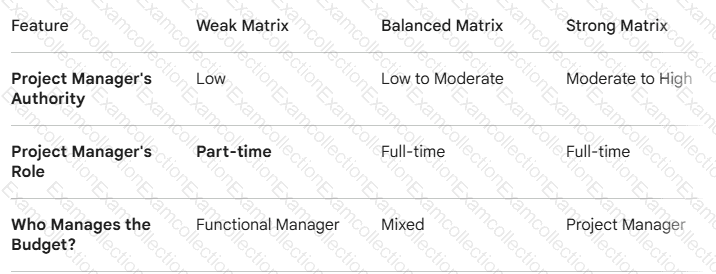
In a weak matrix, the project managers role is:
part-time
full-time
occasional
unlimited
The Answer Is:
AExplanation:
According to the PMBOK® Guide, the level of authority and the specific role of a project manager are heavily influenced by the Organizational Structure of the performing organization. PMI classifies matrix structures into three categories: Weak, Balanced, and Strong.
In a Weak Matrix organizational structure, the project manager maintains many of the characteristics of a functional organization.
Role Definition: The project manager ' s role is typically part-time. They often function more as a Project Expediter or Project Coordinator rather than a true manager.
Authority: Their authority is very low to non-existent. The functional manager retains most of the power, including control over the budget and resources.
Staffing: The project team members also work part-time on the project, with their primary loyalty and reporting line remaining with their functional department.
B. full-time: This is a characteristic of a Strong Matrix or a Projectized organization. In these structures, the project manager is a designated professional with a full-time commitment to the project and significant authority.
C. occasional: While a project manager in a weak matrix has limited hours, " occasional " is not a formal PMI term used to describe the role. The standard designation is " part-time. "
D. unlimited: This is incorrect in any organizational structure. All project managers operate within defined constraints of authority, budget, and schedule as outlined in the Project Charter.
What does earned value (EV) measure?
Budgeted work that has been completed
Total costs incurred while accomplishing work
Budget associated with planned work
Cost efficiency of budgeted resources
The Answer Is:
AExplanation:
In accordance with the PMBOK® Guide and the Standard for Project Management, Earned Value (EV) is a critical metric in the Earned Value Management (EVM) framework used within the Control Costs process.
Earned Value (EV): It is defined as the measure of work performed expressed in terms of the budget authorized for that work. Essentially, it represents the budgeted amount for the work that has actually been completed to date. It is often referred to as the Budgeted Cost of Work Performed (BCWP).
Analysis of other options:
B. Total costs incurred (Actual Cost - AC): This represents the realized cost incurred for the work performed on an activity during a specific time period.
C. Budget associated with planned work (Planned Value - PV): This is the authorized budget assigned to scheduled work. It represents what we intended to do, whereas EV represents what we actually achieved.
D. Cost efficiency (Cost Performance Index - CPI): This is a ratio derived from EV and AC (
$$CPI = EV / AC$$
). While EV is used to calculate efficiency, EV itself is a measure of value, not a ratio of efficiency.
Per PMI standards, EV is used to determine the project ' s progress. If $EV < PV$, the project is behind schedule; if $EV < AC$, the project is over budget. It serves as the bridge between the physical progress of the work and the financial expenditure.
Which action should a project manager take to ensure that the project management plan is effective and current?
Conduct periodic project performance reviews.
Identify quality project standards.
Follow ISO 9000 quality standards.
Complete the quality control checklist.
The Answer Is:
AExplanation:
According to the PMBOK® Guide, specifically within the Monitor and Control Project Work process, the project manager is responsible for tracking, reviewing, and reporting the overall progress to meet the performance objectives defined in the project management plan.
Performance Reviews: These reviews compare actual performance against the performance measurement baseline (scope, schedule, and cost baselines). By conducting these periodically, the project manager can determine if the project is " on track " or if variances exist that require corrective or preventive actions.
Keeping the Plan Current: The project management plan is a " living document. " When performance reviews identify significant deviations, the project manager initiates Change Requests through the Perform Integrated Change Control process. Once approved, these changes are incorporated into the plan, ensuring it remains a realistic and effective guide for the remainder of the project.
Continuous Improvement: Periodic reviews allow the team to analyze trends (Trend Analysis) and forecast future performance (Variance Analysis), which are essential for proactive management and keeping the plan aligned with the project ' s evolving environment.
Comparison with other options:
B. Identify quality project standards: This is a specific activity within the Plan Quality Management process. While important for quality, it does not address the broader effectiveness or " currency " of the entire integrated project management plan.
C. Follow ISO 9000 quality standards: ISO 9000 is an external international standard for quality management systems. While an organization might adopt these, " following " them is a general compliance activity rather than a specific project management mechanism for updating and maintaining a project-specific plan.
D. Complete the quality control checklist: This is a tool used in the Control Quality process to verify that a set of required steps has been performed. It is a tactical task used for deliverables, not a strategic tool for ensuring the project management plan is effective and current.
Which of the following is a narrative description of products, services, or results to be delivered by a project?
Project statement of work
Business case
Accepted deliverable
Work performance information
The Answer Is:
AExplanation:
According to the PMBOK® Guide (specifically in the context of the Develop Project Charter process), the Project Statement of Work (SOW) is a critical narrative document used to define the boundaries of the project before it is formally authorized.
Definition: The SOW is a narrative description of products, services, or results to be delivered by the project. For internal projects, the project initiator or sponsor provides the statement of work based on business needs, product, or service requirements. For external projects, the statement of work can be received from the customer as part of a bid document (e.g., a request for proposal, request for information, or as part of a contract).
Key Components: The SOW typically references:
Business Need: An organization’s business need may be based on a market demand, technological advance, legal requirement, government regulation, or environmental consideration.
Product Scope Description: Documents the characteristics of the product, service, or results that the project will be undertaken to create.
Strategic Plan: Documents the organization ' s strategic goals and ensures the project aligns with the corporate mission.
Comparison with other options:
B. Business case: This document provides the necessary information from a business standpoint to determine whether or not the project is worth the required investment. It focuses on the economic feasibility and " why " of the project, rather than a narrative description of the deliverables.
C. Accepted deliverable: These are products, results, or capabilities produced by a project and validated by the customer or sponsor as meeting their specified acceptance criteria during the Validate Scope process.
D. Work performance information: This consists of the performance data collected from various controlling processes, analyzed in context and integrated based on relationships across areas. It describes how the project is performing (e.g., status of deliverables), but it is not the initial narrative description of what is to be delivered.
Calculate the Schedule Performance Index (SPI) based on the following information: earned value (EV) is 30 and planned value (PV) is 15.
2.0
45
0.5
15
The Answer Is:
AExplanation:
According to the PMBOK® Guide, specifically within the Monitor and Control Project Work process, the Schedule Performance Index (SPI) is a measure of schedule efficiency expressed as the ratio of earned value to planned value.
The Formula: The SPI is calculated using the following equation:
$$SPI = \frac{EV}{PV}$$
The Calculation:
Given Earned Value ($EV$) = $30$
Given Planned Value ($PV$) = $15$
$SPI = \frac{30}{15} = 2.0$
Interpreting the Result:
SPI > 1.0: Indicates that more work was completed than was originally planned. The project is ahead of schedule.
SPI < 1.0: Indicates that less work was completed than was planned. The project is behind schedule.
SPI = 1.0: Indicates that the project is exactly on schedule.
Context: An SPI of $2.0$ means the project team is performing at $200\%$ efficiency relative to the schedule. For every hour of work planned, two hours ' worth of work (in terms of value) has been accomplished.
Analysis of other options:
Option B (45): This is the result of adding $EV$ and $PV$ ($30 + 15$), which has no standard meaning in Earned Value Management.
Option C (0.5): This is the result of dividing $PV$ by $EV$ ($15 / 30$). This is the inverse of the SPI formula and is incorrect.
Option D (15): This is the result of $EV - PV$ ($30 - 15$), which is the formula for Schedule Variance (SV), not the index.
Per PMI standards, the Schedule Performance Index (SPI) is a critical metric for determining the efficiency of the project team ' s use of time, and in this specific case, the value of 2.0 indicates exceptionally high schedule performance.
What is one of the main purposes of the project chatter?
Formal authorization of the existence of the project
Formal acceptance of the project management plan
Formal approval of the detailed project budget
Formal definition of stakeholder roles and responsibilities
The Answer Is:
AExplanation:
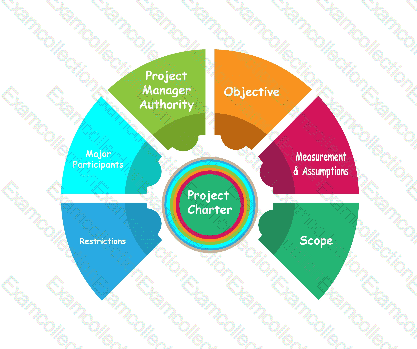
According to the PMBOK® Guide and the Standard for Project Management, the Project Charter is the foundational document issued by the project initiator or sponsor that formally authorizes the existence of a project and provides the project manager with the authority to apply organizational resources to project activities.
Key characteristics and purposes of the Project Charter include:
Establishment of a Partnership: It creates a formal agreement between the performing and requesting organizations.
Authorization: It is the " birth certificate " of the project. Without a signed charter, a project does not officially exist in the eyes of the organization.
High-Level Focus: Unlike the Project Management Plan, the charter focuses on high-level requirements, measurable objectives, and a summary-level milestone schedule.
Analysis of Distractors:
B (Project Management Plan): The charter precedes the project management plan. The plan is a comprehensive document that defines how the project is executed, monitored, and controlled; it is not the purpose of the charter to accept it.
C (Detailed Project Budget): The charter typically contains a pre-approved financial resources summary or a high-level budget. A " detailed " budget is developed later during the planning process.
D (Stakeholder Roles): While the charter might identify the project manager and the main sponsor, the formal definition of all stakeholder roles and responsibilities is typically handled in the Stakeholder Engagement Plan and the Responsibility Assignment Matrix (RAM/RACI).
Which item is an example of personnel assessment?
Resource calendar
Tight matrix
Team-building activity
Focus group
The Answer Is:
DExplanation:
According to the PMBOK® Guide and the Standard for Project Management, specifically within the Develop Team process, Personnel Assessment Tools are used to give the project manager and the project team insight into areas of strength and weakness.
A Focus group can be utilized as a personnel assessment technique by bringing together stakeholders or team members to discuss and evaluate individual or team competencies, behaviors, and expectations. While often used for requirement gathering, in the context of human resources, it serves as a qualitative assessment tool.
The other options are incorrect based on the following PMI definitions:
Resource calendar: This is a document that identifies the working days and shifts on which each specific resource is available. It is an output of the Acquire Resources process and does not assess the quality or skills of the personnel.
Tight matrix: This is a term used for Colocation, where team members are placed in the same physical location to improve communication and working relationships. It is a technique for team development, not an assessment tool.
Team-building activity: These are tasks or exercises designed to help team members work together more effectively. While they may reveal certain traits, their primary purpose is Development, not formal Assessment.
As per the PMI Lexicon of Project Management Terms, personnel assessment tools (which also include attitudinal surveys, indexed tests, and 360-degree reviews) help project managers assess the team’s motivation, how they take in and process information, and how they interact with others.
Which of the following is a strategy to deal with positive risks or opportunities?
Mitigate
Transfer
Exploit
Avoid
The Answer Is:
CExplanation:
According to the PMBOK® Guide, specifically within the Plan Risk Responses process, risk response strategies are divided into two categories: those for threats (negative risks) and those for opportunities (positive risks).
Exploit: This strategy is used for high-priority opportunities where the organization wants to ensure that the opportunity is realized. By " exploiting " the risk, the project manager seeks to eliminate the uncertainty associated with a particular positive risk by ensuring the opportunity definitely happens (e.g., assigning the organization ' s most talented resources to a project to shorten the time to completion).
Other Opportunity Strategies:
Share: Allocating some or all of the ownership of the opportunity to a third party who is best able to capture the benefit for the project (e.g., a joint venture).
Enhance: Increasing the probability and/or the positive impacts of an opportunity.
Accept: Being willing to take advantage of the opportunity if it arises, but not actively pursuing it.
Analysis of Other Options:
A. Mitigate: This is a strategy for threats. It involves seeking to reduce the probability of occurrence or impact of a negative risk.
B. Transfer: This is a strategy for threats. It involves shifting the impact of a threat to a third party, together with ownership of the response (e.g., insurance or warranties).
D. Avoid: This is a strategy for threats. It involves changing the project management plan to eliminate the threat entirely, isolating project objectives from the risk ' s impact, or relaxing the objective that is in jeopardy.
Which process identifies whether the needs of a project can best be met by acquiring products, services, or results outside of the organization?
Plan Procurement Management
Control Procurements
Collect Requirements
Plan Cost Management
The Answer Is:
AExplanation:
According to the PMBOK® Guide and the Standard for Project Management, the process that identifies whether the needs of a project can best be met by acquiring products, services, or results from outside the organization is Plan Procurement Management.
As per PMI standards, this process belongs to the Project Procurement Management Knowledge Area and occurs within the Planning Process Group. It involves documenting project procurement decisions, specifying the approach, and identifying potential sellers. A critical tool and technique used specifically for the determination mentioned in the question is Make-or-Buy Analysis.
Make-or-Buy Analysis: This technique is used to determine whether a particular work or product can be produced by the project team or should be purchased from external sources. It considers factors such as budget constraints, internal expertise, resource availability, and risk.
Procurement Management Plan: The primary output of this process, which describes how the procurement processes will be managed, from developing procurement documents through contract closure.
Procurement Strategy: Once the decision to " buy " is made, the strategy defines the delivery method, types of agreements (e.g., Fixed-price, Cost-reimbursable), and how the procurement will advance through its stages.
The other options are incorrect based on the following PMI process definitions:
Control Procurements: This is a Monitoring and Controlling process. it focuses on managing procurement relationships, monitoring contract performance, and making changes and corrections as appropriate. It occurs after the decision to procure has already been made and executed.
Collect Requirements: This is a Scope Management process. It focuses on determining, documenting, and managing stakeholder needs to meet project objectives. While it defines what is needed, it does not determine where (internally or externally) those needs will be fulfilled.
Plan Cost Management: This process establishes the policies and procedures for planning, managing, expending, and controlling project costs. While it provides the framework for financial decisions, it does not specifically address the sourcing of products or services.
As per the PMI Lexicon of Project Management Terms, the Plan Procurement Management process ensures that the project ' s external resource needs are identified early and integrated into the overall project management plan to minimize risk and maximize value.
Select three processes that are associated with Project Schedule Management.
Define Activities
Plan Resource Management
Estimate Activity Durations
Develop Schedule
Acquire Resources
The Answer Is:
A, C, DExplanation:
According to the PMBOK® Guide, the Project Schedule Management knowledge area includes the processes required to manage the timely completion of the project. There are six processes in this knowledge area, and the three correct options from your list are:
A. Define Activities: This is the process of identifying and documenting the specific actions to be performed to produce the project deliverables. It breaks down work packages into schedule activities.
C. Estimate Activity Durations: This is the process of estimating the number of work periods needed to complete individual activities with estimated resources. It uses inputs like the activity list and resource requirements.
D. Develop Schedule: This is the process of analyzing activity sequences, durations, resource requirements, and schedule constraints to create the project schedule model for project execution and monitoring and controlling.
Analysis of other options:
B. Plan Resource Management (Option B): This process belongs to the Project Resource Management knowledge area. It involves defining how to estimate, acquire, manage, and use team and physical resources.
E. Acquire Resources (Option E): This is also part of Project Resource Management. It is the process of obtaining team members, facilities, equipment, materials, supplies, and other resources necessary to complete project work.
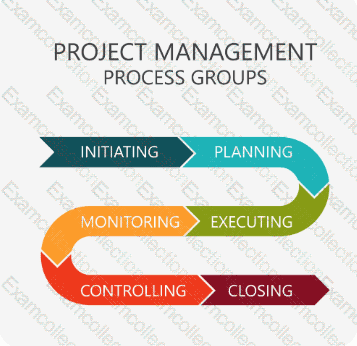
Per the PMI standards, the full sequence of Schedule Management involves Planning, Defining Activities, Sequencing Activities, Estimating Durations, Developing the Schedule, and finally, Controlling the Schedule.
Which of the following lists of tools and techniques is used when conducting procurements?
Expert judgement, procurement negotiations, bidder conferences, proposal evaluation advertising and independent estimates
Budgeting procurement negotiations, bidder conferences, proposal evaluation and advertising, and seller ' s proposal C. Expert judgement, procurement negotiations bidder conferences, proposal evaluation and advertising, and make-or-buy decisions
Agreements procurement negotiations, bidder conferences, proposal evaluation and advertising selected seller
The Answer Is:
AExplanation:
According to the PMBOK® Guide, the Conduct Procurements process is the process of obtaining seller responses, selecting a seller, and awarding a contract. This process happens during the Executing Process Group.
Tools and Techniques of Conduct Procurements (Choice A): This list correctly identifies the formal tools and techniques used to select a vendor:
Expert Judgment: Relying on individuals with specialized knowledge in legal, financial, or technical aspects of procurement.
Bidder Conferences: Meetings between the buyer and all prospective sellers prior to the submittal of a bid or proposal to ensure all prospective sellers have a clear and common understanding of the procurement.
Proposal Evaluation: A formal process for reviewing and scoring proposals based on the weight of various selection criteria.
Advertising: Used to expand the list of potential sellers by placing notices in newspapers or online registries.
Independent Estimates: Often prepared by the buyer or an outside professional to serve as a " benchmark " to validate the reasonableness of the bids submitted by sellers.
Procurement Negotiations: The final discussions to clarify requirements and other terms to reach a mutual agreement.
Choice B: " Budgeting " is a part of the Determine Budget process, and " Seller ' s Proposal " is an Input to the Conduct Procurements process, not a tool or technique.
Choice C: " Make-or-buy decisions " is an Output of the Plan Procurement Management process. By the time you are conducting procurements, the decision to " buy " has already been made.
Choice D: " Agreements " and " Selected Seller " are the primary Outputs of the Conduct Procurements process, not the tools used to get there.
The goal of these tools is to ensure that the selection process is fair, competitive, and results in a contract that provides the best value to the organization while meeting project requirements.
Which of the following is a tool or technique used in the Determine Budget process?
Variance analysis
Three-point estimating
Bottom-up estimating
Historical relationships
The Answer Is:
DExplanation:
According to the PMBOK® Guide, the Determine Budget process is the process of aggregating the estimated costs of individual activities or work packages to establish an authorized cost baseline.
Historical Relationships: This is a specific tool and technique used in this process. It involves using project characteristics (parameters) to develop mathematical models to predict total costs. These models can be simple (e.g., residential home construction costing a certain amount per square foot) or complex (e.g., software development costs based on points of complexity).
Reliability: To be effective, these relationships must be based on accurate historical data and be scalable (the parameters used in the model must be quantifiable).
Other Tools and Techniques for Determine Budget:
Cost Aggregation: Summing lower-level cost estimates up to higher WBS levels.
Funding Limit Reconciliation: Adjusting the project schedule to stay within budget constraints imposed by the organization or customer.
Expert Judgment: Leveraging experience from similar past projects.
Reserve Analysis: Establishing management reserves and contingency reserves.
Analysis of Other Options:
A. Variance analysis: This is a tool and technique used in the Control Costs process to compare actual performance against the baseline. It is a " monitoring and controlling " tool, not a " planning " tool.
B. Three-point estimating: This is a tool and technique primarily used in the Estimate Costs or Estimate Activity Durations processes. While it helps create the estimates that go into the budget, the PMBOK® Guide specifically categorizes it under the " Estimate " processes.
C. Bottom-up estimating: Similar to three-point estimating, this is a method used to create cost estimates during the Estimate Costs process. Once those estimates are created, the Determine Budget process uses Cost Aggregation to roll them up.
A project manager is assigned to a strategic project Senior management asks the project manager to give a presentation in order to request support that will ensure the success of the project.
Which entities will the project manager attempt to influence?
The project and the organization
The organization and the industry
The subject matter experts and the project
The change control board and the organization
The Answer Is:
AExplanation:
According to the PMBOK® Guide (7th Edition) and the Standard for Project Management, one of the key leadership roles of a project manager is to exert influence across various spheres to ensure project success. When senior management requests a presentation to secure support, the project manager is operating within the " Sphere of Influence. "
The project manager ' s influence is categorized as follows:
The Project: The project manager leads the project team to meet project objectives and satisfy stakeholder needs. This involves managing internal resources, communication, and team dynamics.
The Organization: Project managers must proactively interact with other project managers and functional managers within the organization. Influencing the organization is critical for securing resources, advocating for the project ' s strategic value, and ensuring alignment with organizational goals.
Analysis of Distractors:
B (Industry): While project managers stay informed about industry trends, they rarely have the direct objective to " influence the industry " in order to secure support for a specific internal strategic project.
C (Subject Matter Experts and the Project): Subject Matter Experts (SMEs) are considered part of the project team or stakeholders within the project/organization sphere. This option is too narrow and misses the broader organizational support requested by senior management.
D (Change Control Board and the Organization): The Change Control Board (CCB) is a specific governance body. While important, the request for support to " ensure success " of a strategic project typically involves broader organizational influence (such as resource owners and executive sponsors) rather than just the board that approves scope changes.
What process is included in Project Integration Management?
Monitor and Control Project Work
Control Scope
Control Schedule
Develop Team
The Answer Is:
AExplanation:
According to the PMBOK® Guide, Project Integration Management includes the processes and activities to identify, define, combine, unify, and coordinate the various processes and project management activities within the Project Management Process Groups.
There are seven processes within this knowledge area, and Monitor and Control Project Work is one of them. Its primary function is to track, review, and report the overall progress to meet the performance objectives defined in the project management plan. It is a high-level integration process that looks across all other knowledge areas to ensure the project is on track.
Analysis of other options:
Control Scope (Option B): This process belongs to the Project Scope Management knowledge area. It focuses specifically on monitoring the status of the project and product scope and managing changes to the scope baseline.
Control Schedule (Option C): This process is part of Project Schedule Management. Its focus is strictly on monitoring the status of project activities to update project progress and manage changes to the schedule baseline.
Develop Team (Option D): This process belongs to Project Resource Management. It involves improving competencies, team member interaction, and the overall team environment to enhance project performance.
Per PMI standards, Integration Management is the unique responsibility of the project manager and cannot be delegated or departmentalized, as it provides the cohesive " glue " that links the entire project together.
A project team working on an automobile manufacturing project is detailing the parts needed for a car door design. The door is composed of several parts that have to be developed in sequence, as the frame is needed before other parts can be designed and built. What activity is the team involved in?
Creating a work breakdown structure (WBS)
Identifying risks and issues in the project
Developing a stakeholder engagement plan
Developing a communications management plan
The Answer Is:
AExplanation:
According to the PMBOK® Guide, the process of Create WBS involves subdividing project deliverables and project work into smaller, more manageable components.
Decomposition: The team is performing " decomposition, " which is the primary technique for creating a WBS. By detailing the specific parts of a car door (the frame, handle, locking mechanism, etc.), they are breaking down a high-level deliverable into its constituent work packages.
Hierarchical Structure: While the prompt mentions that parts must be developed in sequence, the act of identifying the specific physical components that make up the " Door " deliverable is a core scoping activity. The WBS provides the framework of what needs to be delivered.
Relationship to Scheduling: Once the WBS is created, these components can be moved into the Define Activities and Sequence Activities processes. The " sequence " mentioned (frame before other parts) will eventually be reflected in the project schedule, but the identification of these hierarchical parts is a WBS activity.
Analysis of other options:
Option B: Identifying risks involves looking for uncertain events that could impact the project. While the sequential nature of the parts is a constraint, detailing the parts themselves is a scope activity, not a risk identification exercise.
Option C: Stakeholder engagement plans focus on how to involve and influence people with an interest in the project. It does not involve the technical detailing of manufacturing parts.
Option D: Communications management plans determine the " who, what, when, and how " of information distribution. Detailing car door components is engineering and scope work, not communication planning.
Per PMI standards, the Work Breakdown Structure (WBS) is a deliverable-oriented hierarchical decomposition of the work to be executed by the project team. It organizes and defines the total scope of the project.
How can a project manager evaluate project team development?
Produce team performance assessments.
Hold weekly meetings to engage every member
Complete a personal skill assessment on each team member
Provide recognition awards to team members
The Answer Is:
AExplanation:
According to the PMBOK® Guide, the Develop Team process includes the specific output of Team Performance Assessments. As a project manager implements development strategies (such as training, team building, and ground rules), they must evaluate the effectiveness of these efforts.
Purpose of Assessments: The formal evaluation of the project team ' s effectiveness. This is not just about technical output, but about how the team is functioning as a cohesive unit.
Evaluation Criteria: Successful team development is measured by:
Improvements in individual skills that allow members to perform tasks more effectively.
Improvements in competencies and personality attributes that help the team work together.
Reduced staff turnover rate.
Increased team cohesiveness where members share information and help each other.
Continuous Feedback: These assessments are used to identify the specific training, coaching, or changes required to improve team performance.
Analysis of Other Options:
B. Hold weekly meetings to engage every member: While meetings are a tool for communication and engagement, the meeting itself is an activity, not a method of evaluation. You would use the results of those meetings to help inform the performance assessment.
C. Complete a personal skill assessment on each team member: While individual assessments (like the Individual Development Plan) are part of the process, they only measure one person. The question asks about project team development, which requires a broader assessment of the group ' s collective synergy.
D. Provide recognition awards to team members: This is a Tool and Technique used during the Develop Team process to motivate and reinforce positive behavior. It is a reward for performance, not the formal analytical tool used to evaluate the overall development of the team.
Which enterprise environmental factors should be considered when creating a new procurement contract?
Supply chains
Trial engagements
Lessons learned register
Local laws and regulalk
The Answer Is:
DExplanation:
According to the PMBOK® Guide, specifically within the Plan Procurement Management process, the project manager must account for Enterprise Environmental Factors (EEFs). These are conditions, not under the immediate control of the project team, that influence, constrain, or direct the project.
Local Laws and Regulations (Choice D): When creating a procurement contract, legal and regulatory environments are critical EEFs. Contracts are legally binding documents, and they must comply with local, regional, or international laws. This includes labor laws, environmental regulations, tax requirements, and specific jurisdictional codes that dictate how contracts must be structured and enforced.
Supply Chains (Choice A): While marketplace conditions (which include the availability of products and the reputation of suppliers) are EEFs, " Supply chains " is a broad term. In the specific context of contract creation, the legal framework (laws) is a more direct and mandatory constraint than the general existence of supply chains.
Trial Engagements (Choice B): This is a technique or a strategy sometimes used in procurement to evaluate a vendor ' s performance on a small scale before committing to a larger contract. It is not an Enterprise Environmental Factor.
Lessons Learned Register (Choice C): This is a classic example of an Organizational Process Asset (OPA), not an EEF. OPAs are internal to the organization (like templates, procedures, and historical databases), whereas EEFs are typically external or systemic pressures.
In Project Procurement Management, ignoring local laws and regulations can lead to contract invalidity, legal penalties, or project delays. Therefore, they are among the most significant external constraints a project manager must navigate during the planning phase.
Outputs of the Control Communications process include:
expert judgment and change requests.
work performance information and change requests.
organizational process asset updates and an issue log.
project management plan updates and an issue log.
The Answer Is:
BExplanation:
In the PMBOK® Guide, the Monitor Communications (formerly known as Control Communications in earlier editions) process is the process of ensuring the information needs of the project and its stakeholders are met.
The primary outputs of this process are:
Work Performance Information (WPI): This is a core output of any monitoring and controlling process. It involves taking the raw Work Performance Data (status of communication activities) and comparing it against the Communications Management Plan. This provides a processed summary of how communication is actually performing, such as whether stakeholders are receiving information on time or if they are satisfied with the level of detail provided.
Change Requests: If the monitoring process reveals that the current communication strategy is ineffective or that stakeholders ' needs have changed, a change request is generated. These requests are processed through the Perform Integrated Change Control process and may result in adjustments to the project management plan or communication protocols.
Project Management Plan Updates: Specifically, updates to the Communications Management Plan or the Stakeholder Engagement Plan based on the findings of the monitoring activities.
Project Document Updates: This often includes updates to the Issue Log, Lessons Learned Register, and Stakeholder Register.
Comparison with other options:
A. Expert judgment: This is a Tool and Technique, not an output.
C and D. Issue log: While the issue log is often updated during this process, it is considered a Project Document Update rather than a primary standalone output of the process in the same category as Work Performance Information. Furthermore, Option B represents the two most definitive and critical outputs that drive project action (analysis and formal change).
Which tools or techniques will a project manager use for Develop Project Team?
Negotiation
Roles and responsibilities
Recognition and rewards
Prizing and promoting
The Answer Is:
CExplanation:
According to the PMBOK® Guide, the Develop Team process (formerly Develop Project Team) uses several specific tools and techniques to improve the competencies, team member interaction, and overall team environment.
Recognition and Rewards: This is a formal tool and technique used to promote and reinforce desirable behavior. The process involves recognizing and rewarding people for their performance and contributions to the project.
Application: To be effective, rewards must be based on activities and performance under a person ' s control. For example, rewarding a team member for meeting a challenge or reaching a specific milestone encourages continued high performance.
Cultural Sensitivity: The project manager must consider cultural differences when determining rewards (e.g., some cultures value individual praise, while others prefer team-based recognition).
Other Tools and Techniques for Develop Team:
Colocation (Tight Matrix): Placing team members in the same physical location.
Virtual Teams: Using technology to bring together people in different locations.
Communication Technology: Tools like email, portals, and video conferencing.
Interpersonal and Team Skills: Including conflict management, influence, motivation, negotiation, and team building.
Individual and Team Assessments: Tools like surveys or structured interviews to understand team strengths and weaknesses.
Training: Activities designed to enhance the competencies of the project team members.
Comparison with other options:
A. Negotiation: While negotiation is an interpersonal skill used in many processes, it is a primary tool and technique for the Acquire Resources process (used to " negotiate " for staff from functional managers or other teams).
B. Roles and responsibilities: This is an output of the Plan Resource Management process (documented in the Resource Management Plan). It is a definition of what people do, not a technique used to develop the team ' s capabilities or cohesion.
D. Prizing and promoting: These are not formal terms used in the PMBOK® Guide. While " promoting " might happen in a general business sense, the specific PMI-standard term for reinforcing behavior within a project is Recognition and Rewards.
Which of the following is developed from the project scope baseline and defines only that portion of the project scope that is to be included within a related contract?
Product scope description
Procurement statement of work
Project schedule
Work breakdown structure (WBS)
The Answer Is:
BExplanation:
According to the PMBOK® Guide, specifically within the Plan Procurement Management process, the Procurement Statement of Work (SOW) is developed from the project scope baseline and defines only that portion of the project scope that is to be included within a related contract.
Derivation from Scope Baseline: The Procurement SOW is a detailed narrative description of the work to be performed by a seller. It is derived from the Project Scope Statement, the WBS, and the WBS Dictionary.
Purpose and Content: It describes the procurement item in sufficient detail to allow prospective sellers to determine if they are capable of providing the products, results, or services. It includes specifications, quantity desired, quality levels, performance data, period of performance, and work location.
Contractual Relationship: Each individual procurement requires a separate SOW. While the project may have a massive overall scope, a specific SOW for a subcontractor might only cover the " Electrical Wiring " or " Software Testing " portion of that scope.
Evolution: As the procurement process moves from planning to a signed agreement, the SOW may be refined and eventually becomes a formal part of the contract.
Comparison with Other Options:
Product scope description (A): This describes the features, functions, and characteristics of the product, service, or result. While it informs the SOW, it is a broader document that defines the entire " what " of the project, not specifically the contracted portion.
Project schedule (C): This is a model that links activities with planned dates, durations, and milestones. While a contract will have a schedule, the schedule itself does not define the " portion of the scope " to be included in the contract; that is the role of the SOW.
Work breakdown structure (D): The WBS is a hierarchical decomposition of the total scope of work to be carried out by the project team. It is a component of the Scope Baseline, but it covers the entire project, not just the portion assigned to a specific external seller.
A production support system is being managed by a team. The team members cannot plan their work in advance, even for a week, because they do not know when new support issues will be submitted. The team cannot start working on new issues until they finish existing issues, no matter how long it takes to finish the existing issues.
Which method should be used in this situation?
SAFe®, as it does not allow for scaling work across different teams in the organization.
Extreme Programming (XP), as it does not allow for moving on to new items until the existing items are finished.
Kanban, because the team does not start new work until the existing work is finished.
Scrum, as it allows for completing the whole architecture up front without leaving any technical debt for the future.
The Answer Is:
CExplanation:
According to the Agile Practice Guide and the PMBOK® Guide, the choice of an adaptive lifecycle depends on the nature of the work. Support and maintenance environments are characterized by high variability and the need for a " pull-based " system.
Why Choice C is correct: Kanban is the ideal method for " continuous flow " work where tasks cannot be planned in time-boxed iterations (like Scrum Sprints).
Work in Progress (WIP) Limits: The scenario states the team cannot start new issues until they finish existing ones. This is the core principle of WIP limits in Kanban. By limiting how much work can be " In Progress, " the team prevents bottlenecks and ensures they focus on completing tasks before taking on new ones.
On-Demand Planning: Since support issues are unpredictable, Kanban allows the team to pull the next highest-priority item from the backlog as soon as capacity becomes available, rather than waiting for a new sprint cycle.
Analysis of other options:
A (SAFe®): The Scaled Agile Framework (SAFe®) is designed for large-scale, multi-team development. The description provided in the option ( " it does not allow for scaling " ) is factually incorrect, as SAFe is specifically built for scaling.
B (Extreme Programming - XP): XP is a software development methodology focused on technical excellence (e.g., pair programming, test-driven development). While it emphasizes quality, it does not fundamentally dictate the flow of work for unpredictable support issues as effectively as Kanban.
D (Scrum): Scrum relies on Sprints (time-boxes). If a team cannot plan their work even for a week, Scrum ' s " Sprint Planning " becomes impossible. Furthermore, the statement that Scrum allows for " completing the whole architecture up front " is incorrect; that describes a Waterfall/Predictive approach, whereas Scrum is iterative.
In a production support environment, the Lead Time and Cycle Time metrics used in Kanban provide the visibility needed to manage a reactive workload without the overhead of rigid sprint structures.