

PMI CAPM - Certified Associate in Project Management (CAPM)
Which of the in an adaptive project environment, which action helps the project manager?
Project charter and project management plan
Communications management plan and scope management plan
Quality management plan and risk management plan
Project scope statement and communications management plan
The Answer Is:
AExplanation:
According to the PMBOK® Guide and the Agile Practice Guide, even in an Adaptive (Agile) environment, the fundamental governance and direction of a project must be established. While the level of detail in these documents evolves, their presence is essential to help the project manager align the team and stakeholders.
Project Charter and Project Management Plan (Choice A): * Project Charter: This is the document that formally authorizes the existence of a project and provides the project manager with the authority to apply organizational resources to project activities. In adaptive environments, the charter provides the high-level vision and " north star " that keeps the team focused as specific requirements change.
Project Management Plan: While agile teams don ' t create a massive, 200-page static plan, they do have a project management plan that describes how the project will be executed, monitored, and controlled. In an adaptive context, this plan outlines the cadence (sprints/iterations), the definition of done, and the governance framework the team will use to manage changes.
Scope and Communications Management Plans (Choice B): While important, these are subsidiary components of the Project Management Plan. The question asks what " helps the project manager " in a broad sense; the overarching plan and charter provide the foundational authority and strategy required to implement these subsidiary plans.
Quality and Risk Management Plans (Choice C): Like Choice B, these are specific focus areas. In agile, quality is often handled through " Definition of Done " and risks through " Risk-Adjusted Backlogs, " but these are managed under the umbrella of the Project Management Plan.
Project Scope Statement and Communications Plan (Choice D): In an adaptive environment, a detailed Project Scope Statement is often avoided early on because the scope is expected to be refined iteratively. Instead, a Product Vision or Backlog is used.
By having a Project Charter, the project manager ensures there is an agreement on the project’s value proposition. By utilizing a Project Management Plan, the PM establishes the rules of engagement (such as how often the team meets and how they measure progress), which is vital for the self-organizing nature of adaptive teams.
On which type of project.... only after the final iteration?
On wtiich type of project lite cycle is ihe deliverable produced trough a series of ileralrons considering thai the deliverable ts completed only after the Imal iteration?
Incremental life cycle
Predictive life cycle
Iterative life cycle
Adaptive life cycle
The Answer Is:
CExplanation:
According to the PMBOK® Guide and the Agile Practice Guide, project life cycles are defined by how they handle requirements, activities, and the delivery of the product.
Iterative Life Cycle (Choice C): In an iterative life cycle, the project scope is generally determined early, but time and cost estimates are routinely modified as the project team’s understanding of the product increases. The deliverable is developed through a series of repeated cycles (iterations) that successively add functionality or refine the product. Crucially, the full deliverable is only completed and considered finished after the final iteration. Each iteration improves the quality or detail of the single deliverable until it meets the final requirements.
Incremental Life Cycle (Choice A): Unlike iterative, an incremental life cycle delivers a functional portion of the product at the end of each iteration. The deliverable is produced through a series of iterations that each add a complete, usable " increment " to the previous ones.
Predictive Life Cycle (Choice B): Also known as " Waterfall, " this life cycle is characterized by a linear approach where the scope, time, and cost are determined in the early phases of the life cycle. It does not typically use a series of iterations to produce the deliverable.
Adaptive Life Cycle (Choice D): This is a combination of iterative and incremental (Agile). It uses iterations to refine the product but also delivers functional increments frequently (usually every 2-4 weeks).
The key distinction for an Iterative approach is that the goal is the correctness of the solution through refinement of a single deliverable, whereas an Incremental approach focuses on speed of delivery by providing small, working pieces of the deliverable over time.
The activity tailoring is necessary because:
the members of the project team need to select the appropriate order of every tool, technique, input, and output listed in the PMBOK Guide, this is required for all projects
each project is unique, and the members of the project team should select the appropriate tools, techniques, inputs, and outputs from the PMBOK Guide
the members of the project team need to understand the PMBOK Guide processes, which are applied to all projects
each project is unique, and the project team must plain how to apply all the tools, techniques, inputs, and outputs in the PMBOK Guide
The Answer Is:
BExplanation:
According to the PMBOK® Guide, Tailoring is the deliberate adaptation of the selected project management processes, inputs, tools, techniques, outputs, and life cycle phases to make them fit the specific environment and the work of the project.
Uniqueness of Projects: Every project is unique due to its specific objectives, stakeholders, complexity, risks, and organizational context. Because of this, it is neither practical nor efficient to use every single process or tool described in the PMBOK Guide for every project.
Team Responsibility: It is the responsibility of the project manager and the project management team to select only what is necessary to manage the project effectively. This prevents " over-management " and ensures that project resources are focused on activities that add value.
Framework vs. Methodology: The PMBOK Guide is a global standard and framework, not a rigid methodology. It provides a " menu " of best practices from which the team must choose based on the project’s needs.
Why other options are incorrect:
Option A: Tailoring is not about selecting a specific " order " for every single item in the guide for every project; it is about deciding what to include and what to exclude.
Option C: While the team needs to understand the processes, simply " understanding " them does not explain why tailoring is necessary. Furthermore, the processes are not applied to all projects in the same way.
Option D: This is incorrect because the team should not apply all tools, techniques, inputs, and outputs. Applying everything would result in unnecessary bureaucracy and wasted effort. Tailoring is the act of omitting unnecessary elements just as much as it is about selecting necessary ones.
What does a CPI value greater than 1.0 indicate?
Cost right at the estimated value
Cost under the estimated value
Cost right at the actual value
Cost over the estimated value
The Answer Is:
BExplanation:
According to the PMBOK® Guide, the Cost Performance Index (CPI) is the most critical Earned Value Management (EVM) metric for measuring the cost efficiency of a project.
The Formula: $CPI = \frac{EV}{AC}$ (Earned Value divided by Actual Cost).
Interpreting a CPI > 1.0: A value greater than 1.0 indicates that for every dollar spent on the project, more than one dollar ' s worth of work was actually accomplished. This means the project is performing more efficiently than planned and is currently under budget (cost under the estimated value).
Benchmarking Performance:
CPI = 1.0: The project is exactly on budget (Cost = EV).
CPI < 1.0: The project is over budget (Cost > EV).
CPI > 1.0: The project is under budget (Cost < EV).
Analysis of Other Options:
A. Cost right at the estimated value: This would result in a CPI of exactly 1.0.
C. Cost right at the actual value: This is a tautology; actual cost is always the actual value spent, but CPI measures that against the value earned.
D. Cost over the estimated value: This would result in a CPI of less than 1.0 (e.g., 0.85), indicating cost inefficiency.
Cost baseline is an output of which of the following processes?
Control Costs
Determine Budget
Estimate Costs
Estimate Activity Resources
The Answer Is:
BExplanation:
According to the PMBOK® Guide, the Cost Baseline is the approved version of the time-phased project budget, excluding any management reserves, which can be changed only through formal change control procedures. It is the primary output of the Determine Budget process.
Process Context: The Determine Budget process aggregates the estimated costs of individual activities or work packages to establish an authorized cost baseline.
Components: The cost baseline includes all authorized budgets but excludes management reserves. Management reserves are intended to cover " unknown unknowns " and are not part of the performance measurement baseline (PMB) but are part of the total project budget.
Usage: It is used as a basis for comparison to actual results to measure and monitor cost performance. In an S-curve graph, the cost baseline represents the cumulative values of the project ' s expected spending over time.
Analysis of other choices:
Choice A (Control Costs): This is a monitoring and controlling process. Its primary outputs include work performance information, cost forecasts, and change requests. It uses the cost baseline as an input to measure variance.
Choice C (Estimate Costs): This process develops an approximation of the monetary resources needed to complete project work. Its primary output is Cost Estimates, which are then used as an input to the Determine Budget process to create the baseline.
Choice D (Estimate Activity Resources): This process identifies the types and quantities of material, human resources, equipment, or supplies required. While this impacts cost, it is a resource management process, not the budget-setting process.
A project manager who communicates to the project team though email is using which type of communication?
Formal
Informal
Horizontal
Unofficial
The Answer Is:
BExplanation:
According to the PMBOK® Guide, communication within a project is categorized by its level of formality and the direction of the information flow.
Informal Communication: This includes emails, memos, ad hoc conversations, and social media. While email is a written record, it is technically classified as informal written communication in the context of standard project management terminology. It is used for day-to-day coordination and information exchange that does not require the level of legal or contractual weight found in formal documents.
Formal Communication: This is reserved for official project documents such as the Project Charter, Project Management Plan, status reports to stakeholders, and legal contracts.
Choice of Medium: The project manager selects the communication method based on the Communications Management Plan, which identifies the requirements of the team and stakeholders. Email is the most common form of informal written communication used to manage project work efficiently.
Comparison with other options:
A. Formal: Formal communication typically refers to official reports, briefings, or legal documents. While some high-level emails might be considered " formal, " the standard PMI classification for general email use is informal.
C. Horizontal: This describes the direction of communication (between peers at the same level of the organization) rather than the type or formality of the communication itself.
D. Unofficial: While similar to informal, " unofficial " is not a standard term used in the PMBOK® Guide to classify communication types; the guide strictly uses the Formal/Informal and Written/Verbal axes.
The Plan Stakeholder Management process belongs to which Process Group?
Executing
Initiating
Planning
Monitoring and Controlling
The Answer Is:
CExplanation:
According to the PMBOK® Guide and the Standard for Project Management, the Plan Stakeholder Engagement process (referred to as Plan Stakeholder Management in some earlier versions and study guides) is situated within the Planning Process Group.
This process is a key part of the Project Stakeholder Management Knowledge Area. Its primary purpose is to develop appropriate management strategies to effectively engage stakeholders throughout the project life cycle, based on the analysis of their needs, interests, and potential impact on project success.
The mapping of the Stakeholder Management processes across Process Groups is as follows:
Initiating: Identify Stakeholders.
Planning: Plan Stakeholder Engagement.
Executing: Manage Stakeholder Engagement.
Monitoring and Controlling: Monitor Stakeholder Engagement.
The other options are incorrect based on the PMI Process Group and Knowledge Area Mapping:
Initiating: This group is where stakeholders are first identified (Identify Stakeholders), but the strategic plan for managing them is developed later.
Executing: This group involves the actual " Manage Stakeholder Engagement " process, where the project manager works with stakeholders to meet their needs and address issues as they occur.
Monitoring and Controlling: This group contains the " Monitor Stakeholder Engagement " process, which focuses on monitoring overall project stakeholder relationships and adjusting strategies for engaging stakeholders.
As per the PMI Lexicon of Project Management Terms, the Plan Stakeholder Engagement process provides a clear, actionable plan to interact with project stakeholders to support the project’s interests.
An output of the Create WBS process is:
Scope baseline.
Project scope statement.
Organizational process assets.
Requirements traceability matrix.
The Answer Is:
AExplanation:
According to the PMBOK® Guide, the Create WBS (Work Breakdown Structure) process is the process of subdividing project deliverables and project work into smaller, more manageable components.
The primary output of this process is the Scope Baseline. The Scope Baseline is a component of the project management plan and consists of three specific elements:
Project Scope Statement: Includes the description of the project scope, major deliverables, assumptions, and constraints.
Work Breakdown Structure (WBS): A hierarchical decomposition of the total scope of work to be carried out by the project team.
WBS Dictionary: A document that provides detailed deliverable, activity, and scheduling information about each component in the WBS.
Analysis of other choices:
Choice B (Project scope statement): While part of the scope baseline, the Project Scope Statement itself is a primary output of the Define Scope process, which occurs before Create WBS.
Choice C (Organizational process assets): These are typically inputs to the Create WBS process (such as WBS templates or policies), rather than outputs.
Choice D (Requirements traceability matrix): This is an output of the Collect Requirements process. It is used as an input to Create WBS to ensure that every requirement is linked to a specific WBS element.
In summary, because the Create WBS process " finalizes " the WBS and WBS Dictionary, it integrates them with the previously defined Scope Statement to form the Scope Baseline.
An important project stakeholder has low risk tolerance. Which type ot communication should a project manager use to provide this stakeholder with a difficult update?
Informal conversation
Face-to-face meeting
Short email update
Written report
The Answer Is:
BExplanation:
According to the PMBOK® Guide (6th Edition), specifically within the Project Communications Management and Project Stakeholder Management knowledge areas, the choice of communication technology and method must be tailored to the stakeholder ' s needs, risk tolerance, and the nature of the information being delivered.
When dealing with a stakeholder who has low risk tolerance and needs to receive difficult news (such as a project delay, a cost overrun, or a major risk realization), a Face-to-face meeting is the most effective approach for the following reasons:
Nonverbal Cues: A significant portion of communication is nonverbal (body language, facial expressions, and tone of voice). Face-to-face interaction allows the project manager to sense the stakeholder ' s reaction in real-time and adjust the delivery to provide reassurance.
Immediate Feedback: It allows the stakeholder to ask questions immediately, which is critical for someone with low risk tolerance who may otherwise escalate their anxiety while waiting for a reply to an email or report.
Relationship Building: Difficult updates can damage trust. Face-to-face meetings demonstrate transparency and accountability, which are essential for maintaining engagement with sensitive stakeholders.
Complex Information: Difficult updates often involve nuance that can be easily misinterpreted in written form.
Analysis of Distractors:
A (Informal conversation): While personal, an informal conversation may lack the professional weight required for a " difficult update. " For major issues, stakeholders expect a degree of formality to show the project manager is taking the problem seriously.
C (Short email update): This is a form of Push Communication. It is the least effective for difficult news because it provides no opportunity for immediate clarification and can often lead to " fear of the unknown " for a low-risk-tolerance stakeholder.
D (Written report): While a report provides data, it is a cold medium. For a stakeholder who is already sensitive to risk, receiving a report with bad news without a verbal explanation can lead to a loss of confidence in the project ' s leadership.
How can a project manager ensure effective project stakeholder engagement?
Build a stakeholder responsibility matrix
Hold weekly project staff meetings
Improve interpersonal and team leadership skills
Create detailed project reports for stakeholders
The Answer Is:
CExplanation:
According to the PMBOK® Guide, specifically the Manage Stakeholder Engagement process, the ability to influence and engage stakeholders effectively relies heavily on the project manager ' s " soft skills. "
Interpersonal and Team Leadership Skills (Choice C): This is the primary Tool and Technique used to foster engagement. Stakeholder engagement is about building relationships and trust. To do this, a project manager must utilize:
Conflict Management: To resolve divergent interests between stakeholders.
Cultural Awareness: To tailor communication styles to diverse backgrounds.
Negotiation: To find common ground on project objectives.
Observation/Conversation: To stay in touch with the work and the attitudes of project members and other stakeholders. While technical tools exist, engagement is a human-centric activity that cannot be fully achieved without strong leadership and interpersonal competence.
Stakeholder Responsibility Matrix (Choice A): While a RAM (Responsibility Assignment Matrix) or a RACI chart clarifies who does what, it is a tool for resource management and accountability. It does not necessarily ensure that a stakeholder is engaged or supportive of the project ' s goals.
Weekly Project Staff Meetings (Choice B): Meetings are a communication tool, but frequency does not equate to effectiveness. Without the interpersonal skills to facilitate those meetings properly, they can actually lead to stakeholder fatigue or disengagement.
Detailed Project Reports (Choice D): Reports are part of Manage Communications. Providing information is a prerequisite for engagement, but it is passive. Engagement is active; a stakeholder might receive every report and still be resistant to the project.
By focusing on Interpersonal and Team Skills, the project manager can navigate the complex political and emotional landscape of a project, turning resistant or neutral stakeholders into supportive advocates for the project ' s success.
A project manager needs to develop a product roadmap. Which artifact category is a product roadmap?
Report artifact
Strategic artifact
Baseline artifact
Plan artifact
The Answer Is:
BExplanation:
A product roadmap is a strategic artifact because it communicates direction, sequencing, intent, and high-level alignment for product development. It is not primarily a report artifact, because reports describe status, performance, issues, or forecasts after work is underway. It is not a baseline artifact, because a baseline is an approved reference point used for variance comparison and controlled through formal change control. It is also not merely a plan artifact, because a roadmap sits above detailed planning and links product evolution to business goals, milestones, releases, and decision points. PMI’s terminology defines a roadmap as “a high-level timeline†showing items such as milestones, significant events, reviews, and decision points, which fits strategic communication rather than execution-level planning. The CAPM-aligned course structure also places project fundamentals, development approaches, and delivery planning in a broader context of predictive, agile, and hybrid project execution. References/topics: Common Project Management Artifacts, Strategy Artifacts, Product Roadmap, Project Management Fundamentals and Core Concepts.
In the Plan Stakeholder Management process, expert judgment is used to:
Provide information needed to plan appropriate ways to engage project stakeholders.
Ensure comprehensive identification and listing of new stakeholders.
Analyze the information needed to develop the project scope statement.
Decide the level of engagement of the stakeholders at each required stage.
The Answer Is:
DExplanation:
In accordance with the PMBOK® Guide (Project Stakeholder Management), specifically within the Plan Stakeholder Engagement process (referred to as Plan Stakeholder Management in earlier versions), Expert Judgment is a critical tool and technique.
Purpose of Expert Judgment: In this specific process, expert judgment is used to decide the level of engagement of each stakeholder at each required stage of the project. This involves evaluating the current vs. desired engagement levels to bridge the gap and ensure project success.
Application: Project managers seek input from individuals or groups with specialized knowledge of the organization’s culture, power structures, and politics. This expertise helps in determining the most effective strategies for communicating with and influencing stakeholders based on their specific needs and interests.
Stakeholder Engagement Assessment Matrix: Experts often help populate this matrix by identifying whether a stakeholder is Unaware, Resistant, Neutral, Supportive, or a Leader, and then deciding where they need to be for the project to meet its objectives.
Analysis of Distractors:
A. Provide information needed to plan appropriate ways to engage project stakeholders: While this sounds plausible, it is a broader description of the entire process output. Expert judgment is the means used to make specific decisions (like engagement levels) rather than just providing " information. "
B. Ensure comprehensive identification and listing of new stakeholders: This is a primary function of the Identify Stakeholders process, not the Plan Stakeholder Management process.
C. Analyze the information needed to develop the project scope statement: This activity belongs to the Define Scope process within the Project Scope Management Knowledge Area. It is unrelated to stakeholder engagement planning.
Based on the following metrics: EV= $20,000, AC= $22,000, and PV= $28,000, what is the project CV?
-8000
-2000
2000
8000
The Answer Is:
BExplanation:
Based on the principles of Earned Value Management (EVM) found in the PMBOK® Guide, the Cost Variance (CV) is a measure of cost performance on a project.
Formula: $CV = EV - AC$
Calculation: Given the metrics:
Earned Value ($EV$) = $\$20,000$
Actual Cost ($AC$) = $\$22,000$
$CV = 20,000 - 22,000 = -2,000$
Interpretation:
A negative CV ($-2,000$ in this case) indicates that the project is over budget. It means the actual cost spent to date is higher than the value of the work performed.
A positive CV would indicate that the project is under budget.
A CV of zero would indicate that the project is exactly on budget.
Note: The Planned Value ($PV$) of $\$28,000$ is used for calculating Schedule Variance ($SV = EV - PV$), but it is not used in the calculation for Cost Variance.
A technique used to determine the cause and degree of difference between baseline and actual performance is:
Product analysis.
Variance analysis.
Document analysis,
Decomposition.
The Answer Is:
BExplanation:
According to the PMBOK® Guide, specifically within the Monitoring and Controlling Process Group, Variance Analysis is a key data analysis technique used across multiple knowledge areas (Scope, Schedule, Cost).
Cause and Degree of Difference: The primary purpose of variance analysis is to review the difference (or variance) between planned performance (the Baseline) and actual performance. It involves:
Determining the cause: Investigating why the variance occurred (e.g., resource shortages, scope creep, or underestimated durations).
Determining the degree: Quantifying how far off the project is from its baseline (e.g., $5,000 over budget or 3 days behind schedule).
Decision Making: By understanding the cause and degree, the project manager can determine if corrective or preventive actions are required to bring the project back into alignment with the management plan.
Why the other options are incorrect:
A. Product analysis: This is a tool used in the Define Scope process to translate high-level product descriptions into meaningful deliverables. It does not measure performance against a baseline.
C. Document analysis: This is a data gathering technique used in Collect Requirements or Identify Stakeholders to elicit requirements by analyzing existing documentation.
D. Decomposition: This is a technique used in Create WBS and Define Activities. It involves breaking down project scope and deliverables into smaller, more manageable components. It is a planning tool, not a performance measurement tool.
A project team is starting to work on a project based on a Kanban approach. In order to frame the capacity of the team ' s workflow at any moment, the project manager will need to restrict the maximum amount of activities to be performed.
Which element will the project manager handle?
Capacity limit
Pull system
Work in progress
Virtual board
The Answer Is:
CExplanation:
In the Agile Practice Guide and Kanban methodology, the primary goal is to optimize the flow of work and increase efficiency by identifying and removing bottlenecks.
Why Choice C is correct:
WIP Limits: The project manager implements Work in Progress (WIP) limits. These are constraints placed on the number of work items that can be in a specific stage of the workflow (e.g., " In Development " or " Testing " ) at any given time.
Restricting Capacity: By restricting the maximum amount of activities, the team is forced to finish current tasks before starting new ones. This prevents the " multitasking trap " and ensures that work moves through the system faster.
Flow Management: If a column reaches its WIP limit, no new work can enter that stage. This makes bottlenecks immediately visible, allowing the team to collaborate (or " swarm " ) to clear the blockage.
Analysis of other options:
A (Capacity limit): While " capacity " is what is being managed, " Capacity limit " is not the formal technical term used in Kanban. The specific mechanism used to enforce that limit is called a WIP limit.
B (Pull system): A pull system is the result of using WIP limits. In a pull system, a team member only " pulls " new work into a column when there is available capacity (i.e., when they are below the WIP limit). It describes the movement of work, not the restriction itself.
D (Virtual board): This is simply the tool (like Jira, Trello, or a physical whiteboard) used to visualize the work. While the board displays the WIP limits, the board itself is not the element being " handled " to restrict the work.
Key Concept: The Project Management Institute (PMI) emphasizes that in a Kanban approach, the focus is on Cycle Time and Throughput. By managing Work in Progress (Choice C), the project manager ensures the team doesn ' t become overwhelmed, leading to a more predictable and sustainable pace of delivery.
Which process is engaged when a proiect learn inember makes a change to project budget with the project manager ' s approval?
Manage Cost Plan
Estimate Costs
Determine Budget
Control Costs
The Answer Is:
DExplanation:
According to the PMBOK® Guide (6th Edition), the Control Costs process is the process of monitoring the status of the project to update the project costs and managing changes to the cost baseline.
When a change is made to the project budget during the execution of the project—even with the project manager ' s approval—it falls under the monitoring and controlling domain. This process ensures that all change requests are processed in a timely manner and that the budget remains aligned with the actual work performed.
Key responsibilities within Control Costs include:
Influencing the factors that create changes to the authorized cost baseline.
Ensuring that all change requests are acted upon through the Perform Integrated Change Control process.
Managing the actual changes when they occur.
Ensuring that cost overruns do not exceed the authorized funding (both periodic and total).
Analysis of Distractors:
A (Manage Cost Plan): This is not a formal PMI process. The document that describes how costs will be managed is the Cost Management Plan, which is an output of the Plan Cost Management process.
B (Estimate Costs): This is a planning process focused on developing an approximation of the monetary resources needed to complete project activities. It happens before a budget is established.
C (Determine Budget): This is the process of aggregating the estimated costs of individual activities or work packages to establish an authorized cost baseline. Once the budget is determined and the project moves into execution, any further adjustments to that budget are handled by Control Costs.
Key Document Reference: Section 7.4 of the PMBOK® Guide states that " Control Costs " involves informing the appropriate stakeholders of all approved changes and associated costs. It is the mechanism through which the budget is maintained and adjusted throughout the project life cycle.
Status of deliverables, implementation status for change requests, and forecasted estimates to complete are examples of:
Earned value management.
Enterprise environmental factors.
Organizational process assets.
Work performance information.
The Answer Is:
DExplanation:
In accordance with the PMBOK® Guide (Project Integration Management) and the Monitoring and Controlling Process Group, project data is transformed into information and reports through a specific hierarchy. Work performance information consists of the performance data collected from various controlling processes, analyzed in context, and integrated based on relationships across areas.
Contextual Analysis: While " Work Performance Data " is the raw observation (e.g., " the cost is $100 " ), Work Performance Information is the result of comparing that data against the project management plan (e.g., " the cost is $100, which is $20 over the baseline " ).
Examples in Practice:
Status of Deliverables: Knowing if a deliverable is started, in progress, or completed relative to the schedule.
Implementation Status for Change Requests: Tracking which approved changes have been successfully integrated into the project.
Forecasted Estimates: Calculated values such as Estimate to Complete (ETC) and Estimate at Completion (EAC) which predict future performance based on current trends.
Data Flow: Work Performance Data (Input) $\rightarrow$ Data Analysis (Tool) $\rightarrow$ Work Performance Information (Output) $\rightarrow$ Work Performance Reports (Output of Monitor and Control Project Work).
Analysis of Distractors:
A. Earned value management: This is a specific methodology or tool used to generate work performance information (like CV, SV, CPI, and SPI). It is the calculation method, not the category of the items listed.
B. Enterprise environmental factors: These are internal or external factors, not under the control of the project team, that influence, constrain, or direct the project (e.g., marketplace conditions or organizational culture).
C. Organizational process assets: These are the plans, processes, policies, procedures, and knowledge bases specific to and used by the performing organization (e.g., templates or lessons learned). While status reports might eventually become OPAs, the active status and forecasts during the project are categorized as performance information.
What CPI > 1 and SPI < 1 mean?
Under budget ahead of schedule
Over budget, behind schedule
Under budget, behind schedule
Over budget, ahead of schedule
The Answer Is:
CExplanation:
In Project Management, specifically within Earned Value Management (EVM), the Cost Performance Index (CPI) and Schedule Performance Index (SPI) are critical metrics used to determine the health of a project.
Cost Performance Index (CPI): This measures the cost efficiency of budgeted resources. It is calculated as $CPI = EV / AC$ (Earned Value divided by Actual Cost).
$CPI > 1$: This indicates that the project is under budget. For every dollar spent, the project has earned more than a dollar ' s worth of work.
Schedule Performance Index (SPI): This measures the schedule efficiency. It is calculated as $SPI = EV / PV$ (Earned Value divided by Planned Value).
$SPI < 1$: This indicates that the project is behind schedule. The project has completed less work than was originally planned for this point in time.
Summary Table of EVM Indicators:
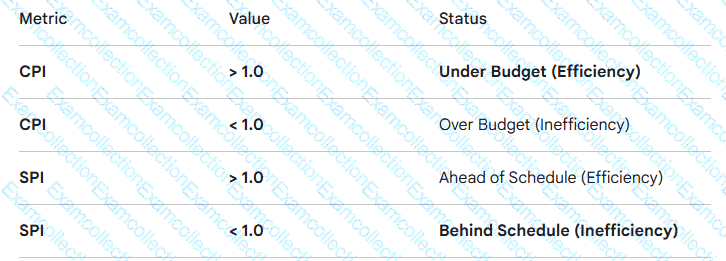
Why other options are incorrect:
Option A: This would require both CPI and SPI to be greater than 1.
Option B: This would require both CPI and SPI to be less than 1.
Option D: This would require CPI to be less than 1 and SPI to be greater than 1.
When would resource leveling be applied to a schedule model?
Before constraints have been identified
Before it has been analyzed by the critical path method
After it has been analyzed by the critical path method
After critical activities have been removed from the critical path
The Answer Is:
CExplanation:
According to the PMBOK® Guide, specifically within the Develop Schedule process, Resource Leveling is a resource optimization technique used to adjust the start and finish dates of activities to address resource constraints.
Sequential Application: In the standard flow of schedule development, the project manager first performs Critical Path Method (CPM) analysis to determine the theoretical shortest duration of the project based on logical dependencies and constraints.
Addressing Over-allocation: Once the critical path is identified, the project manager often finds that certain resources are " over-allocated " (assigned to multiple tasks at the same time) or that resource demand exceeds available supply. Resource leveling is then applied to resolve these conflicts.
Impact on the Schedule: Because resource leveling prioritizes resource availability, it often results in the original critical path changing or the project duration increasing. It is essentially the process of making the " ideal " schedule (the CPM) " realistic " based on the actual people and equipment available.
Resource Smoothing: A related technique, resource smoothing, is also applied after CPM analysis but only adjusts activities within their " float " so as not to affect the critical path or the completion date.
Comparison with other options:
A. Before constraints have been identified: This is illogical. Resource leveling is the response to resource constraints. You cannot level resources until you know what those constraints are.
B. Before it has been analyzed by the critical path method: If you level before CPM analysis, you won ' t know which activities are critical versus which ones have flexibility (float). You need the CPM " baseline " to understand the impact of your leveling decisions.
D. After critical activities have been removed from the critical path: Critical activities are not " removed " from the critical path; the path itself is a calculation of the longest sequence. While leveling might change which activities are on the critical path, you don ' t remove activities to perform leveling.
The output that defines an approach to increase the support and minimize negative impacts of stakeholders is the:
stakeholder management strategy.
communications management plan,
stakeholder register,
performance report.
The Answer Is:
AExplanation:
According to the PMBOK® Guide (specifically within the Plan Stakeholder Engagement process), the project manager must develop a clear plan for how to interact with stakeholders based on their needs, expectations, interests, and potential impact on project success.
The Stakeholder Management Strategy (often documented within the Stakeholder Engagement Plan) defines the specific approach to increase the support of stakeholders who are already favorable and, more importantly, to mitigate or minimize the negative impacts of those who may be resistant to the project.
Focus: It identifies the required engagement levels (Unaware, Resistant, Neutral, Supportive, Leading).
Technique: It uses tools like the Stakeholder Engagement Assessment Matrix to identify gaps between current and desired engagement levels and prescribes actions to close those gaps.
B. Communications management plan: While this plan describes how information will be distributed (who, what, when, and how), it does not define the strategic approach to managing a stakeholder ' s attitude or shifting their level of support.
C. Stakeholder register: This is a project document that identifies and categorizes stakeholders. It is an input to developing the strategy, but it is a repository of information (names, roles, requirements) rather than a defined approach for management.
D. Performance report: This is an output of the Monitor and Control Project Work process. It provides data on project status (scope, schedule, cost) but does not provide a strategy for stakeholder engagement.
In the most recent PMI standards, the " Stakeholder Management Strategy " is typically integrated into the Stakeholder Engagement Plan to ensure it is managed as a formal part of the Project Management Plan while maintaining the necessary level of confidentiality for sensitive strategies.
What does ’verified’ in verified deliverable represent?
The correctness of a deliverable
The completeness of a deliverable
The deliverable requirements
The customer acceptance of a deliverable
The Answer Is:
AExplanation:
According to the PMBOK® Guide, a Verified Deliverable is a specific output of the Control Quality process. The term " verified " refers to the internal technical assessment of the work performed by the project team.
Internal Validation: Verification is the process of evaluating a product, service, or result to determine whether it complies with the quality requirements and specifications. It is essentially an internal check to ensure the correctness of the work.
Prevention of Errors: The goal of creating verified deliverables is to ensure that any defects or nonconformities are identified and corrected internally before the deliverable is presented to the customer or sponsor.
The Path to Acceptance: A verified deliverable is a mandatory input for the Validate Scope process. Only after a deliverable is verified (internally checked for correctness) can it be submitted for formal customer acceptance.
Why other options are incorrect:
Option B: The completeness of a deliverable: While a deliverable must be complete to be verified, " completeness " is only one aspect of quality. Verification focuses specifically on whether the item was built correctly according to the standards.
Option C: The deliverable requirements: Requirements are the criteria used to perform the verification, but they do not define what the " verified " status itself represents.
Option D: The customer acceptance of a deliverable: This is a common point of confusion. Customer acceptance results in an Accepted Deliverable, which occurs during the Validate Scope process. Verification happens before acceptance and is performed by the project team/Quality department, not the customer.
An output of Control Schedule is:
A project schedule network diagram
A schedule management plan
Schedule data
Schedule forecasts
The Answer Is:
DExplanation:
According to the PMBOK® Guide, the Control Schedule process is the process of monitoring the status of the project to update the project schedule and managing changes to the schedule baseline.
Schedule Forecasts: These are estimates or predictions of conditions and events in the project ' s future based on information and knowledge available at the time of the forecast. As the project progresses, the schedule is updated based on work performance data, and the Schedule Forecasts (such as the predicted finish date) are updated and communicated to stakeholders.
Calculation: These forecasts are often derived from Earned Value Management (EVM) metrics. For example, the Schedule Performance Index (SPI) and Schedule Variance (SV) are used to predict if the project will finish on time or if corrective actions are required to meet the baseline.
Context within Outputs: Other key outputs of this process include Work Performance Information (WPI), Change Requests, and updates to the Project Management Plan and Project Documents.
Comparison with other options:
A. A project schedule network diagram: This is a schematic display of the logical relationships (dependencies) among the project schedule activities. It is a primary output of the Sequence Activities process, not Control Schedule.
B. A schedule management plan: This is a component of the project management plan that establishes the criteria and the activities for developing, monitoring, and controlling the schedule. It is the output of the Plan Schedule Management process.
C. Schedule data: This is a collection of information for describing and controlling the schedule, such as schedule milestones, schedule activities, and activity attributes. It is primarily an output of the Develop Schedule process. While it may be updated during Control Schedule, " Schedule Forecasts " is the definitive, specific output related to the controlling and predictive nature of this process.
The project team of a predictive project is following the requirements traceability matrix to ensure the deliverables align with customer expectations. If the project had been an adaptive project, the project team would use a different artifact to ensure the deliverables align with customer expectations. What should the project team use in an adaptive project?
Business case
Product backlog
Milestone list
Product management plan
The Answer Is:
BExplanation:
In an adaptive project, the team should use the product backlog to maintain alignment between deliverables and customer expectations. PMI defines a product backlog as an ordered list of user-centric requirements maintained for a product. This makes it the adaptive equivalent of a living requirements control artifact: it contains features, fixes, enhancements, technical work, and other product needs, ordered by value, urgency, risk, and stakeholder priority. In predictive projects, a requirements traceability matrix links requirements to business objectives, deliverables, design, test cases, and acceptance. In adaptive delivery, traceability is achieved more dynamically through backlog items, acceptance criteria, refinement, ordering, sprint selection, reviews, and continuous stakeholder feedback. The Scrum Guide describes the Product Backlog as an emergent, ordered list of what is needed to improve the product and the single source of work undertaken by the Scrum Team. A business case justifies the initiative, a milestone list tracks major schedule points, and a product management plan is not the primary adaptive artifact for day-to-day requirement alignment. References/topics: Product Backlog, Adaptive Requirements Management, Agile Artifacts, Customer Value Alignment, Agile Frameworks/Methodologies.
What method for categorizing stakeholders is suitable for small projects with simple relationships among stakeholders ' ?
Prioritization
Directions of influence
Salience model
Power/influence grid
The Answer Is:
BExplanation:
According to the PMBOK® Guide, specifically within the Identify Stakeholders process, there are several models used to categorize the stakeholder community. The choice of model depends on the complexity of the project and the nature of the stakeholder relationships.
Directions of Influence: This method categorizes stakeholders according to their influence on the work of the project or the project team itself. It is specifically noted for its simplicity and efficiency in smaller project environments. The categories typically include:
Upward: Senior management, sponsor, or steering committee.
Downward: The team or specialists who contribute knowledge or skills.
Outward: Stakeholders outside the project team, such as suppliers, government agencies, or the public.
Sideward: Peers of the project manager, such as other project managers or middle managers sharing resources.
Suitability for Small Projects: Because this model uses a simple four-way classification based on organizational positioning, it requires less data and analysis time than complex grids or multi-dimensional models. This makes it the most suitable choice for projects with simple stakeholder landscapes.
Why other options are incorrect:
Option A: Prioritization: Prioritization is a general activity performed after categorization. It is not a specific " method for categorizing " in the way the other models are described in the PMBOK® Guide.
Option C: Salience model: This model is used for large, complex communities of stakeholders. It categorizes them based on three dimensions: power, urgency, and legitimacy. It is far too complex for a " small project with simple relationships. "
Option D: Power/influence grid: While very common, this grid (and the similar Power/Interest grid) is typically used for projects that require a more visual mapping of authority versus their ability to impact project outcomes. While it could be used for small projects, the Directions of Influence is the most streamlined method for simple relationships.
Which tool or technique is used in Manage Stakeholder Expectations?
Stakeholder management strategy
Communication methods
Issue log
Change requests
The Answer Is:
BExplanation:
According to the PMBOK® Guide (specifically the Manage Stakeholder Engagement process, which is the current terminology for managing stakeholder expectations), the project manager must use various tools to communicate and work with stakeholders to meet their needs and address issues.
In the context of managing expectations, the project manager must select the most effective way to share information. Communication methods (such as meetings, emails, reports, or social media) are classified as a key Tool and Technique. By using the appropriate method defined in the Communications Management Plan, the project manager ensures that stakeholders receive the right information at the right time, which directly manages their expectations of the project ' s progress and outcomes.
A. Stakeholder management strategy: In older versions of the PMBOK® Guide, this was a document. In the current standard, it is integrated into the Stakeholder Engagement Plan, which is an input to this process, not a tool or technique.
C. Issue log: This is a project document used to track and monitor elements under discussion or in dispute. In the Manage Stakeholder Engagement process, the Issue Log is an input (to be reviewed) and an output (to be updated), but it is not a tool or technique used to perform the engagement.
D. Change requests: These are a primary output of this process. When managing stakeholders, their feedback or changing expectations often result in a formal request to modify the project ' s scope, schedule, or cost.
Beyond communication methods, the project manager also relies heavily on Interpersonal and Team Skills (a major Tool and Technique category) including:
Conflict management: To settle disagreements between stakeholders.
Cultural awareness: To bridge gaps in diverse global teams.
Negotiation: To reach an agreement that supports project success.
Observation/Conversation: To stay " in touch " with the hidden needs of the stakeholders.
What benefit does the Manage Stakeholder Engagement process offer?
Allows the project manager to increase support and minimize resistance from stakeholders
Maintains or increases the efficiency and effectiveness of stakeholder engagement activities as the project evolves and its environment changes
Provides an actionable plan to interact effectively with stakeholders
Enables the project team to identify the appropriate focus for engagement of each stakeholder or group of stakeholders
The Answer Is:
AExplanation:
According to the PMBOK® Guide, the Manage Stakeholder Engagement process is the process of communicating and working with stakeholders to meet their needs and expectations, address issues, and foster appropriate stakeholder engagement in project activities throughout the project life cycle.
The key benefit of this process is that it allows the project manager to increase support and minimize resistance from stakeholders. This is achieved by:
Ensuring stakeholders clearly understand the project goals, objectives, benefits, and risks.
Addressing any risks or potential concerns related to stakeholder management and anticipating future issues.
Negotiating and communicating with stakeholders to manage their expectations.
Analysis of other options based on PMI Standards:
Option B: This describes the key benefit of Monitor Stakeholder Engagement, which is the process of monitoring project stakeholder relationships and tailoring strategies for engaging stakeholders through the modification of engagement strategies and plans.
Option C: This describes the key benefit of Plan Stakeholder Engagement, which is providing an actionable plan to interact with stakeholders effectively.
Option D: This describes the key benefit of Identify Stakeholders, which enables the project team to identify the appropriate focus for engagement for each stakeholder or group of stakeholders.
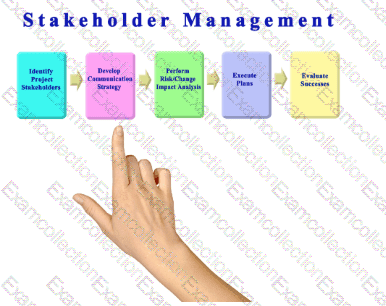
Per the PMI standards, while " Planning " creates the strategy, Manage Stakeholder Engagement is the active execution of that strategy to ensure stakeholders remain aligned with the project ' s success.
When addressing roles and responsibilities,which item ensures that the staff has the skills required to complete project activities?
Authority
Role
Competency
Responsibility
The Answer Is:
CExplanation:
According to the PMBOK® Guide, specifically within the Plan Resource Management process, defining roles and responsibilities is a critical step in ensuring the project team is equipped for success. The specific attribute that addresses the skills and capacities of the team is Competency.
In a professional project management context, roles and responsibilities are broken down into four key components:
Role: The label describing the portion of a project for which a person is accountable (e.g., Civil Engineer, Business Analyst, or Tester).
Authority: The right to apply project resources, make decisions, sign approvals, or accept deliverables.
Responsibility: The assigned duties and work that a project team member is expected to perform.
Competency: The skill and capacity required to complete project activities. If a team member does not possess the required competencies, project performance can be jeopardized.
A. Authority: This refers to the power granted to an individual to make decisions or use resources. While a person may have the authority to act, it does not guarantee they have the technical skills (competency) to do the work correctly.
B. Role: This is simply a title or designation. It describes who someone is in the project hierarchy, not their specific level of skill or ability.
D. Responsibility: This is the obligation to perform the work. A person can be responsible for a task but still lack the underlying competency needed to execute it to the required quality standards.
In PMI standards, if the team members do not have the required competencies, the project manager is responsible for initiating proactive responses, such as:
Training: To develop the necessary skills.
Hiring/Acquisition: Bringing in experts who already possess the competency.
Schedule/Scope Adjustments: Adjusting the project to align with the available skill sets of the current team.
Which Knowledge Areas include processes from the Closing Process Group?
Project Quality Management and Project Time Management
Project Scope Management and Project Risk Management
Project Stakeholder Management and Project Cost Management
Project Integration Management and Project Procurement Management
The Answer Is:
DExplanation:
In accordance with the PMBOK® Guide (Process Groups and Knowledge Areas Mapping), the Closing Process Group consists of those processes performed to formally complete or close a project, phase, or contractual obligations. Historically and within the structured mapping of PMI standards, two specific Knowledge Areas contain processes that fall into this group:
Project Integration Management: This Knowledge Area contains the process Close Project or Phase. This is the overarching process used to finalize all activities across all Project Management Process Groups to formally complete the project or phase. It involves reviewing the management plan to ensure all work is complete and the project has met its objectives.
Project Procurement Management: In earlier versions of the PMBOK® Guide (such as the 5th Edition), this Knowledge Area included the process Close Procurements. In the 6th Edition, the administrative aspects of closing procurements were integrated into Control Procurements and Close Project or Phase. However, in the context of standard certification exam questions, " Procurement " and " Integration " remain the two functional areas tied to formal " Closing " activities (closing the project/phase and closing the legal contracts).
Analysis of Distractors:
A, B, and C: None of these Knowledge Areas (Quality, Time/Schedule, Scope, Risk, Stakeholder, or Cost) contain a process that is officially part of the Closing Process Group.
Scope and Quality are finalized in the Monitoring and Controlling Process Group (via Validate Scope and Control Quality).
Risk, Stakeholder, and Cost activities are concluded within the Monitoring and Controlling or Executing groups. Only Integration and Procurement have specific mandates to " Close " the endeavor or its legal obligations.
Where are key project deliverables documented?
Project management plan
Requirements traceability matrix
User acceptance criteria
Work breakdown structure (WBS)
The Answer Is:
DExplanation:
In the PMBOK® Guide, the Work Breakdown Structure (WBS) is the primary tool for organizing and defining the total scope of the project. It is defined as a " deliverable-oriented hierarchical decomposition of the work to be executed by the project team. "
Why Choice D is correct:
Deliverable-Oriented: Unlike a schedule (which is action-oriented), the WBS focuses entirely on the " nouns " of the project—the actual products, results, or services that must be delivered.
Visualization of Scope: Each level of the WBS provides more detail about the deliverables. The highest levels represent the major project deliverables, which are then decomposed into smaller, more manageable components called work packages.
The Scope Baseline: The WBS, along with the WBS Dictionary and the Project Scope Statement, forms the Scope Baseline. While the Scope Statement describes the deliverables in text, the WBS documents and structures them visually to ensure 100% of the scope is accounted for.
Analysis of other options:
A (Project management plan): This is a master document that contains many subsidiary plans (like the scope management plan, schedule management plan, etc.). While it contains the WBS, it is too broad to be the specific answer for where deliverables are documented.
B (Requirements traceability matrix): The RTM links requirements to the deliverables that satisfy them. It tracks the status and origin of requirements throughout the project life cycle, but it is not the primary document used to structure and define the deliverables themselves.
C (User acceptance criteria): These are the conditions (the " rules " ) that must be met before a deliverable is accepted by the customer. Acceptance criteria are usually found in the Project Scope Statement or the WBS Dictionary, but they describe the quality/standards of a deliverable rather than acting as the documentation of the deliverables themselves.
Key Concept: The Project Management Institute (PMI) teaches the 100% Rule: The WBS must include 100% of the work defined by the project scope and capture all deliverables—internal, external, and interim. By using the WBS (Choice D), the project manager ensures that there is no " scope creep " and that every key deliverable is accounted for and assigned to a specific part of the project hierarchy.
Which statement correctly describes the value of a business case?
It provides the necessary information to determine if a project is worth the required investment.
It provides for alternative dispute resolution procedures in event of contract default.
It offers one of several alternative scenarios which assist in performing qualitative risk analysis.
It is used to help a project manager understand the scope of commercial advantages.
The Answer Is:
AExplanation:
According to the PMBOK® Guide, a Business Case is a high-level strategic document that justifies the investment in a project. It is typically created during the pre-project phase and serves as a primary input to the Develop Project Charter process.
Purpose of the Business Case: The business case lists the objectives and reasons for initiating the project. It helps the organization ' s leadership or a project steering committee determine if the expected outcomes (benefits) justify the cost and resources required.
Key Components: A standard business case usually includes:
Business Need: The problem or opportunity being addressed.
Analysis of the Situation: Identifying organizational goals, strategies, and objectives.
Recommendation: A statement of the recommended solution and the feasibility of that solution.
Evaluation: A statement describing the plan for measuring the benefits the project will deliver (linked to the Benefits Management Plan).
Economic Feasibility: It often contains financial indicators such as Net Present Value (NPV), Internal Rate of Return (IRR), and Payback Period to prove the project ' s financial viability.
Analysis of Other Options:
B. It provides for alternative dispute resolution procedures in event of contract default: This describes a component typically found in a Contract or a Procurement Management Plan, not a business case.
C. It offers one of several alternative scenarios which assist in performing qualitative risk analysis: While a business case may discuss risks, it is not a tool for Qualitative Risk Analysis. Scenario analysis is more closely related to Quantitative Risk Analysis or Plan Risk Responses.
D. It is used to help a project manager understand the scope of commercial advantages: While it does discuss advantages, this description is too narrow. The project manager uses the Project Charter (which is authorized by the business case) to understand their authority and the project goals. The business case is primarily for the Sponsor to justify the investment.
A project team is reviewing project performance. During the execution phase, the project team discovers that there is an off-the-shelf (OTS) product, which could reduce the timeline for development.
What should the project manager do next?
Update the project management plan.
Add the discovery to the assumptions.
Evaluate the risk with the project team.
Conduct an opportunity analysis with the team.
The Answer Is:
DExplanation:
According to the PMBOK® Guide and the Standard for Project Management, when a potential benefit—such as an off-the-shelf (OTS) product that can reduce the timeline—is identified during the execution phase, it is classified as a positive risk or an opportunity.
Why Choice D is correct: Before any changes are made to the plan or the risk register, the Project Manager must understand the potential value and feasibility of the discovery. Opportunity Analysis (part of the Perform Qualitative and Quantitative Risk Analysis processes) involves evaluating the probability of success and the impact of the opportunity on project objectives (e.g., cost vs. time savings). This aligns with the " Optimize " or " Exploit " strategies for positive risks.
Analysis of other options:
A (Update the project management plan): This is premature. You cannot update the plan (which requires the Perform Integrated Change Control process) until the opportunity has been fully analyzed and a change request has been approved.
B (Add the discovery to the assumptions): An assumption is something considered to be true without proof. A discovered product is a tangible option/opportunity, not a foundational assumption.
C (Evaluate the risk with the project team): While " risk " technically covers both threats and opportunities, in PMI terminology, when a specific beneficial discovery is made, the most proactive and targeted step is Opportunity Analysis to determine if the benefit outweighs the potential drawbacks of switching from custom development to an OTS product (such as integration issues or licensing costs).
By conducting an opportunity analysis, the Project Manager determines if the OTS product should be pursued, which then leads to a formal change request to capture the timeline reduction.
Which estimating technique uses the actual costs of previous similar projects as a basis for estimating the costs of the current project?
Analogous
Parametric
Bottom-up
Top-down
The Answer Is:
AExplanation:
According to the PMBOK® Guide, specifically within the Estimate Costs and Estimate Activity Durations processes, Analogous Estimating is a technique used to estimate the duration or cost of an activity or a project using historical data from a similar activity or project.
Basis of Estimation: It uses values such as scope, cost, budget, and duration or measures of scale (such as size, weight, and complexity) from a previous, similar project as the basis for estimating the same parameter or measure for a current project.
When to Use: It is frequently used when there is a limited amount of detailed information about the project (e.g., in the early phases of a project).
Characteristics:
Cost and Time: It is generally less costly and time-consuming than other techniques.
Accuracy: It is generally less accurate than parametric or bottom-up estimating.
Reliability: It is most reliable when the previous projects are similar in fact and not just in appearance, and the project team members preparing the estimates have the needed expertise.
Top-Down Nature: Analogous estimating is a form of expert judgment and is often referred to as a top-down approach because it looks at the project as a whole rather than its individual components.
Comparison with other options:
B. Parametric: This technique uses a statistical relationship between historical data and other variables (e.g., square footage in construction) to calculate an estimate. It is more data-driven than analogous estimating.
C. Bottom-up: This involves estimating the cost or duration of individual work packages or activities and then summarizing (rolling up) these estimates to higher levels. It is the most accurate but also the most time-consuming.
D. Top-down: While analogous estimating is a type of top-down estimation, " Top-down " is a general category. In the context of specific PMI tools and techniques for estimating, Analogous is the formal term used to describe the use of previous similar projects as the primary basis.
A graphic display of project team members and their reporting relationships is known as a:
Resource calendar.
Project organization chart.
Resource breakdown structure (RBS).
Responsibility assignment matrix (RAM).
The Answer Is:
BExplanation:
According to the PMBOK® Guide (Project Management Body of Knowledge), specifically within the Project Resource Management knowledge area and the Plan Resource Management process, different tools are used to document team roles and relationships:
Project Organization Chart (Option B): This is a graphic display of project team members and their reporting relationships. It can be formal or informal, highly detailed or broadly framed, depending on the needs of the project. Its primary purpose is to show the hierarchy and how information flows between team members and the project manager.
Resource Calendar (Option A): This is a document that identifies the working days and shifts on which each specific resource is available. it tracks " when " a resource can work, not " who " they report to.
Resource Breakdown Structure (RBS) (Option C): This is a hierarchical list of resources related by category and resource type. It is used for planning and controlling project work (e.g., listing all " Engineers " or " Laptops " needed), but it does not typically show the reporting or command structure of the personnel.
Responsibility Assignment Matrix (RAM) (Option D): A RAM (such as a RACI chart) shows the project resources assigned to each work package. It illustrates the connections between work packages or activities and project team members, ensuring that there is only one person accountable for any single task, but it is a matrix, not an organizational hierarchy chart.
In the PMI framework, the Project Organization Chart is a subset of the Resource Management Plan and is vital for reducing confusion regarding authority and communication channels within the project team.
A project manager is leading a technology project that is about to enter the execution phase. The project requires the procurement of certain key components from an external vendor. The project manager has been notified that because of a government regulation, some parts can no longer be used in the country and the vendor will be unable to deliver them.
What should the project manager do?
Identify the impact and follow the procurement plan.
Identify the impact and follow the project management plan.
Identify the impact and follow the risk management plan.
Identify the impact and follow the change control plan.
The Answer Is:
CExplanation:
In the PMBOK® Guide, when an external event—such as a new government regulation—occurs that threatens the project ' s objectives, it is classified as a Risk (specifically an external threat). Since the project is just about to enter the execution phase, the project manager must handle this uncertainty systematically.
Why Choice C is correct:
Risk Identification and Assessment: The first step when a problem or change in the environment is " notified " is to identify the specific impact on the project (Schedule, Cost, Quality).
Risk Management Plan: This plan outlines how the team should respond to risks. It contains the processes for updating the Risk Register, performing qualitative/quantitative analysis, and selecting a Risk Response Strategy (such as Mitigation by finding an alternative component or Avoidance by changing the project design).
Proactive vs. Reactive: Even though the regulation is a current reality, the " impact " on the project ' s future execution is still a risk that needs to be managed according to the predefined risk protocols before jumping into formal change requests.
Analysis of other options:
A (Procurement plan): While the issue involves a vendor, the procurement plan describes how to buy items (bidding, types of contracts), not how to handle a major strategic roadblock caused by legal changes.
B (Project management plan): This is too broad. The project management plan is the " parent " document for all other plans. While technically true, PMI questions always look for the most specific subsidiary plan that addresses the situation.
D (Change control plan): You follow the change control plan only after you have assessed the impact and decided on a specific response. You don ' t " follow the plan " to solve the problem; you follow it to formally document and approve a solution once the risk management process has identified what that solution should be.
Key Concept: The Project Management Institute (PMI) emphasizes that Risk Management (Choice C) is the primary tool for dealing with Enterprise Environmental Factors (EEFs). By following the risk management plan, the project manager ensures that the impact of the regulation is fully understood and that a validated strategy is in place before the project’s scope, schedule, or budget is officially altered.
Which tool or technique of the Define Activities process allows for work to exist at various levels of detail depending on where it is in the project life cycle?
Historical relationships
Dependency determination
Bottom-up estimating
Rolling wave planning
The Answer Is:
DExplanation:
In accordance with the PMBOK® Guide (Project Schedule Management), specifically within the Define Activities process, Rolling Wave Planning is a form of progressive elaboration where the work to be accomplished in the near term is planned in detail, while the work in the future is planned at a higher level.
Function: This technique allows for work to exist at various levels of detail depending on its position in the project life cycle. During early strategic planning, when information is less defined, work packages may be decomposed only to a certain level. As the project progresses and more information becomes available, those high-level components are decomposed into detailed activities.
Application: It is particularly useful in projects with high levels of uncertainty or those using an adaptive (agile) or hybrid life cycle, where the final product is not fully defined at the start.
Relationship to WBS: While the WBS provides the structural framework, Rolling Wave Planning is the specific scheduling technique used to manage the timing of that detail ' s emergence.
Analysis of Distractors:
A. Historical relationships: This is a tool/technique used in Estimate Activity Durations or Estimate Costs (Parametric Estimating) to predict future results based on past data. It does not dictate the level of detail in the plan based on the life cycle.
B. Dependency determination: This is used in the Sequence Activities process to define the relationship between tasks (e.g., Mandatory, Discretionary, External, or Internal). It determines the order of work, not the level of detail.
C. Bottom-up estimating: This is a technique for estimating duration or cost by aggregating the estimates of lower-level components. It requires a high level of detail to be present before the estimate can be made, rather than allowing for various levels of detail.
What is a hierarchically organized depiction of the identified project risks arranged by risk category?
Risk register
Risk breakdown structure (RBS)
Risk management plan
Risk category
The Answer Is:
BExplanation:
According to the PMBOK® Guide, specifically within the Plan Risk Management process, the Risk Breakdown Structure (RBS) is a critical tool for ensuring all potential risks are identified and categorized systematically.
Definition: An RBS is a hierarchically organized depiction of identified project risks. It is arranged by risk category and subcategory, which identifies the various areas and causes of potential risks.
Structure: Similar to a Work Breakdown Structure (WBS), the RBS starts at a high level (e.g., Technical, External, Organizational, Project Management) and decomposes into more specific levels.
Level 0: All Project Risks.
Level 1: Broad categories (e.g., Technical Risk).
Level 2: Specific subcategories (e.g., Requirements, Technology, Complexity).
Purpose: The primary benefit of the RBS is that it helps the project team to look at the project from different perspectives during the Identify Risks process. It prevents " tunnel vision " by forcing the team to consider risks across all domains of the project environment. It also provides a framework for summarizing and reporting risk data.
Comparison with other options:
A. Risk register: This is a document that captures the details of individual identified risks, including their description, owner, probability, impact, and planned responses. While it uses the categories defined in the RBS, the register is a list/database, not a hierarchical depiction of categories.
C. Risk management plan: This is the overarching plan that describes how risk management activities will be structured and performed. While the RBS is often included as a component of the Risk Management Plan, the plan itself is a narrative and procedural document, not the specific hierarchical chart.
D. Risk category: This is a singular classification (e.g., " External Risk " ). While the RBS is made of risk categories, a single category does not represent the entire hierarchical depiction asked for in the question.
An adaptive project manager is handling a five-sprint cycle to deliver a minimum viable product (MVP). After the third sprint, the productivity of the team drops to 30% due to a change in the way the team operates.
Which of the following changes has caused this loss in productivity?
Two of the team members have been working in silos using different methods to validate their performance.
The team velocity was measured in the third sprint since the tool to measure velocity was introduced only in the third sprint.
The team picked up technical debt items in the third sprint as technical debt can only be picked up after completing two sprints.
Two of the team members were asked to do multitasking, which they did not do in the previous two sprints.
The Answer Is:
DExplanation:
In adaptive (Agile) project management, maintaining a steady and predictable Velocity is crucial for delivering an MVP within a fixed number of sprints. According to the Agile Practice Guide and lean manufacturing principles integrated into Agile, " Context Switching " is one of the primary " wastes " that destroys productivity.
Why Choice D is correct:
The Cost of Task Switching: When team members are forced to multitask (switching between different projects or unrelated tasks), there is a significant mental " restart " cost. Research often cited in Agile literature suggests that multitasking can lead to a loss of up to 20% to 40% of a person ' s productive capacity due to the time lost re-focusing on different contexts.
Impact on Flow: Agile teams thrive on " Focus, " one of the five Scrum values. By introducing multitasking in the third sprint, the team ' s ability to maintain a flow state was broken, leading to the dramatic 30% drop in productivity described in the scenario.
Analysis of other options:
A (Working in silos): While silos are inefficient and discourage collaboration, they usually lead to quality issues or integration delays rather than a sudden, sharp 30% drop in overall productivity in a single sprint.
B (Measuring velocity for the first time): Measuring velocity is a data-gathering activity. The act of measuring does not inherently cause productivity to drop; it simply makes existing productivity visible.
C (Technical debt): Picking up technical debt items actually counts toward the work completed in a sprint. While technical debt makes future work slower, addressing it in the current sprint is a planned activity and wouldn ' t cause a " loss in productivity " relative to the work assigned; it would simply be the work the team chose to do.
Key Concept: The PMBOK® Guide and Agile methodologies emphasize the importance of dedicated teams. In an adaptive environment, a Project Manager (or Scrum Master) must protect the team from external interruptions and multitasking to ensure the Sustainable Pace required to hit the MVP deadline. Choice D represents a common management error that violates the principle of focused, iterative delivery.
A new project manager wishes to recommend creating a project management office to senior management. Which statement would the project manager use to describe the Importance of creating the project management office?
It will give the project manager Independence to make decisions without other departmental input.
It Integrates organizational data and information to ensure that strategic objectives are fulfilled.
The project management office can execute administrative tasks.
The project management office can coordinate projects.
The Answer Is:
BExplanation:
According to the PMBOK® Guide, a Project Management Office (PMO) is an organizational structure that standardizes the project-related governance processes and facilitates the sharing of resources, methodologies, tools, and techniques.
Strategic Alignment: The most compelling reason for senior management to establish a PMO is its ability to act as a bridge between strategic high-level goals and departmental-level execution. The PMO ensures that all projects within the organization are aligned with the business ' s strategic objectives.
Integration of Data: A PMO integrates data and information from various projects to provide a " big picture " view of the organization ' s portfolio. This allows senior management to see if the collective work is actually delivering the intended business value.
Types of PMOs:
Supportive: Provides templates and best practices (low control).
Controlling: Provides support and requires compliance with frameworks (moderate control).
Directive: Manages the projects directly (high control).
Value Proposition: Beyond just " coordinating, " a PMO supports the organization by managing shared resources, identifying and developing project management methodologies, and coaching/mentoring project managers.
Analysis of Other Options:
A. It will give the project manager independence to make decisions without other departmental input: This is incorrect. A PMO actually increases transparency and often introduces more governance and standardization, not less. It is not designed to create " independent " silos.
C. The project management office can execute administrative tasks: While a PMO can assist with administrative duties (especially in a Supportive PMO), this is a low-level benefit. Senior management is much more interested in the strategic integration described in Option B than in simple administrative support.
D. The project management office can coordinate projects: While coordination is a function of a PMO, this statement is too narrow. A PMO does much more than just coordinate; it manages the integration of those projects into the broader organizational strategy and governance framework.
What are the objectives of Initiation processes?
Initiation processes are performed in order to develop the project charier and Identify stakeholders.
Initiation processes are performed in order to obtain budget approval for a project or phase and approve scope with customers.
Initiation processes are performed to identify business objectives for a project or phase and identify stakeholders ' goals.
Initiation processes are performed to map initial requirements for a project or phase and prioritize them with stakeholders.
The Answer Is:
AExplanation:
According to the PMBOK® Guide, the Initiating Process Group consists of those processes performed to define a new project or a new phase of an existing project by obtaining authorization to start the project or phase.
The primary objectives of this group are encapsulated in its two core processes:
Develop Project Charter: The purpose is to create a document that formally authorizes the existence of a project and provides the project manager with the authority to apply organizational resources to project activities.
Identify Stakeholders: The purpose is to identify the people, groups, or organizations that could impact or be impacted by the project, and to document relevant information regarding their interests, involvement, interdependencies, influence, and potential impact on project success.
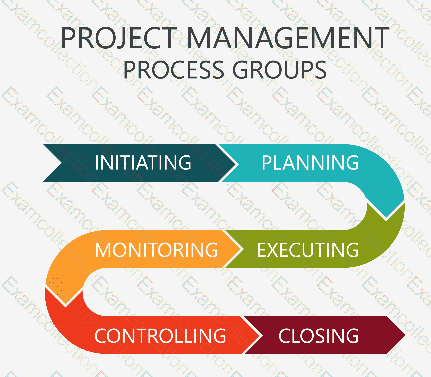
Why Option A is correct: Option A directly aligns with the formal names and outputs of the processes within the Initiating Process Group. By developing the charter and identifying stakeholders, the project manager sets the initial boundary for the project, ensures high-level alignment with organizational strategy, and identifies the human landscape of the project.
Analysis of Distractors:
B (Budget and Scope Approval): Detailed budget approval and formal scope approval (the Scope Baseline) are primary outputs of the Planning Process Group. Initiation only involves " pre-approved financial resources " and high-level scope.
C (Business Objectives and Stakeholder Goals): Identifying business objectives is typically part of the Business Case or Needs Assessment conducted before initiation. While stakeholders ' goals are explored, the formal objective of the process group is the identification of the stakeholders themselves and the formal authorization of the project.
D (Map and Prioritize Requirements): Collecting, mapping, and prioritizing requirements are activities that take place during the Collect Requirements process, which is part of the Planning Process Group.
The process for performing variance analysis may vary, depending on:
scenario building, technology forecasting, and forecast by analogy.
working relationships among various stakeholders and team members.
application area, the standard used, and the industry,
work to be completed next.
The Answer Is:
CExplanation:
According to the PMBOK® Guide, while the general concept of Variance Analysis (comparing planned performance to actual performance) remains constant, the specific methodologies, tools, and metrics used can differ significantly based on the project environment.
Application Area: The specific field the project is in (e.g., software development, construction, or pharmaceuticals) dictates what constitutes a " significant " variance. For example, a 5% cost variance in a high-margin research project might be acceptable, while the same variance in a low-margin construction bid could be critical.
The Standard Used: Different organizations or regulatory bodies may require specific standards for reporting variances (e.g., Earned Value Management standards vs. traditional budget-to-actual accounting).
The Industry: Industry-specific practices often define the thresholds for variance. In the aerospace industry, weight variance is a critical metric, whereas in the publishing industry, it would be irrelevant.
Context in Control Processes: Variance analysis is a key tool in Control Scope, Control Schedule, and Control Costs. The project management plan usually defines how these variances will be measured and the " action thresholds " that require the project manager to issue a change request.
Analysis of Other Options:
A. scenario building, technology forecasting, and forecast by analogy: These are techniques used in forecasting and risk analysis, particularly when looking at future possibilities, rather than the process for analyzing current deviations from a baseline.
B. working relationships among various stakeholders and team members: While relationships affect how information is communicated, they do not dictate the technical process of how variance analysis is performed.
D. work to be completed next: Variance analysis is backward-looking (comparing what was planned to be done by now vs. what was actually done). While the results might influence what work is done next, the " work to be completed next " does not define the analysis process itself.
In an organization with a projectized organizational structure, who controls the project budget?
Functional manager
Project manager
Program manager
Project management office
The Answer Is:
BExplanation:
According to the PMBOK® Guide, the organizational structure significantly influences how resources are assigned and who holds the power over project constraints, including the budget.
Projectized Organizational Structure: In this type of structure, the organization is arranged by projects rather than functional departments.
Authority: The Project Manager (PM) has a high to almost total level of authority.
Budget Control: Because the project is the primary unit of the organization, the Project Manager has full control over the project budget and the resources assigned to the project.
Reporting Lines: Team members are often co-located and report directly to the Project Manager. There are usually no functional managers, or if they exist, their role is minimal and focused on administrative support rather than project direction.
The " Varying Degrees " of Authority:
Functional Structure: The Functional Manager has full control of the budget; the PM has little to no authority (often just a coordinator).
Matrix Structure: Authority is shared between the Functional Manager and the PM. In a Strong Matrix, the PM has more control; in a Weak Matrix, the Functional Manager maintains control.
Projectized Structure: This is the opposite of the Functional structure. The PM is the primary decision-maker for the budget.
Comparison with other options:
A. Functional manager: In a functional organization, this individual controls the budget. In a projectized organization, functional managers typically do not exist in a way that interferes with project-level financial decisions.
C. Program manager: While a Program Manager oversees a group of related projects and may allocate funds to those projects, the day-to-day control and management of a specific project ' s budget within a projectized structure rests with the Project Manager.
D. Project management office (PMO): A PMO provides support, templates, and governance. While they may monitor budget performance or provide the framework for financial reporting, they do not " control " the individual project ' s budget in the same direct capacity as the Project Manager in this structure.
What process in Project Schedule Management identifies and documents specific actions to be performed to produce a project’s deliverables?
Plan Schedule Management
Define Activities
Develop Schedule
Estimate Activity Durations
The Answer Is:
BExplanation:
According to the PMBOK® Guide, specifically within the Project Schedule Management knowledge area, the process of breaking down work packages into specific, actionable steps is essential for creating a realistic schedule.
Define Activities: This is the process of identifying and documenting the specific actions to be performed to produce the project deliverables. While the Create WBS process identifies the deliverables at the " work package " level, Define Activities takes those work packages and decomposes them into activities, which provide a basis for estimating, scheduling, executing, monitoring, and controlling the project work.
Decomposition: The primary tool used here is decomposition. In this context, it involves taking the lowest level of the WBS (the work package) and breaking it down into the actual tasks or actions required to complete that work.
Outputs: The key outputs of this process are the Activity List, Activity Attributes, and a Milestone List. These documents ensure that the project team has a clear, documented path for what needs to be physically done.
Why other options are incorrect:
Option A: Plan Schedule Management: This is the initial process that establishes the criteria and the activities for developing, monitoring, and controlling the schedule. It creates the " rulebook " (the Schedule Management Plan) but does not identify specific project activities.
Option C: Develop Schedule: This process analyzes activity sequences, durations, resource requirements, and schedule constraints to create the actual project schedule model. You cannot develop a schedule until the activities have already been defined and sequenced.
Option D: Estimate Activity Durations: This process focuses on the time required to complete individual activities. It assumes the activities have already been identified and documented in the Define Activities process.
What is the total float of the critical path?
Can be any number
Zero or positive
Zero or negative
Depends on the calendar
The Answer Is:
CExplanation:
According to the PMBOK® Guide, specifically within the Develop Schedule process and the Critical Path Method (CPM), the total float is a measure of schedule flexibility.
The Definition of Critical Path: The critical path is the sequence of activities that represents the longest path through a project, which determines the shortest possible project duration.
Total Float on the Critical Path: By definition, activities on the critical path have zero total float. This means there is no flexibility; any delay in a critical path activity will delay the project finish date.
Negative Float: Negative float occurs when a constraint on a finish date (a " Must Finish By " date) is violated. If the calculated early finish of the network is later than the required constraint date, the critical path will show negative float. This indicates that the project is already behind schedule relative to its constraints.
Positive Float: Positive float exists only on non-critical paths. These are sequences of activities that have " slack, " meaning they can be delayed without affecting the project completion date.
Comparison with other options:
A. Can be any number: While float can be many values, it is mathematically constrained by the network logic and project targets. It cannot be " any " number in the context of the critical path ' s definition.
B. Zero or positive: This describes a healthy, unconstrained schedule. However, it ignores the reality of negative float, which is a standard PMI concept for schedules that have missed their mandatory deadlines.
D. Depends on the calendar: While calendars (working vs. non-working days) affect the calculation of dates, the definition of the critical path float is a mathematical result of the forward and backward pass, not the calendar itself.
What is a key benefit of using virtual project teams?
Ensures appropriate behavior, security, and the protection of proprietary information
Reduces the risk of conflict due to interpersonal communications and other interactions
Assures that all team members have a clear and common understanding of the project
Reduces project cost by use of modern technologies allowing seamless team collaboration
The Answer Is:
DExplanation:
According to the PMBOK® Guide, specifically within the Develop Team and Acquire Resources processes, virtual teams are groups of people with a shared goal who fulfill their roles with little or no time spent meeting face-to-face.
Cost Reduction: One of the primary drivers for implementing virtual teams is the reduction of project costs. Organizations can save significantly on travel expenses, relocation costs, and the physical infrastructure (office space, utilities, etc.) required to house a co-located team.
Access to Expertise: Beyond cost, virtual teams allow a project manager to acquire specialized skills that may not be available in a single geographic area. By using modern communication technologies, the team can collaborate regardless of their physical location.
Global Talent Pool: Virtual teams enable the inclusion of people with mobility limitations or those who work different shifts, creating a " follow-the-sun " model that can actually increase productivity across time zones.
Why other options are incorrect:
Option A: Ensures appropriate behavior, security, and protection of information: Virtual teams actually face greater challenges in these areas. Monitoring behavior and ensuring data security is often more complex when team members are working from dispersed, remote locations.
Option B: Reduces the risk of conflict: Virtual teams often experience more conflict, not less. The lack of non-verbal cues (body language, tone of voice) in digital communication can lead to misunderstandings, feelings of isolation, and " us vs. them " mentalities between different sites.
Option C: Assures that all team members have a clear and common understanding: Achieving a " shared mental model " is significantly harder in a virtual environment. Co-located teams benefit from " osmotic communication, " whereas virtual teams must be much more intentional and disciplined to ensure everyone is on the same page.
A business analyst sent multiple meeting requests via instant message to a subject matter expert (SME) working in another country but did not receive a response. What should the business analyst do to reduce the likelihood of this occurring in the future with other stakeholders distributed across multiple locations?
Ask each stakeholder for their preferred communication method.
Confirm the time zone and work days in each location.
Check with the IT department to see if there is a technical issue.
Assume the meeting request is accepted unless declined.
The Answer Is:
AExplanation:
In the Plan Communications Management process of the PMBOK® Guide, the primary goal is to ensure that the right information reaches the right person at the right time through the most effective channel.
Why Choice A is correct:
Stakeholder Requirements: Communication is not " one size fits all. " Factors such as culture, organizational hierarchy, and personal work styles influence how stakeholders interact. In some cultures, instant messaging (IM) is seen as overly intrusive or informal for scheduling, while in others, email is preferred for documentation.
The Communications Management Plan: This plan specifically documents " person or groups who will receive the information " and " methods or technologies used to convey the information. " By asking for preferences, the Business Analyst (BA) can tailor the approach for each stakeholder, significantly increasing the response rate.
Engagement: Directly asking stakeholders how they want to be reached demonstrates respect for their time and local norms, which is a key component of Manage Stakeholder Engagement.
Analysis of other options:
B (Confirm time zone and work days): While important for scheduling the content of the meeting, knowing the time zone does not fix the issue of a stakeholder ignoring a specific channel (like IM). This is a logistical detail, whereas Choice A addresses the behavioral/preferred method of contact.
C (Check with the IT department): While technical issues can occur, in a global project environment, " no response " is more likely a communication style or engagement issue than a total system failure. This should only be done if a communication method was previously working and suddenly stopped.
D (Assume the meeting is accepted): This is a high-risk and unprofessional approach. It violates the " closed-loop " communication principle (Feedback) and often leads to empty meetings and project delays when the SME inevitably does not show up.
Key Concept: The Project Management Institute (PMI) emphasizes that the sender is responsible for ensuring the message is clear and received. By proactively identifying the preferred communication method (Choice A), the project team reduces " noise " and ensures that global stakeholders remain engaged and informed, regardless of their location.
Which of the following is an input to Direct and Manage Project Execution?
Requested changes
Approved change requests
Work performance information
Implemented defect repair
The Answer Is:
BExplanation:
According to the PMBOK® Guide, the Direct and Manage Project Work process (formerly referred to as Direct and Manage Project Execution in older editions) is the process of leading and performing the work defined in the project management plan and implementing approved changes to achieve the project ' s objectives.
Approved Change Requests: These are a critical input to this process. Once a change request is processed through the Perform Integrated Change Control process and receives formal approval, it is sent back to the Direct and Manage Project Work process to be implemented.
Types of Changes: These can include corrective actions, preventive actions, or defect repairs.
Execution: The project team carries out the work associated with these approved changes alongside the originally planned project activities.
Other Key Inputs:
Project Management Plan: Provides the " blueprints " for all project work.
Project Documents: Such as the requirements documentation, project schedule, and risk register.
Organizational Process Assets (OPAs) and Enterprise Environmental Factors (EEFs).
Comparison with other options:
A. Requested changes: These are an output of various processes (including Direct and Manage Project Work itself) when the team identifies that a change is necessary. They do not become an input to execution until they have been " Approved. "
C. Work performance information: This is typically an output of the Control processes (like Control Schedule or Control Costs). The Direct and Manage process produces Work Performance Data (raw observations), which is then processed into Information by the controlling functions.
D. Implemented defect repair: This is an output of the Direct and Manage Project Work process. It represents the result of taking action on an approved change request regarding a defect.
Activity cost estimates and the project schedule are inputs to which Project Cost Management process?
Estimate Costs
Control Costs
Plan Cost Management
Determine Budget
The Answer Is:
DExplanation:
According to the PMBOK® Guide (Project Management Body of Knowledge), specifically within the Project Cost Management knowledge area, it is essential to distinguish between the individual processes and their respective inputs:
Determine Budget (Option D): This is the process of aggregating the estimated costs of individual activities or work packages to establish an authorized cost baseline. The primary inputs required to perform this aggregation include the Activity Cost Estimates (the cost of each specific task) and the Project Schedule (which provides the timing of when these costs will be incurred, allowing for the calculation of time-phased budget requirements).
Estimate Costs (Option A): This is the preceding process where the Activity Cost Estimates are actually created. Therefore, the estimates are an output of this process, not an input.
Control Costs (Option B): This process involves monitoring the status of the project to update the project costs and managing changes to the cost baseline. While it uses the budget, its primary inputs are Work Performance Data and the Cost Baseline itself.
Plan Cost Management (Option C): This is the initial planning process that establishes the policies, procedures, and documentation for planning, managing, expending, and controlling project costs. It occurs before any specific activity costs have been estimated.
In the PMI framework, the Determine Budget process is what transforms individual task-level data into the Cost Baseline, which is the version of the budget used to measure and monitor cost performance throughout the project.
An effective technique for resolving conflict that incorporates multiple viewpoints from differing perspectives to achieve consensus and commitment is:
smooth/accommodate.
force/direct,
collaborate/problem solve,
compromise/reconcile.
The Answer Is:
CExplanation:
In accordance with the PMBOK® Guide (Project Resource Management), specifically within the Manage Team process, there are five general techniques for resolving conflict. The Collaborate/Problem Solve approach is considered the most effective for long-term project success.
Mechanism: This technique involves incorporating multiple viewpoints and insights from differing perspectives. it requires a cooperative attitude and open dialogue that typically leads to consensus and commitment.
Outcome: Because this approach addresses the root cause of the conflict and allows all parties to contribute to the solution, it results in a " win-win " situation.
When to use: It is best used when the relationship between parties is important, when the interests of both parties are too significant to be compromised, or when you need to gain commitment by incorporating concerns into a consensus.
Analysis of Distractors:
A. Smooth/Accommodate: This technique emphasizes areas of agreement rather than areas of difference, or conceding one ' s position to the needs of others to maintain harmony. This is a " lose-win " approach and often provides only a temporary solution.
B. Force/Direct: This involves pushing one ' s viewpoint at the expense of others, offering only " win-lose " solutions. It is often enforced through a power position and can lead to resentment.
D. Compromise/Reconcile: This involves searching for solutions that bring some degree of satisfaction to all parties in order to temporarily or partially resolve the conflict. It is often a " lose-lose " or " neutral-neutral " approach because both parties must give something up, which rarely leads to true consensus or long-term commitment.
Which risk response strategy is common for both positive and negative risks?
Share
Accept
Mitigate
Transfer
The Answer Is:
BExplanation:
According to the PMBOK® Guide, specifically the Plan Risk Responses process, risks are categorized into threats (negative risks) and opportunities (positive risks). While most strategies are unique to the type of risk, Acceptance is the only strategy used for both.
Acceptance (General): This strategy is adopted when the project team decides not to change the project management plan to deal with a risk, or is unable to identify any other suitable response strategy.
Passive Acceptance: Requires no action other than documenting the strategy and periodically reviewing the risk to ensure it has not changed significantly.
Active Acceptance: The most common approach, which involves establishing a contingency reserve, including amounts of time, money, or resources to handle the risk if it occurs.
In Threats: You accept the risk because the cost of other responses (like Transfer or Mitigate) outweighs the potential impact, or the risk is very low priority.
In Opportunities: You accept the opportunity without actively pursuing it, but you are prepared to take advantage of it if it happens to occur.
Analysis of Other Options:
A. Share: This is a strategy used exclusively for opportunities (positive risks). It involves allocating some or all of the ownership of the opportunity to a third party who is best able to capture the benefit.
C. Mitigate: This is a strategy used exclusively for threats (negative risks). It aims to reduce the probability of occurrence or the impact of a risk. The equivalent for opportunities is Enhance.
D. Transfer: This is a strategy used exclusively for threats (negative risks). It involves shifting the impact and ownership of a threat to a third party (e.g., insurance). The equivalent for opportunities is Share.
Which process includes prioritizing risks for subsequent further analysis or action by assessing and combining their probability of occurrence and impact?
Perform Qualitative Risk Analysis
Perform Quantitative Risk Analysis
Plan Risk Management
Plan Risk Responses
The Answer Is:
AExplanation:
According to the PMBOK® Guide, the process of Perform Qualitative Risk Analysis is the process of prioritizing individual project risks for further analysis or action by assessing their probability of occurrence and impact, as well as other characteristics.
Key Function: This process focuses on the subjective evaluation of risks. It allows project managers to reduce the level of uncertainty and focus on high-priority risks.
Methodology: It involves the use of a Probability and Impact Matrix to assign a risk rating (e.g., Low, Medium, High). This prioritization is essential because it identifies which risks require a more detailed Quantitative Risk Analysis (Choice B) or immediate Risk Response Planning (Choice D).
Efficiency: By combining probability and impact, the project team can effectively categorize risks and allocate resources to manage the most critical threats or opportunities first.
Analysis of other choices:
Choice B (Perform Quantitative Risk Analysis): This process numerically analyzes the combined effect of identified individual project risks and other sources of uncertainty on overall project objectives. It usually follows Qualitative analysis.
Choice C (Plan Risk Management): This is the process of defining how to conduct risk management activities for a project; it sets the " rules, " but does not assess the risks themselves.
Choice D (Plan Risk Responses): This is the process of developing options, selecting strategies, and agreeing on actions to address overall project risk exposure, which occurs after the risks have been prioritized.