


PMI CAPM - Certified Associate in Project Management (CAPM)
Which three techniques can be estimate costs?
Financing, bottom-up estimating, and expert judgment
Cost aggregation, analogous estimating, and financing
Expert judgment, financing, and cost aggregation
Expert judgment, analogous estimating, and bottom-up estimating
The Answer Is:
DExplanation:
According to the PMBOK® Guide, the Estimate Costs process involves several specific tools and techniques used to develop an approximation of the monetary resources needed to complete project work. The three techniques listed in the correct option are foundational to this process:
Expert Judgment: This involves providing insight based upon experience and knowledge from a specific application area, Knowledge Area, discipline, or industry. It is used to determine which combination of estimating techniques to use and how to reconcile differences between them.
Analogous Estimating: This technique uses the values (such as scope, cost, budget, and duration) or measures of scale (such as size, weight, and complexity) from a previous, similar project as the basis for estimating the same parameter or measure for a current project. It is generally less costly and time-consuming than other techniques but also less accurate.
Bottom-up Estimating: This is a method of estimating a component of work. The cost of individual work packages or activities is estimated with the greatest level of specified detail. The detailed cost is then summarized or " rolled up " to higher levels for subsequent reporting and tracking purposes.
Why other options are incorrect:
Option A, B, and C (Financing): Financing is a tool used in the Determine Budget process, not the Estimate Costs process. It involves acquiring funding for projects.
Option B and C (Cost Aggregation): Cost Aggregation is also a tool used specifically in the Determine Budget process. It involves summing the lower-level cost estimates (work packages) into higher-level components (control accounts) to establish the cost baseline.
While preparing the project management plan on a weekly basis, the project manager indicates the intention to provide an issues report to the staff via e-mail. In which part of the plan will this type of information be included?
Communications management plan
Human resource plan
Quality management plan
Procurement management plan
The Answer Is:
AExplanation:
According to the PMBOK® Guide, the Communications Management Plan is a component of the project management plan that describes how, when, and by whom project information will be administered and disseminated.
Information Distribution: The scenario describes the " who " (the staff), the " what " (an issues report), the " how " (via e-mail), and the " frequency " (weekly). All of these are core elements defined during the Plan Communications Management process.
Content of the Plan: A standard Communications Management Plan includes:
Stakeholder communication requirements.
Information to be communicated, including language, format, content, and level of detail.
Reason for the distribution of that information.
Time frame and frequency for the distribution of required information and receipt of acknowledgment or response, if applicable.
Person responsible for communicating the information.
Person responsible for authorizing release of confidential information.
Issues Reporting: Managing and communicating the status of issues is a critical part of keeping stakeholders informed and ensuring project transparency. By documenting this in the Communications Management Plan, the project manager ensures that the staff expects the report and understands the channel through which it will arrive.
Analysis of Other Options:
B. Human resource plan: This plan (now often referred to as the Resource Management Plan) focuses on how project resources (people, equipment, materials) are acquired, managed, and eventually released. It does not dictate the specific logistics of weekly reporting.
C. Quality management plan: This plan describes how the project team will implement the organization ' s quality policy. While it might include reporting on quality metrics, the general distribution of an issues report via email is a communication function.
D. Procurement management plan: This plan contains the activities to be undertaken during the procurement process, such as obtaining seller responses or selecting sellers. It does not cover internal team status reporting.
Completion of the product scope is measured against the product:
prototypes
requirements
analyses
benchmarks
The Answer Is:
BExplanation:
According to the PMBOK® Guide, a clear distinction is made between Project Scope and Product Scope regarding how completion is measured:
Product Scope: The features and functions that characterize a product, service, or result. Completion of the product scope is measured against the product requirements to ensure that the delivered product has all the specified characteristics and functions.
Project Scope: The work performed to deliver a product, service, or result with the specified features and functions. Completion of the project scope is measured against the project management plan, specifically the scope baseline (which includes the scope statement, WBS, and WBS dictionary).
Validation: During the Validate Scope process, the formalized acceptance of the completed project deliverables is obtained. This involves inspecting the deliverables to ensure they meet the documented requirements and acceptance criteria.
Comparison with other options:
A. Prototypes: These are a tool used in the Collect Requirements process to provide a working model of the expected product. While they help define requirements, they are not the formal metric against which final completion is measured.
C. Analyses: Data analysis is a technique used throughout the project to make decisions or identify trends, but it is not the baseline for scope completion.
D. Benchmarks: Benchmarking involves comparing actual or planned practices to those of comparable organizations to identify best practices or provide a basis for measuring performance. It helps set the standard for requirements but is not the requirements document itself.
Company A’s accountant sends notification about a change in the company’s tax classification.
What would a project have to be initiated?
To change business and technological strategies
To improve processes and services
To meet regulatory and legal requirements
To satisfy stakeholder requests
The Answer Is:
CExplanation:
According to the PMBOK® Guide, projects are initiated in response to factors that influence an organization. These factors are generally categorized into four primary areas of project initiation context.
Meet Regulatory, Legal, or Social Requirements (Choice C): A change in a company’s tax classification is a formal legal and financial status update mandated by government or tax authorities. To remain compliant with the law, the company may need to initiate a project to update its financial systems, reporting structures, and accounting processes. This is a classic example of a project triggered by the need to adhere to external regulations.
Change Business or Technological Strategies (Choice A): This usually refers to a project initiated because the company wants to move in a new direction—such as launching a new product line or moving to a cloud-based infrastructure—rather than reacting to a mandatory tax change.
Improve Processes and Services (Choice B): While the tax change might involve changing a process, the reason for the project is the legal requirement itself. " Improvement " implies a choice to make something better or more efficient for the sake of performance, rather than a mandatory compliance task.
Satisfy Stakeholder Requests (Choice D): While an accountant is a stakeholder, their notification is regarding a structural/legal change. Stakeholder requests as a project trigger usually refer to specific desired features or changes requested by customers or internal executives that are not necessarily legally mandated.
By initiating a project to address Regulatory and Legal Requirements, the organization avoids penalties, fines, and legal complications, ensuring that its operations remain sustainable and legitimate under the new tax classification.
Which of the following documents allows the project manager to assess risks that may require near term action?
Probability and impact matrix
Contingency analysis report
Risk urgency assessment
Rolling wave plan
The Answer Is:
CExplanation:
In accordance with the PMBOK® Guide, specifically within the Perform Qualitative Risk Analysis process, Risk Urgency Assessment is the tool used to identify risks that require near-term action.
Definition: Risk urgency assessment reviews and determines the timing of actions that may need to occur sooner than other risk responses. It considers the time available to react to a risk, the time to implement a risk response, and the project ' s tolerance for delay.
Purpose: While the Probability and Impact Matrix helps prioritize risks based on their severity, it does not necessarily account for when those risks might occur. A high-impact risk that is scheduled to happen in two days is more " urgent " than a high-impact risk scheduled for next year.
Categorization: Risks that may occur soon or require a long lead time to implement a response are moved to the top of the priority list for immediate attention. Indicators of urgency can include " Time to Effect " or " Time to Respond. "
Output: The results of this assessment are typically documented in the Risk Register to help the project manager focus on the most pressing threats or opportunities.
Comparison with Other Options:
Probability and impact matrix (A): This identifies the importance of a risk but not necessarily the timing or urgency of the required response.
Contingency analysis report (B): This usually refers to the amount of funds or time set aside (reserves) to handle identified risks; it is a result of planning, not a tool for assessing near-term timing.
Rolling wave plan (D): This is a form of progressive elaboration used in Schedule Management where work to be accomplished in the near term is planned in detail, while future work is planned at a higher level. While it deals with " near term, " it is a scheduling technique, not a risk assessment document.
Which of the following involves making information available to project stakeholders in a timely manner?
Plan Communications
Performance reporting
Project status reports
Distribute Information
The Answer Is:
DExplanation:
According to the PMBOK® Guide, specifically within the Project Communications Management knowledge area, Distribute Information (often referred to as Manage Communications in newer editions) is the process of making relevant information available to project stakeholders as planned.
Timely Availability: The core focus of this process is the execution of the Communications Management Plan. It ensures that the right information reaches the right stakeholders at the right time using the appropriate retrieval and distribution systems.
Information Distribution Tools: This involves using various technologies and methods, such as:
Electronic Communications: Email, project management software, and web-based portals.
Hard-Copy Document Distribution: Standardized letters, reports, and manuals.
Meetings and Presentations: Face-to-face or virtual briefings to ensure clarity.
Stakeholder Needs: Distributing information is not just about " sending " data; it is about ensuring the information is received, understood, and acts as a foundation for stakeholder engagement. It addresses both expected information (status reports) and unexpected requests for information.
Feedback Loop: Effective distribution includes a mechanism for stakeholders to provide feedback or ask for clarification, ensuring that the communication remains a two-way street.
Comparison with other options:
A. Plan Communications: This is a Planning process. It identifies the information and communication needs of the stakeholders (who needs what, when, and how). It creates the strategy but does not perform the actual act of making the information available.
B. Performance reporting: This is the act of collecting and distributing performance information, including status reports, progress measurements, and forecasts. While it involves distribution, " Performance Reporting " is a subset of the broader " Distribute Information " process.
C. Project status reports: These are a specific tool or output (a type of information) used within the communication process. They are the content being distributed, not the process of distribution itself.
What are the project management processes associated with project quantity management?
Plan Quality Management, Manage Quality, and Control Quality
Plan Quality Management, Manage Quality, and Cost of Quality
Manage Quality, Customer Satisfaction, and Control Quality
Customer Satisfaction, Control Quality, and Continuous Improvement
The Answer Is:
AExplanation:
According to the PMBOK® Guide, specifically the Project Quality Management knowledge area, there are three formal processes designed to ensure that the project meets the needs for which it was undertaken. (Note: The user ' s question mentions " Quantity, " but in the context of PMI certification and the provided choices, this is a known typo for Quality Management).
The Three Formal Processes (Choice A):
Plan Quality Management: The process of identifying quality requirements and/or standards for the project and its deliverables, and documenting how the project will demonstrate compliance with quality requirements.
Manage Quality: Sometimes called " Quality Assurance, " this is the process of translating the quality management plan into executable quality activities that incorporate the organization’s quality policies into the project. It focuses on the processes used to create the deliverables.
Control Quality: The process of monitoring and recording results of executing the quality management activities to assess performance and ensure the project outputs are complete, correct, and meet customer expectations. It focuses on the deliverables themselves.
Cost of Quality (Choice B): This is a Tool and Technique used within the Plan Quality Management process, not a standalone process itself.
Customer Satisfaction (Choice C and D): This is a fundamental principle or objective of quality management, but it is not a named process in the PMI framework.
Continuous Improvement (Choice D): This (also known as kaizen) is an organizational philosophy or an outcome of effective quality management, but it is not one of the three specific processes defined in the PMBOK® Guide.
By following these three processes, a project manager ensures that the " Triple Constraint " is maintained and that the final product adheres to the scope and functional requirements defined by the stakeholders.
Project contracts generally fall into which of the following three broad categories?
Fixed-price, cost reimbursable, time and materials
Make-or-buy, margin analysis, fixed-price
Time and materials, fixed-price, margin analysis
Make-or-buy, lump-sum, cost-plus-incentive
The Answer Is:
AExplanation:
According to the PMBOK® Guide, specifically within the Plan Procurement Management process, project contracts are generally categorized into three broad types based on how the risk is shared between the buyer and the seller.
Fixed-Price Contracts (FP): This category involves setting a fixed total price for a defined product, service, or result to be provided. It places the greatest risk on the seller, as they are responsible for any cost overruns. Sub-types include Firm Fixed Price (FFP) and Fixed Price Incentive Fee (FPIF).
Cost-Reimbursable Contracts (CR): This category involves payments to the seller for all legitimate actual costs incurred for completed work, plus a fee representing seller profit. This category places the greatest risk on the buyer. Sub-types include Cost Plus Fixed Fee (CPFF) and Cost Plus Incentive Fee (CPIF).
Time and Materials Contracts (TandM): This is a hybrid type of contractual arrangement that contains aspects of both cost-reimbursable and fixed-price contracts. They are often used for staff augmentation or when a precise statement of work cannot be quickly prescribed. They are typically used for smaller dollar amounts or short-term engagements.
Analysis of Other Options:
B and C. Margin analysis: This is a financial calculation used to determine profitability, not a category of procurement contract.
D. Make-or-buy: This is a tool and technique used to determine whether particular work can best be accomplished by the project team or should be purchased from outside sources; it is not a contract category itself.
Tools and techniques used for Plan Communications include the communication:
requirements analysis, communication technology, communication models, and communication methods.
methods, stakeholder register, communication technology, and communication models.
requirements, communication technology, communication requirements analysis, and communication methods.
management plan, communication technology, communication models, and communication requirements analysis.
The Answer Is:
AExplanation:
According to the PMBOK® Guide, specifically within the Plan Communications Management process, the project manager identifies the information needs of the stakeholders and defines a communication approach. The specific tools and techniques used to develop this plan are:
Communication Requirements Analysis: This technique determines the specific information needs of project stakeholders. This includes considering the number of potential communication channels using the formula $n(n-1)/2$.
Communication Technology: This refers to the specific tools, systems, or methods used to transfer information among stakeholders (e.g., conversations, written documents, online databases, or websites).
Communication Models: These are descriptions, metaphors, or graphical representations that show how communication processes are performed (e.g., the basic sender-receiver model involving encoding, transmitting, decoding, and noise).
Communication Methods: These are the systematic procedures used to share information. They are categorized into Interactive (multidirectional), Push (sent to specific recipients), and Pull (used for large volumes of information where recipients access content at their own discretion).
Comparison with Other Options:
B. methods, stakeholder register, communication technology, and communication models: The Stakeholder Register is an Input to the process, not a tool or technique.
C. requirements, communication technology, communication requirements analysis, and communication methods: " Communication requirements " is the result or an input factor, but " Communication Requirements Analysis " is the actual technique.
D. management plan, communication technology, communication models, and communication requirements analysis: The Communication Management Plan is the Output of this process, not a tool or technique used to create it.
A project manager has the task of determining the deliverables for a six-month project using a predictive approach. How should the project manager determine which processes to include in the project management plan?
Follow organizational methodology and produce all required deliverables.
Discuss the processes and deliverables needed to meet the project objectives with the team.
Identify the processes and deliverables for only the current phase first.
Integrate hybrid approach processes and deliverables to meet the short delivery timeline.
The Answer Is:
BExplanation:
According to the PMBOK® Guide, specifically within the Develop Project Management Plan and Plan Scope Management processes, determining the right " fit " for a project is a collaborative effort known as Tailoring.
The Importance of Tailoring: Even in a predictive (waterfall) approach, project management is not a " one size fits all " endeavor. The project manager should not blindly follow every possible process. Instead, they must determine which processes, inputs, tools, techniques, and outputs are necessary to manage the specific project at hand.
Team Collaboration: The project manager works with the project team to determine the work required and the deliverables needed to meet the project objectives. Because the team members are the subject matter experts (SMEs) who will actually perform the work, their input is vital to ensuring that the deliverables are realistic and that the processes selected add value rather than unnecessary bureaucracy.
Meeting Objectives: The ultimate goal of the project management plan is to define how the project will be executed, monitored, and controlled to achieve its specific goals. Discussing this with the team ensures alignment and commitment to the project’s success.
Analysis of other options:
Option A: While following organizational methodology is important, simply producing " all required deliverables " without tailoring can lead to inefficiency. The project manager must first determine which deliverables are truly required for this specific six-month scope.
Option C: This describes Rolling Wave Planning or a multi-phase approach. While useful for long-term projects, the prompt asks how to determine processes for the project management plan (which typically covers the entire project scope in a predictive approach), not just the immediate phase.
Option D: The prompt explicitly states the project is using a predictive approach. Forcing a hybrid approach solely because of a " short delivery timeline " (six months is often a standard duration for predictive projects) contradicts the premise of the question.
Per PMI standards, the project manager is responsible for Tailoring the project management processes. This is best done by leveraging the expertise of the project team to ensure the most efficient path toward meeting the project ' s strategic objectives.
What important qualities should project managers possess for strategic and business management?
Skills and behaviors related to specific domains of project management
Knowledge and competencies needed to guide and motivate a team
Skills and behaviors needed to help an organization achieve its goals
Expertise in the industry and organization that deliver better outcomes
The Answer Is:
DExplanation:
According to the PMBOK® Guide and the PMI Talent Triangle®, project managers must possess a balance of three skill sets: Technical Project Management, Leadership, and Strategic and Business Management.
Strategic and Business Management: This specific arm of the Talent Triangle involves the " expertise in the industry and organization that enhances delivery and better business outcomes. " It is about understanding the high-level business functions and ensuring the project remains aligned with the business ' s strategic direction.
Key Competencies: A project manager proficient in this area can explain to others the business value of the project and work with the project sponsor to ensure the project aligns with the organization ' s vision. This includes knowledge of:
Business models and structures.
Industry trends and standards.
Competitive forces.
Legal and regulatory compliance within that specific industry.
Delivering Value: By having this expertise, the project manager is not just managing tasks but is acting as a strategic partner who ensures the project contributes to the organization ' s long-term success.
Why other options are incorrect:
Option A: Skills and behaviors related to specific domains of project management: This defines Technical Project Management. This is the " how-to " of project management, such as managing scope, schedules, and budgets.
Option B: Knowledge and competencies needed to guide and motivate a team: This defines Leadership. This focuses on the interpersonal skills, emotional intelligence, and ability to influence others to achieve goals.
Option C: Skills and behaviors needed to help an organization achieve its goals: While this sounds correct, it is a very broad statement. Per the PMI definitions, Option D is the specific phrasing used to describe the " expertise " required for the Strategic and Business Management portion of the talent triangle.
During a sprint demo, the customer says that one of the user stories is not ready for customer use. Which checklist should the team look at to find out what has been missed for the user story?
Burndown chart
Velocity chart
Definition of ready (DoR)
Definition of done (DoD)
The Answer Is:
DExplanation:
In Agile/Scrum methodologies, as described in the Agile Practice Guide and the Scrum Guide, there is a critical distinction between getting a story " ready " to start and getting it " ready " for the customer (Done).
Why Choice D is correct:
The Definition of Done (DoD): This is a formal description of the state of the Increment when it meets the quality measures required for the product. It is a checklist of all the technical and quality criteria that a user story must meet before it can be considered complete (e.g., coded, unit tested, integrated, documented, and bug-free).
Customer Use: When a customer claims a story is " not ready for use " during a demo, it usually means a quality standard or a functional requirement was missed. The team reviews the DoD to see if they skipped a mandatory step (like security testing or user documentation) that would have caught the issue before the demo.
Transparency: The DoD ensures that everyone (the team and the stakeholders) has a shared understanding of what " complete " work means.
Analysis of other options:
A (Burndown chart): This is a trend tool that shows how much work is remaining in a sprint. It tracks progress over time but does not contain quality criteria or checklists for individual user stories.
B (Velocity chart): This tracks the amount of work (usually in story points) a team completes in each sprint. It is a capacity planning tool, not a quality or requirements checklist.
C (Definition of Ready - DoR): This is the checklist used to determine if a user story is well-defined enough to be taken into a sprint (e.g., it has clear acceptance criteria and dependencies are removed). Since the story in the question is already being demoed, it had already passed the DoR. The issue now is whether it was finished correctly, which is the role of the DoD.
Key Concept: The Project Management Institute (PMI) emphasizes that the Definition of Done is the primary tool for maintaining quality in an adaptive environment. If an increment is not " Ready for Customer Use, " it means it failed to meet the DoD, and therefore, cannot be considered part of the Increment or contribute to the team ' s Velocity for that sprint. Choice D is the governing document for this situation.
The project management processes are usually presented as discrete processes with defined interfaces, while in practice they:
operate separately.
move together in batches,
overlap and interact.
move in a sequence.
The Answer Is:
CExplanation:
According to the PMBOK® Guide, project management is an integrative endeavor. Although the processes are presented as discrete elements with well-defined requirements and interfaces for the purpose of study and organization, they rarely function as independent or linear events in a real-world project environment.
Overlapping and Interaction: Most experienced practitioners recognize that process groups and individual processes overlap and interact throughout the project. For example, the Planning process group is not " finished " before Executing begins; instead, as work is executed, new information often requires further planning (progressive elaboration).
Integrative Nature: The output of one process generally becomes an input to another process or is a deliverable of the project. This creates a continuous " web " of activity rather than a simple checklist.
Monitoring and Controlling: This process group specifically interacts with every other process group. It runs concurrently with Planning, Executing, and even Closing to ensure the project remains aligned with the management plan.
Analysis of Other Options:
A. operate separately: This is incorrect because project management is integrated. Decisions made in one area (e.g., Scope) directly affect others (e.g., Cost and Schedule).
B. move together in batches: This is not a standard PMBOK® term. Processes are triggered by specific inputs or events, not necessarily in arbitrary batches.
D. move in a sequence: While there is a logical flow (you generally need a Charter before a detailed WBS), the processes do not strictly follow a " waterfall " sequence where one must 100% finish before the next begins. They are often performed iteratively.
Which set of competencies should a project manager have?
Leadership, strategic and business management, and technical project management
Expertise in the Industry, leadership and business management, and bilingual skills
Technical project management, expertise in every role, and PMP certification
Expertise in every detail on project activities. PMP certification, and leadership
The Answer Is:
AExplanation:
According to the PMBOK® Guide, the core competencies required of a project manager are represented by the PMI Talent Triangle®. This framework ensures that project managers possess a balanced mix of skills to navigate the complexities of modern project environments.
Technical Project Management (Ways of Working): The knowledge, skills, and behaviors related to specific domains of project, program, and portfolio management. This includes the technical aspects of performing one’s role, such as schedule management, cost estimation, and risk analysis.
Leadership (Power Skills): The knowledge, skills, and behaviors needed to guide, motivate, and direct a team to help an organization achieve its business goals. This includes emotional intelligence, conflict resolution, and communication.
Strategic and Business Management (Business Acumen): The performance-enhancing knowledge of the industry and organization. It involves understanding the " big picture " of how a project aligns with the organization ' s strategic goals and its impact on the business ' s bottom line.
Analysis of Other Options:
B. Expertise in the Industry, leadership and business management, and bilingual skills: While industry expertise and bilingual skills are valuable assets in specific contexts, they are not defined by PMI as the universal " core " competencies required for all project managers.
C. Technical project management, expertise in every role, and PMP certification: A project manager does not need to be an expert in every technical role (e.g., they don ' t need to be the best coder and the best accountant). Their role is to manage those experts. Furthermore, while the PMP certification is a professional credential, it is not listed as a " competency " itself in the PMBOK Guide.
D. Expertise in every detail on project activities, PMP certification, and leadership: Focusing on " every detail " can lead to micro-management. Effective project managers focus on the integration of the project rather than getting lost in every minor technical task.
Which tool or technique is used to manage change requests and the resulting decisions?
Change control tools
Expert judgment
Delphi technique
Change log
The Answer Is:
AExplanation:
According to the PMBOK® Guide and the Standard for Project Management, specifically within the Perform Integrated Change Control process, the specific tool or technique used to manage change requests and the resulting decisions is Change control tools.
As per PMI standards, Perform Integrated Change Control is the process of reviewing all change requests; approving changes and managing changes to deliverables, organizational process assets, project documents, and the project management plan; and communicating the decisions. The Change control tools are essential for:
Configuration Management: Identifying and maintaining the consistency of a product ' s performance, functional, and physical attributes with its requirements and design throughout its life.
Change Management: Identifying, documenting, and approving or rejecting changes to the project documents, deliverables, or baselines.
Tracking and Communication: Providing a system to track change requests from initiation through to final disposition (approval, rejection, or deferral) and ensuring that stakeholders are notified of the outcomes.
The other options are incorrect based on the following PMI definitions:
Expert judgment: While expert judgment is a tool and technique for the Perform Integrated Change Control process, it refers to the specialized knowledge used to evaluate a change request (e.g., assessing the impact on scope or cost), rather than the tool used to manage the request and the resulting decisions.
Delphi technique: This is a specific Group Creativity Technique (or Data Gathering technique) used to reach a consensus among experts who participate anonymously. It is not used for the administrative management of change requests.
Change log: The change log is a Project Document (specifically an Output of the process), not a tool or technique. It is used to document changes that occur during a project, but the tools are what allow for the management and decision-making process itself.
As per the PMI Lexicon of Project Management Terms, Change Control Tools ensure that only approved changes are incorporated into the project, thereby preventing " scope creep " and ensuring all impacts are integrated across the Knowledge Areas.
A project manager is working with the team to prepare the estimates for various work items. The team needs to compare the relative sizing of the items. What should the project manager suggest the team use?
Project task estimation
Dependency planning
Story point estimation
Sprint planning
The Answer Is:
CExplanation:
The correct technique is story point estimation because the team is comparing the relative size of work items rather than calculating exact hours, dates, or costs. Story points are commonly used in agile environments to estimate effort, complexity, uncertainty, and risk in relation to other backlog items. PMI’s Lexicon defines a story point as “a unit used to estimate the relative level of effort needed to implement a user story.†This directly matches the question’s requirement to compare relative sizing. Project task estimation is broader and may apply to duration, effort, or cost in predictive planning, but it does not specifically indicate relative sizing. Dependency planning identifies sequencing relationships between work items, not size. Sprint planning is the event where the team selects and plans work for a sprint; it may include estimation discussions, but it is not itself the estimation method. In agile practice, relative estimation helps teams avoid false precision and create a shared understanding of work magnitude. References/topics: Agile Estimation, Story Points, Relative Sizing, User Stories, Adaptive Approaches.
Which action is included in the Control Costs process?
Identify how the project costs will be planned, structured, and controlled
Determine policies, objectives, and responsibilities to satisfy stakeholder needs
Develop an approximation of the monetary resources needed to complete project activities
Monitor cost performance to isolate and understand variances from the approved cost baseline
The Answer Is:
DExplanation:
According to the PMBOK® Guide, specifically within the Project Cost Management knowledge area, the Control Costs process is the process of monitoring the status of the project to update the project costs and managing changes to the cost baseline.
Monitor and Isolate Variances (Option D): This is a core function of the Control Costs process. It involves comparing the actual money spent (Actual Cost) against the planned expenditure (Planned Value) and the physical work performed (Earned Value). By doing so, the project manager can determine the Cost Variance (CV) and the Cost Performance Index (CPI) to understand if the project is over or under budget and why.
Identify how costs will be planned (Option A): This describes the Plan Cost Management process. This is the initial planning stage where the " rules " for cost management are established.
Determine policies and objectives (Option B): This is more closely related to Plan Quality Management or general Stakeholder Management, where the project ' s overarching policies are aligned with stakeholder needs.
Develop an approximation of resources (Option C): This is the definition of the Estimate Costs process, which occurs before the budget is finalized and before control activities begin.
In the PMI framework, the Control Costs process ensures that any changes to the cost baseline are managed through the Perform Integrated Change Control process, ensuring that the project remains financially viable.
Which process develops options and actions to enhance opportunities and reduce threats to project objectives?
Identify Risks
Control Risks
Plan Risk Management
Plan Risk Responses
The Answer Is:
DExplanation:
According to the PMBOK® Guide, the process of Plan Risk Responses is specifically defined as the process of developing options, selecting strategies, and agreeing on actions to address overall project risk exposure, as well as to treat individual project risks.
Addressing Threats and Opportunities: This process identifies specific ways to handle risks. For threats (negative risks), strategies include Avoid, Transfer, Mitigate, or Accept. For opportunities (positive risks), strategies include Exploit, Share, Enhance, or Accept.
Enhancing and Reducing: The primary goal is to " enhance opportunities " by increasing their probability or impact and to " reduce threats " by decreasing their probability or impact.
Action-Oriented: Unlike the identification or analysis phases, this process results in the Risk Response Plan, which is integrated into the Project Management Plan and includes budget and schedule allocations for the chosen responses.
Why the other options are incorrect:
A. Identify Risks: This is the process of determining which risks may affect the project and documenting their characteristics. It focuses on finding the risks, not on developing the actions to fix them.
B. Control Risks (referred to as Monitor Risks in newer editions): This is a Monitoring and Controlling process. It involves tracking identified risks, monitoring residual risks, identifying new risks, and evaluating risk process effectiveness. It does not " develop " the initial options; it ensures the developed options are working.
C. Plan Risk Management: This process defines how to conduct risk management activities for a project. It establishes the " methodology " and " rules of engagement " for risk management but does not address specific individual risks or their response actions.
What internal enterprise environmental factor (EEF) can impact a project?
Cultural influences
Physical environmental elements
Commercial databases
Infrastructure
The Answer Is:
DExplanation:
According to the PMBOK® Guide, Enterprise Environmental Factors (EEFs) refer to conditions, not under the control of the project team, that influence, constrain, or direct the project. These can be internal or external to the organization.
The PMI standards classify Infrastructure as a primary Internal EEF. Internal EEFs arise from the organization itself and include:
Infrastructure: This includes existing facilities, equipment, organizational telecommunications channels, information technology hardware, availability, and capacity. For example, the quality of a company ' s server network directly impacts a software project ' s development speed.
Organizational Culture, Structure, and Governance: Vision, mission, values, beliefs, cultural norms, and hierarchy.
Geographic Distribution of Facilities and Resources: Factory locations, virtual teams, and shared systems.
Resource Availability: Physical and team resource constraints.
Employee Capability: Existing human resources ' expertise, skills, and specialized knowledge.
Analysis of other options:
Cultural influences (Option A): While culture is an EEF, the PMBOK® Guide specifically lists " Organizational Culture " as the internal factor. " Cultural influences " is often used in a broader context that can imply external societal cultures, making " Infrastructure " a more definitive internal technical EEF in PMI terminology.
Physical environmental elements (Option B): These are considered External EEFs. They include working conditions, weather, and constraints imposed by the physical geography of the project location.
Commercial databases (Option C): These are considered External EEFs. They include benchmarking results, standardized cost estimating data, and industry risk study information provided by third parties.
Per PMI standards, understanding the internal Infrastructure is vital during the planning phase to ensure the project management plan is realistic regarding the tools and facilities available to the team.
Which piece of information is part of the WBS Dictionary?
Responsible organization
Change requests
Validated deliverables
Organizational process assets
The Answer Is:
AExplanation:
According to the PMBOK® Guide, the WBS Dictionary is a document that provides detailed delivery information about each component in the Work Breakdown Structure (WBS). It supports the WBS by providing the narrative description of the work required to produce the deliverable.
Content of the WBS Dictionary: Because the WBS itself is usually a graphic hierarchy with limited text, the dictionary captures the specific details for each " work package. " Key elements typically include:
Code of account identifier (linking the WBS to the accounting system).
Description of work.
Responsible organization (the department or unit accountable for the work).
List of schedule milestones.
Associated schedule activities.
Resources required and Cost estimates.
Quality requirements and Acceptance criteria.
Technical references and Contract information.
Purpose: It prevents " scope creep " by clearly defining the boundaries of each work package. If a task is not described in the WBS Dictionary, it is considered out of scope.
Comparison with Other Options:
Change requests (B): These are formal proposals to modify any document, deliverable, or baseline. While a change request might result in an update to the WBS Dictionary, it is not a component of the dictionary itself.
Validated deliverables (C): These are an output of the Control Quality process. They are the actual completed products that have been inspected and found to be correct. The dictionary defines how to make them, but is not the deliverable itself.
Organizational process assets (D): These are the plans, processes, policies, procedures, and knowledge bases used by the performing organization. The WBS Dictionary may be archived as an OPA at the end of a project, but OPAs are an input to the creation of the dictionary, not a piece of information contained within it.
The approaches, tools, and data sources that will be used to perform risk management on a project are determined by the:
Methodology
Risk category
Risk attitude
Assumption analysis
The Answer Is:
AExplanation:
According to the PMBOK® Guide, specifically the Plan Risk Management process, the Methodology is a key component of the Risk Management Plan.
Definition of Methodology in Risk: It defines the specific approaches, tools, and data sources that will be used to perform risk management on a project. This ensures that the degree, type, and visibility of risk management are proportionate to both the risk and the importance of the project to the organization.
Role in Planning: During the Plan Risk Management process, the project team decides how to conduct risk management activities. The " Methodology " section of the resulting plan outlines whether the team will use qualitative analysis, quantitative modeling, specific software tools, or standardized organizational templates.
Consistency: By defining the methodology upfront, the project manager ensures a consistent approach to identifying, analyzing, and responding to risks throughout the project life cycle.
Comparison with other options:
B. Risk category: This refers to the Risk Breakdown Structure (RBS), which provides a means for grouping potential causes of risk (e.g., Technical, External, Organizational). It is a way to organize risks, not the selection of tools or data sources to manage them.
C. Risk attitude: This describes the disposition of stakeholders toward uncertainty (e.g., risk-averse, risk-seeking). While risk attitude influences the thresholds and how much risk is acceptable, it does not define the technical tools or data sources used.
D. Assumption analysis: This is a specific Tool and Technique used during the Identify Risks process to explore the validity of assumptions. It is a single activity within risk management, rather than the overarching definition of the tools and approaches for the entire project.
How is the schedule variance calculated using the earned value technique?
EV less AC
AC less PV
EV less PV
AC less EV
The Answer Is:
CExplanation:
In accordance with the PMBOK® Guide and the standard practices for Earned Value Management (EVM), Schedule Variance (SV) is a measure of schedule performance expressed as the difference between the earned value and the planned value.
The Formula:
$$SV = EV - PV$$
EV (Earned Value): The measure of work performed expressed in terms of the budget authorized for that work.
PV (Planned Value): The authorized budget assigned to scheduled work.
Interpretation of Results:
Positive SV ($ > 0$): Indicates that the project is ahead of schedule (more work has been earned than was planned).
Negative SV ($ < 0$): Indicates that the project is behind schedule (less work has been earned than was planned).
Zero SV ($= 0$): Indicates that the project is exactly on schedule.
Comparison with Other Options:
EV less AC (A): This is the formula for Cost Variance (CV) ($CV = EV - AC$). It measures cost performance.
AC less PV (B): This is not a standard EVM metric used for performance measurement.
AC less EV (D): This is essentially the inverse of Cost Variance and is not a standard project management formula.
In the Control Schedule process, SV is a critical indicator used to determine if the project is deviating from the schedule baseline and if corrective or preventive actions are required.
A project team submits a weekly progress report to the project manager. The project manager consolidates the same report and sends a complete progress report to the stakeholders. What is this an example of?
Informal communication
Internal communication
Formal communication
Horizontal communication
The Answer Is:
CExplanation:
According to the PMBOK® Guide (6th Edition), project communications are categorized based on their nature, direction, and the level of structure involved. A Progress Report is a structured document intended to provide stakeholders with an official status of the project, which classifies it as Formal Communication.
Key Characteristics of Formal Communication:
Standardized Format: It follows a specific template or structure (in this case, a consolidated weekly progress report).
Official Record: It serves as a documented history of project performance, often used for auditing or high-level decision-making.
Defined Frequency: It occurs on a regular, planned schedule (e.g., weekly, monthly).
Professional Tone: It is intended for stakeholders and follows the guidelines laid out in the Communications Management Plan.
Analysis of Distractors:
A (Informal communication): This refers to ad-hoc conversations, emails without a standard format, or social interactions. While team members might chat informally about progress, the submission and consolidation of a report for stakeholders is a formal administrative task.
B (Internal communication): While the team reporting to the PM is internal, the question asks what the overall act of consolidating and sending a complete report to stakeholders represents. Furthermore, if stakeholders include clients or sponsors outside the organization, it becomes external. " Formal " is the more precise description of the type of communication.
D (Horizontal communication): This refers to communication between peers at the same level of the organizational hierarchy. The flow described (team to PM, and PM to stakeholders) is typically vertical (upward) or multidirectional, not strictly horizontal.
A project manager in a bank is developing market risk-related processes and is midway through the project. More than half of the product backlog items are developed and delivered to the customer. Due to regulatory and compliance changes in the industry, new backlog items were added to the product backlog with a significant impact on the project schedule. Who should the project manager send this change request to?
The project steering committee (PSC)
The project management office (PMO)
The change control board (CCB)
The change management committee (CMC)
The Answer Is:
CExplanation:
The change request should be sent to the Change Control Board (CCB) because the new regulatory and compliance backlog items have a significant impact on the project schedule. PMI defines a change request as a formal proposal to modify a document, deliverable, or baseline, and defines change control as the process through which modifications are identified, documented, approved, or rejected. A CCB is the formally chartered group responsible for reviewing, evaluating, approving, delaying, or rejecting project changes and communicating those decisions. In a regulated banking environment, schedule-impacting changes cannot be treated as ordinary backlog reprioritization if they affect approved constraints, commitments, or baselines. The PMO may provide governance standards, templates, or process support, but it is not normally the approving authority for specific project changes. A steering committee provides senior direction and may decide issues outside team authority, but formal change approval belongs to the designated CCB when baselines are affected. References/topics: Integrated Change Control, Change Requests, CCB, Schedule Baseline, Predictive Plan-Based Methodologies.
In one of the project meetings during a project execution, a new stakeholder attends and highlights a new risk. What should the project manager do next?
Add this risk to the lessons learned register on project completion.
Add the stakeholder to the stakeholder register and add the risk to the risk register.
Make sure proper testing gets completed to minimize the risk highlighted.
Ignore the risk from this stakeholder as this stakeholder never showed up at the start of the project.
The Answer Is:
BExplanation:
According to the PMBOK® Guide, both stakeholder management and risk management are iterative processes that continue throughout the entire project lifecycle. Project environments are dynamic, and new information must be captured as soon as it is identified.
Why Choice B is correct:
Stakeholder Register: Since this is a " new " stakeholder, the Project Manager must first perform the Identify Stakeholders process. Adding them to the Stakeholder Register ensures their influence, interests, and communication requirements are documented and managed moving forward.
Risk Register: One of the primary responsibilities of a stakeholder is to provide expertise and perspective. If a risk is identified—regardless of when the stakeholder joined the project—it must be formally recorded in the Risk Register as part of the Identify Risks process. Once recorded, the risk can then be analyzed (qualitatively and quantitatively) to determine the appropriate response.
Analysis of other options:
A (Add to lessons learned at completion): This is a passive approach. Lessons learned are for future projects; the risk needs to be managed now to protect the current project’s success.
C (Complete proper testing): This jumps to a solution before the risk has been analyzed. Testing is a risk response (mitigation/appraisal), but the PM must first document and assess the risk before deciding that testing is the correct course of action.
D (Ignore the risk): This is a violation of professional responsibility. Stakeholders can emerge at any time (e.g., a new regulatory officer or a replacement department head), and their input is valid regardless of their presence at the project ' s start.
By following Choice B, the Project Manager ensures that project documentation reflects the current reality of the project environment, maintaining the integrity of the Project Management Plan and ensuring all potential threats are visible to the team and sponsors.
What is the purpose of the project management process groups?
To define a new project
To track and monitor processes easily
To logically group processes to achieve specific project objectives
To link specific process inputs and outputs
The Answer Is:
CExplanation:
According to the PMBOK® Guide, the Project Management Process Groups are defined as a logical grouping of project management inputs, tools and techniques, and outputs. Their primary purpose is to organize the project management processes to achieve specific project objectives efficiently.
Logical Grouping: The five process groups (Initiating, Planning, Executing, Monitoring and Controlling, and Closing) are independent of project phases. They provide a structured way to manage the flow of work throughout the project life cycle.
Achieving Objectives: Each group focuses on a distinct functional area:
Initiating: To define a new project or a new phase by obtaining authorization.
Planning: To establish the scope, refine objectives, and define the course of action.
Executing: To complete the work defined in the project management plan.
Monitoring and Controlling: To track, review, and regulate progress and performance.
Closing: To formally complete or close the project, phase, or contract.
Why other options are incorrect:
Option A: Defining a new project is specifically the purpose of the Initiating Process Group, not the purpose of all process groups collectively.
Option B: While tracking and monitoring is a benefit, it is specifically the focus of the Monitoring and Controlling Process Group. The collective purpose of all groups is broader organization.
Option D: Linking inputs and outputs is a mechanical function of how processes interact (the " how " ), but the " purpose " (the " why " ) of the groups themselves is to provide the logical structure to reach project goals.
The following is a network diagram for a project.
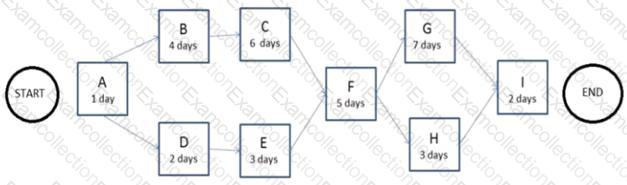
The total float for the project is how many days?
5
9
12
14
The Answer Is:
BExplanation:
According to the PMBOK® Guide (Project Management Body of Knowledge), specifically the Project Schedule Management knowledge area and the Develop Schedule process, calculating the total float requires identifying the Critical Path and comparing it to the other paths in the network diagram.
Identify all possible paths and their durations:
Path 1: A → B → C → F → G → I
Calculation: $1 + 4 + 6 + 5 + 7 + 2 = 25$ days
Path 2: A → B → C → F → H → I
Calculation: $1 + 4 + 6 + 5 + 3 + 2 = 21$ days
Path 3: A → D → E → F → G → I
Calculation: $1 + 2 + 3 + 5 + 7 + 2 = 20$ days
Path 4: A → D → E → F → H → I
Calculation: $1 + 2 + 3 + 5 + 3 + 2 = 16$ days
Determine the Critical Path:
The Critical Path is the longest path through the network. In this case, Path 1 (A-B-C-F-G-I) is the Critical Path with a duration of 25 days. The float on the Critical Path is $0$.
Calculate the Total Float for the project:
In PMI terminology, when a question asks for the " total float for the project " in the context of specific non-critical paths, it is typically referring to the amount of time a specific path can be delayed without delaying the project finish date.
The question asks for the total float of the project (often interpreted as the float of the secondary path or the difference between the longest and shortest paths if phrased generally). However, mathematically, the Total Float for the activities on the " near-critical " path (Path 3) compared to the Critical Path (Path 1) is:
$Critical Path (25) - Path 3 (20) = 5$ days.
By definition in the Standard for Scheduling, Total Float is the amount of time that a schedule activity can be delayed or extended from its early start date without delaying the project finish date. The primary non-critical sequence (starting with A-D-E) has 5 days of flexibility before it impacts the 25-day completion target set by the critical path.
Match each tool or technique with its corresponding Project Cost Management process.
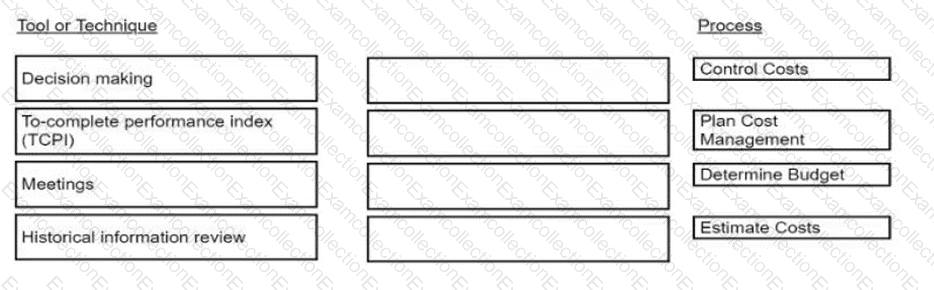
The Answer Is:
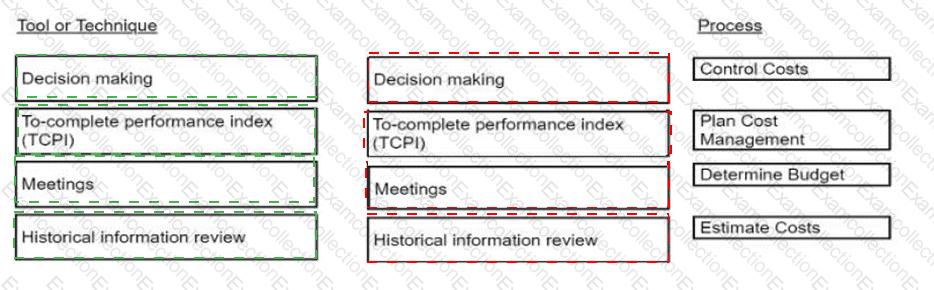
Explanation:
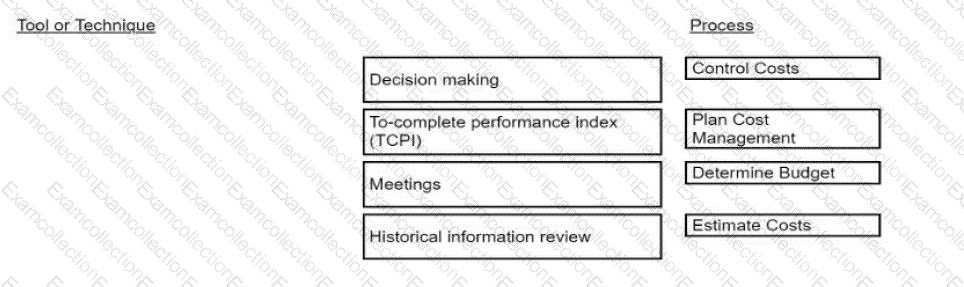 A close-up of a list Description automatically generated
According to the PMBOK® Guide, Project Cost Management consists of four processes. Each has a distinct set of Tools and Techniques (TandT) designed to move the project from high-level planning to granular financial control.
Plan Cost Management (Expert Judgment): This is the initial process that establishes the policies and documentation for planning and controlling costs. Expert Judgment, based upon historical information and specialized knowledge in a particular area, is the primary tool used to determine how costs will be managed throughout the project lifecycle.
Estimate Costs (Analogous Estimating): This process involves developing an approximation of the monetary resources needed to complete project work. Analogous Estimating (using values from a similar past project) is a key technique used here, especially when there is limited detail available.
Determine Budget (Cost Aggregation): This process aggregates the estimated costs of individual activities or work packages to establish an authorized cost baseline. Cost Aggregation is the specific technique where work package cost estimates are summed up through the WBS levels to reach the total project budget.
Control Costs (To-Complete Performance Index - TCPI): This is the monitoring and controlling process. TCPI is a specialized tool used to calculate the cost performance that must be achieved with the remaining resources to meet a specific management goal (either the original Budget at Completion or a new Estimate at Completion).
Per PMI standards, understanding the placement of these tools is essential for maintaining the Cost Baseline and ensuring the project is completed within the approved budget. Each tool serves a specific chronological purpose, from the " Top-Down " approach of Analogous Estimating to the " Bottom-Up " summation of Cost Aggregation.
What is a tailoring consideration for Project Scope Management ' ?
Life cycle approach
Continuous improvement
Validation and control
Project complexity
The Answer Is:
BExplanation:
According to the PMBOK® Guide, tailoring is necessary because every project is unique. The project manager must customize the processes within the Project Scope Management knowledge area to fit the specific needs of the project.
The PMI standards specifically list the following tailoring considerations for Project Scope Management:
Knowledge and Content Management: Does the organization have formal or informal knowledge management systems?
Continuous Improvement: Does the organization have a formal process for continuous improvement (such as Kaizen or Six Sigma), and how does that influence the definition and management of scope?
Stability of Requirements: Are the requirements stable, or do they evolve (as in Agile environments)?
Governance: Does the organization have formal policies and procedures for scope oversight?
Analysis of other options:
Life cycle approach: This is a tailoring consideration for Project Integration Management or the project as a whole, rather than specifically listed under Scope Management tailoring.
Validation and control: These are core processes (Validate Scope and Control Scope) within the knowledge area, not the high-level factors used to tailor those processes.
Project complexity: While project complexity influences tailoring for many knowledge areas, it is a broad environmental factor. In the context of Scope Management specifically, Continuous improvement is explicitly cited in the PMBOK® Guide as a specific tailoring dimension regarding how requirements and scope are refined over time.
By considering Continuous improvement, the project manager determines how frequently the scope should be reviewed and updated to ensure it remains aligned with business value.
Which of the following is an input to Direct and Manage Project Execution?
Performance reports
Project charter
Outputs from planning processes
Enterprise environmental factors
The Answer Is:
CExplanation:
According to the PMBOK® Guide, the Direct and Manage Project Work (referred to in older versions as " Direct and Manage Project Execution " ) is the process of leading and performing the work defined in the project management plan and implementing approved changes to achieve the project ' s objectives.
Outputs from Planning Processes: This is a major input to this process. Because the execution phase is where the project team carries out the work, they must use the various plans and baselines developed during the planning processes to guide their actions. This includes the project management plan itself, which integrates all subsidiary plans (Scope, Schedule, Cost, etc.) and baselines.
The Nature of Execution: Execution is where the " plan " meets " action. " Therefore, the primary driver for what work is performed, how it is performed, and what the standards are, comes directly from the outputs produced during the planning phase.
Other Key Inputs:
Project Management Plan: The comprehensive document that describes how the project will be executed.
Approved Change Requests: These are specific directives to modify the work, often resulting from the Perform Integrated Change Control process.
Organizational Process Assets (OPAs): Procedures, guidelines, and historical data.
Enterprise Environmental Factors (EEFs): Organizational culture and infrastructure.
Analysis of Other Options:
A. Performance reports: These are outputs of the Monitor and Control Project Work process. They are used to communicate status but are not the primary inputs that tell the team how to execute the work.
B. Project charter: While the Charter is the foundation of the project, it is an input to the Develop Project Management Plan and Identify Stakeholders processes. By the time the project is in the " Execution " phase, the more detailed Project Management Plan has superseded the high-level Charter as the primary guiding document.
D. Enterprise environmental factors: While EEFs are listed as an input in many processes, PMI practice questions of this specific nature (Question 638) emphasize that " Outputs from planning processes " is the more specific and comprehensive answer, as it directly provides the " instructions " for the work being directed.
Which output is the approved version of the time-phased project budget?
Resource calendar
Scope baseline
Trend analysis
Cost baseline
The Answer Is:
DExplanation:
According to the PMBOK® Guide (Project Management Body of Knowledge), specifically within the Project Cost Management knowledge area, the approved version of the budget is defined as follows:
Cost Baseline (Option D): This is the approved version of the time-phased project budget, excluding any management reserves, which can only be changed through formal change control procedures. It is used as a basis for comparison to actual results. It is developed during the Determine Budget process by aggregating the estimated costs of individual activities or work packages.
Resource Calendar (Option A): This identifies the working days and shifts on which each specific resource is available. It is an output of the Acquire Resources process and is used for scheduling, not for establishing the financial budget.
Scope Baseline (Option B): This consists of the approved Project Scope Statement, the WBS (Work Breakdown Structure), and the WBS Dictionary. While the WBS is an input to determining the budget, the scope baseline itself is used to measure scope performance, not financial performance.
Trend Analysis (Option C): This is a Data Analysis technique used in the Control Costs process to examine project performance over time to determine if performance is improving or deteriorating. It is a process tool/technique, not a budget output.
In PMI standards, the Cost Baseline is typically displayed as an S-curve, representing the cumulative values of the time-phased budget. Once management reserves are added to the cost baseline, the result is the total Project Budget.
Who provides the inputs for the original estimates of activity durations for tasks on the project plan?
Project sponsor
Project manager
Person responsible for project scheduling
Person who is most familiar with the task
The Answer Is:
DExplanation:
According to the PMBOK® Guide, specifically within the Estimate Activity Durations process, the primary principle for achieving accuracy in scheduling is to involve the individuals who will actually perform the work or those with the greatest expertise in the specific functional area.
In the PMI framework, duration estimates should be provided by the person or group on the project team who is most familiar with the nature of the work in the specific activity.
Expert Judgment: This is a primary Tool and Technique for estimating. The individual with the most familiarity provides " expert judgment " based on historical experience, technical nuances, and potential pitfalls that a generalist might overlook.
Accuracy and Buy-in: When the person responsible for the task provides the estimate, it leads to a more realistic schedule. Furthermore, it creates a sense of commitment and accountability; a team member is more likely to meet a deadline they helped set than one imposed upon them.
Bottom-Up Estimating: This approach is part of the broader " Bottom-Up " philosophy where the granular details are defined by the technical experts and then rolled up into the total project duration.
A. Project sponsor: The sponsor provides the project ' s funding, high-level requirements, and authorization (Project Charter). They generally do not have the granular, technical knowledge required to estimate specific task durations.
B. Project manager: While the Project Manager facilitates the estimating process and " owns " the final project schedule, they are often a generalist. They should not provide the original estimates themselves unless they are also the primary subject matter expert for that specific task.
C. Person responsible for project scheduling: A scheduler or " Project Scheduler " is responsible for the mechanical act of building the schedule model using software. They take the duration data provided by the team and input it into the tool; they do not typically generate the original duration data themselves.
The Estimate Activity Durations process utilizes several techniques to refine the inputs provided by the person most familiar with the task, including:
Analogous Estimating: Using a similar previous project.
Parametric Estimating: Using a statistical relationship (e.g., hours per square foot).
Three-Point Estimating: Using Optimistic, Pessimistic, and Most Likely values to account for uncertainty.
Regardless of the technique used, the Subject Matter Expert (SME) remains the foundational source of the raw data.
Which type of probability distribution is used to represent uncertain events such as the outcome of a test or a possible scenario in a decision tree?
Uniform
Continuous
Discrete
Linear
The Answer Is:
CExplanation:
According to the PMBOK® Guide (Project Management Body of Knowledge), specifically within the Project Risk Management knowledge area and the Perform Quantitative Risk Analysis process, project managers use various probability distributions to model uncertainty.
Discrete Distribution (Option C): This type of distribution is used to represent uncertain events where there are a finite number of possible outcomes. Examples provided by PMI include the outcome of a test (pass/fail), the occurrence of a specific risk event (yes/no), or different branches in a Decision Tree Analysis. Because these events have specific, countable results rather than a range of infinite values, they are categorized as discrete.
Continuous Distribution (Option B): These are used to represent values that can occur anywhere within a range, such as the duration of an activity or the cost of a work package. Common examples in project management include Beta and Triangular distributions (used in PERT).
Uniform Distribution (Option A): This is a specific type of continuous distribution where every value within a range has an equal probability of occurring. It is typically used when there is no clear tendency for a value to fall in the middle of a range (unlike a Normal or Beta distribution).
Linear (Option D): While " linear " describes a relationship between variables (like a straight line on a graph), it is not a standard probability distribution used for modeling uncertain events or decision tree scenarios in the PMI framework.
In the PMI framework, selecting the correct distribution is vital for the accuracy of a Monte Carlo simulation or a Decision Tree, ensuring that the quantitative analysis reflects the true nature of the project risks.
Which Process Group includes the Manage Stakeholder Engagement process?
Executing
Planning
Monitoring and Controlling
Initiating
The Answer Is:
AExplanation:
According to the PMBOK® Guide, specifically the Process Group and Knowledge Area Mapping, the Manage Stakeholder Engagement process is a core component of the Executing Process Group.
Definition: Manage Stakeholder Engagement is the process of communicating and working with stakeholders to meet their needs and expectations, address issues, and foster appropriate stakeholder involvement in project activities throughout the project life cycle.
Purpose: The primary benefit of this process is that it allows the project manager to increase support and minimize resistance from stakeholders. Since this involves the actual " doing " and interpersonal interaction required to move the project forward, it is classified under Executing.
Key Activities:
Engaging stakeholders at appropriate project stages.
Managing stakeholder expectations through negotiation and communication.
Addressing any risks or potential concerns related to stakeholder management and anticipating future issues.
Clarifying and resolving issues that have been identified.
Comparison with other options:
B. Planning: This group includes the Plan Stakeholder Engagement process, where the strategies for involvement are developed, rather than executed.
C. Monitoring and Controlling: This group includes the Monitor Stakeholder Engagement process, which focuses on monitoring project stakeholder relationships and tailoring strategies for engaging stakeholders through modification of engagement plans.
D. Initiating: This group includes the Identify Stakeholders process, which occurs at the very beginning of the project or phase to identify the people, groups, or organizations that could impact or be impacted by the project.
What is an emerging practice in stakeholder engagement?
Confirming that all identified stakeholders are engaged and actually affected by the work
Assuring that team leadership is primarily involved in stakeholder engagement
Ensuring that stakeholders do not change after stakeholder identification
Ensuring that stakeholders most affected by the work are involved as collaborative team partners
The Answer Is:
DExplanation:
According to the PMBOK® Guide, specifically the Project Stakeholder Management knowledge area, the concept of stakeholder engagement has evolved from simply " managing " people to actively " engaging " them as critical components of the project ' s success.
Collaborative Partnerships: An emerging practice in this field is moving beyond traditional communication and toward co-creation or collaborative partnerships. This involves inviting stakeholders who are most affected by the work—such as end-users, customers, or local communities—to participate as partners.
Benefits of Collaboration: When stakeholders are treated as partners rather than just recipients of information, the project benefits from:
Higher quality requirements.
Reduced resistance to change.
Increased trust and transparency.
Better alignment between the project ' s output and the actual needs of the users.
Agile Influence: This practice is heavily influenced by Agile methodologies, which emphasize customer collaboration over contract negotiation and ensure that the " voice of the customer " is present throughout the entire development lifecycle.
Why other options are incorrect:
Option A: Confirming all stakeholders are engaged and actually affected: This is a standard activity within the Identify Stakeholders and Monitor Stakeholder Engagement processes. It is a fundamental requirement of project management, not an " emerging practice. "
Option B: Assuring team leadership is primarily involved: Effective engagement is the responsibility of the entire project team, not just leadership. Emerging trends actually encourage decentralized engagement, where team members interact directly with their counterparts in the stakeholder organization.
Option C: Ensuring stakeholders do not change: Stakeholders are dynamic and will change throughout the project life cycle. Attempting to keep them static is unrealistic and counterproductive to the Identify Stakeholders process, which should be performed continuously.
Which is a major component of an agreement?
Change request handling
Risk register templates
Lessons learned register
Procurement management plan
The Answer Is:
AExplanation:
According to the PMBOK® Guide, an Agreement (which can take the form of a contract, a service level agreement (SLA), or a memorandum of understanding) is a formal document that defines the relationship between a buyer and a seller. To prevent disputes and ensure the project can adapt to necessary shifts, an agreement must include specific administrative components.
Change Request Handling: This is a critical component of any formal agreement. It specifies the process by which changes to the contract (scope, price, or terms) are requested, reviewed, and approved. Without a defined change control process within the agreement, the project is highly susceptible to legal disputes and scope creep.
Other Standard Components: Agreements also typically include the Statement of Work (SOW), schedule, price, payment terms, acceptance criteria, insurance/bonds, and termination clauses.
Why other options are incorrect:
Risk Register Templates (Option B): These are Organizational Process Assets (OPAs). While they are used during the project to manage risks, the templates themselves are not a component of a legal agreement between two parties.
Lessons Learned Register (Option C): This is a Project Document created and updated throughout the project life cycle to capture knowledge. It is internal to the project ' s management and not a part of the formal procurement agreement.
Procurement Management Plan (Option D): This is a component of the Project Management Plan. It describes how the project team will acquire goods and services from outside the performing organization, but it is a planning document, not the legal agreement itself.
How is the Project Scope Management process different in agile and adaptive projects then in traditional projects?
Less time spent on defining scope early on
More time spent on defining scope early on
Less time spent on scope management process
Project scope management is the same in all projects
The Answer Is:
AExplanation:
According to the PMBOK® Guide and the Agile Practice Guide, the primary difference in scope management between these methodologies lies in the timing and the level of detail of scope definition.
Traditional (Predictive) Projects: These projects aim to define the entire scope as early as possible (during the planning phase) to create a fixed Scope Baseline. The goal is to minimize changes once execution begins. This requires a significant upfront investment of time in Requirement Collection and Scope Definition.
Agile/Adaptive Projects: These projects recognize that requirements are likely to evolve or that the final solution is not fully understood at the start. Therefore, less time is spent on defining scope early on. Instead, the scope is refined incrementally throughout the project life cycle.
Backlog Management: In agile, the scope is maintained in a Product Backlog. High-level requirements are identified at the start, but detailed specifications are only developed " just-in-time " for the iteration in which they will be built. This is often referred to as Rolling Wave Planning.
Evolutionary Discovery: This approach allows the project team and stakeholders to spend their time refining scope based on actual prototypes and feedback rather than hypothetical requirements at the project ' s inception.
Analysis of Other Options:
B. More time spent on defining scope early on: This is characteristic of traditional/waterfall projects, where " Scope Creep " is avoided by attempting to lock down all details at the beginning.
C. Less time spent on scope management process: This is incorrect. The total time spent on scope management may be the same or even more in agile, but it is distributed throughout the project (during backlog grooming, sprint planning, and reviews) rather than being front-loaded.
D. Project scope management is the same in all projects: This is fundamentally incorrect. The PMBOK® Guide explicitly provides " Tailoring Considerations " for different environments, highlighting that scope management must adapt to the project ' s level of uncertainty.
A product owner asked for a change in one of the requirements during the elicitation phase. What should the business analyst do?
Provide the information to the product manager for approval.
Provide the information to the project manager to seek approval or rejection.
Reject the change as the project scope has already been defined.
Accept the modification and update the requirements traceability matrix.
The Answer Is:
DExplanation:
In the PMI Guide to Business Analysis, the Elicitation Phase is an iterative process where requirements are discovered, analyzed, and refined. Because this phase occurs before a formal baseline is established, the management of changes is handled differently than in the Execution phase.
Why Choice D is correct:
Iterative Nature: During elicitation, the primary goal is to capture the most accurate and up-to-date business needs. Since the requirements are still being defined and have not yet been " baselined " (officially signed off as the project scope), the Business Analyst (BA) should incorporate the Product Owner ' s feedback immediately.
Authority of the Product Owner: In most modern frameworks (especially Adaptive/Agile), the Product Owner is the ultimate authority on the product ' s value and requirements. If they request a change during elicitation, they are clarifying the vision.
Traceability: By updating the Requirements Traceability Matrix (RTM), the BA ensures that the change is documented and linked to the business objectives. This maintains transparency and ensures the team doesn ' t work on outdated versions of the requirement.
Analysis of other options:
A and B (Provide to Product/Project Manager for approval): Formal change control (CCB) and PM approval are typically required only after the requirements baseline has been set. During the elicitation phase, the requirements are still " fluid. " Asking for permission to change a requirement that hasn ' t been finalized yet creates unnecessary bureaucracy.
C (Reject the change): This is incorrect because the prompt specifies the project is in the " elicitation phase. " In this stage, the scope is being built, not guarded. Rejecting a stakeholder ' s input during elicitation would lead to a final product that doesn ' t meet the business need.
Key Concept: The Project Management Institute (PMI) emphasizes that the Elicitation Phase is about discovery. The Business Analyst must be flexible to ensure the requirements accurately reflect the stakeholders ' needs. By Accepting and Updating (Choice D), the BA ensures that the eventual Scope Baseline is built on the most current and accurate information available.
Which behavior is a management trait?
Asking what and why
Challenging the status quo
Innovating
Relying on control
The Answer Is:
DExplanation:
According to the PMBOK® Guide (specifically the section on Project Manager Competencies and the comparison between Leadership vs. Management), PMI distinguishes between the traits of a leader and the traits of a manager.
Management is primarily concerned with stability, efficiency, and predictability within an organization or project. The key differences highlighted in the PMI standards are:
Relying on Control (Management): Managers ensure that work is performed according to the plan. They use systems, processes, and " control " mechanisms (like status reports, quality checks, and budget tracking) to minimize risk and maintain order.
Innovating and Challenging the Status Quo (Leadership): These are leadership traits. Leaders look toward the future, seeking to improve and change existing paradigms rather than just maintaining them.
Asking What and Why (Leadership): Leaders focus on the purpose and the bigger picture ( " What are we doing and why? " ). Conversely, managers typically focus on " How and When " to ensure the execution is timely and correct.
The following table summarizes the distinction according to PMI ' s Project Manager Competency Development Framework:
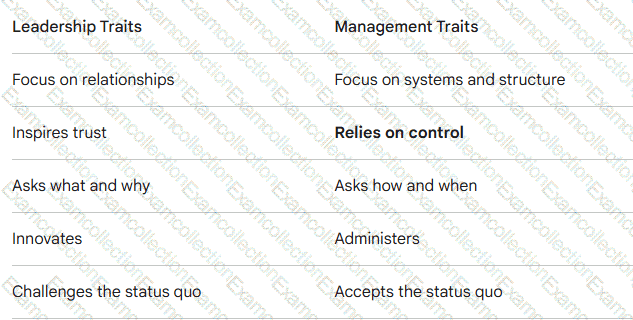
Therefore, Relying on control is the definitive management trait among the provided options.
Which of the following are components of the technical project management skill?
Ability to explain business aspects of the project, business strategy, goals and objectives, and business value.
Ability to deal with people, to be collaborative, and to apply persuasion and negotiation.
Ability to focus on relationships with people, inspire trust, and implement decisions and actions that support the business strategy.
Ability to plan and prioritize, gather the right artifacts available for each project, and focus on critical success factors.
The Answer Is:
DExplanation:
According to the PMBOK® Guide (6th Edition) and the PMI Talent Triangle®, Technical Project Management refers to the skills to effectively apply project management knowledge to deliver the desired outcomes for programs or projects. It is the " domain-specific " leg of the triangle that focuses on the mechanics of the role.
Key components of the Technical Project Management skill set include:
Focus on Critical Success Factors: Identifying the specific elements that must go right for the project to succeed.
Artifact Management: Knowing which documents (charter, WBS, logs) are necessary for the specific project and tailoring them accordingly.
Planning and Prioritization: The ability to organize work, manage schedules, and ensure that the team is working on the most valuable tasks at the right time.
Technical Tools: Mastery of specific techniques like Earned Value Management (EVM), critical path, and decomposition.
Analysis of Distractors:
A (Business Strategy/Value): This describes the Strategic and Business Management skill set. It involves understanding the organizational overview and how the project aligns with high-level goals.
B (Persuasion and Negotiation): This describes the Leadership skill set. These are interpersonal or " soft skills " used to guide and motivate a team.
C (Inspiring Trust/Relationships): This is another core component of Leadership. While technical skills get the work organized, leadership skills get the people moving toward the goal.
Key Document Reference: Section 3.4 of the PMBOK® Guide details that while all three legs of the Talent Triangle are necessary, the Technical Project Management leg is what allows a project manager to " plan and prioritize " the actual project work effectively.
Which of the following characteristics are found in a functional organizational structure?
Little or no project manager authority, little or no resource availability, and the functional manager controls the project budget
Limited project manager authority, limited resource availability, and a part-time project manager ' s role
Low to moderate project manager authority, low to moderate resource availability, and a full-time project manager ' s role
High to almost total project manager authority, high to almost total resource availability, and full-time project management administrative staff
The Answer Is:
AExplanation:
According to the PMBOK® Guide, specifically the section detailing Organizational Influences and Project Life Cycle, a Functional Organization is a classic hierarchy where each employee has one clear superior. Staff members are grouped by specialty, such as production, marketing, engineering, and accounting.
Project Manager Authority: In a functional structure, the project manager has little to no formal authority. They often function more as a " Project Coordinator " or " Project Expediter " rather than a true manager.
Resource Availability: Since resources (people, equipment, and funds) are " owned " by the functional departments, the project manager has little to no power to assign or move resources. They must negotiate with functional managers to get work done.
Budget Control: The Functional Manager maintains complete control over the project budget. The project manager typically has no autonomy to make financial decisions or reallocate funds.
Communication Flow: Communication usually follows the departmental hierarchy. If a project requires work from multiple departments, the request often goes up to the top of one department, across to the head of another, and then back down to the relevant staff.
Comparison with Other Options:
Limited project manager authority (B): This characterizes a Weak Matrix organization. In a weak matrix, the project manager has a bit more influence than in a functional setup but still works part-time and lacks budget control.
Low to moderate authority (C): This characterizes a Balanced Matrix organization. Here, the project manager is usually full-time and shares authority/budget control with functional managers.
High to almost total authority (D): This characterizes a Projectized (Project-Oriented) organization. In this structure, the project manager has full authority, a full-time staff, and total control over the budget, as the organization is built specifically around project delivery.
The item that provides more detailed descriptions of the components in the work breakdown structure (WB5) is called a WBS:
dictionary.
chart.
report.
register.
The Answer Is:
AExplanation:
According to the PMBOK® Guide, the WBS Dictionary is a document that provides detailed deliverable, activity, and scheduling information about each component in the Work Breakdown Structure (WBS).
The Purpose of the Dictionary: Because the WBS itself is a graphical or hierarchical chart, it often lacks the space to provide specific details. The WBS dictionary supports the WBS by providing the " narrative " or definition for each work package.
Contents of a WBS Dictionary: Information in the WBS dictionary may include, but is not limited to:
Code of account identifier.
Description of work.
Assumptions and constraints.
Responsible organization or individual.
Schedule milestones.
Associated schedule activities.
Resources required.
Cost estimates.
Quality requirements.
Acceptance criteria.
Technical references.
Scope Baseline: Together, the Project Scope Statement, the WBS, and the WBS Dictionary form the Scope Baseline for the project.
Analysis of Other Options:
B. chart: A WBS chart is simply the visual representation (the tree structure) of the work. It shows the hierarchy but does not typically contain the " detailed descriptions " required to execute the work.
C. report: While WBS information can be included in various project reports, there is no formal PMBOK® document called a " WBS report " that serves as the repository for component descriptions.
D. register: A register is typically used for tracking dynamic lists that change throughout the project (e.g., Risk Register, Stakeholder Register, Issue Log). The WBS details are considered static baseline information and are housed in the dictionary.
Which of the following sets are inputs to the Collect Requirements process?
Project charter and requirements documentation
Project charter and business documents
Project charter and stakeholder requirements
Business documents and requirements traceability matrix
The Answer Is:
BExplanation:
According to the PMBOK® Guide (6th Edition), the Collect Requirements process is the process of determining, documenting, and managing stakeholder needs and requirements to meet project objectives. Because this process occurs early in the planning phase, it relies on high-level foundational documents to provide context.
The specific inputs for the Collect Requirements process include:
Project Charter: Used to provide the high-level project description and high-level requirements that will be used to derive detailed requirements.
Business Documents: Specifically the Business Case, which describes the required, desired, and optional criteria for meeting business needs.
Project Management Plan: (Specifically the Scope, Requirements, and Stakeholder Engagement management plans).
Project Documents: (Specifically the Stakeholder Register, Lessons Learned Register, and Assumption Log).
Agreements: If the project is under a contract.
EEFs and OPAs.
Analysis of Distractors:
A (Requirements documentation): This is an output of the Collect Requirements process, not an input. You cannot use the finished documentation to start the process of collecting them.
C (Stakeholder requirements): This is a category of requirements that are identified during the process. The input used to find these stakeholders is the Stakeholder Register.
D (Requirements traceability matrix): Like requirements documentation, the matrix is a primary output of this process. It is used later in the project to track requirements, but it does not exist until the Collect Requirements process is performed.
Key Concept: The Project Charter provides the " why " and the high-level " what, " while the Business Documents provide the economic and strategic justification. Together, they form the boundary within which detailed requirements are gathered.
What is a deliverable-oriented, hierarchical decomposition of the work to be executed to accomplish the project objectives and create the required deliverables?
Organizational breakdown structure (OBS)
Work performance information
Work package
Work breakdown structure (WBS)
The Answer Is:
DExplanation:
In accordance with the PMBOK® Guide and the Practice Standard for Work Breakdown Structures, the Work Breakdown Structure (WBS) is a fundamental tool used in the Create WBS process within the Scope Management knowledge area.
Definition: The WBS is a deliverable-oriented hierarchical decomposition of the total scope of work to be carried out by the project team. It organizes and defines the total scope of the project.
Hierarchical Structure: Each descending level of the WBS represents an increasingly detailed definition of the project work. The total of the work at the lowest levels must roll up to the higher levels so that nothing is left out and no extra work is performed (the 100% Rule).
Purpose: It provides a structured vision of what has to be delivered. It serves as the framework for subsequent project management processes, including cost estimating, scheduling, and risk planning.
Comparison with Other Options:
Organizational Breakdown Structure (OBS) (A): This is arranged according to an organization ' s existing departments, units, or teams, with the project activities or work packages listed under each department. It shows which department is responsible for which work.
Work Performance Information (B): This is the performance data collected from various controlling processes, analyzed in context and integrated based on relationships across areas.
Work Package (C): This is the lowest level of the WBS. While it is part of the decomposition, it is the component of the WBS, not the hierarchical structure itself.
Which tool or technique is used in the Perform Integrated Change Control process?
Decomposition
Modeling techniques
Resource optimization
Meetings
The Answer Is:
DExplanation:
In accordance with the PMBOK® Guide (Project Integration Management), the Perform Integrated Change Control process is the process of reviewing all change requests; approving changes and managing changes to deliverables, project documents, and the project management plan; and communicating the decisions.
Meetings are a primary tool and technique specifically used for this process, often referred to as Change Control Board (CCB) meetings.
Role of the CCB: The Change Control Board is a formally chartered group responsible for reviewing, evaluating, approving, deferring, or rejecting changes to the project.
Meeting Function: During these meetings, the impact of each change request is discussed. The board reviews the configuration management activities and determines the feasibility of the change in relation to the project ' s scope, schedule, cost, and risk baselines.
Decision Documentation: The outcome of these meetings is recorded in the Change Log as approved or rejected change requests.
Other Tools and Techniques: This process also utilizes Expert Judgment, Change Control Tools (manual or automated), and Data Analysis (including Alternatives Analysis and Cost-Benefit Analysis).
Analysis of Distractors:
A. Decomposition: This is a tool and technique used in Create WBS and Define Activities. It involves breaking down project scope and deliverables into smaller, more manageable components.
B. Modeling techniques: These are typically used in Develop Schedule (e.g., Schedule Network Analysis or S Curve) or Estimate Costs to simulate different scenarios.
C. Resource optimization: This is a tool and technique used in Develop Schedule and Control Schedule (such as Resource Leveling or Resource Smoothing) to adjust the schedule model based on resource demand and supply.
An element of the project scope statement is:
Acceptance criteria.
A stakeholder list.
A summary budget,
High-level risks.
The Answer Is:
AExplanation:
According to the PMBOK® Guide (specifically within the Define Scope process), the Project Scope Statement is the document that describes the project scope, major deliverables, assumptions, and constraints. One of its primary components is Acceptance Criteria, which defines the conditions that must be met before deliverables are accepted.
The detailed elements of a Project Scope Statement typically include:
Product scope description: Progressively elaborates the characteristics of the product, service, or result.
Deliverables: Any unique and verifiable product, result, or capability.
Acceptance criteria: A set of conditions that is required to be met before deliverables are accepted.
Project exclusions: Explicitly states what is excluded from the project to manage stakeholder expectations.
The other options are incorrect because they belong to different project documents as per PMI standards:
A stakeholder list: This is part of the Stakeholder Register, which is an output of the Identify Stakeholders process.
A summary budget: This is typically found in the Project Charter, which contains high-level financial information before the detailed budget is determined during planning.
High-level risks: These are also documented in the Project Charter and later expanded upon in the Risk Register during the Identify Risks process.
As per the PMI Standard for Project Management, the project scope statement provides a common understanding of the project scope among project stakeholders.
Which document includes the project scope, major deliverables, assumptions, and constraints?
Project charter
Project scope statement
Scope management plan
Project document updates
The Answer Is:
BExplanation:
According to the PMBOK® Guide, specifically the Define Scope process, the Project Scope Statement is the primary output that provides a documented description of the project scope, major deliverables, and the work required to create those deliverables.
Detailed Content: While the Project Charter contains high-level information, the Project Scope Statement contains a much more detailed description of the scope components. It explicitly includes:
Product scope description: Progressively elaborates the characteristics of the product, service, or result.
Deliverables: Any unique and verifiable product, result, or capability.
Acceptance criteria: A set of conditions that is required to be met before deliverables are accepted.
Project Exclusions: Explicitly states what is excluded from the project to manage stakeholder expectations (the " out of scope " list).
Assumptions: Factors in the planning process that are considered to be true, real, or certain without proof.
Constraints: Limiting factors that affect the execution of a project, such as budget, schedule, or resources.
Comparison with other options:
A. Project charter: The charter is a high-level document. While it may contain a summary of scope and major deliverables, the " detailed " and " typical " repository for specific assumptions, constraints, and granular deliverables is the Scope Statement.
C. Scope management plan: This is a component of the Project Management Plan that describes how the scope will be defined, developed, monitored, controlled, and validated. It does not contain the actual scope itself.
D. Project document updates: This is a generic output category. While the scope statement is a project document, this option is too broad to be the correct answer for a document defined by these specific contents.
For what project management process is work performance information an output?
Implement Risk Responses
Plan Stakeholder Engagement
Monitor Stakeholder Engagement
Plan Quality Management
The Answer Is:
CExplanation:
According to the PMBOK® Guide, the distinction between Work Performance Data, Work Performance Information, and Work Performance Reports is a critical flow of information within a project.
Work Performance Information (WPI): This is an Output of the Monitoring and Controlling process group. WPI is created when Work Performance Data (raw observations collected during execution) is analyzed in context and integrated based on relationships across areas.
Monitor Stakeholder Engagement: This is a Monitoring and Controlling process. Its purpose is to monitor project stakeholder relationships and tailor strategies for engaging stakeholders. During this process, the raw data regarding stakeholder engagement (e.g., which stakeholders attend meetings or support the project) is compared against the Stakeholder Engagement Plan. The result of this analysis is Work Performance Information, which describes how stakeholder engagement is actually performing compared to the plan.
Analysis of other options:
Implement Risk Responses (Option A): This is an Executing process. Its primary outputs are Change Requests and Project Document Updates. It typically takes Work Performance Reports as an input but does not output WPI.
Plan Stakeholder Engagement (Option B): This is a Planning process. Its primary output is the Stakeholder Engagement Plan.
Plan Quality Management (Option D): This is a Planning process. Its primary outputs are the Quality Management Plan and Quality Metrics.
As per PMI standards, almost every " Monitor " or " Control " process (e.g., Control Schedule, Control Costs, Monitor Communications) takes Work Performance Data as an input and produces Work Performance Information as an output.
When developing the project schedule, a project manager uses decomposition and rolling wave planning techniques in this process.
Develop Schedule
Define Activities
Define Scope
Collect Requirements
The Answer Is:
BExplanation:
According to the PMBOK® Guide, the Define Activities process is the stage where the project manager identifies and documents the specific actions to be performed to produce the project deliverables. To do this effectively, two primary techniques are utilized:
Decomposition: This is the same technique used in " Create WBS, " but with a different level of granularity. In this process, the Work Packages (the lowest level of the WBS) are further subdivided into Activities. While a work package is a deliverable, an activity is the actual work required to create that deliverable.
Rolling Wave Planning: This is a form of progressive elaboration. It is used when the project team cannot define the work in detail for the entire project duration.
Work to be performed in the near term is planned in detail.
Work further in the future is planned at a higher level (often as Planning Packages).
As the project progresses and more information becomes available, the planning packages are decomposed into detailed activities.
The Output: The primary outputs of this process are the Activity List, Activity Attributes, and the Milestone List.
Analysis of Other Options:
A. Develop Schedule: This process involves analyzing activity sequences, durations, resource requirements, and schedule constraints to create the project schedule model. While it uses the results of decomposition, it does not perform the decomposition itself.
C. Define Scope: This process involves developing a detailed description of the project and product. The technique used here is Product Analysis and Alternatives Generation, leading to the Project Scope Statement.
D. Collect Requirements: This process focuses on determining, documenting, and managing stakeholder needs. Techniques include Interviews, Focus Groups, and Questionnaires. It occurs before the work is decomposed into activities.
Which of the following activities are included as part of a project manager ' s responsibilities?
Direct, control, and focus on structure.
Problem solve , achieve the bottom line, and focus on success.
Control, maintain project status, and develop.
Inspire, engage, and build relationships with people.
The Answer Is:
DExplanation:
According to the PMBOK® Guide (6th and 7th Editions) and the PMI Talent Triangle®, the role of a Project Manager has evolved from a purely technical " controller " to a leader who must balance technical skills with power skills (soft skills).
Why Choice D is correct: Modern Project Management emphasizes Leadership over Management.
Inspire: A leader creates a vision and motivates the team to achieve project goals.
Engage: Effective Stakeholder Engagement (as defined in the PMBOK® Guide) is critical for project success.
Build Relationships: The PMI Talent Triangle highlights " Leadership " (now termed " Power Skills " ), which involves interpersonal skills, influencing, and relationship-building to navigate organizational politics and team dynamics.
Analysis of other options:
A and C: These reflect traditional Management functions (Directing, Controlling, Maintaining). While a PM does some of this, PMI documents distinguish these as " administrative " tasks. " Focusing on structure " and " maintaining status " describe a manager who maintains the status quo rather than a leader who drives change.
B: While " problem-solving " is part of the job, " achieving the bottom line " is often a functional or executive goal. Focusing strictly on the bottom line at the expense of the team is contrary to the Servant Leadership model promoted in the Agile Practice Guide and PMBOK® 7.
In summary, the Standard for Project Management explicitly states that project managers are responsible for leading the team to meet the project ' s objectives, which requires the ability to inspire and build trust across the stakeholder landscape.
