


PMI CAPM - Certified Associate in Project Management (CAPM)
Which three of the following interpersonal skills does a project manager rely on when developing the project management plan? (Choose three)
Focus groups
Facilitation
Meeting management
Conflict management
Interviews
The Answer Is:
B, C, DExplanation:
According to the PMBOK® Guide, the process of Develop Project Management Plan requires the integration of various subsidiary plans and baselines. Because this process involves high-level coordination and negotiation among diverse stakeholders, the project manager must rely heavily on Interpersonal and Team Skills.
Why Choices B, C, and D are correct:
B (Facilitation): This is the ability to guide a group to a successful decision, solution, or conclusion. In developing the project plan, the PM facilitates sessions to ensure that the team and stakeholders reach a consensus on the project’s approach and objectives.
C (Meeting Management): The project management plan is often built through a series of planning meetings. Effective meeting management (preparing agendas, ensuring the right people are present, and following up on actions) is essential to keep the planning process on track and prevent " analysis paralysis. "
D (Conflict Management): Stakeholders often have competing interests (e.g., Finance wants low costs, while Operations wants high-quality features). The PM must use conflict management techniques to resolve these differences and create a cohesive, realistic plan that all parties can support.
Analysis of other options:
A (Focus groups): This is categorized as a Data Gathering technique, not an interpersonal skill. It is used to bring together stakeholders or SMEs to learn about their expectations, but it is a research method rather than a soft skill.
E (Interviews): Similar to focus groups, interviews are a Data Gathering technique. While they require communication skills, in the context of the PMBOK® tools and techniques, they are classified as a method for obtaining information rather than a core interpersonal skill used to develop the integrated plan.
Key Concept: The Project Management Institute (PMI) emphasizes that a Project Manager ' s " Power Skills " are what turn a collection of data into a functional plan. Facilitation, Meeting Management, and Conflict Management (Choices B, C, and D) are the tools that allow a PM to manage the human element of project planning, ensuring that the resulting Project Management Plan is both technically sound and socially accepted by the organization.
A project manager proactively meets with other project managers who manage other projects in the same program. To minimize the impact that other projects within the program may have on their project of what should the project manager be aware?
Demands on the same resources
Requirements that impact the scope
Uncertainty of emerging issues
Project charter
The Answer Is:
AExplanation:
According to the PMBOK® Guide, specifically within the context of Program Management and Project Resource Management, projects existing within the same program are often interdependent. The most common point of friction and risk between these projects is the competition for shared resources.
Resource Constraints: In a program environment, multiple projects often draw from the same pool of specialized personnel, equipment, or facilities. If one project falls behind or requires more resources than planned, it can create a " ripple effect, " causing delays for all other projects in the program.
Proactive Coordination: By meeting with other project managers, the PM is engaging in Resource Leveling or Resource Smoothing at a program level. Being aware of these demands allows the project manager to identify potential resource bottlenecks early and negotiate schedules or priorities with the Program Manager.
Interdependencies: Managing these interdependencies is a key part of the project manager’s role in a multi-project environment to ensure that " Resource Scarcity " does not become a major issue for the project ' s critical path.
Why other options are incorrect:
Option B: Requirements that impact the scope: While scope changes can occur, they are typically managed through the Integrated Change Control process specific to that project. While there are " program-level " requirements, the immediate day-to-day impact from neighboring projects is most frequently felt in the resource pool.
Option C: Uncertainty of emerging issues: This is a general definition of risk. While a PM should always be aware of uncertainty, it is too broad. The specific reason for meeting with colleagues in the same program is to address the tangible, shared constraints like resource availability.
Option D: Project charter: The Project Charter is a document that authorizes the project and defines high-level objectives. It is an internal foundational document and is not a dynamic factor that a PM needs to " watch out for " in relation to other projects in the program.
A large portion of a projects budget is typically expended on the processes in which Process Group?
Executing
Planning
Monitoring and Controlling
Closing
The Answer Is:
AExplanation:
According to the PMBOK® Guide, specifically in the section regarding Project Life Cycle and Project Characteristics, the distribution of resource usage and cost varies significantly across the different Process Groups.
Resource and Budget Consumption: The Executing Process Group is where the project team performs the actual work defined in the Project Management Plan. This involves the consumption of physical resources, labor, and materials. Consequently, a large portion of the project’s budget is typically expended during this phase.
Process Purpose: The " Direct and Manage Project Work " process, which is the heart of the Executing group, is where the deliverables are produced. Activities such as hiring specialized contractors, purchasing high-value equipment, and utilizing man-hours for development or construction happen here, leading to the highest rate of " burn " for the project budget.
Cost Profile: While Planning and Monitoring and Controlling are critical for success, they involve smaller teams of managers and leads. The " doing " phase (Executing) involves the full project team and the bulk of procurement costs.
Why the other options are incorrect:
B. Planning: While planning is intensive and crucial, it typically involves a smaller subset of the project team (leads and managers). The costs are significant but generally represent a much smaller percentage of the total budget compared to the actual implementation.
C. Monitoring and Controlling: These processes occur concurrently with Planning, Executing, and Closing. They are " oversight " processes. While they require effort, they do not involve the massive resource expenditures found in the direct production of deliverables.
D. Closing: This group involves administrative tasks, archiving, and releasing resources. By this point, the vast majority of the budget has already been spent on the creation of the product or service.
Which input to the Manage Stakeholder Engagement process provides guidance on how stakeholders can best be involved in a project?
Feedback analysis
Stakeholder analysis
Communication management plan
Stakeholder management plan
The Answer Is:
DExplanation:
According to the PMBOK® Guide and the Standard for Project Management, the Stakeholder Management Plan (referred to in the most recent editions as the Stakeholder Engagement Plan) is the primary input to the Manage Stakeholder Engagement process that provides the strategy for involving stakeholders.
As per PMI standards, the Stakeholder Management Plan is a formal document that identifies the management strategies required to effectively engage stakeholders. It provides specific guidance on:
Desired and current engagement levels: Identifying where stakeholders are (e.g., Unaware, Resistant, Neutral, Supportive, or Leading) and where the project needs them to be.
Scope and impact of stakeholder change: How the project affects stakeholders and vice versa.
Engagement strategies: Specific activities and approaches for involving stakeholders based on their power, interest, and influence.
The other options are incorrect based on their specific roles within the PMI framework:
Feedback analysis: This is a Tool and Technique (Data Analysis) used in the Monitor Stakeholder Engagement process to evaluate information received from stakeholders, rather than an input providing guidance for engagement.
Stakeholder analysis: This is a Tool and Technique used during the Identify Stakeholders and Plan Stakeholder Engagement processes to create the plan; it is not the plan itself.
Communication management plan: While this plan describes how information will be distributed (the " what, when, and how " ), the Stakeholder Management Plan focuses on the why and the behavioral strategies to ensure stakeholders are appropriately involved and supportive.
As per the PMI Lexicon of Project Management Terms, the Stakeholder Management Plan ensures that stakeholders are involved at the right time and in the right way to foster support and minimize resistance.
An issue log is an input to which Project Human Resource Management process?
Manage Project Team
Acquire Project Team
Plan Human Resource Management
Develop Project Team
The Answer Is:
AExplanation:
According to the PMBOK® Guide, the Manage Project Team process involves tracking team member performance, providing feedback, resolving issues, and managing team changes to optimize project performance.
The Role of the Issue Log: The Issue Log is a critical input to this process because it documents who is responsible for resolving specific issues by a target date. In the context of Human Resource Management (now referred to as Project Resource Management in newer editions), issues often arise regarding:
Resource availability and conflicts.
Individual performance or interpersonal friction.
Disagreements over technical approaches or roles and responsibilities.
Problem Solving: The project manager uses the issue log to monitor these items and ensure they are addressed. Resolving these issues is a key part of " managing " the team to keep them focused and productive.
Updates: As issues are resolved or as new interpersonal issues are identified during the execution of the work, the issue log is updated as an output of this process as well.
Comparison with other options:
B. Acquire Project Team: This process focuses on outlining and reaching an agreement for the people who will work on the project. Its inputs include the Human Resource Management Plan and Enterprise Environmental Factors, but not the issue log, as the team has not yet begun the work where issues would be logged.
C. Plan Human Resource Management: This is a planning process used to identify and document project roles, responsibilities, required skills, and reporting relationships. It creates the framework before any execution or issues occur.
D. Develop Project Team: This process focuses on improving competencies, team member interaction, and the overall team environment to enhance project performance. While closely related to Managing the team, its primary inputs are the Human Resource Management Plan and Project Staff Assignments. The actual tracking and resolution of specific documented " issues " fall under the Manage Project Team process.
What is the purpose of the Manage Quality process?
To translate the quality management plan into executable quality activities
To monitor and record the results of executed quality management activities
To determine if project activities comply with organizational and project policies.
To identify project deliverables and quality requirements and/or standards
The Answer Is:
AExplanation:
According to the PMBOK® Guide, Manage Quality (sometimes referred to as Quality Assurance) is the process of translating the quality management plan into executable quality activities that incorporate the organization’s quality policies into the project.
Translating the Plan: While " Plan Quality Management " identifies the standards, Manage Quality is about the implementation. It takes the high-level goals and turns them into specific actions, such as audits, process analysis, and design for X, to ensure the project is on track to meet those standards.
Process Focus: Manage Quality is primarily concerned with the processes used in the project. By ensuring that the processes are efficient and effective, the project manager increases the probability of meeting the quality objectives and reducing the cost of non-conformance.
Key Activities: This process includes activities such as quality audits, trend analysis, and problem-solving. It is an umbrella term for the work done to provide confidence that the project will satisfy its stakeholders ' requirements.
Why other options are incorrect:
Option B: To monitor and record the results of executed quality management activities: This describes the Control Quality process. Control Quality is focused on the product and deliverables, whereas Manage Quality is focused on the process.
Option C: To determine if project activities comply with organizational and project policies: While this is a part of a Quality Audit (which is a tool used within Manage Quality), it is a specific activity rather than the overall " purpose " of the process as defined in the PMBOK® Guide.
Option D: To identify project deliverables and quality requirements and/or standards: This describes the Plan Quality Management process, which occurs during the planning phase to set the foundation for the quality activities.
In which phase of team building activities do team members begin to work together and adjust their work habits and behavior to support the team?
Performing
Storming
Norming
Forming
The Answer Is:
CExplanation:
According to the PMBOK® Guide (Project Management Body of Knowledge), specifically within the Project Resource Management knowledge area, the development of a project team typically follows the Tuckman Ladder model, which consists of five stages:
Norming (Option C): In this stage, team members begin to work together and adjust their work habits and behavior to support the team. Trust begins to develop as they resolve their differences and recognize the virtues of their teammates. They begin to develop a " team identity " and establish unwritten rules or " norms " for how the work will be accomplished.
Forming (Option D): This is the initial phase where the team meets and learns about the project and their formal roles and responsibilities. Team members tend to be independent and not as open in this phase.
Storming (Option B): In this phase, the team begins to address the project work, technical decisions, and the project management approach. If team members are not collaborative or open to different ideas and perspectives, the environment can become counterproductive.
Performing (Option A): Teams that reach this stage function as a well-organized unit. They are interdependent and work through issues smoothly and effectively. The project manager ' s role shifts more toward delegation.
In the PMI framework, understanding these stages is crucial for the Develop Team process. The Project Manager must adapt their leadership style—from directing in the Forming stage to supporting in the Norming stage—to help the team transition toward high performance as quickly as possible.
Which of the following Project Communication Management processes uses performance reports as an input?
Manage Stakeholder Expectations
Report Performance
Distribute Information
Plan Communications
The Answer Is:
CExplanation:
According to the PMBOK® Guide (specifically within the Communications Management knowledge area), the process of getting the right information to the right stakeholders at the right time is central to project success. In older versions of the PMBOK® Guide (which these specific numbered questions often reference), Distribute Information is the process that handles the collection and delivery of project data.
The Distribute Information process is focused on making relevant information available to project stakeholders as planned.
Input vs. Output: While " Performance Reports " are the primary output of the Report Performance process, they immediately become a critical input for Distribute Information.
The Flow of Data:
Work performance data is collected.
It is analyzed and turned into a Performance Report (in the Report Performance process).
That report is then fed into Distribute Information to be sent out via email, meetings, or portals to the stakeholders who need to see it.
A. Manage Stakeholder Expectations: This process (now called Manage Stakeholder Engagement) uses the Communications Management Plan and the Stakeholder Management Plan as primary guides. While performance reports might be discussed during engagement, they are not the primary mechanical input for this process.
B. Report Performance: This is the process that creates the performance reports. In the PMI framework, an output of a process is generally not listed as its own input; it is the result of the tools and techniques applied to work performance data.
D. Plan Communications: This is the initial process where you determine who needs what information. Since it happens during the Planning phase, performance reports (which reflect actual work) do not yet exist and cannot be an input.
In the most recent versions of the PMBOK® Guide, these processes have been consolidated and renamed:
Distribute Information and Report Performance are now largely contained within Manage Communications.
Manage Stakeholder Expectations is now Manage Stakeholder Engagement.
Testing falls into which of the following categories of cost of quality?
Internal failure costs
Prevention costs
Appraisal costs
External failure costs
The Answer Is:
CExplanation:
According to the PMBOK® Guide, specifically within the Plan Quality Management process and the Cost of Quality (COQ) framework, testing is classified as an Appraisal cost.
Definition of Appraisal Costs: These are the costs incurred to determine the degree of conformance to quality requirements. They are associated with measuring, evaluating, or auditing products or services to assure conformance to quality standards and performance requirements.
Examples of Appraisal Costs:
Testing (destructive and non-destructive).
Inspections.
Lab setup and maintenance for quality checks.
Formal quality audits.
Analysis of Other Categories:
A. Internal failure costs: Costs related to defects found before the product is shipped to the customer (e.g., rework, scrap).
B. Prevention costs: Costs related to preventing poor quality in the first place (e.g., training, process documentation, equipment maintenance).
D. External failure costs: Costs related to defects found after the customer has received the product (e.g., warranties, liability, lost business).
Which project manager competency is displayed through the knowledge, skills, and behaviors related to specific domains of project, program, and portfolio management?
Leadership management
Technical project management
Strategic management
Business management
The Answer Is:
BExplanation:
According to the PMBOK® Guide (6th Edition) and the PMI Talent Triangle®, PMI defines three key skill sets required for project managers to be effective. These competencies ensure that a project manager can navigate the complexities of modern projects.
The Technical Project Management competency is specifically defined as the knowledge, skills, and behaviors related to the specific domains of Project, Program, and Portfolio Management. It represents the technical aspects of performing one’s role. Examples include the ability to:
Define the scope, schedule, and cost.
Use appropriate project management tools and techniques (e.g., Earned Value Management, Critical Path Method).
Tailor the project management processes to the specific needs of the project.
Analysis of the PMI Talent Triangle components:
Technical Project Management (The Answer): Focuses on the " how-to " of the project management domain.
Leadership: Focuses on the " soft skills " or power skills, such as the ability to guide, motivate, and direct a team to help an organization achieve its business goals.
Strategic and Business Management: Focuses on the " big picture " or business acumen, including the ability to see the high-level overview of the organization and effectively negotiate and implement decisions that support strategic alignment and innovation.
Analysis of Distractors:
A (Leadership management): While a core part of the Talent Triangle, it focuses on interpersonal skills and the ability to influence people, rather than domain-specific technical knowledge.
C and D (Strategic and Business Management): These are often grouped together in the Talent Triangle. They involve understanding the business environment, industry trends, and organizational strategy, rather than the technical tools of project management.
Which of the following is an example of tacit knowledge
Risk register
Project requirements
Expert judgment
Make-or-buy analysis
The Answer Is:
CExplanation:
In the PMBOK® Guide, particularly within the Manage Project Knowledge process, a clear distinction is made between two types of knowledge: Explicit and Tacit.
Tacit Knowledge (Choice C): This is personal knowledge that is difficult to express or formalize. It includes Expert Judgment, insights, experience, " know-how, " and beliefs. It is often shared through interpersonal interaction, mentoring, and social connection. Because it is embedded in the individual ' s mind and influenced by their unique context, it cannot be easily written down or stored in a database.
Explicit Knowledge (Choice A, B, and D): This is knowledge that can be codified using symbols such as words, numbers, and pictures. It can be easily documented and shared.
Risk Register (Choice A): A formal document containing identified risks and their characteristics.
Project Requirements (Choice B): Documented needs or conditions that must be met.
Make-or-buy Analysis (Choice D): A documented technique and result used to determine whether work should be performed internally or purchased from outside sources.
The goal of the Manage Project Knowledge process is to use existing organizational knowledge and create new knowledge to achieve the project ' s objectives. While explicit knowledge is managed via Information Management, tacit knowledge is managed through Knowledge Management (e.g., networking and communities of practice) because it resides within the experts themselves.
A subject matter expert (SME) was recently assigned to a project to manage the new compliance requirement. The SME claimed that the activity ' s prioritization needed to change and the schedule could be cut to mitigate the effect of this new compliance need.
How should the project manager proceed?
Perform Integrated Change Control.
Conduct a risk assessment with the team.
Update the schedule to include compliance.
Manage Stakeholder Engagement.
The Answer Is:
AExplanation:
According to the PMBOK® Guide, specifically the Perform Integrated Change Control (PICC) process, any change to a project baseline (scope, schedule, or cost) must be formally reviewed and processed.
Why Choice A is correct: The SME is suggesting two significant changes: a change in prioritization (Scope/Resource baseline) and a reduction in the schedule (Schedule baseline). Even though the change is intended to " mitigate " a compliance need, the Project Manager cannot simply update the plan. They must follow the formal change management plan. This involves:
Assessing the impact of the SME ' s suggestion on all project constraints.
Documenting the request in the Change Log.
Presenting the change to the Change Control Board (CCB) or the relevant authority for approval or rejection. This ensures that the " mitigation " doesn ' t inadvertently introduce new risks or quality issues.
Analysis of other options:
B (Conduct a risk assessment): While assessing risk is a part of analyzing a change request, the question asks how the PM should proceed with the SME ' s claim. The formal procedure for handling modifications to the project plan is Integrated Change Control.
C (Update the schedule): This is " gold plating " or bypasses formal governance. A Project Manager should never update a baseline without an approved change request.
D (Manage Stakeholder Engagement): This is a continuous process of communicating and working with stakeholders. While the PM will engage the SME, the specific action required to handle a change to the project ' s execution logic is Change Control.
In summary, the Project Management Plan defines the " rules of the game. " When a technical expert suggests a shortcut or a pivot, the Project Manager acts as the guardian of the baselines, ensuring every move is vetted through the Perform Integrated Change Control process.
When does Monitor and Control Risks occur?
At project initiation
During work performance analysis
Throughout the life of the project
At project milestones
The Answer Is:
CExplanation:
According to the PMBOK® Guide, specifically within the Project Risk Management Knowledge Area, Monitor Risks (formerly Monitor and Control Risks) is the process of monitoring the implementation of agreed-upon risk response plans, tracking identified risks, identifying and analyzing new risks, and evaluating risk process effectiveness.
Continuous Process: Risk management is not a one-time event. Because the project environment is dynamic, new risks can emerge at any time, and existing risks can change in probability or impact. Therefore, this process is performed throughout the life of the project.
Integration with Execution: As project work is executed, the team gathers work performance data. This data is used to determine if:
Assumptions are still valid.
Risk contingency reserves are adequate.
Project policies and procedures are being followed.
Risk responses are as effective as expected.
Lifecycle Persistence: From the moment the project is authorized until the final administrative closure, the project manager and team must remain vigilant. While the intensity of risk monitoring might peak during high-complexity phases, the process itself never stops until the project ends.
Analysis of other choices:
Choice A (At project initiation): While high-level risks are identified in the Project Charter during initiation, the monitoring and controlling of those risks cannot happen until there is a plan to monitor and work being performed to control.
Choice B (During work performance analysis): Work performance analysis is a tool/technique and an input used within the process of monitoring risks, but it does not define when the process occurs.
Choice D (At project milestones): While formal risk audits or reviews often take place at major milestones or phase gates, limiting risk monitoring only to these points would leave the project vulnerable to risks that emerge between milestones.
Who identifies project requirements in the early phase of the project?
Business analyst, product team, and key stakeholders
Project manager, business analyst, and key stakeholders
Project manager, business analyst, and project sponsor
Project sponsor, business analyst, and key stakeholders
The Answer Is:
BExplanation:
In the Initiating and early Planning phases of a project, the identification of requirements is a collaborative effort. While the Business Analyst (BA) often leads the elicitation, they do not work in a vacuum.
Why Choice B is correct:
The Business Analyst: Responsible for the " what. " They use elicitation techniques (interviews, focus groups, surveys) to draw out the requirements from those who will use or be affected by the solution.
The Project Manager: Responsible for the " how " and " when. " The PM ensures that requirements align with the project charter and constraints (budget, time, and resources). They manage the process of capturing these requirements to build the Scope Statement.
Key Stakeholders: These are the primary sources of requirements. Stakeholders include end-users, department heads, and subject matter experts (SMEs). Without their input, the requirements would be incomplete or inaccurate.
The Synergy: The PM and BA work together to ensure that the requirements provided by the stakeholders are clear, measurable, and achievable within the project ' s boundaries.
Analysis of other options:
A (Product team): While the product/development team may provide technical constraints later, they are typically not the primary " identifiers " of business requirements in the early phases. They consume the requirements to build the solution.
C and D (Focusing on the Sponsor): While the Project Sponsor provides the high-level business case and project objectives (the " why " ), they are usually not involved in the granular identification of requirements. They delegate this to the stakeholders who will actually use the product. Choice B is more comprehensive by including the " Key Stakeholders " group, which covers a much broader and more accurate range of requirement sources.
Key Concept: The Project Management Institute (PMI) emphasizes that " Requirement Identification " is a foundational step in Scope Management. By involving the Project Manager, Business Analyst, and Key Stakeholders (Choice B), the organization ensures that the project has a balanced view of technical feasibility, business value, and user needs, which is documented in the Requirements Documentation and the Requirements Traceability Matrix (RTM).
The process of monitoring the status of the project and product scope as well as managing the changes to the scope baseline is known as:
Validate Scope.
Plan Scope Management.
Control Scope.
Define Scope.
The Answer Is:
CExplanation:
According to the PMBOK® Guide (Project Management Body of Knowledge), specifically within the Project Scope Management knowledge area, the definition of monitoring and managing baseline changes is attributed to the Control Scope process:
Control Scope (Option C): This is the process of monitoring the status of the project and product scope and managing changes to the scope baseline. It ensures that all requested changes and recommended corrective or preventive actions are processed through the Perform Integrated Change Control process. It is also used to manage " scope creep " —the uncontrolled expansion to product or project scope without adjustments to time, cost, and resources.
Validate Scope (Option A): This is the process of formalizing acceptance of the completed project deliverables. While it is a monitoring and controlling process, its primary focus is on customer acceptance rather than managing changes to the baseline.
Plan Scope Management (Option B): This is a planning process that creates a scope management plan that documents how the project and product scope will be defined, validated, and controlled. It sets the " how-to " but does not perform the monitoring itself.
Define Scope (Option D): This is the process of developing a detailed description of the project and product. This occurs during the planning phase and results in the Project Scope Statement, which becomes an input to the scope baseline.
In the standard PMI framework, Control Scope is essential for maintaining the integrity of the scope baseline throughout the project life cycle.
A project sponsor has asked the project manager to determine how soon the project can be completed. Which of the following methods can a project manager use to find this information?
Scope baseline
Decomposition
Critical path method (CPM)
Work breakdown structure (WBS)
The Answer Is:
CExplanation:
According to the PMBOK® Guide, specifically within the Develop Schedule process, the Critical Path Method (CPM) is the primary technique used to estimate the minimum project duration and determine the amount of scheduling flexibility on the logical network paths within the schedule model.
Determining Duration: CPM calculates the theoretical start and finish dates for all activities without regard for any resource limitations. By performing a forward and backward pass analysis through the schedule network, the project manager identifies the sequence of activities that represents the longest path through the project.
The Critical Path: The " critical path " is the sequence of activities that determines the shortest time possible to complete the project. Any delay in an activity on the critical path will directly impact the project ' s finish date.
Total Float: This method also identifies the " float " or " slack " (the amount of time an activity can be delayed without delaying the project finish date) for non-critical activities.
Answering the Sponsor: When a sponsor asks " how soon " a project can be finished, the PM uses CPM to provide a data-driven completion date based on the logical sequence of work.
Analysis of other options:
Scope baseline (Option A): This is a component of the project management plan that includes the project scope statement, WBS, and WBS dictionary. While it defines what work needs to be done, it does not provide information on when or how fast that work can be completed.
Decomposition (Option B): This is a technique used in both Create WBS and Define Activities. It involves breaking down project deliverables into smaller, more manageable components. It is a prerequisite for scheduling but does not calculate the project duration itself.
Work breakdown structure (Option D): The WBS is a deliverable-oriented hierarchical decomposition of the total scope. Like the scope baseline, it identifies the work packages but does not include the logical dependencies or durations required to calculate a project ' s end date.
Per PMI standards, the Critical Path Method is the essential tool for schedule analysis, providing the project manager with the specific date the project can be completed based on the current sequence of activities.
Match the life cycle type to when its requirements are defined.

The Answer Is:

Explanation:
 A screenshot of a login box Description automatically generated
According to PMI standards, the choice of life cycle determines how the project scope is managed and when the " What " of the project is finalized.
Predictive (Waterfall): This lifecycle is used when the product is well understood. Requirements are locked in during the planning phase. Any changes later usually require a formal change request. This provides high predictability but low flexibility.
Iterative: The goal here is to arrive at the correct solution through successive prototypes or versions. Requirements are revisited and refined based on feedback from the previous iteration. It focuses on the " correctness " of the solution.
Incremental: This life cycle delivers a finished, usable portion of the product in each interval. Requirements for a specific " slice " of the project are defined and delivered, with subsequent increments adding more features until the total scope is met.
Adaptive (Agile): In highly uncertain environments, requirements are never " finished " until the project is. They are maintained in a Product Backlog and refined/prioritized just before the start of a sprint or iteration. This allows the team to respond to change and deliver value quickly.
Understanding these distinctions is crucial for the Project Integration Management knowledge area. The Project Manager must choose the life cycle that best fits the project ' s level of uncertainty, complexity, and the need for frequent delivery.
An input to Conduct Procurements is:
Independent estimates.
Selected sellers.
Seller proposals.
Resource calendars.
The Answer Is:
CExplanation:
According to the PMBOK® Guide (Project Procurement Management), the Conduct Procurements process is the process of obtaining seller responses, selecting a seller, and awarding a contract.
Seller Proposals are a critical input to this process. These are prepared by sellers in response to a procurement document package (like an RFP or RFQ) and form the basic information that will be used by an evaluation body to select one or more successful bidders (sellers). The proposal constitutes a formal response to the buyer ' s requirements.
Other key inputs to this process include:
Project Management Plan (specifically the Procurement Management Plan).
Procurement Documentation (Bid documents, Statement of Work).
Source Selection Criteria.
Make-or-Buy Decisions.
Analysis of Distractors:
A. Independent estimates: This is a tool and technique (specifically under Data Analysis) used during the Conduct Procurements process. The organization may prepare its own " benchmarks " to check the reasonableness of the seller proposals.
B. Selected sellers: This is a primary output of the Conduct Procurements process. Once the proposals are evaluated, the sellers are selected and contracts are awarded.
D. Resource calendars: This is an output of the Conduct Procurements process. Once a seller is contracted, the schedule and availability of their resources are documented in resource calendars to be used in the Develop Schedule process.
Stakeholder satisfaction should be managed as a key project:
Benefit
Initiative
Objective
Process
The Answer Is:
CExplanation:
In accordance with the PMBOK® Guide (Project Stakeholder Management), the success of a project is measured not only by the completion of the scope within time and budget but also by the satisfaction of the stakeholders. Therefore, stakeholder satisfaction is managed as a key project objective.
Strategic Alignment: Managing stakeholder satisfaction as an objective ensures that the project team remains focused on the needs, expectations, and requirements of those impacted by the project.
Success Criteria: Modern project management standards (including the PMI Standard for Project Management) explicitly state that a project can meet all technical requirements (the " iron triangle " of scope, time, and cost) and still be considered a failure if the key stakeholders are not satisfied with the end result.
Measurement: Because it is an objective, it should be clearly defined during the planning phase, and metrics (such as surveys, feedback loops, or Net Promoter Scores) should be used to track progress toward this goal throughout the project life cycle.
Analysis of Distractors:
A. Benefit: While stakeholder satisfaction is a positive outcome, a " Benefit " in PMI terms (specifically in Program Management) is typically a gain realized by the organization (e.g., increased revenue or reduced risk). Satisfaction is the goal or objective that leads to those benefits.
B. Initiative: An initiative usually refers to a specific project or a group of tasks designed to achieve a goal. Stakeholder satisfaction is the aim of the initiative, not the initiative itself.
D. Process: While there are processes used to manage stakeholders (e.g., Identify Stakeholders, Plan Stakeholder Engagement), the satisfaction itself is the end state or objective the project strives to reach.
Which is an output from Distribute Information?
Earned value analysis
Trend analysis
Project records
Performance reviews
The Answer Is:
CExplanation:
According to the PMBOK® Guide, the Distribute Information process (referred to as Manage Communications in later editions) involves making relevant information available to project stakeholders as planned.
Project Records: This is a primary output of this process. Project records include correspondence, memos, meeting minutes, and other documents that describe the project. These records should be maintained in a searchable format and are often stored in the Project Management Information System (PMIS).
Other Key Outputs:
Organizational Process Assets (OPA) Updates: Specifically, the project records mentioned above, which become part of the historical database.
Change Requests: Occasionally, the distribution of information reveals the need for a change in the project or the communication plan itself.
Analysis of Other Options:
A. Earned value analysis: This is a tool and technique used in the Control Costs and Report Performance processes to assess project health; it is not an output of distributing information.
B. Trend analysis: This is a tool and technique used in Report Performance and Monitor and Control Project Work to examine project performance over time to determine if it is improving or deteriorating.
D. Performance reviews: These are tools and techniques used in Report Performance or Control Schedule/Costs to compare actual performance against the baseline. While the results of these reviews are distributed, the " reviews " themselves are not the output of the distribution process.
Which of the following items is a technique for data gathering?
Facilitation
Meeting management
Conflict management
Interviews
The Answer Is:
DExplanation:
According to the PMBOK® Guide, Interviews are a formal or informal approach to elicit information from stakeholders by talking to them directly. It is one of the most common and effective Data Gathering techniques used across various project management processes (such as Collect Requirements, Identify Stakeholders, and Plan Risk Management).
Process of Interviewing: It typically involves asking prepared and spontaneous questions and recording the responses. Interviews are often conducted " one-on-one " but can involve multiple interviewers and/or multiple interviewees.
Benefits: Interviews are particularly useful for obtaining confidential information, identifying complex requirements, or understanding individual stakeholder perspectives that might not be shared in a group setting.
Other Data Gathering Techniques: In addition to interviews, other standard PMI data gathering techniques include brainstorming, checklists, focus groups, and questionnaires/surveys.
Why other options are incorrect:
Option A: Facilitation: This is categorized as an Interpersonal and Team Skill. It is the ability to effectively guide a group event to a successful decision, solution, or conclusion. While it helps gather data, it is a management skill rather than a data gathering technique.
Option B: Meeting management: This is also an Interpersonal and Team Skill. It involves preparing for, conducting, and documenting meetings. It is a process to ensure meetings are efficient, but it is not the data gathering tool itself.
Option C: Conflict management: This is an Interpersonal and Team Skill used to resolve disagreements. While essential for team cohesion and communication, it is not used as a method to gather raw data or requirements.
During project selection, which factor is most important?
Types of constraints
Internal business needs
Budget
Schedule
The Answer Is:
BExplanation:
According to the PMBOK® Guide, specifically in the sections regarding Project Initiation and the Develop Project Charter process, projects are authorized by an organization to respond to specific business drivers.
Internal Business Needs: This is the foundational factor for project selection. A project is a means to achieve a strategic goal or solve a specific problem within the organization. These needs are typically documented in the Business Case, which justifies the investment based on market demand, organizational need, customer request, legal requirement, or ecological impacts.
Strategic Alignment: Projects are selected based on how well they align with the organization ' s strategic objectives. If a project does not meet an internal business need or provide value to the organization, it is unlikely to be selected, regardless of its budget or schedule.
The Selection Process: Organizations often use a variety of selection criteria (such as Net Present Value, Internal Rate of Return, or scoring models) to evaluate which projects best address their internal business needs and offer the highest return on investment.
Analysis of Other Options:
A. Types of constraints: While constraints (such as scope, time, and cost) are critical to manage once a project is selected, they are secondary to the reason for doing the project in the first place.
C. Budget: The availability of a budget is a requirement for a project to proceed, but the decision to allocate that budget is based on the underlying business need. A project is not selected simply because money is available; it is selected because there is a need that justifies the expenditure.
D. Schedule: Similar to budget, the schedule is a constraint. A project must be feasible within a certain timeframe, but the timeframe itself is not the most important driver for selection—the business outcome is.
A project manager is reviewing the change requests for project documents, deliverables, and the project plan. In which project management process does this review belong?
Monitor and Control Project Work
Direct and Manage Project Work
Close Project or Phase
Perform Integrated Change Control
The Answer Is:
DExplanation:
According to the PMBOK® Guide, the Perform Integrated Change Control process is the specific process conducted from project inception through completion to review all change requests, approve changes, and manage changes to deliverables, project documents, and the project management plan.
Centralized Responsibility: This process is where the project manager and, in many cases, a Change Control Board (CCB), evaluate the impact of a requested change across all knowledge areas (Scope, Schedule, Cost, Quality, Risk, etc.).
Key Activities:
Reviewing, evaluating, and approving or rejecting change requests.
Ensuring that only approved changes are incorporated into a revised baseline.
Maintaining the integrity of the baselines by releasing only approved changes into the project work.
Documenting the complete impact of change requests in the Change Log.
The Workflow: A change request is typically generated in Monitor and Control Project Work or Direct and Manage Project Work, but it is officially reviewed and decided upon only within the Perform Integrated Change Control process.
Analysis of Other Options:
A. Monitor and Control Project Work: This process involves tracking, reviewing, and reporting the overall progress to meet the performance objectives defined in the project management plan. While it may identify the need for a change, the actual review and approval happens in Integrated Change Control.
B. Direct and Manage Project Work: This is an Executing process where the team performs the work defined in the project plan. If a change is approved, this is the process where that change is actually implemented.
C. Close Project or Phase: This process involves finalizing all activities for the project, phase, or contract. It occurs at the end of the project life cycle and does not involve the ongoing review of change requests for deliverables or plans.
What is the schedule performance index (SPI) if the planned value (PV) is $100, the actual cost (AC) is $150, and the earned value (EV) is $50?
0.50
0.67
1.50
2.00
The Answer Is:
AExplanation:
According to the PMBOK® Guide, specifically within the Monitor and Control Project Work process using Earned Value Management (EVM), the Schedule Performance Index (SPI) is a measure of schedule efficiency expressed as the ratio of earned value to planned value.
The Formula: The formula for calculating SPI is:
$$SPI = \frac{EV}{PV}$$
The Calculation:
Given Earned Value ($EV$) = $\$50$
Given Planned Value ($PV$) = $\$100$
Calculation: $50 / 100 = 0.50$
Interpretation: An SPI value less than $1.0$ indicates that less work was completed than was planned. In this specific case, an SPI of $0.50$ means the project is progressing at only $50\%$ of the rate originally planned. The Actual Cost ($AC = \$150$) is used to calculate the Cost Performance Index ($CPI$) but is not a variable in the SPI formula.
Why the other options are incorrect:
B. 0.67: This result is obtained if you incorrectly divide Earned Value by Actual Cost ($50 / 150$), which is the formula for the Cost Performance Index (CPI), not SPI.
C. 1.50: This result is obtained if you incorrectly divide Actual Cost by Planned Value ($150 / 100$), which is not a standard EVM metric.
D. 2.00: This result is obtained if you incorrectly divide Planned Value by Earned Value ($100 / 50$), which is the inverse of the correct SPI formula.
Projects are undertaken by an organization to support the:
Product performance.
Budget process.
Collective capabilities.
Organizational strategy.
The Answer Is:
DExplanation:
According to the PMBOK® Guide and The Standard for Portfolio Management, projects are not isolated activities; they are the primary means by which organizations implement their strategic plans.
Strategic Alignment: Organizations use projects to bridge the gap between their high-level organizational strategy and the actual delivery of business value. Every project should be linked to the organization ' s goals to ensure that resources are being used effectively.
Business Value Creation: Projects are initiated as a result of one or more of the following strategic considerations:
Market demand (e.g., building a new fuel-efficient car).
Strategic opportunity/Business need (e.g., a training company authorizing a project to create a new course to increase its revenue).
Social need (e.g., a non-governmental organization authorizing a project to provide potable water to a community).
Environmental considerations (e.g., a project to reduce a company ' s carbon footprint).
Portfolio Management Link: Projects and programs are often grouped into portfolios specifically to ensure they align with and support the overall organizational strategy and objectives. If a project no longer aligns with the strategy, it is often terminated to redirect resources to more relevant initiatives.
Comparison with other options:
A. Product performance: While a project might improve a product ' s performance, this is a technical objective or a result of a project, rather than the high-level organizational reason why the project was undertaken in the first place.
B. Budget process: The budget process is a functional activity that supports the project by providing funds. Projects are not undertaken to support the budget; rather, the budget exists to support the projects that drive the strategy.
C. Collective capabilities: While projects can enhance the " collective capabilities " of a team or organization (through learning and development), the fundamental driver for initiating a project is to meet a strategic business goal.
When is a Salience Model used?
In a work breakdown structure (WBS)
During quality assurance
In stakeholder analysis
During quality control (QC)
The Answer Is:
CExplanation:
According to the PMBOK® Guide, specifically within the Identify Stakeholders process, the Salience Model is a classification tool used during Stakeholder Analysis.
Definition and Purpose: The Salience Model is used to describe classes of stakeholders based on their assessments of three specific attributes:
Power: The level of authority or ability to influence the project outcome.
Urgency: The need for immediate attention or the time-sensitivity of the stakeholder ' s claim on the project.
Legitimacy: The perceived validity or appropriateness of the stakeholder’s involvement.
Application: This model is particularly useful in large, complex projects or where there are a vast number of stakeholders and complex networks of relationships. By mapping these three attributes, the project manager can identify which stakeholders have the highest priority ( " Definitive Stakeholders " ) and require the most engagement.
Classification: Stakeholders are grouped into categories such as Latent, Expectant, or Definitive, depending on which of the three attributes they possess. This helps the project manager tailor the Stakeholder Engagement Plan effectively.
Comparison with other options:
A. In a work breakdown structure (WBS): The WBS is a tool for scope management used to decompose project deliverables into smaller, manageable work packages. It does not involve stakeholder classification.
B. During quality assurance: Quality assurance (now called Manage Quality) is focused on the project ' s processes and ensuring that the project will satisfy the quality standards. It does not utilize stakeholder salience modeling.
D. During quality control (QC): Control Quality is the process of monitoring and recording results of executing the quality activities to assess performance. It is an inspection-driven process, not a stakeholder analysis process.
Project deliverables that have been completed and checked for correctness through the Control Quality process are known as:
Verified deliverables.
Validated deliverables.
Acceptance criteria.
Activity resource requirements.
The Answer Is:
AExplanation:
According to the PMBOK® Guide (Project Management Body of Knowledge), specifically within the Quality Management and Integration Management knowledge areas, the flow of deliverables follows a very specific sequence of states:
Verified Deliverables (Option A): These are the completed project deliverables that have been checked for correctness through the Control Quality process. The primary goal of Control Quality is to ensure that the technical requirements and quality standards defined in the project management plan have been met. Once they pass this internal check, they are " Verified. "
Validated Deliverables (Option B): These are deliverables that have been signed off by the customer or sponsor during the Validate Scope process. Verification (Internal/Quality) must happen before Validation (External/Customer Acceptance).
Acceptance Criteria (Option C): These are the standards, rules, or requirements that a deliverable must meet to be accepted by the customer. They are the inputs or benchmarks used during the testing, not the deliverables themselves.
Activity Resource Requirements (Option D): This is a document from the Project Schedule Management area that identifies the types and quantities of resources required for each activity; it is unrelated to the status of completed deliverables.
In the standard PMI process flow, the Control Quality process produces Verified Deliverables as an output, which then becomes an input to the Validate Scope process to eventually become Accepted Deliverables.
Which stakeholder approves a project ' s result?
Customer
Sponsor
Seller
Functional manager
The Answer Is:
AExplanation:
According to the PMBOK® Guide (Project Management Body of Knowledge), specifically within the Validate Scope process and the Project Stakeholder Management knowledge area, it is crucial to identify which stakeholder provides the formal acceptance of the finished deliverables.
Customer (Option A): The customer is the individual or organization that will use the project ' s product, service, or result. In the Validate Scope process, the Customer (or the User) is responsible for reviewing the verified deliverables to ensure they meet the requirements and providing formal written acceptance. Without this approval, the project cannot officially move into the Close Project or Phase process.
Sponsor (Option B): The sponsor provides the financial resources and " charters " the project. While the sponsor may sign off on the Project Charter and the final Project Report, the technical and functional " approval of the result " (the deliverables) is primarily the responsibility of the customer who will utilize them.
Seller (Option C): In a procurement context, the seller is the provider of the product or service. They seek approval from the buyer; they do not approve the final result themselves.
Functional Manager (Option D): A functional manager has management authority over an organizational unit (like HR or Engineering). While they may provide resources to the project, they generally do not have the authority to approve the final project results unless they are also acting as the customer.
In the PMI framework, the distinction between the Sponsor (who pays) and the Customer (who accepts/uses) is vital. Validate Scope is specifically concerned with the Customer’s formal acceptance of the completed project deliverables.
An input to the Create WBS process is a:
project charter.
stakeholder register.
project scope statement.
requirements traceability matrix.
The Answer Is:
CExplanation:
According to the PMBOK® Guide, specifically within the Project Scope Management knowledge area, the Create WBS process involves subdividing project deliverables and project work into smaller, more manageable components.
Project Scope Statement as a Primary Input: The Project Scope Statement is the most critical input for creating the Work Breakdown Structure (WBS). It contains the detailed description of the project scope, major deliverables, assumptions, and constraints. Without this detailed definition of what needs to be accomplished, the team cannot accurately decompose the work into work packages.
Other Key Inputs:
Project Management Plan: Specifically the scope management plan, which defines how the WBS will be created from the scope statement.
Project Documents: Including the Requirements Documentation, which describes the high-level requirements that must be met by the deliverables defined in the WBS.
EEFs and OPAs: Standard industry WBS templates or organizational policies for work breakdown.
The Process Logic: The flow of scope management moves from Collect Requirements → Define Scope (resulting in the Scope Statement) → Create WBS (resulting in the Scope Baseline). Therefore, the output of the previous process (the Scope Statement) becomes the direct input for the next.
Comparison with other options:
A. project charter: This is an input to the Define Scope process. While it contains high-level information, it lacks the technical detail required to build a WBS.
B. stakeholder register: This is primarily used in Collect Requirements and Plan Communications Management to identify who has a " say " in the project, but it does not define the work to be broken down.
D. requirements traceability matrix: This is a document that links product requirements from their origin to the deliverables that satisfy them. While it is a project document, it is used more for Validating Scope and tracking, rather than as the foundational architectural input for the WBS.
A purchase order for a specified item to be delivered by a specified date for a specified price is the simplest form of what type of contract?
Cost-reimbursable
Time and material
Fixed price or lump-sum
Cost-plus-fixed-fee
The Answer Is:
CExplanation:
According to the PMBOK® Guide and the Practice Standard for Project Procurement Management, a purchase order is a specific subtype of a Fixed-Price (FP) contract.
Definition: A Fixed-Price or Lump-Sum Contract involves setting a fixed total price for a well-defined product, service, or result to be provided. It is used when the requirements are well-defined and unlikely to change significantly.
The Purchase Order (PO): This is considered the simplest form of a fixed-price contract. It is a unilateral document (sent from buyer to seller) that becomes a legally binding bilateral contract once the seller accepts it or begins performance. It specifies the precise quantity, item description, delivery date, and total price.
Risk Allocation: In this contract type, the buyer has the least amount of cost risk, while the seller carries the highest risk. If the cost of production increases, the seller must still deliver at the specified price.
Comparison with Other Options:
Cost-reimbursable (A): These involve payments to the seller for actual costs incurred, plus a fee. They are used when the scope is not well-defined.
Time and material (B): A hybrid type used for staff augmentation or small volumes where a precise statement of work cannot be quickly prescribed. It charges based on hourly rates and material costs.
Cost-plus-fixed-fee (D): A specific type of cost-reimbursable contract where the seller is reimbursed for allowable costs plus a fixed amount of profit (fee).
Which document defines how a project is executed, monitored and controlled, and closed?
Strategic plan
Project charter
Project management plan
Service level agreement
The Answer Is:
CExplanation:
According to the PMI (Project Management Institute) standards and the PMBOK® Guide (6th and 7th Editions), the Project Management Plan is the formal document that describes how the project will be executed, monitored and controlled, and closed. It is the primary tool used by the Project Manager to ensure the project goals are met.
Here is the breakdown of why this is the correct document based on PMI frameworks:
Integration Management: The development of this plan is a key process within Project Integration Management. It aggregates all subsidiary management plans (such as Scope, Schedule, Cost, Quality, Resource, Communications, Risk, Procurement, and Stakeholder plans) and the three baselines (Scope, Schedule, and Cost Performance).
Execution and Control: While the Project Charter (Option B) authorizes the project and the project manager, it does not provide the " how-to " details. The Project Management Plan provides the roadmap for the team to follow and the benchmarks against which performance is measured.
Closing: The plan defines the criteria for project closure and the transition of the final product, service, or result to operations.
Baselines: It contains the " Performance Measurement Baseline, " which is the integrated scope-schedule-cost plan against which project execution is compared to measure and manage performance.
Which of the following strategic considerations often results in project authorization?
Customer requests and/or issue resolution
Stakeholder expectations and/or strategic opportunity (business need)
Technological advancement and/or senior executive request
Market demand and/or legal requirements
The Answer Is:
DExplanation:
According to the PMBOK® Guide, specifically within the Develop Project Charter process, projects are authorized by someone external to the project, such as a sponsor, program, or PMO. This authorization is typically the result of one or more specific strategic considerations (often called business cases).
The PMI standard lists several key factors that lead to the creation of a project:
Market Demand: For example, a car manufacturer authorizing a project to build more fuel-efficient cars in response to gasoline shortages.
Legal Requirements: A new regulation or law that requires an organization to change its processes or products (e.g., new data privacy laws requiring a software update).
Organizational Need: To improve efficiency or address a specific internal requirement.
Customer Request: A project initiated specifically because a customer asked for a unique product or service.
Technological Advancement: High-tech companies often authorize projects to stay ahead of the competition with new innovations.
Social Need: Projects aimed at improving public health, education, or infrastructure.
Comparison with Other Options:
A. Customer requests and/or issue resolution: While customer requests are a valid reason, " issue resolution " is generally considered part of Operations or Control Quality/Direct and Manage Project Work rather than a high-level strategic reason for new project authorization.
B. Stakeholder expectations and/or strategic opportunity: While these are related to project success, " stakeholder expectations " is a very broad term. The PMBOK® specifically points to " Market Demand " and " Legal Requirements " as primary, concrete business case drivers.
C. Technological advancement and/or senior executive request: Technological advancement is a valid driver, but a " senior executive request " is the mechanism of authorization, not the strategic consideration behind why the project is being done.
While working in an adaptive environment, a business analyst is collaborating with other roles in drafting a product roadmap. Which three roles are involved in establishing the product roadmap? (Choose three)
Project sponsor
Portfolio manager
End user
Program manager
Internal inspector
The Answer Is:
A, B, DExplanation:
According to the Agile Practice Guide and the Standard for Portfolio Management, establishing a product roadmap in an adaptive environment is a strategic activity that requires alignment across different levels of the organization ' s hierarchy.
Project Sponsor (A): The sponsor provides the vision and the funding for the project. In an adaptive environment, they are essential for ensuring the roadmap aligns with the business case and that the high-level milestones provide the expected return on investment (ROI).
Portfolio Manager (B): The portfolio manager ensures that the product roadmap is aligned with the organization ' s strategic objectives and that it does not conflict with other initiatives within the portfolio. They provide the " big picture " context needed to prioritize the roadmap ' s themes.
Program Manager (D): The program manager coordinates the dependencies between different projects or components that contribute to the product. They are instrumental in mapping out the timeline and ensuring that the roadmap is realistic given the shared resources and interdependencies across the program.
Analysis of other options:
End user (C): While the end user is critical for providing feedback and helping refine User Stories or the Product Backlog, they are typically not involved in " establishing " the high-level strategic roadmap. Their needs are represented by the Product Owner or Business Analyst.
Internal inspector (E): This role is focused on compliance and quality control. While they may review the results of the work, they do not participate in the strategic planning or the drafting of the product roadmap.
Per PMI standards, the product roadmap serves as a high-level visual summary that maps out the vision and direction of the product offering over time. It requires the collaboration of the Sponsor, Portfolio Manager, and Program Manager to ensure financial, strategic, and operational alignment.
During which process group is the quality policy determined?
Initiating
Executing
Planning
Controlling
The Answer Is:
CExplanation:
According to the PMBOK® Guide, the quality policy is primarily addressed and integrated into the project during the Planning Process Group, specifically within the Plan Quality Management process.
Definition of Quality Policy: The quality policy is the formal statement by top management of an organization ' s commitment to quality. it provides the overall intentions and direction of the performing organization regarding quality.
Role in Planning: During the Plan Quality Management process, the project management team identifies the quality requirements and/or standards for the project and its deliverables, and documents how the project will demonstrate compliance with these standards.
Organizational Process Assets (OPAs): In many cases, the quality policy is an input to the planning process, provided by the performing organization. However, if the performing organization lacks a formal quality policy, or if the project involves multiple performing organizations (like a joint venture), the project management team must develop a quality policy for the project during the planning phase.
Output Consistency: The quality policy serves as the foundation for the Quality Management Plan, which is a key output of the planning process and a component of the Project Management Plan.
Comparison with other options:
A. Initiating: The Initiating Process Group focuses on defining a new project or a new phase by obtaining authorization (Project Charter). While high-level goals are set here, specific policies like quality are detailed during planning.
B. Executing: The Executing Process Group (specifically Manage Quality) is where the quality policy is implemented and turned into actionable quality activities. It is not where the policy is determined.
D. Controlling: The Monitoring and Controlling Process Group (specifically Control Quality) is where the results of executing the quality activities are monitored and recorded to assess performance and recommend necessary changes. It ensures the policy is being followed, rather than defining it.
A project requires a component with well-understood specifications. Performance targets are established at the outset, and the final contract price is determined after completion of all work based on the seller ' s performance. The most appropriate agreement with the supplier is:
Cost Plus Incentive Fee (CPIF).
Fixed Price Incentive Fee (FPIF).
Cost Plus Award Fee (CPAF).
Fixed Price with Economic Price Adjustment (FP-EPA).
The Answer Is:
BExplanation:
According to the PMBOK® Guide, specifically the Plan Procurement Management process, selecting the correct contract type depends on the nature of the statement of work and the distribution of risk between the buyer and the seller.
Fixed Price Incentive Fee (FPIF): This contract type is used when the requirements and specifications are well-understood (a hallmark of Fixed Price contracts), but the buyer wants to provide a financial incentive for the seller to meet specific performance targets (such as cost, schedule, or technical performance).
Determining the Price: In an FPIF contract, a price ceiling is set, and all costs above that ceiling are the responsibility of the seller. The final contract price is determined after completion of all work based on the seller ' s performance relative to the pre-established incentive formula (often involving a " share ratio " for cost savings or overruns).
Risk Distribution: This contract type shifts some risk to the seller (due to the fixed-price nature) but aligns the seller ' s goals with the buyer ' s objectives through the incentive fee.
Comparison with other options:
A. Cost Plus Incentive Fee (CPIF): While this also uses performance incentives, it is a cost-reimbursable contract. It is typically used when the scope is not well-defined at the outset, and the buyer bears more risk by paying the seller ' s actual costs plus a fee.
C. Cost Plus Award Fee (CPAF): In this type, the majority of the fee is earned based on the satisfaction of certain broad subjective performance criteria. The " Award " is typically determined by a board and is subjective, whereas the question specifies " performance targets established at the outset, " which points toward a mathematical incentive formula.
D. Fixed Price with Economic Price Adjustment (FP-EPA): This is a fixed-price contract used for long-term projects (spanning years) to protect the seller from inflation or fluctuations in the cost of specific commodities. It does not primarily focus on performance-based incentives.
Which of the following is the primary output of the Identify Risks process?
Risk management plan
Risk register
Change requests
Risk response plan
The Answer Is:
BExplanation:
According to the PMBOK® Guide, specifically within the Identify Risks process, the primary output is the Risk Register. This document serves as the central repository for recording all individual project risks identified during the project lifecycle.
The Identify Risks process is the act of determining which risks may affect the project and documenting their characteristics.
Initial Documentation: The process initiates the transformation of uncertainty into documented data. The Risk Register starts as a simple list of identified risks and potential responses during this process.
Evolution of the Document: While created in this process, the Risk Register is a living document. It is subsequently updated in the Perform Qualitative Risk Analysis, Perform Quantitative Risk Analysis, and Plan Risk Responses processes as more information is gathered.
Key Content at this Stage: At the conclusion of the Identify Risks process, the register typically contains:
List of identified risks: A description of the event, the cause, and the effect.
List of potential risk owners: Stakeholders who might be best suited to manage specific risks.
List of potential risk responses: Initial ideas on how to handle the risk if it occurs.
A. Risk management plan: This is an input to Identify Risks. It is the output of the Plan Risk Management process and defines how risk activities will be structured and performed, but it does not contain the actual risks themselves.
C. Change requests: Identifying a risk might eventually lead to a change request if a preventive action is needed, but they are not a primary output of the initial identification process.
D. Risk response plan: Specific strategies (Avoid, Transfer, Mitigate, Accept, etc.) are formalized during the Plan Risk Responses process, which happens after risks have been identified and analyzed.
In more recent editions of the PMBOK® Guide, the Identify Risks process also produces a Risk Report. While the Risk Register focuses on individual risks, the Risk Report provides information on sources of overall project risk and summary information on the identified individual project risks.
A community project with a large number of stakeholders is scheduled for delivery in six months. The project manager asked the business analyst to ensure an effective requirements elicitation.
What should the business analyst do?
Organize a workshop with the sponsor and major stakeholders.
Engage a consultant that is familiar with the community needs.
Ask the project coordinator to facilitate some of the workshops.
Invite both internal and external stakeholders to the workshops.
The Answer Is:
DExplanation:
In the Collect Requirements process, as defined by the PMBOK® Guide and the PMI Guide to Business Analysis, the goal is to capture a complete and accurate set of requirements. For a community project, the " stakeholder landscape " is typically broad and diverse.
Why Choice D is correct:
Inclusivity: Community projects affect a wide range of people. Internal stakeholders (e.g., project team, sponsors, government officials) provide technical and budgetary constraints, while external stakeholders (e.g., community members, local business owners, environmental groups) provide the " voice of the customer " and define the actual needs the project must solve.
Risk Mitigation: By inviting both groups to workshops, the Business Analyst (BA) can identify conflicting requirements early. This prevents " not-in-my-backyard " (NIMBY) issues or legal challenges that often arise if external stakeholders feel ignored until the project is nearly finished.
Facilitated Workshops: These are a key tool for elicitation because they allow for real-time discussion, consensus-building, and a deeper understanding of requirements than surveys or interviews alone.
Analysis of other options:
A (Sponsor and major stakeholders only): This is too narrow for a " community project. " While these stakeholders are powerful, they may not understand the day-to-day needs of the end-users (the community). This approach often leads to scope gaps.
B (Engage a consultant): While a consultant might have expertise, the BA’s role is to elicit requirements directly from the stakeholders. Relying solely on a third party can create a " filter " that results in misunderstood requirements.
C (Ask project coordinator to facilitate): The responsibility for elicitation and facilitating requirements workshops typically falls on the Business Analyst or the Project Manager. Offloading this to a coordinator—who may lack the necessary analytical skills—could compromise the quality of the requirements gathered.
Key Concept: For projects with a " large number of stakeholders, " the Requirements Management Plan must prioritize broad engagement. Choice D ensures that the elicitation process is comprehensive and that the final deliverables will meet the expectations of all parties involved, thereby increasing the likelihood of community acceptance and project success.
Which are the main objectives of Project Risk Management?
Increase the probability of positive risks and decrease the probability of negative risks
Avoid all kind of risks
Increase the probability of positive risks and eliminate all negative risks
Identify positive and negative risks
The Answer Is:
AExplanation:
According to the PMBOK® Guide, the primary objective of Project Risk Management is to optimize the project ' s chances of success by proactively addressing uncertainty. Risk is defined as an uncertain event or condition that, if it occurs, has a positive or negative effect on one or more project objectives.
Positive Risks (Opportunities): The goal is to increase the probability and/or impact of these events. If an opportunity is realized, it can lead to benefits such as reduced cost, accelerated schedule, or enhanced quality.
Negative Risks (Threats): The goal is to decrease the probability and/or impact of these events. This involves planning responses to mitigate, transfer, or avoid threats that could jeopardize the project ' s constraints.
Overall Project Risk: Beyond individual risks, the process also aims to manage the overall project risk exposure to keep it within an acceptable range for the stakeholders.
Analysis of Other Options:
B. Avoid all kind of risks: This is impossible and undesirable. Every project involves some level of risk to achieve a reward. Furthermore, " Avoid " is only one specific strategy for negative risks; you cannot avoid " positive " risks if you want to benefit from them.
C. Increase the probability of positive risks and eliminate all negative risks: While increasing positive risks is correct, it is a common misconception that all negative risks can be eliminated. Many risks are inherent to the work and can only be mitigated or accepted. Elimination (Avoidance) is not always possible or cost-effective.
D. Identify positive and negative risks: Identification is merely the first step (the Identify Risks process). The " main objective " of the entire knowledge area is the active management and optimization of those risks, not just the act of listing them.
An international company that is starting to practice an adaptive approach has several development teams located globally. They are having problems with multiple time zones and repetitive project schedule slippage.
What effective tools should the project teams use to collaborate?
Adopt an iterative development approach and conduct virtual meetings.
Arrange frequent colocated meetings and let the teams work together.
Focus on developing products by only using teams that are colocated.
Benchmark and adopt best practices that are being used by the competition.
The Answer Is:
AExplanation:
Managing globally distributed teams in an Adaptive (Agile) environment requires a shift in how communication and coordination are handled. According to the Agile Practice Guide and the PMBOK® Guide, when physical colocation is impossible, the project manager must implement " Virtual Colocation " (or " Fishbowl Windows " ).
Why Choice A is correct:
Iterative Development: By breaking work into short cycles (iterations/sprints), the teams can synchronize their outputs more frequently. This reduces the " slippage " because issues are identified every 2–4 weeks rather than at the end of a long waterfall phase.
Virtual Meetings: To bridge the time zone gap, teams must use asynchronous communication tools (like wikis or boards) combined with strategic Virtual Meetings (like video conferencing or chat) scheduled during " overlap " hours. This facilitates the necessary face-to-face interaction—even if digital—required for Agile ceremonies like Daily Standups and Retrospectives.
Global Collaboration: This approach acknowledges the reality of a global workforce while providing the structure needed to keep disparate teams aligned.
Analysis of other options:
B (Frequent colocated meetings): While physically working together is the " gold standard " for Agile, it is often financially and logistically impossible for an international company with multiple teams. " Frequent " international travel would likely blow the project budget and cause further delays.
C (Use only colocated teams): This is a regression. It ignores the strategic benefits of a global workforce (such as 24/7 development " follow-the-sun " models or local market expertise) and may not be possible if the required talent is distributed globally.
D (Benchmarking competition): Benchmarking helps with quality or process standards, but it doesn ' t solve the immediate, practical problem of time zone synchronization and team coordination.
Key Concept: The Project Management Institute (PMI) emphasizes that for distributed teams, the Communication Management Plan must be robust. By adopting an iterative approach (Choice A), the project manager creates a " heartbeat " for the project that keeps all global teams moving at the same pace, regardless of their physical location.
A practitioner organized a requirements workshop with the client ' s frontline application users. The users explained that one of the challenges of the current application is that they must click on each input before entering data, which happens thousands of times a day.
Which technique did the practitioner use to identify this pain point?
System thinking
User acceptance testing
Decision-making
Active listening
The Answer Is:
DExplanation:
According to the PMBOK® Guide and the PMI Guide to Business Analysis, during a requirements workshop, the facilitator must employ interpersonal and team skills to effectively extract underlying needs and " pain points " from stakeholders.
Why Choice D is correct: Active Listening is a communication technique that involves more than just hearing words; it requires the listener to observe body language, acknowledge feelings, and provide feedback to confirm understanding. In this scenario, the practitioner is facilitating a workshop where users are describing a specific, repetitive frustration (the " pain point " of clicking thousands of times). By using active listening, the practitioner is able to identify the emotional and operational significance of this requirement—recognizing that it isn ' t just a functional request, but a critical usability issue. This technique allows the practitioner to " read between the lines " of user complaints to define formal requirements.
Analysis of other options:
A (System thinking): This involves looking at how different parts of a system interrelate. While relevant to the solution ' s design, it is not the primary technique used to hear and identify a user ' s specific manual frustration during a conversation.
B (User acceptance testing): UAT occurs at the end of a project or phase to verify that the solution meets the requirements. It is not a technique used during an initial requirements-gathering workshop.
C (Decision-making): This refers to the process of selecting a course of action from different alternatives (e.g., voting or multicriteria decision analysis). It follows the identification of the problem but is not the tool used to discover the problem itself.
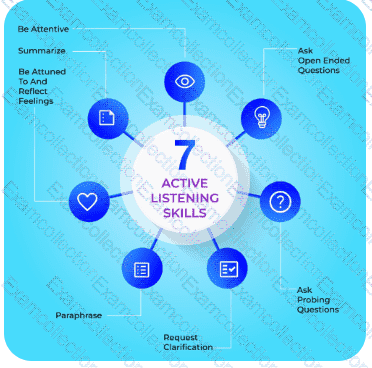
By applying Active Listening within the Collect Requirements process, the practitioner ensures that the voice of the customer is accurately captured, leading to a more efficient and user-friendly final product.
Which of the following can a project manager use to represent dellned team member roles in a group of tasks?
Work breakdown structure (WBS)
Responsibility assignment matrix (RAM)
Organizational breakdown structure (OBS)
Resource breakdown structure (RBS)
The Answer Is:
BExplanation:
According to the PMBOK® Guide, a Responsibility Assignment Matrix (RAM) is a grid that shows the project resources assigned to each work package. It is used to illustrate the connections between work packages or activities and project team members.
The RAM and RACI: A common example of a RAM is the RACI chart (Responsible, Accountable, Consulted, and Informed).
Responsible: The person who performs the work.
Accountable: The person with ultimate decision-making authority (only one per task).
Consulted: People whose opinions are sought.
Informed: People who are kept up-to-date on progress.
Purpose: The RAM ensures that there is clear assignment of responsibility for every task in the group, preventing confusion about who is doing what. On larger projects, RAMs can be developed at various levels (e.g., high-level for groups/units and low-level for specific individuals and tasks).
Integration: It bridges the gap between the work (WBS) and the people (OBS).
Analysis of Other Options:
A. Work breakdown structure (WBS): This is a deliverable-oriented hierarchical decomposition of the work to be executed. While it defines the tasks/deliverables, it does not inherently show the people or roles assigned to them.
C. Organizational breakdown structure (OBS): This is a hierarchical representation of the project organization, which illustrates the relationship between project activities and the organizational units that will perform those activities. It focuses on the organizational hierarchy, not the mapping of roles to specific tasks.
D. Resource breakdown structure (RBS): This is a hierarchical list of team and physical resources related by category and resource type. It is used for planning and controlling project work, but it lists what resources are available, not who is assigned to which specific task.
Which output of Project Cost Management consists of quantitative assessments of the probable costs required to complete project work?
Activity cost estimates
Earned value management
Cost management plan
Cost baseline
The Answer Is:
AExplanation:
According to the PMBOK® Guide (Project Management Body of Knowledge), specifically within the Project Cost Management knowledge area and the Estimate Costs process:
Activity Cost Estimates (Option A): This is the primary output of the Estimate Costs process. They are defined as quantitative assessments of the probable costs required to complete project work. These estimates can be presented in summary form or in detail and include all resources that will be charged to the project (e.g., direct labor, materials, equipment, services, facilities, and special categories such as inflation allowance or contingency costs).
Earned Value Management (Option B): This is a methodology or a tool and technique used in the Control Costs process. It integrates scope, schedule, and resources to measure project performance and progress. It is not an output consisting of initial cost assessments.
Cost Management Plan (Option C): This is an output of the Plan Cost Management process. It is a component of the project management plan that describes how the project costs will be planned, structured, and controlled. It sets the " rules " for estimation but does not contain the actual quantitative estimates for activities.
Cost Baseline (Option D): This is the approved version of the time-phased project budget. While it is built using the activity cost estimates, it represents the formal benchmark for measuring performance and includes contingency reserves, but it is a higher-level aggregation rather than the raw quantitative assessment of individual activity costs.
In the PMI framework, Activity Cost Estimates provide the granular data necessary to eventually roll up into the work package estimates, which then form the basis for the Cost Baseline.
The process to ensure that appropriate quality standards and operational definitions are used is:
Plan Quality.
Perform Quality Assurance.
Perform Quality Control.
Total Quality Management.
The Answer Is:
BExplanation:
According to the PMBOK® Guide, specifically within the Project Quality Management knowledge area, Perform Quality Assurance (often referred to as Manage Quality in newer editions) is the process of auditing the quality requirements and the results from quality control measurements to ensure that appropriate quality standards and operational definitions are used.
The Focus of Quality Assurance: Unlike Quality Control, which focuses on the product or the output, Quality Assurance focuses on the process. It is an executing process that uses data from the controlling process to confirm that the project is following the " rules " and standards set during the planning phase.
Operational Definitions: These are the specific descriptions of a project or product attribute and how the quality control process will measure it. Quality Assurance ensures these definitions are being applied correctly during the work.
Key Tool - Quality Audit: A structured, independent process to determine if project activities comply with organizational and project policies, processes, and procedures. The objective of a quality audit is to identify inefficient or ineffective policies and processes being used on the project.
Analysis of Other Options:
A. Plan Quality: This is the process where you identify which quality standards are relevant to the project and determine how to satisfy them. It creates the standards, but it is not the process that ensures they are being used during execution.
C. Perform Quality Control: This process is focused on monitoring and recording results of executing the quality activities to assess performance and recommend necessary changes. It is concerned with finding defects in the final deliverables rather than ensuring process standards.
D. Total Quality Management (TQM): This is an organizational philosophy and a management approach to long-term success through customer satisfaction. While TQM influences project quality management, it is not a specific process within the PMBOK® Guide framework.
One of the tools and techniques of the Manage Project Team process is:
organization charts.
ground rules.
organizational theory,
conflict management.
The Answer Is:
DExplanation:
According to the PMBOK® Guide, Conflict Management is a primary tool and technique used in the Manage Project Team process. This process involves tracking team member performance, providing feedback, resolving issues, and managing team changes to optimize project performance.
Role of the Project Manager: In a project environment, conflict is inevitable. Sources of conflict include scarce resources, scheduling priorities, and personal work styles. The project manager must use conflict management to minimize negative impacts and turn differences into positive outcomes.
Conflict Resolution Techniques: The PMBOK® identifies five general techniques for resolving conflict:
Withdraw/Avoid: Retreating from a potential conflict situation.
Smooth/Accommodate: Emphasizing areas of agreement rather than areas of difference.
Compromise/Reconcile: Searching for solutions that bring some degree of satisfaction to all parties.
Force/Direct: Pushing one ' s viewpoint at the expense of others (win-lose).
Collaborate/Problem Solve: Incorporating multiple viewpoints and insights from different perspectives to reach a consensus.
Comparison with Other Options:
Organization charts (A): These are a tool and technique for Plan Human Resource Management (now Plan Resource Management) used to document roles and reporting relationships.
Ground rules (B): These are established in the Develop Project Team process to set expectations regarding acceptable behavior by project team members.
Organizational theory (C): This is a tool and technique used in Plan Human Resource Management to provide information regarding the way in which people, teams, and organizational units behave.
Which activity is an input to the Conduct Procurements process?
Organizational process assets
Resource availability
Perform Integrated Change Control
Team performance assessment
The Answer Is:
AExplanation:
According to the PMBOK® Guide, the Conduct Procurements process is the process of obtaining seller responses, selecting a seller, and awarding a contract.
Organizational Process Assets (OPAs): These are internal to the organization and serve as a primary input to the Conduct Procurements process. They provide the framework and historical data necessary to execute the procurement successfully.
Specific Examples: OPAs include a list of preferred sellers (vetted vendors), specialized procurement policies, established templates for contracts or evaluation criteria, and historical information from previous procurement activities that can help in selecting the right bidder.
Other Key Inputs:
Project Management Plan: Includes the procurement management plan and scope baseline.
Project Documents: Such as the lessons learned register, project schedule, and requirements documentation.
Procurement Documentation: Including the bid documents (RFP/RFQ), Statement of Work (SOW), and independent cost estimates.
Seller Proposals: The formal responses from vendors being evaluated.
Comparison with other options:
B. Resource availability: This is typically an output of the Acquire Resources process (representing the physical or human resources assigned to the project). While procurement involves external resources, " Resource Availability " as a specific document/status is not a formal input for Conducting Procurements.
C. Perform Integrated Change Control: This is a process, not an input. While change requests from Conduct Procurements are sent to this process, the process itself is not an input to procurement activities.
D. Team performance assessment: This is an output of the Develop Team process. It measures the effectiveness of the project team ' s performance and is not used as a criterion or input for selecting external sellers during procurement.
A method of obtaining early feedback on requirements by providing a working model of the expected product before actually building is known as:
Benchmarking.
Context diagrams.
Brainstorming.
Prototyping.
The Answer Is:
DExplanation:
According to the PMBOK® Guide and the Standard for Project Management, Prototyping is a specific tool and technique used in the Collect Requirements process. It involves creating a working version of the product before building the final, functional version.
As per PMI standards, prototyping supports the concept of progressive elaboration. It provides a tangible model that allows stakeholders to visualize and interact with the product, which helps in:
Obtaining early feedback: Stakeholders can identify missing or misunderstood requirements early in the lifecycle.
Mitigating risk: It reduces the likelihood of costly changes later in the project by validating requirements before full-scale production.
Stakeholder engagement: It provides a common understanding of the product expectations among the project team and the customers.
The other options are incorrect based on the following PMI definitions:
Benchmarking: This involves comparing actual or planned practices (such as processes and operations) to those of comparable organizations to identify best practices and generate ideas for improvement. It is a comparative tool, not a modeling tool.
Context diagrams: This is a visual representation of the product scope that shows a business system (process, equipment, computer system, etc.) and how people and other systems (actors) interact with it. It is a high-level mapping of interfaces, not a " working model. "
Brainstorming: This is a general data-gathering technique used to identify a list of ideas in a short period. It is a verbal or written collaborative exercise and does not involve building physical or digital models.
As per the PMI Lexicon of Project Management Terms, prototypes allow for " storyboarding " and " mock-ups, " which are essential for complex products where requirements may be difficult to define using text alone.
Which key interpersonal skill of a project manager is defined as the strategy of sharing power and relying on interpersonal skills to convince others to cooperate toward common goals?
Collaboration
Negotiation
Decision making
Influencing
The Answer Is:
DExplanation:
According to the PMBOK® Guide (Project Management Body of Knowledge), specifically within the Project Resource Management knowledge area and the Develop Team and Manage Team processes:
Influencing (Option D): This is a key interpersonal skill defined by PMI as the strategy of sharing power and relying on interpersonal skills to convince others to cooperate toward common goals. In many organizational structures (especially matrix organizations), project managers may have little or no direct authority over team members or stakeholders. Therefore, the ability to influence others—by building rapport, exercising ethical persuasion, and demonstrating competence—is essential to gain support and commitment to the project objectives.
Collaboration (Option A): This is a conflict resolution technique (also known as " Problem Solve " ) where parties work together to find a " win-win " solution. While it involves cooperation, it is a method of addressing disagreement rather than the broad power-sharing strategy used to motivate others toward a goal.
Negotiation (Option B): This is the process of reaching an agreement between parties with different interests. While influencing is often used during a negotiation, negotiation is typically more transactional or focused on specific terms (like resource allocation or scope) rather than the general strategy of power-sharing for common goals.
Decision Making (Option C): This refers to the ability to select a course of action from among different alternatives. While a PM must decide how to influence, the act of deciding is a cognitive process, not the interpersonal strategy of convincing others.
In the PMI framework, Influencing is considered a critical competency because it allows the Project Manager to navigate organizational politics and secure the necessary resources and buy-in without relying solely on formal " legitimate " power.
