


Databricks Databricks-Certified-Professional-Data-Engineer - Databricks Certified Data Engineer Professional Exam
Total 202 questions
A junior data engineer has been asked to develop a streaming data pipeline with a grouped aggregation using DataFrame df. The pipeline needs to calculate the average humidity and average temperature for each non-overlapping five-minute interval. Incremental state information should be maintained for 10 minutes for late-arriving data.
Streaming DataFrame df has the following schema:
" device_id INT, event_time TIMESTAMP, temp FLOAT, humidity FLOAT "
Code block:
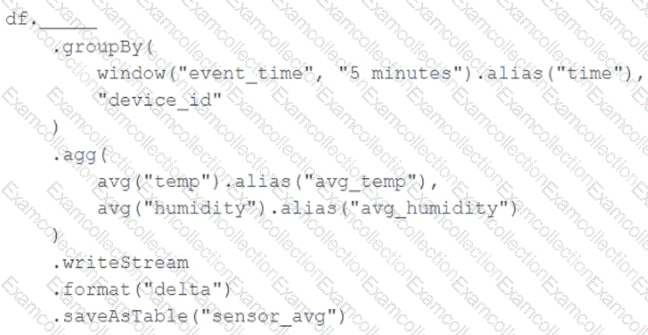
Choose the response that correctly fills in the blank within the code block to complete this task.
The following code has been migrated to a Databricks notebook from a legacy workload:
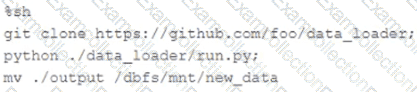
The code executes successfully and provides the logically correct results, however, it takes over 20 minutes to extract and load around 1 GB of data.
Which statement is a possible explanation for this behavior?
Each configuration below is identical to the extent that each cluster has 400 GB total of RAM, 160 total cores and only one Executor per VM.
Given a job with at least one wide transformation, which of the following cluster configurations will result in maximum performance?
A junior data engineer is working to implement logic for a Lakehouse table named silver_device_recordings. The source data contains 100 unique fields in a highly nested JSON structure.
The silver_device_recordings table will be used downstream for highly selective joins on a number of fields, and will also be leveraged by the machine learning team to filter on a handful of relevant fields, in total, 15 fields have been identified that will often be used for filter and join logic.
The data engineer is trying to determine the best approach for dealing with these nested fields before declaring the table schema.
Which of the following accurately presents information about Delta Lake and Databricks that may Impact their decision-making process?
The business reporting tem requires that data for their dashboards be updated every hour. The total processing time for the pipeline that extracts transforms and load the data for their pipeline runs in 10 minutes.
Assuming normal operating conditions, which configuration will meet their service-level agreement requirements with the lowest cost?
A data engineer is performing a join operating to combine values from a static userlookup table with a streaming DataFrame streamingDF.
Which code block attempts to perform an invalid stream-static join?
A data engineer manages a production Lakeflow Declarative Pipeline that processes customer transaction data. The pipeline includes several data quality expectations such as transaction_amount > 0 and customer_id IS NOT NULL. These expectations are defined using the EXPECT clause in SQL.
The engineer aims to monitor the pipeline’s data quality by analyzing the number of records that passed or failed each expectation during the latest pipeline update. The Lakeflow Declarative Pipelines event logs are stored in a Delta table named event_log_table.
For the most recent pipeline update, determine a programmatically appropriate approach to extract information like the name of each expectation, associated dataset, count of records that passed the expectation, and count of records that failed the expectation.
Which method retrieves the desired data quality metrics from the Lakeflow Declarative Pipelines event log?
Given the following error traceback:
AnalysisException: cannot resolve ' heartrateheartrateheartrate ' given input columns:
[spark_catalog.database.table.device_id, spark_catalog.database.table.heartrate,
spark_catalog.database.table.mrn, spark_catalog.database.table.time]
The code snippet was:
display(df.select(3* " heartrate " ))
Which statement describes the error being raised?
A junior data engineer is migrating a workload from a relational database system to the Databricks Lakehouse. The source system uses a star schema, leveraging foreign key constrains and multi-table inserts to validate records on write.
Which consideration will impact the decisions made by the engineer while migrating this workload?
The data engineer team is configuring environment for development testing, and production before beginning migration on a new data pipeline. The team requires extensive testing on both the code and data resulting from code execution, and the team want to develop and test against similar production data as possible.
A junior data engineer suggests that production data can be mounted to the development testing environments, allowing pre production code to execute against production data. Because all users have
Admin privileges in the development environment, the junior data engineer has offered to configure permissions and mount this data for the team.
Which statement captures best practices for this situation?
