New Year Sale Special Limited Time 70% Discount Offer - Ends in 0d 00h 00m 00s - Coupon code: xmas50

F5 F5CAB1 - BIG-IP Administration Install, Initial Configuration, and Upgrade

Page: 1 / 2
Total 46 questions

A BIG-IP Administrator needs to install a HotFix on a standalone BIG-IP device, which hasHD1.1as the Active Boot Location.

The administrator has already re-activated the license and created a UCS archive.

In which sequence should the administrator perform the remaining steps?

A.

Install HotFix in HD1.2, Install base Image in HD1.2, Activate HD1.2

B.

Install HotFix in HD1.1, Reboot the BIG-IP device, Install UCS Archive

C.

Install base Image in HD1.2, Install HotFix in HD1.2, Activate HD1.2

D.

Activate HD1.2, Install base Image in HD1.2, Install HotFix in HD1.2

A BIG-IP Administrator needs to purchase new licenses for a BIG-IP appliance.

The administrator needs to know:

    Whether a module is licensed

    The memory requirement for that module

Where should the administrator view this information in theSystem menu?

A.

Configuration » OVSDB

B.

Software Management

C.

Configuration » Device

D.

Resource Provisioning

Refer to the exhibit.

An organization has purchased a BIG-IP license that includes all available modules but has chosen to provision only the modules they require.

The exhibit displays the current resource allocation from theSystem → Resource Provisioningpage.

Based on the information provided, which F5 modules have been provisioned?

A.

LTM, APM

B.

DNS, APM

C.

LTM, DNS, APM

D.

TMM, DNS, APS

Which configuration file can a BIG-IP administrator use to verify theprovisioned modules?

A.

/config/bigip.license

B.

/config/bigip_base.conf

C.

/config/bigip.conf

D.

/var/local/ucs/config.ucs

The monitoring team reports that the SNMP server is unable to poll data from a BIG-IP device.

What information will help the BIG-IP Administrator determine whether the issue originates from the BIG-IP system?

A.

The “Port Lockdown” setting is preventing the SNMP server from polling data from the BIG-IP.

B.

The “Traffic Group” setting must use a floating Traffic Group.

C.

The “VLAN / Tunnel” setting must allow All Vlans.

D.

The configuration on the exhibit is correct and other options should be explored.

A BIG-IP Administrator needs to install aHotFixon a standalone BIG-IP device.

The device currently hasHD1.1as the Active Boot Location.

The administrator has already reactivated the license and created a UCS archive.

In which sequence should the administrator perform theremaining steps?

A.

Install HotFix in HD1.2, Install base Image in HD1.2, Activate HD1.2

B.

Install HotFix in HD1.1, Reboot the BIG-IP device, Install UCS Archive

C.

Install base Image in HD1.2, Install HotFix in HD1.2, Activate HD1.2

D.

Activate HD1.2, Install base Image in HD1.2, Install HotFix in HD1.2

The device is currently onv15.1.2.1.

The BIG-IP Administrator needs to boot the device back tov13.1.0.6to gather data for troubleshooting.

The system shows:

Sys::Software Status

Volume Product Version Build Active Status Allowed

HD1.1 BIG-IP 15.1.2.1 0.0.10 yes complete yes

HD1.2 BIG-IP 13.1.0.6 0.0.3 no complete yes

Which is the correct command-line sequence to boot the device to version13.1.0.6?

A.

Use tmsh to select a new boot volume, tmsh reboot HD1.2

B.

switchboot -b HD1.2, then reboot

C.

switchboot -I HD1.2, then reboot

D.

Use tmsh to select a new boot volume, tmsh switchboot HD1.2

An administrator is in the process of reactivating the license using the interface displayed in the exhibit.

What is the address of the license server to which the BIG-IP device must be able to establish an outbound connection in order to use theAutomatic Activation Method?

A.

license.f5.com

B.

callhome.f5.com

C.

ask.f5.com

D.

activate.f5.com

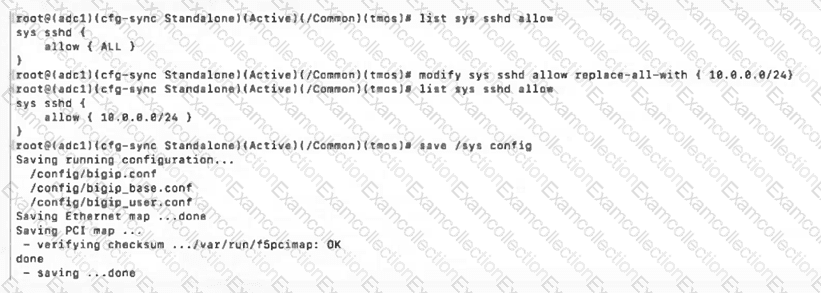
A BIG-IP Administrator discovers malicious brute-force attempts to access the BIG-IP device on themanagement interfacevia SSH.

The administrator needs to restrict SSH access to the management interface.

Where should this be accomplished?

A.

Network > Interfaces

B.

Network > Self IPs

C.

System > Configuration

D.

System > Platform

The Port Lockdown feature prevents unwanted connection attempts to a Self IP.

Which three types of connection attempts areunaffectedby Port Lockdown settings?

A.

Defined virtual server traffic, Secure Shell (SSH), Centralized Management Infrastructure (CMI)

B.

Centralized Management Infrastructure (CMI), Secure Shell (SSH), Internet Control Message Protocol (ICMP)

C.

Defined virtual server traffic, Internet Control Message Protocol (ICMP), Centralized Management Infrastructure (CMI)