Cyber Monday Sale Special Limited Time 70% Discount Offer - Ends in 0d 00h 00m 00s - Coupon code: xmas50

Fortinet FCSS_SDW_AR-7.4 - FCSS - SD-WAN 7.4 Architect

Page: 2 / 2
Total 68 questions

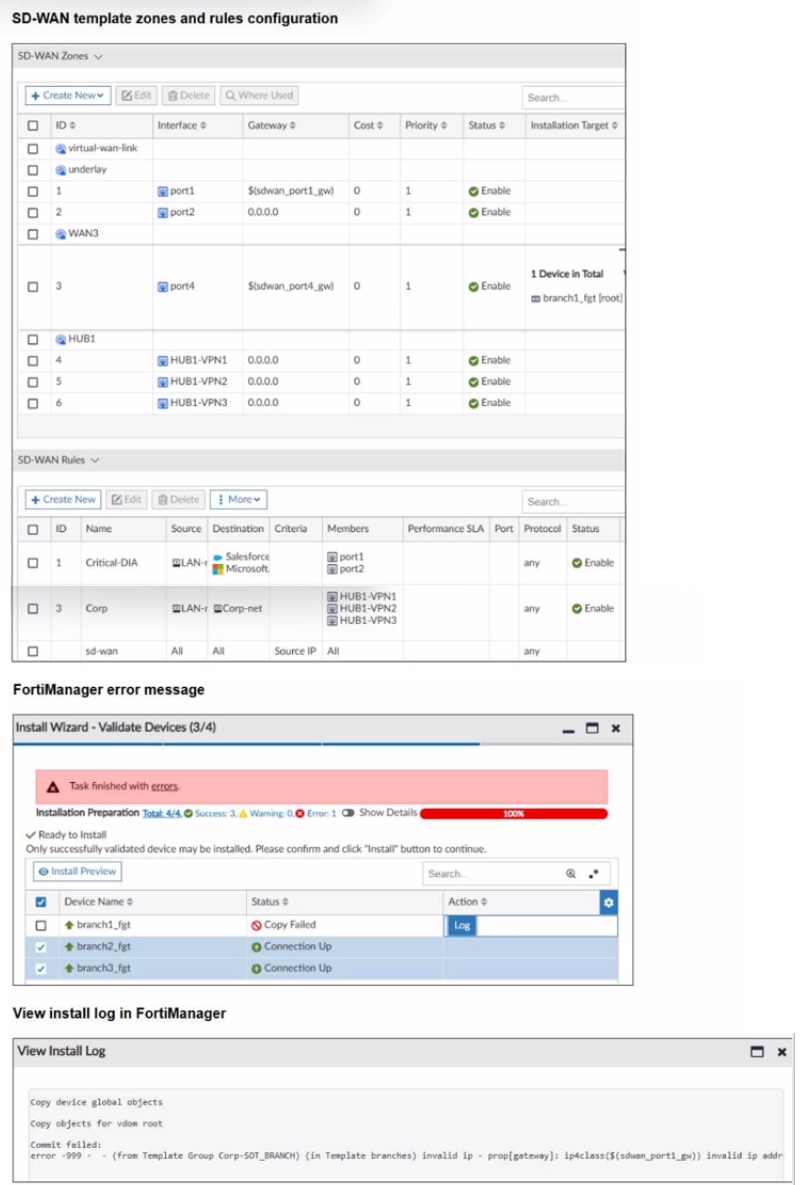
The FortiGate devices are managed by ForliManager, and are configured for direct internet access (DIA). You confirm that DIA is working as expected for each branch, and check the SD-WAN zone configuration and firewall policies shown in the exhibits.
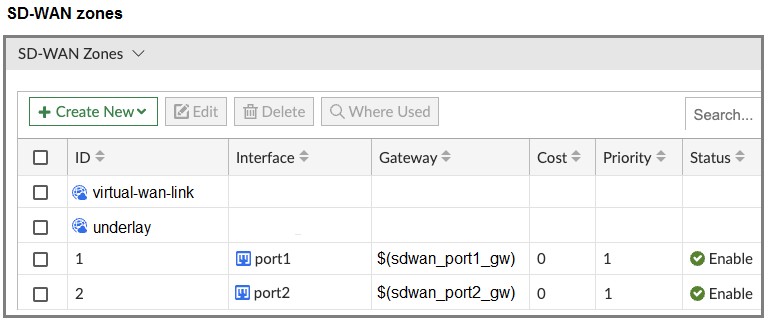

Then, you use the SD-WAN overlay template to configure the IPsec overlay tunnels. You create the associated SD-WAN rules to connect existing branches to the company hub device and apply the changes on the branches.

After those changes, users complain that they lost internet access. DIA is no longer working.

Based on the exhibit, which statement best describes the possible root cause of this issue?

A.

The SD-WAN overlay template defines a zone for each underlay interface and moves the interfaces into those zones.

B.

The SD-WAN overlay template didn’t configure a firewall policy to allow traffic through the overlay.

C.

The SD-WAN overlay template redefines the interface gateway addresses if they are defined with metadata variables.

D.

The SD-WAN overlay template updates the SD-WAN template and the rules.

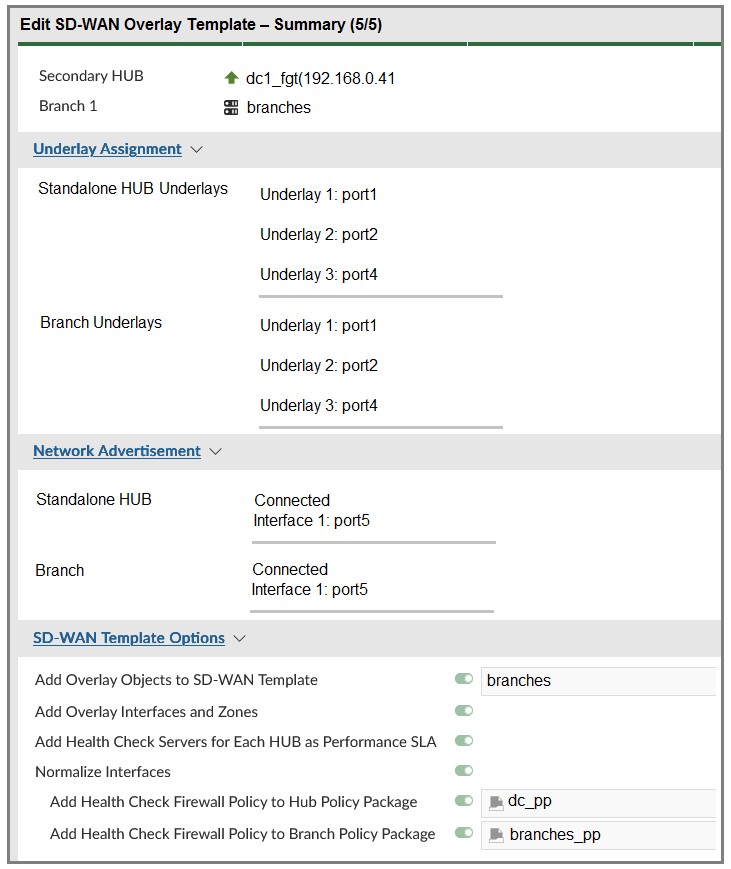
The administrator uses the FortiManager SD-WAN overlay template to prepare an SD-WAN deployment. Using information provided through the SD-WAN overlay template wizard, FortiManager creates templates ready to install on the spoke and hub devices.

What are the three templates created by the SD-WAN overlay template for a spoke device? (Choose three.)

A.

Static route template

B.

Rules template

C.

CLI template

D.

BGP template

E.

IPsec tunnel template

As an MSSP administrator, you are asked to configure ADVPN on an existing SD-WAN topology. FortiManager manages the customer devices in a dedicated ADOM. The previous administrator used the SD-WAN overlay topology.

Which two statements apply to this scenario? (Choose two.)

A.

You can activate auto-discovery VPN in the SD-WAN overlay template only if it is a single hub topology.

B.

When auto-discovery VPN is enabled, FortiManager updates the IPsec and BGP templates in the hub.

C.

After you enable auto-discovery VPN in the overlay template, you must select between ADVPN 2.0 and ADVPN 1.0.

D.

You can activate auto-discovery VPN in the SD-WAN overlay template for any type of topology, including a primary-primary dual-hub topology.

Exhibit.

For your ZTP deployment, you review the CSV file shown in exhibit and note that it is missing important information. Which two elements must you change before you can import it into FortiManager? (Choose two.)

A.

You must associate a device blueprint with each device

B.

You must define a name for each device

C.

You must define a value for each device and each metadata variable that defines an IP address.

D.

You must define a value for each device and each user-defined metadata variable.

You are planning a new SD-WAN deployment with the following criteria:

- Two regions

- Most of the traffic is expected to remain within its region

- No requirement for inter-region ADVPN

To remain within the recommended best practices, which routing protocol should you select for the overlays?

A.

OSPF for the routing within each region and EBGP between the regions.

B.

IBGP with BGP on loopback within each region and EBGP between the regions.

C.

IBGP with BGP per overlays within each region and IBGP with BGP on loopback between the regions.

D.

IBGP within each region and between the regions.

Refer to the exhibits.

You use FortiManager to configure SD-WAN on three branch devices.

When you install the device settings. FortiManager prompts you with the error "Copy Failed" for the device branch1_fat When you click the log button. FortiManager displays the message shown in the exhibit.

A.

Based on the exhibits, which statement best describes the issue and how you can resolve it?

B.

Remove the installation target for the SD-WAN member port4. You cannot combine metadata variable and installation targets.

C.

Gateways for all members in a zone must be defined the same way. Specify the gateway of the SD-WAN member port! without metadata variables.

D.

Check the metadata variable definitions, and review the per-device mapping configuration.

E.

Check the connection between branch1_fgt and FortiManager

What are three key routing principles of SD-WAN? (Choose three.)

A.

Directly connected routes have precedence over SD-WAN rules.

B.

Policy routes have precedence over SD-WAN rules.

C.

SD-WAN rules are skipped if the best route to the destination is a static route

D.

SD-WAN rules are skipped if the best route to the destination is not an SD-WAN member.

E.

SD-WAN members are skipped if they do not have a valid route to the destination.

Refer to the exhibit.

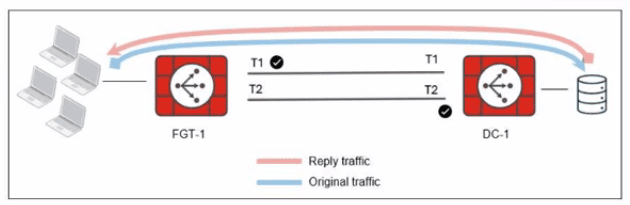
The administrator analyzed the traffic between a branch FortiGate and the server located in the data center, and noticed the behavior shown in the diagram.

When the LAN clients located behind FGT1 establish a session to a server behind DC-1, the administrator observes that, on DC-1, the reply traffic is routed overT2. even though T1 is the preferred member in

the matching SD-WAN rule.

What can the administrator do to instruct DC-1 to route the reply traffic through the member with the best performance?

A.

Enable snat-route-change under config system global.

B.

Enable reply-session under config system sdwan.

C.

Enable auxiliary-session under config system settings.

D.

FortiGate route lookup for reply traffic only considers routes over the original ingress interface.

You manage an SD-WAN topology. You will soon deploy 50 new branches.

Which three tasks can you do in advance to simplify this deployment? (Choose three.)

A.

Update the DHCP server configuration.

B.

Create model devices.

C.

Create a ZTP template.

D.

Define metadata variables value for each device.

E.

Create policy blueprint.

Refer to the exhibits.

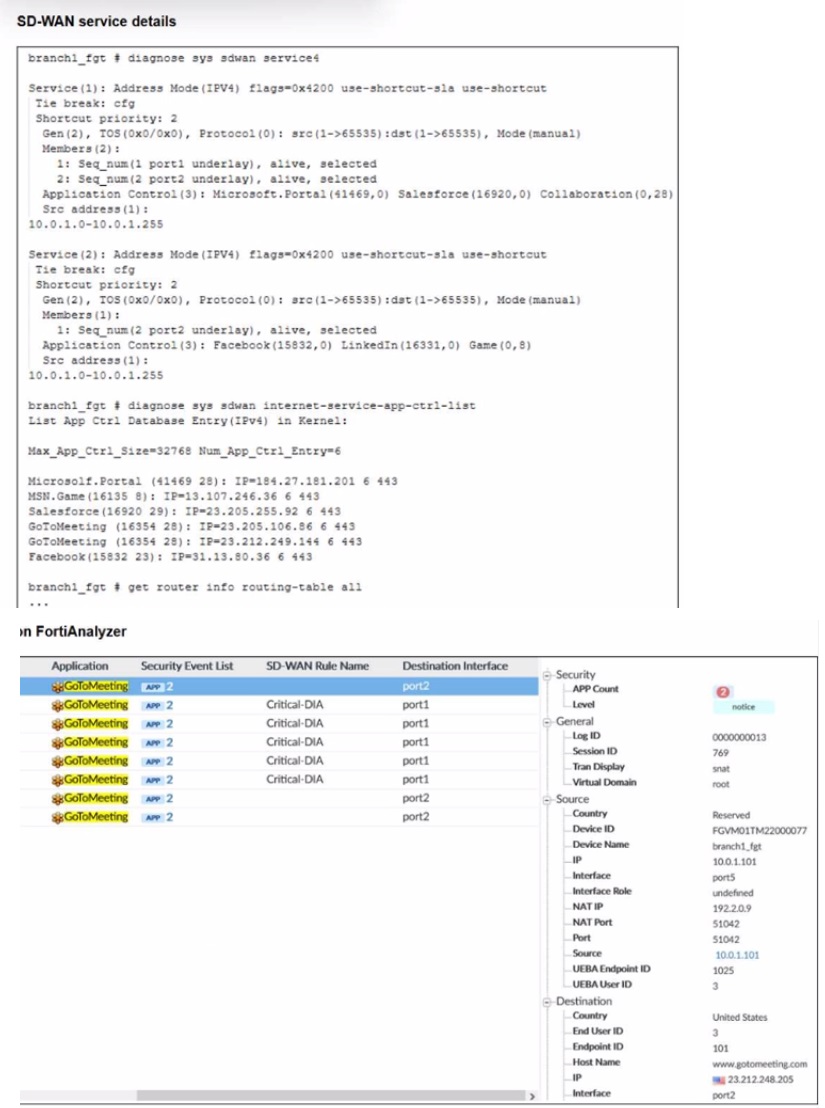
An administrator is testing application steering in SD-WAN. Before generating test traffic, the administrator collected the information shown in the first exhibit. After generating GoToMeeting test traffic, the administrator examined the corresponding traffic log on FortiAnalyzer, which is shown in the second exhibit.

The administrator noticed that the traffic matched the implicit SD-WAN rule, but they expected the traffic to match rule ID 1.

Which two reasons explain why some log messages show that the traffic matched the implicit SD-WAN rule? (Choose two.)

A.

Full SSL inspection is not enabled on the matching firewall policy.

B.

The session 3-tuple did not match any of the existing entries in the ISDB application cache.

C.

FortiGate could not refresh the routing information on the session after the application was detected.

D.

No configured SD-WAN rule matches the traffic related to the collaboration application GoToMeeting