Month End Sale Special Limited Time 70% Discount Offer - Ends in 0d 00h 00m 00s - Coupon code: xmas50

HP HPE7-A02 - Aruba Certified Network Security Professional Exam

Page: 4 / 4
Total 135 questions

A company lacks visibility into the many different types of user and loT devices deployed in its internal network, making it hard for the security team to address

those devices.

Which HPE Aruba Networking solution should you recommend to resolve this issue?

A.

HPE Aruba Networking ClearPass Device Insight (CPDI)

B.

HPE Aruba Networking Network Analytics Engine (NAE)

C.

HPE Aruba Networking Mobility Conductor

D.

HPE Aruba Networking ClearPass OnBoard

A company is using HPE Aruba Networking Central SD-WAN Orchestrator to establish a hub-spoke VPN between branch gateways (BGWs) at 1164 site and VPNCs at multiple data centers. What is part of the configuration that admins need to complete?

A.

In VPNCs’ groups, establish VPN pools to control which branches connect to which VPNCs.

B.

In BGWs’ and VPNCs’ groups, create default IKE policies for the SD-WAN Orchestrator to use.

C.

In BGWs’ groups, select the VPNCs to which to connect in a DC preference list.

D.

At the global level, create default IPsec policies for the SD-WAN Orchestrator to use.

You have created this rule in an HPE Aruba Networking ClearPass Policy Manager (CPPM) service’s enforcement policy:

IF Authorization [Endpoints Repository] Conflict EQUALS true

THEN apply "quarantine_profile"

What information can help you determine whether you need to configure cluster-wide profiler parameters to ignore some conflicts?

A.

Whether some devices are running legacy operating systems

B.

Whether the company has rare Internet of Things (IoT) devices

C.

Whether some devices are incapable of captive portal or 802.1X authentication

D.

Whether the company has devices that use PXE boot

You need to set up an HPE Aruba Networking VIA solution for a customer who needs to support 2100 remote employees. The customer wants employees to

download their VIA connection profile from the VPNC. Only employees who authenticate with their domain credentials to HPE Aruba Networking ClearPass Policy

Manager (CPPM) should be able to download the profile. (A RADIUS server group for CPPM is already set up on the VPNC.)

How do you configure the VPNC to enforce that requirement?

A.

Set up a VIA Authentication Profile that uses CPPM's server group; reference that profile in the VIA Web Authentication Profile.

B.

Reference CPPM's server group in an AAA profile; then, apply that profile to the VPNC's Internet-facing ports.

C.

Create a new VPN Authentication Profile and then reference CPPM's default server group in that profile.

D.

Set up a VIA Authentication Profile that uses CPPM's server group; reference that profile in the VIA Connection Profile.

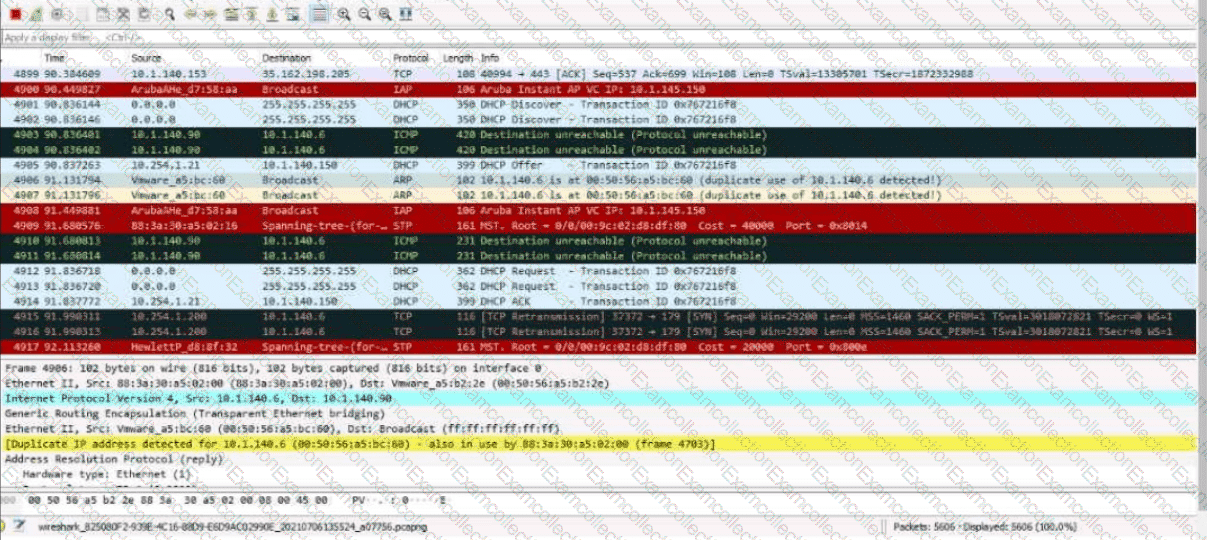
Refer to the exhibit.

The exhibit shows a saved packet capture, which you have opened in Wireshark. You want to focus on the complete conversation between 10.1.70.90 and 10.1.79.11 that uses source port 5448.

What is a simple way to do this in Wireshark?

A.

Apply a capture filter that selects for both the 10.1.70.90 and 10.1.79.11 IP addresses.

B.

Click the Source column and then the Destination column to sort the packets into the desired order.

C.

Apply a capture filter that selects for TCP port 5448.

D.

Right-click one of the packets between those addresses and choose to follow the stream.

A company wants to apply role-based access control lists (ACLs) on AOS-CX switches, which are implementing authentication to HPE Aruba Networking ClearPass Policy Manager (CPPM). The company wants to centralize configuration as much as possible. Which correctly describes your options?

A.

You can configure the role on CPPM; however, the CPPM role must reference a policy name that is configured on the switch.

B.

You can configure the role name on CPPM; however, the role settings, including policy and classes, must be configured locally on the switch.

C.

You can configure the role, its policy, and the classes referenced in the policy all on CPPM.

D.

You can configure the role and its policy on CPPM; however, the classes referenced in the policy must be configured locally on the switch.

You need to create a rule in an HPE Aruba Networking ClearPass Policy Manager (CPPM) role mapping policy that references a ClearPass Device Insight Tag. Which Type (namespace) should you specify for the rule?

A.

Endpoint

B.

TIPS

C.

Device

D.

Application

HPE Aruba Networking switches are implementing MAC-Auth to HPE Aruba Networking ClearPass Policy Manager (CPPM) for a company's printers. The company wants to quarantine a client that spoofs a legitimate printer's MAC address. You plan to add a rule to the MAC-Auth service enforcement policy for this purpose. What condition should you include?

A.

Endpoint Compliance EQUALS false

B.

Endpoint Device Insight Tag EXISTS

C.

Authorization: [Endpoints Repository] Compromised EQUALS true

D.

Authorization: [Endpoints Repository] Conflict EQUALS true

What is one use case that companies can fulfill using HPE Aruba Networking ClearPass Policy Manager’s (CPPM’s) Device Profiler?

A.

Applying the correct enforcement profiles to specialized clients such as security cameras

B.

Identifying OS, browser, and application vulnerabilities by CVE ID

C.

Authenticating clients to Active Directory computer accounts

D.

Quarantining and remediating devices that have disabled firewalls

You have configured an AOS-CX switch to implement 802.1X on edge ports. Assume ports operate in the default auth-mode. VolP phones are assigned to the

"voice" role and need to send traffic that is tagged for VLAN 12.

Where should you configure VLAN 12?

A.

As the trunk native VLAN on edge ports and the trunk native VLAN on the "voice" role

B.

As a trunk allowed VLAN on edge ports and the trunk native VLAN in the "voice" role

C.

As the trunk native VLAN in the "voice" role (and not in the edge port settings)

D.

As the allowed trunk VLAN in the "voice" role (and not in the edge port settings)