


HP HPE7-A10 - HPE Network Security Expert Written Exam
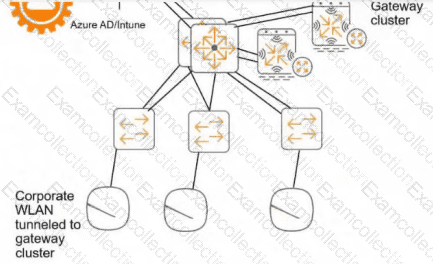
A customer operates two AOS-10 HPE Aruba Networking gateways at a site. The gateways are part of an SD-Branch solution managed by HPE Aruba Networking Central, and their cluster setting uses WLAN mode (the non-default gateway mode).
You are configuring a manual HPE Aruba Networking gateway cluster for dynamic authorization. The gateways have these IP addresses on a subnet that CPPM can access:
Gateway 1 = 10.56.20.2
Gateway 2 = 10.56.20.3
Which VRRP IP address assignments are valid for the gateways? Assume that all IP address options are available.
You are assisting a company with adding HPE Aruba Networking ClearPass to its network, which uses HPE Aruba Networking network infrastructure devices.
The company already has a Windows domain and Windows CA. The Windows CA issues certificates to domain computers, domain users, and servers such as domain controllers.

Refer to the scenario. On CPPM, you are creating the authentication source. You have configured the settings displayed on the tab and have not changed any other settings.
Authentication Sources - UniversityAD
Hostname: ad.acnsxtest.com
Connection Security: AD over SSL
Port: 636
Verify Server Certificate: [X] Enable
Bind DN: bind@acnsxtest.com
NetBIOS Domain Name: ACNSXTEST
Base DN: dc=acnsxtest,dc=com
Search Scope: SubTree Search
User Certificate: userCertificate
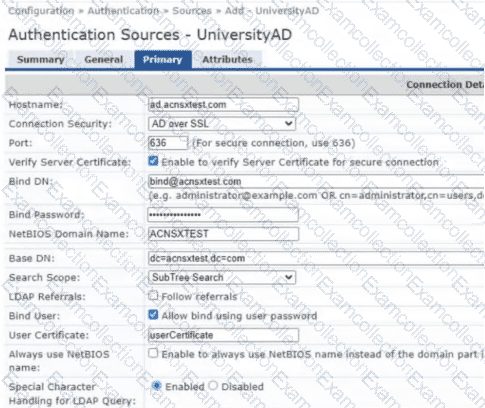
What else must you do to help authentication proceed correctly?
A customer has an AOS-10 architecture managed by HPE Aruba Networking Central. HPE Aruba Networking infrastructure devices authenticate clients to an HPE Aruba Networking ClearPass cluster.
In HPE Aruba Networking Central, you are reviewing network traffic flows for a wireless IoT device categorized as a “Raspberry Pi†client. You observe SSH traffic. You then review several additional wireless IoT clients and find that they are also sending SSH.
Which element helps establish a foundation for robust network-security forensics?
A customer uses an AOS-10 architecture managed by HPE Aruba Networking Central. HPE Aruba Networking infrastructure devices authenticate clients to an HPE Aruba Networking ClearPass cluster.
In HPE Aruba Networking Central, you are reviewing network traffic flows for a wireless IoT device categorized as "Raspberry Pi" clients. You observe SSH traffic. You then examine several additional wireless IoT clients and find that they are also sending SSH.
Refer to the scenario.
You need a fast way to find a list of all IoT clients that have used SSH.
What step can you take?
How does HPE Aruba Networking Central secure site-to-site connections between AOS-10 gateways?
Refer to the scenario.
A customer uses an AOS-10 architecture managed by HPE Aruba Networking Central. HPE Aruba Networking infrastructure devices authenticate clients to an HPE Aruba Networking ClearPass cluster.
In HPE Aruba Networking Central, you are reviewing network traffic flows for a wireless IoT device categorized as a “Raspberry Pi†client. You observe SSH traffic. You then examine several additional wireless IoT clients and find that they are also sending SSH.
You want a relatively easy way to communicate to HPE Aruba Networking CPPM that an IoT client has used SSH.
What is one prerequisite?
A customer has an AOS-10 architecture managed by HPE Aruba Networking Central. HPE Aruba Networking infrastructure devices authenticate clients against an HPE Aruba Networking ClearPass cluster.
In HPE Aruba Networking Central, you are reviewing network traffic flows for a wireless IoT device categorized as "Raspberry Pi" clients. You observe SSH traffic. You then review several additional wireless IoT clients and find that they are also sending SSH.
Refer to the scenario.
You are helping the customer evaluate ways to mitigate the potential threat that was detected. The customer suggests simply adding a rule that denies SSH traffic to the IoT client’s AOS user role.
What is the security drawback of this approach?
A company uses an HPE Aruba Networking EdgeConnect SD-Branch solution. The customer wants to integrate the solution with HPE Aruba Networking SSE.
What is one step that must be completed in HPE Aruba Networking SSE and is not automated as part of the typical setup?
You want to use HPE Aruba Networking ClearPass Device Insight tags as conditions in CPPM role-mapping or enforcement-policy rules.
Which guidelines should you follow?
Your company uses an HPE Aruba Networking AOS-10 architecture managed by HPE Aruba Networking Central. A ClearPass Policy Manager (CPPM) cluster supplies authentication. The company also has a Palo Alto firewall. You want to configure the HPE Aruba Networking infrastructure to quarantine clients for which the firewall sends Syslog Threat messages to CPPM.
Network infrastructure devices already have a “quarantine†role configured.
You checked the CPPM event dictionary and found an entry for Palo Alto Syslog Threats that includes:
Prefix: PANW-Threat
Attributes such as syslogtimestamp and logtype
What is a correct component of the configuration in ClearPass server settings?