


HP HPE7-A10 - HPE Network Security Expert Written Exam
Refer to the exhibit.
An administrator has configured a remote mirror between an AOS-CX switch and a station running a protocol analyzer. The exhibit displays a sample of the packet capture.
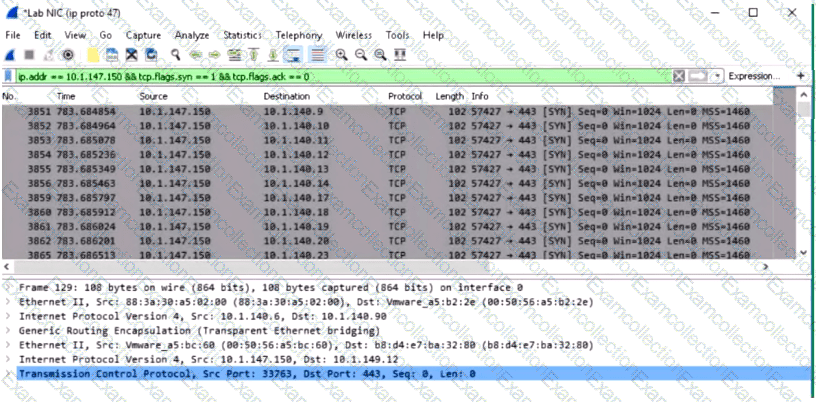
Packet trace details:
Source: 10.1.147.150 - > Destination: 10.1.140.9 TCP 57427 - > 443 [SYN] Seq=0 Len=0
Source: 10.1.147.150 - > Destination: 10.1.140.10 TCP 57427 - > 443 [SYN] Seq=0 Len=0
Source: 10.1.147.150 - > Destination: 10.1.140.11 TCP 57427 - > 443 [SYN] Seq=0 Len=0
Source: 10.1.147.150 - > Destination: 10.1.140.12 TCP 57427 - > 443 [SYN] Seq=0 Len=0
Source: 10.1.147.150 - > Destination: 10.1.140.13 TCP 57427 - > 443 [SYN] Seq=0 Len=0
Packet encapsulation tree shows Generic Routing Encapsulation (Transparent Ethernet bridging).
Which characteristic is suspicious?
You are designing an AOS-10 architecture and ClearPass solution for a manufacturing company with legacy equipment that supports only WPA2. You need to improve security for these devices.
This equipment will connect to an SSID named "Factory." If equipment passes authentication and is assigned the custom Device Category "Manufacturing," it must receive this AOS user role: "equipment." That role, along with a "profiling" role for unprofiled devices, is already configured on the AOS devices.
The users who configure PSKs on the equipment belong to the "FactoryAdmins" group in the company's Active Directory domain. CPPM has an authentication source for that domain named MyAD. As part of the solution, you have created these services on CPPM:
Service 1:
Type: Application
Authentication source: MyAD
Authorization source: None
Enforcement policy:
Rule 1 condition: Authorization:Endpoints Repository:Category EQUALS Manufacturing
Rule 1 profile list: Enforcement profiles that permit application access and assign the Guest Operators role
Default action: Deny access
Service 2:
Type: Wireless with mPSK
Authentication source: Guest Devices Repository
Authorization source: None
Enforcement policy:
Rule 1 condition: Endpoint Device Insight Tag EQUALS Manufacturing
Rule 1 profile list: Enforcement profile that assigns Aruba-User-Role = equipment and [Registered Device MPSK] profile
Rule 2 condition: Endpoint:Device Insight Tag NOT_EXISTS
Rule 2 profile list: Enforcement profile that assigns Aruba-User-Role = profiling and [Registered Device MPSK] profile
Default action: Deny access
What is incorrect in this configuration?