


HP HPE7-A10 - HPE Network Security Expert Written Exam
Refer to the exhibit.
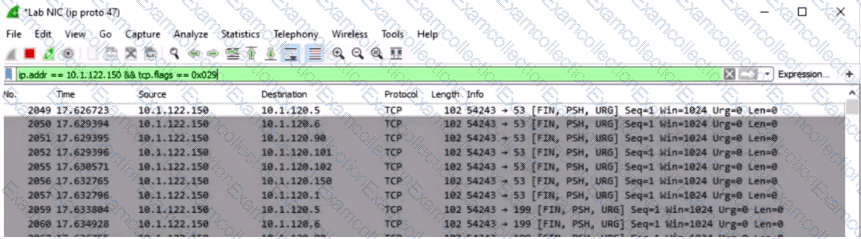
Packet trace display:
Source: 10.1.122.150 - > Destination: 10.1.120.5 TCP 54243 - > 53 [FIN, PSH, URG] Seq=1 Win=1024 Urg=0 Len=0
Source: 10.1.122.150 - > Destination: 10.1.120.6 TCP 54243 - > 53 [FIN, PSH, URG] Seq=1 Win=1024 Urg=0 Len=0
Source: 10.1.122.150 - > Destination: 10.1.120.90 TCP 54243 - > 53 [FIN, PSH, URG] Seq=1 Win=1024 Urg=0 Len=0
Source: 10.1.122.150 - > Destination: 10.1.120.101 TCP 54243 - > 53 [FIN, PSH, URG] Seq=1 Win= 1024 Urg=0 Len=0
Source: 10.1.122.150 - > Destination: 10.1.120.5 TCP 54243 - > 199 [FIN, PSH, URG] Seq=1 Win=1024 Urg=0 Len=0
What does this indicate?
A customer’s administrators have added RF Protect licenses and enabled WIDS for an AOS-8-based solution. The customer wants to use the APs’ built-in capabilities without deploying dedicated air monitors (AMs). Administrators tested rogue-AP detection by connecting an unauthorized wireless AP to a switch, but the rogue AP was still not detected after several hours.
What is one point you should ask about?
A financial institution must authenticate managers of HPE Aruba Networking Mobility Controllers (MCs) and HPE Aruba Networking Mobility Conductors through ClearPass Policy Manager (CPPM). The institution’s security policies require strong encryption for manager-authentication communications between the HPE Aruba Networking devices and CPPM.
What is a valid solution?
A customer has an AOS-10 architecture managed by HPE Aruba Networking Central. HPE Aruba Networking infrastructure devices authenticate clients through an HPE Aruba Networking ClearPass cluster.
In HPE Aruba Networking Central, you are reviewing network traffic flows for a wireless IoT device categorized as a “Raspberry Pi†client. You observe SSH traffic. You then inspect several additional wireless IoT clients and find that they are also sending SSH traffic.
Refer to the scenario.
You are assisting the customer in evaluating ways to mitigate the potential threat detected. One possible option has been identified: add a rule to the clients’ AOS user role that matches SSH traffic and applies denylisting.
What is one benefit of this option?
An organization wants an AOS-CX switch to trigger an alert when its RADIUS server (cp.acnsxtest.local) rejects an unusual number of client authentication requests each hour. After discussions with other HPE Aruba Networking administrators, you still do not know how many rejections are normal or unusual. You expect the value might differ on every switch.
You are helping the developer understand how to create an NAE script for this use case.
Refer to the scenario.
The developer explains that they intend to define the rule with logic like this: `monitor > value`
However, the developer asks what value to include.
What should you recommend?
A customer is migrating from on-premises AD to Microsoft Entra ID (Azure AD) as its only domain solution. The customer also manages wired and wireless devices with Microsoft Endpoint Manager (Intune).
The customer wants to strengthen network-edge security. You are assisting with the design of an HPE Aruba Networking ClearPass deployment for this purpose. HPE Aruba Networking devices will authenticate wireless and wired clients to a ClearPass Policy Manager (CPPM) cluster that uses version 6.10.
The customer has several authentication requirements. Clients should pass EAP-TLS authentication only when a query to Microsoft Entra ID (Azure AD) confirms that they have accounts in Microsoft Entra ID (Azure AD). To further refine client privileges, ClearPass must also use information gathered by Intune to make access-control decisions.
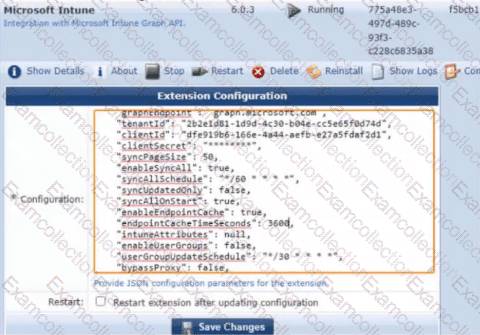
Extension Configuration:
graphEndpoint: graph.microsoft.com
syncPageSize: 50
enableSyncAll: true
syncAllSchedule: "*/60 * * * *"
syncUpdatedOnly: false
syncAllOnStart: true
enableEndpointCache: true
endpointCacheTimeSeconds: 3600
enableUserGroups: false
Refer to the scenario.
The Intune extension is configured as shown in this exhibit.
The customer wants to reduce the overhead of polling information from Intune to CPPM, but requires client information to be current at least once per hour. What should you recommend?
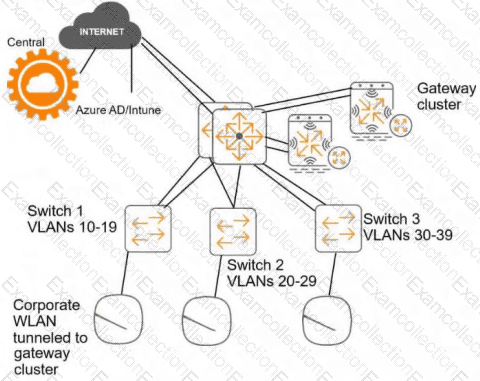
Refer to the exhibit, which depicts the topology for an HPE Aruba Networking network.
* Gateways: GW1 (10.1.30.2 / 10.1.36.2), GW2 (10.1.30.3 / 10.1.36.3), VRRP: 10.1.36.1
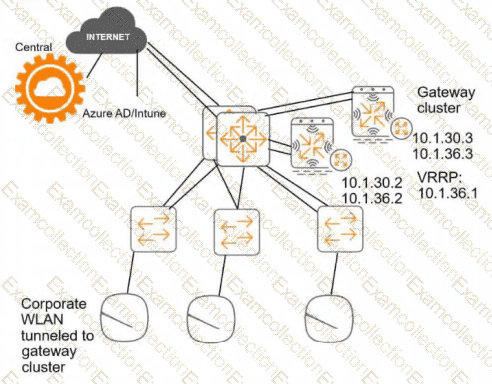
The gateways have sent the following logs to your Syslog server:
```text
< 142 > Jan 9 18:01:15 GW1 authmgr[6118]: < 124039 > < 6118 > Time-range night-hours activated
< 142 > Jan 9 18:01:15 GW1 authmgr[6118]: < 124040 > < 6118 > Time-range working-hours deactivated
< 142 > Jan 9 18:13:07 GW2 authmgr[6159] : < 124709 > < 6159 > Drop ARP-packet with unknown-IP: smac:a0:e7:7b:97:a2:98 sender-mac: a0:e7:7b:97:a2:98 sender-ip:10.1.30.2
< 142 > Jan 9 18:13:38 GW2 authmgr[6159]: < 124709 > < 6159 > Drop ARP-packet with unknown-IP: smac: a0:e7:7b:97:a2:98 sender-mac: a0:e7:7b:97:a2:98 sender-ip:10.1.30.2
< 142 > Jan 9 18:21:24 GW2 isakmpd[6132]: < 103076 > < 6132 > IKEv2 IPSEC Tunnel created for peer 10.1.30.2:500
< 142 > Jan 9 18:21:24 GW2 isakmpd[6132]: < 103101 > < 6132 > IPSEC SA deleted for peer 10.1.30.2
< 142 > Jan 9 18:21:24 GW2 isakmpd[6132]: < 103078 > < 6132 > IKEv2 CHILDSA successful for peer 10.1.30.2:500
< 142 > Jan 9 18:21:26 GW1 isakmpd[6091]: < 103076 > < 6091 > IKEv2 IPSEC Tunnel created for peer 10.1.30.3:500
< 142 > Jan 9 18:21:26 GW1 isakmpd[6091]: < 103101 > < 6091 > IPSEC SA deleted for peer 10.1.30.3
< 142 > Jan 9 18:21:26 GW1 isakmpd[6091]: < 103078 > < 6091 > IKEv2 CHILDSA successful for peer 10.1.30.3:500
```
What potential security issue can be identified from these logs?
An organization wants an AOS-CX switch to generate an alert when its RADIUS server (cp.acnsxtest.local) rejects an abnormal number of client authentication requests each hour. After discussing this with other HPE Aruba Networking administrators, you still do not know how many rejections should be considered normal or abnormal. You expect this value may vary for every switch.
You are assisting the developer with developing an NAE script for this use case.
Refer to the scenario.
You are helping a customer define an NAE script for AOS-CX switches. The script will monitor statistics from a RADIUS server configured on the switch. To future-proof the script, you want administrators to be able to choose a different hostname or IP address for the monitored RADIUS server when they create an agent from the script.
What should you recommend?
Refer to the scenario.
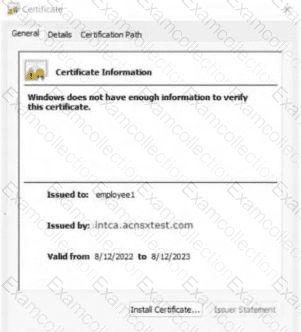
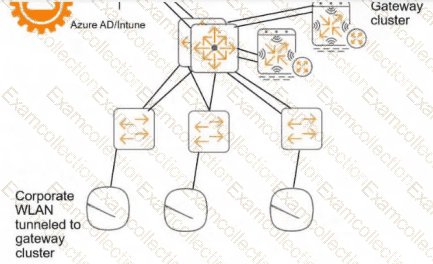
You must configure HPE Aruba Networking ClearPass Onboard to issue client certificates for Azure AD-joined devices. Which step is required to accomplish this objective?
The customer requires a secure method for users to enroll new wireless clients in Intune. You recommend a new WLAN that gives users limited access for enrollment. Captive portal has been configured on this WLAN to direct clients to a web page containing device-enrollment instructions, and several hostnames must be added manually to the captive-portal allowlist.
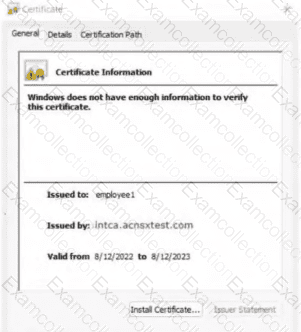
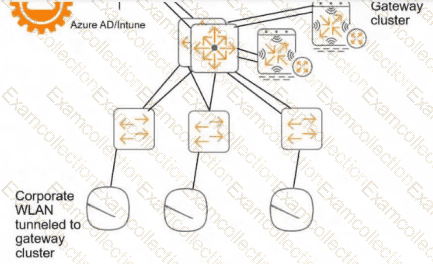
Which of the following is one such hostname?