PECB ISO-9001-Lead-Auditor - QMS ISO 9001:2015 Lead Auditor Exam
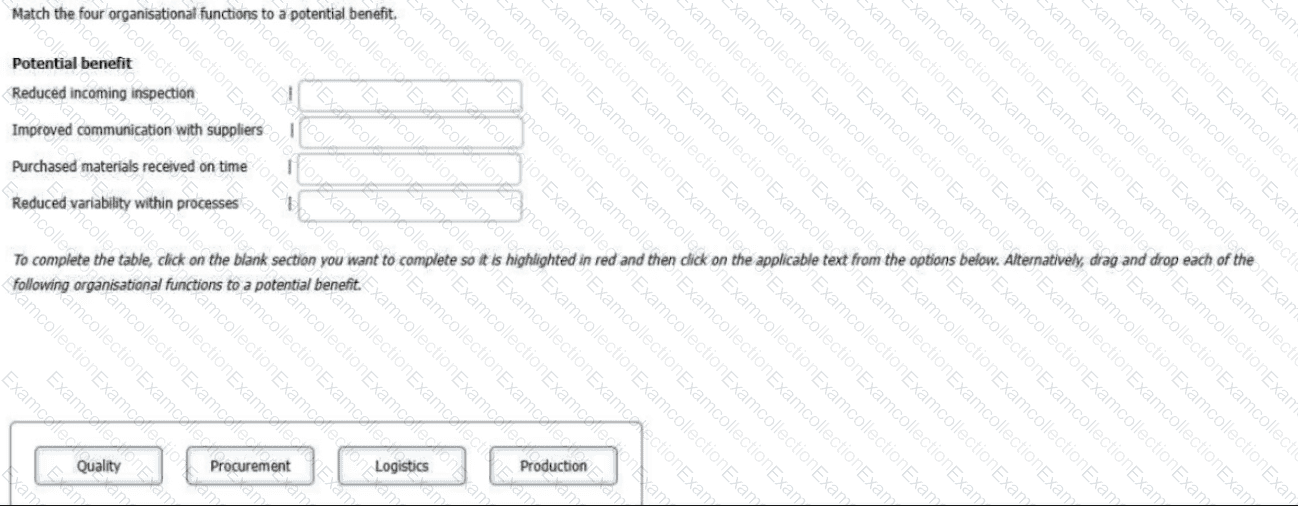
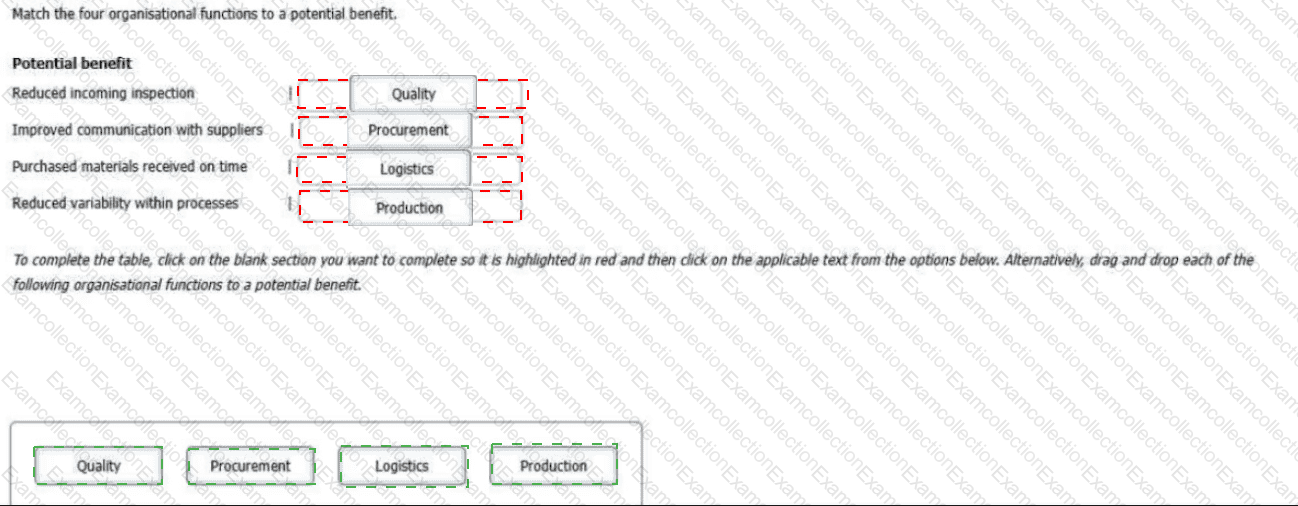
An organisation decides to purchase products and services only from ISO 9001 certified suppliers.
Match the four organisational functions to a potential benefit.
Scenario 3:
Fin-Pro is a financial institution in Austria offering commercial banking, wealth management, and investment services. The company faced a significant loss of customers due to failing to improve service quality as they expanded.
To regain customer confidence, top management implemented a QMS based on ISO 9001. After a year, they contacted ACB, a local certification body, to pursue ISO 9001 certification.
The audit team was led by Emilia, an experienced lead auditor, and included three auditors. After an agreement was reached, ACB sent the audit objectives to the audit team.
The audit team began by gathering information about Fin-Pro’s understanding of ISO 9001 requirements. While reviewing documented information, they noticed missing records of training and awareness sessions. They conducted employee interviews to verify attendance.
The team also reviewed the organizational chart and job descriptions to confirm employee competence. They observed the company’s working environment (social, psychological, and physical conditions).
The audit team analyzed the evidence and prepared an audit report with findings and conclusions.
Which statement below represents the level of responsibility demonstrated by the audit team in scenario 3?
You are an auditor from a construction organisation who is conducting a second party audit to ISO 9001 at a steel rolling mill producing
structural steelwork. When auditing the rolling process, you find that the operator who is unloading the furnace does not use the
adjacent infrared pyrometer to measure the appropriate product temperature in readiness for the next production stage.
You: " How do you tell when the billet is ready for the rolling stage? "
Operator: " I ' ve done this job for 20 years. I can tell by the bright red colour. "
You: " What happens if the colour is wrong? "
Operator: " The billet goes back into the furnace. "
You: " Is the pyrometer ever used? "
Operator: " Only in borderline cases. "
You continue to interview the operator and find that around 25% of the billets are sent back to the furnace. This includes 80% of the borderline cases.
Select three options that would provide evidence of conformance with clause 9.1.1 of ISO 9001.
You are carrying out an audit at a single-site organisation seeking certification to ISO 9001 for the first time. The organisation manufactures
cosmetics for major retailers.
You are interviewing the Manufacturing Manager (MM).
You: " I would like to begin by looking at the cleaning controls. "
MM: " We record the cleaning of the equipment at the end of every batch. This document details the minimum cleaning frequency and the
procedures to follow for all areas and each item of equipment. The person who carries out the cleaning puts their initial on the document and records
the time and date alongside. "
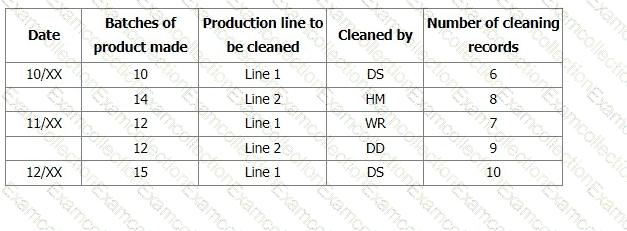
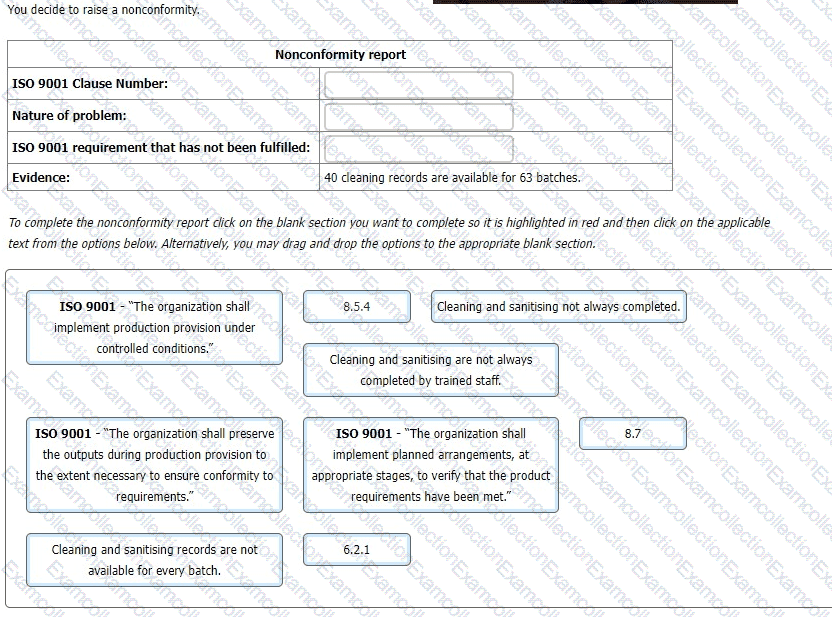
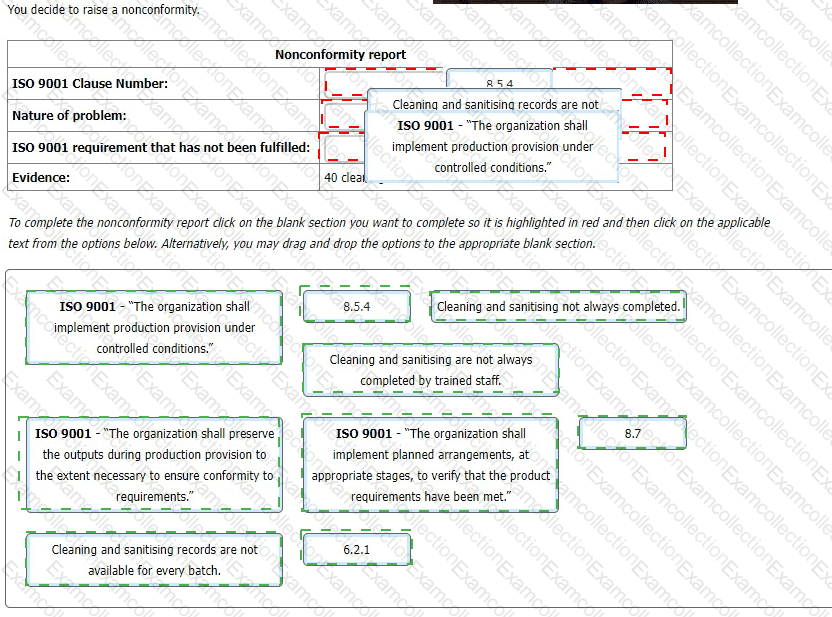
Narrative: You sample production records over 3-days and note down evidence of nonconformity as per the table below.
You have been just hired as the Internal Lead Auditor of a large organisation, responsible for internal audits. Your first job is to analyse the answers to nonconformities included in the report of a recent internal audit to Top Management.
The report contained one nonconformity as follows:
There is no evidence of Top Management ensuring the availability of resources to operate the QMS, the establishment of objectives, the promotion of continual improvement, and the promoting of the process approach.
Which four of the following Top Management actions can be considered ' corrections to the nonconformity ' ?
You are carrying out an audit at an organisation seeking certification to ISO 9001 for the first time. The organisation offers health and safety training to customers. Training courses are offered either as open courses, delivered at a public venue, or online, or as courses that are tailored to meet specific requirements. The business operates from a single office and those who deliver the training are either full-time employees or subcontractors.
You are interviewing the Training Manager (TM).
You: " What quality objectives apply to the training process? "
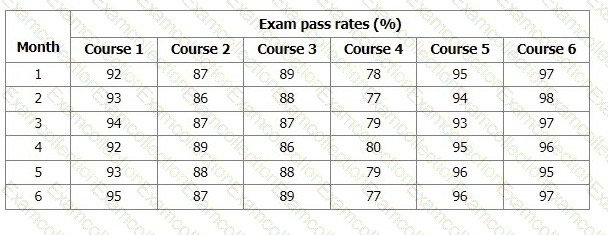
TM: " One of the quality objectives we aim for is a 90% minimum exam pass rate for all open training courses. "
You: " How do you measure this objective? "
The Training Manager shows you a record on her computer and you see the following:
Which two of the following statements are true?
The Closing meeting of a second-party audit was planned for 6 pm with the general manager and the quality manager.
At 6 pm, when the audit team enters the meeting room, only the Quality Manager is present and walting for them.
The dialogue among them is as follows:
Auditor team leader: " Good evening, could you please inform the general manager that we are ready to start with the closing meeting? "
Quality manager: " Good evening. I am sorry to inform you that the general manager will not be able to attend the meeting. He will try to
participate virtually to make some closing remarks. "
Auditor team leader: " OK. We identified seven nonconformities - these are the reports. Could you please review them and sign them? "
Quality manager: " OK. As you know, I reviewed them after yesterday ' s meeting and accept of all them, where shall I sign? "
General manager (from speakers in the room and addressing the quality manager): " Hold on! Do not sign the two nonconformities related to ABC
Bank! I have just checked, and we did not provide any services to ABC Bank during September! You can sign the remaining five nonconformities. "
How would you proceed with the audit? Select one.
During the opening meeting of a third-party audit of a pharmaceutical organisation (CD9000) with seven COVID-19 testing laboratories in various terminals at a major international airport, you are asked if you could
visit all laboratories. As audit team leader you say that, based on sampling criteria, you had planned to audit only three of them as CD9000 is a multisite organisation.
They tell you that they have worked so hard to get ready for the audit that the supervisors of those laboratories that would not be visited would be quite disappointed.
The following are possible responses to the request, select the two best responses:
Whistlekleen is a national dry cleaning and laundry company with 50 shops. You are conducting a surveillance audit of the Head Office and are sampling customer complaints. You find that 80% of complaints originate from five shops in the same region. Most of these complaints relate to damage to customer laundry. The Quality Manager tells you that these are the oldest shops in the company. The cleaning equipment needs replacing but the company cannot afford it at the moment. You learn
that the shop managers were told to dismiss most of the claims on the basis of the poor quality of the laundered materials.
On raising the matter with senior management, you are told that there are plans to replace the equipment in these shops over the next five years.
When reviewing the customer complaint file, you find that the organisation is facing a legal dispute with a customer over damage to an expensive cashmere coat.
Select the best option for how this should be handled by the Quality Management System.
You are an auditor and are in dialogue with the quality manager and the managing director of a small business that supplies specific IT
hardware and software for manufacturers of medical equipment.
You: " I would like to look at how you manage the design and development of your products.
Auditee: " We have made some strategic changes, the main one being that since last month we no longer produce the software of our
products in-house. "
You: " What has been the impact of that? "
Auditee: " We now subcontract the provision of the software needed for our hardware. This allowed us to concentrate our efforts on
the hardware and let specialised organisations develop the software. For the time being, we have subcontracted our software
requirements to three different organisations.
You: " What were the reasons for making the change? "
Auditee: " Our IT software section was a small operation, and we struggled to cope with new technologies. During busy periods, we
found it hard to meet lead times, and in quiet periods, we had staff with little to do. This was having an impact on customer
satisfaction. "
You: " How did you go about the change? "
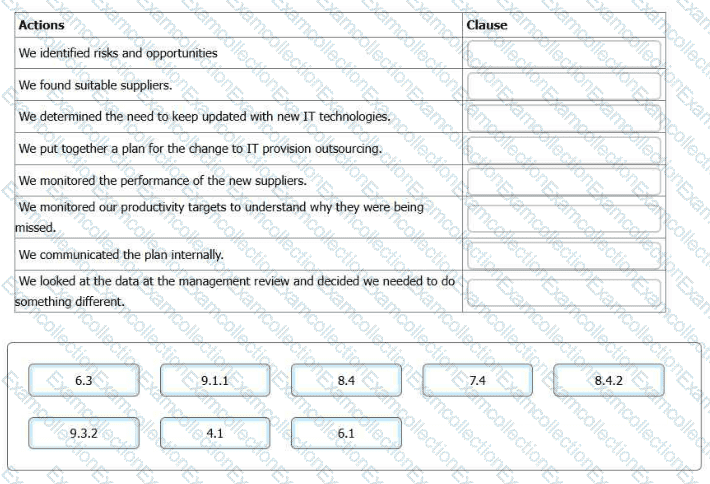
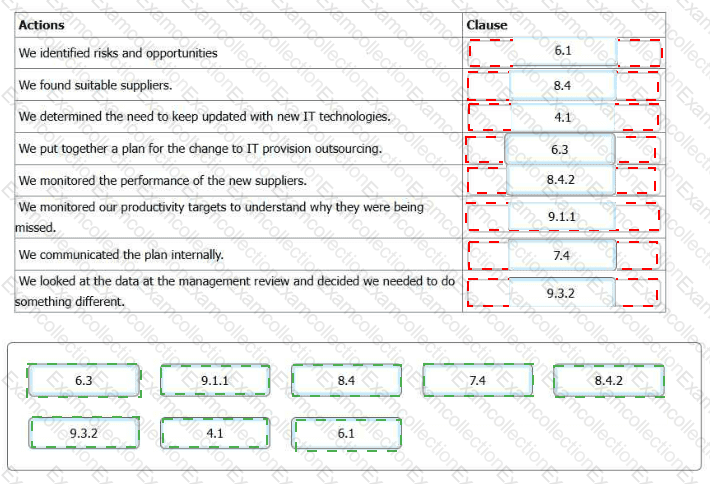
In relation to the auditor ' s question about how the change was managed, the auditee mentions the actions listed
below. Match the ISO 9001 clauses to show which action the requirement applies to.
To complete the table, click on the blank section you want to complete so it is highlighted in red and then click on the
ISO 9001 clauses listed below. Alternatively, drag and drop each clause to show which clause the action applies to.