

Spring Sale Special Limited Time 70% Discount Offer - Ends in 0d 00h 00m 00s - Coupon code: xmas50

Juniper JN0-281 - Data Center Associate (JNCIA-DC)

Page: 2 / 2
Total 67 questions

You want your Junos OS router to drop packets that it receives for a particular destination IP address. You also want to notify the source of the traffic that the destination IP address is unreachable. How would you accomplish this task?

A.

Create a static route for the destination IP address in the inet.3 routing table.

B.

Add the destination IP address to the list of martian IP addresses.

C.

Create a static route for the destination IP address with a next hop of reject.

D.

Create and apply a firewall filter to the ingress interface that discards traffic destined to the IP address.

When evaluating BGP routes, what will be evaluated first?

A.

The local preference value

B.

The AS path

C.

The MED value

D.

The origin value

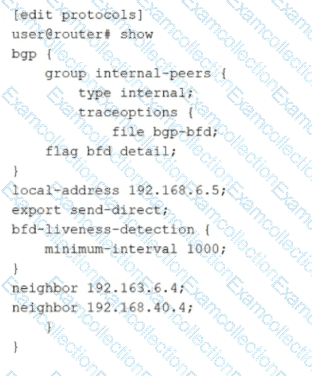
Referring to the exhibit,

how much time must pass before a neighbor is considered down?

A.

5000 ms

B.

2000 ms

C.

1000 ms

D.

3000 ms

What are two characteristics of EBGP? Choose two.

A.

EBGP sessions do not require an IGP.

B.

EBGP sessions require loopback IP address peering.

C.

EBGP does not support sessions with non-directly connected peers.

D.

EBGP sessions are typically established between directly connected peers.

You have a problem bringing up an aggregated Ethernet interface between a spine and a leaf.
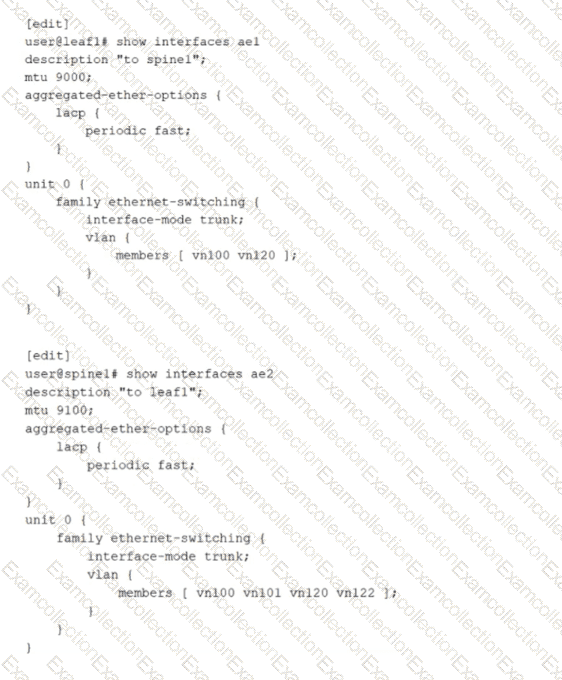
Referring to the exhibit, what is the problem?

A.

The active statement must be added to LACP under the aggregated-ether-options hierarchy on one or both sides.

B.

The ae interface numbers are not consistent.

C.

The leaf-and-spine VLAN memberships are not consistent and should be changed to include the additional VLANs defined on spine1.

D.

The leaf-and-spine MTUs are not consistent.

Which route is preferred by the Junos OS software routing tables?

A.

Static

B.

Aggregate

C.

Direct

D.

BGP

By default, which two statements about trunk and access ports are correct? Choose two.

A.

Trunk ports forward untagged traffic.

B.

Access ports forward untagged traffic.

C.

Access ports forward tagged traffic.

D.

Trunk ports forward tagged traffic.

What are two advantages of spine and leaf architectures compared to legacy architectures within a data center? Choose two.

A.

Containers and hypervisors are easier to manage with spine and leaf architectures.

B.

Spine and leaf fabrics demonstrate better scaling features.

C.

Better performance is due to low and predictable hop counts.

D.

All broadcast domains become reachable, allowing easier host connectivity.

You have configured a static route to be used for management traffic. You want to ensure that this route is not propagated to other routers. In this scenario, which parameter would you add to this route configuration?

A.

reject

B.

preference 255

C.

no-readvertise

D.

discard

When using spine and leaf fabric architectures, what is the role of each device? (Choose two.)

A.

Spine nodes are used for host connectivity.

B.

Spine nodes are used for transit to other leaf nodes.

C.

Leaf nodes are used for traffic to other leafs.

D.

Leaf nodes are used for host connectivity.