


Juniper JN0-364 - Service Provider Routing and Switching - Specialist (JNCIS-SP)
You are configuring BGP on a Juniper router to peer with an external provider. After committing the configuration, the BGP session remains in the Idle state. Which configuration issue would prevent the BGP session from progressing beyond the Idle state?
You have configured an MPLS LSP that begins on R1 and terminates on R5 using the Junos default settings. Referring to the exhibit, which router will perform only label swap operations?
How are routing loops prevented in internal BGP networks?
What is the default route preference for an aggregate route?
You are designing an MPLS network and want to ensure that traffic traverses an LSP between PE routers that follow an explicit path through the core. Which protocol would accomplish this task?
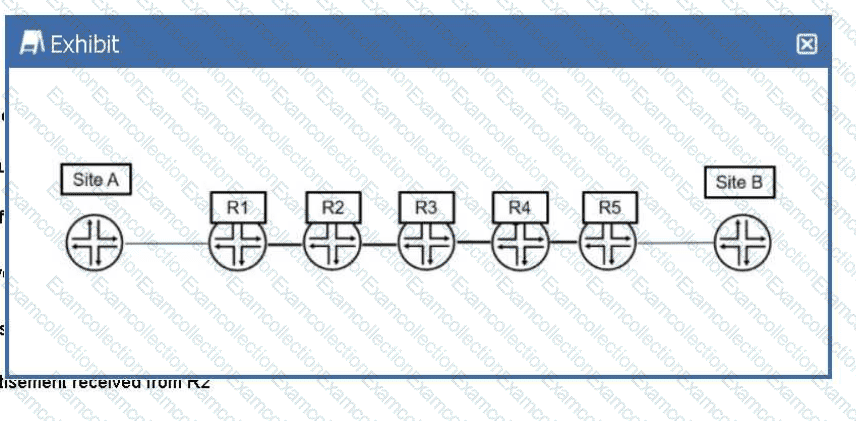
In the exhibit, Site A is sending traffic to Site B. R1 adds MPLS label 7166 to direct the traffic to R5. Which two criteria did R1 use to determine which label number to add to the traffic? (Choose two.)
A service provider is onboarding a new enterprise customer that operates multiple branch offices, each with its own set of VLANs. The customer requires transparent Layer 2 connectivity between sites while maintaining separation of internal VLANs. The provider must also ensure that customer VLAN identifiers do not conflict with other customers on the shared infrastructure. Which solution would provide the desired results?
Exhibit:
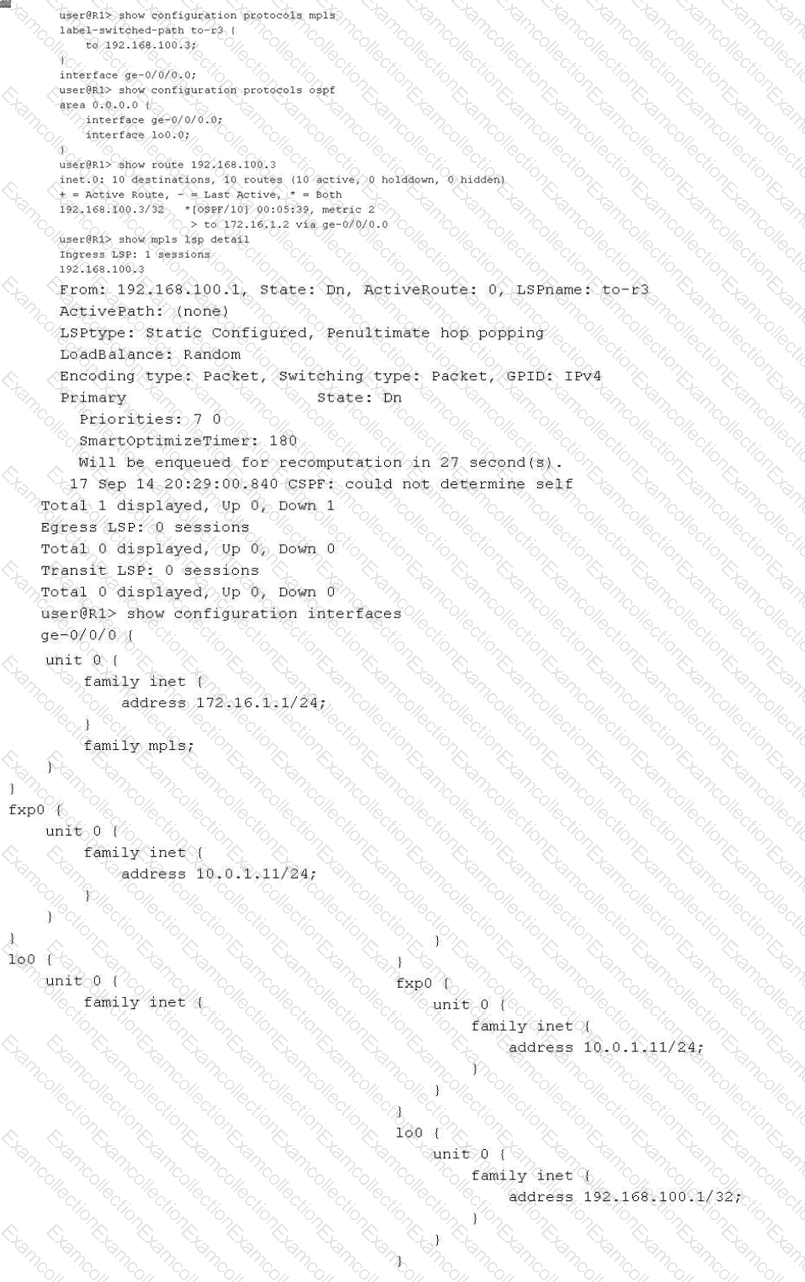
You have configured an MPLS LSP to 192.168.100.3. However, the LSP is in the down state. Referring to the exhibit, which two actions would solve this problem? (Choose two.)
In an OSPF network, what is a purpose of a designated router?
You are a network architect designing a brand new network. You want to deploy RSVP LSPs in this network. You are currently in the process of choosing whether to run OSPF or IS-IS as your interior gateway protocol. In this scenario, which two statements are correct about IGP traffic engineering extensions in an RSVP network? (Choose two.)