Summer Sale Special Limited Time 70% Discount Offer - Ends in 0d 00h 00m 00s - Coupon code: xmas50

Amazon Web Services MLA-C01 - AWS Certified Machine Learning Engineer - Associate

Page: 7 / 8
Total 241 questions

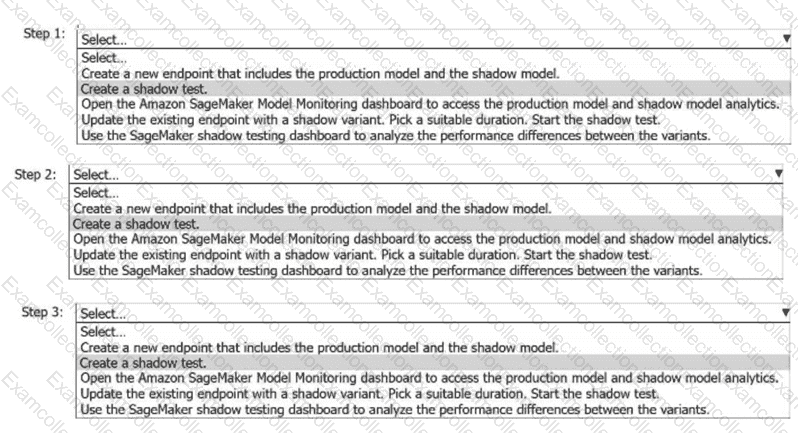
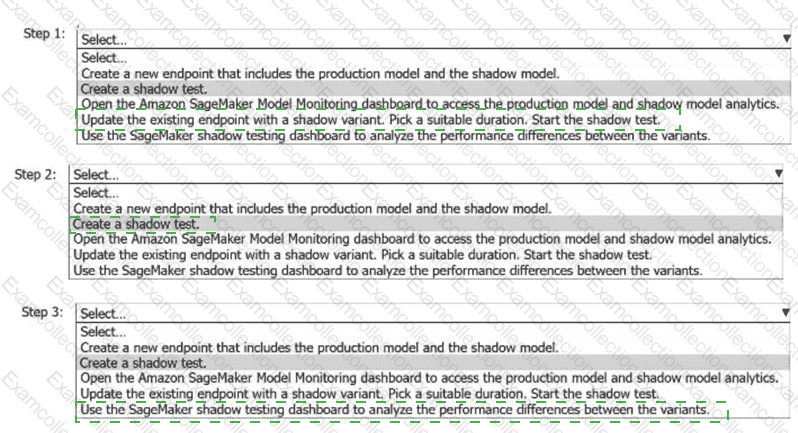
A company wants to evaluate a new ML model architecture to understand its performance before deploying the model to production. The company wants to use Amazon SageMaker AI shadow testing.

The company needs to analyze the performance metrics of the shadow model and the production model without affecting the existing production endpoint. The analysis must use real-time inference requests.

Select and order the correct steps to implement shadow testing and compare the model variants in SageMaker AI. Select each step one time or not at all (Select and order Three)
A company is gathering audio, video, and text data in various languages. The company needs to use a large language model (LLM) to summarize the gathered data that is in Spanish.

Which solution will meet these requirements in the LEAST amount of time?

A.

Train and deploy a model in Amazon SageMaker to convert the data into English text. Train and deploy an LLM in SageMaker to summarize the text.

B.

Use Amazon Transcribe and Amazon Translate to convert the data into English text. Use Amazon Bedrock with the Jurassic model to summarize the text.

C.

Use Amazon Rekognition and Amazon Translate to convert the data into English text. Use Amazon Bedrock with the Anthropic Claude model to summarize the text.

D.

Use Amazon Comprehend and Amazon Translate to convert the data into English text. Use Amazon Bedrock with the Stable Diffusion model to summarize the text.

A company uses an ML model to recommend videos to users. The model is deployed on Amazon SageMaker AI. The model performed well initially after deployment, but the model ' s performance has degraded over time.

Which solution can the company use to identify model drift in the future?

A.

Create a monitoring job in SageMaker Model Monitor. Then create a baseline from the training dataset.

B.

Create a baseline from the training dataset. Then create a monitoring job in SageMaker Model Monitor.

C.

Create a baseline by using a built-in rule in SageMaker Clarify. Monitor the drift in Amazon CloudWatch.

D.

Retrain the model on new data. Compare the retrained model ' s performance to the original model ' s performance.

An ML engineer is setting up an Amazon SageMaker AI pipeline for an ML model. The pipeline must automatically initiate a re-training job if any data drift is detected.

How should the ML engineer set up the pipeline to meet this requirement?

A.

Use an AWS Glue crawler and an AWS Glue extract, transform, and load (ETL) job to detect data drift. Use AWS Glue triggers to automate the re-training job.

B.

Use Amazon Managed Service for Apache Flink to detect data drift. Use an AWS Lambda function to automate the re-training job.

C.

Use SageMaker Model Monitor to detect data drift. Use an AWS Lambda function to automate the re-training job.

D.

Use Amazon Quick Suite (previously known as Amazon QuickSight) anomaly detection to detect data drift. Use an AWS Step Functions workflow to automate the re-training job.

A company is using an Amazon S3 bucket to collect data that will be used for ML workflows. The company needs to use AWS Glue DataBrew to clean and normalize the data.

Which solution will meet these requirements?

A.

Create a DataBrew dataset by using the S3 path. Clean and normalize the data by using a DataBrew profile job.

B.

Create a DataBrew dataset by using the S3 path. Clean and normalize the data by using a DataBrew recipe job.

C.

Create a DataBrew dataset by using a JDBC driver to connect to the S3 bucket. Use a profile job.

D.

Create a DataBrew dataset by using a JDBC driver to connect to the S3 bucket. Use a recipe job.

A company is developing an application that reads animal descriptions from user prompts and generates images based on the information in the prompts. The application reads a message from an Amazon Simple Queue Service (Amazon SQS) queue. Then the application uses Amazon Titan Image Generator on Amazon Bedrock to generate an image based on the information in the message. Finally, the application removes the message from SQS queue.

Which IAM permissions should the company assign to the application ' s IAM role? (Select TWO.)

A.

Allow the bedrock:InvokeModel action for the Amazon Titan Image Generator resource.

B.

Allow the bedrock:Get* action for the Amazon Titan Image Generator resource.

C.

Allow the sqs:ReceiveMessage action and the sqs:DeleteMessage action for the SQS queue resource.

D.

Allow the sqs:GetQueueAttributes action and the sqs:DeleteMessage action for the SQS queue resource.

E.

Allow the sagemaker:PutRecord* action for the Amazon Titan Image Generator resource.

An advertising company uses AWS Lake Formation to manage a data lake. The data lake contains structured data and unstructured data. The company ' s ML engineers are assigned to specific advertisement campaigns.

The ML engineers must interact with the data through Amazon Athena and by browsing the data directly in an Amazon S3 bucket. The ML engineers must have access to only the resources that are specific to their assigned advertisement campaigns.

Which solution will meet these requirements in the MOST operationally efficient way?

A.

Configure IAM policies on an AWS Glue Data Catalog to restrict access to Athena based on the ML engineers ' campaigns.

B.

Store users and campaign information in an Amazon DynamoDB table. Configure DynamoDB Streams to invoke an AWS Lambda function to update S3 bucket policies.

C.

Use Lake Formation to authorize AWS Glue to access the S3 bucket. Configure Lake Formation tags to map ML engineers to their campaigns.

D.

Configure S3 bucket policies to restrict access to the S3 bucket based on the ML engineers ' campaigns.

A company uses Amazon Athena to query a dataset in Amazon S3. The dataset has a target variable that the company wants to predict.

The company needs to use the dataset in a solution to determine if a model can predict the target variable.

Which solution will provide this information with the LEAST development effort?

A.

Create a new model by using Amazon SageMaker Autopilot. Report the model ' s achieved performance.

B.

Implement custom scripts to perform data pre-processing, multiple linear regression, and performance evaluation. Run the scripts on Amazon EC2 instances.

C.

Configure Amazon Macie to analyze the dataset and to create a model. Report the model ' s achieved performance.

D.

Select a model from Amazon Bedrock. Tune the model with the data. Report the model ' s achieved performance.

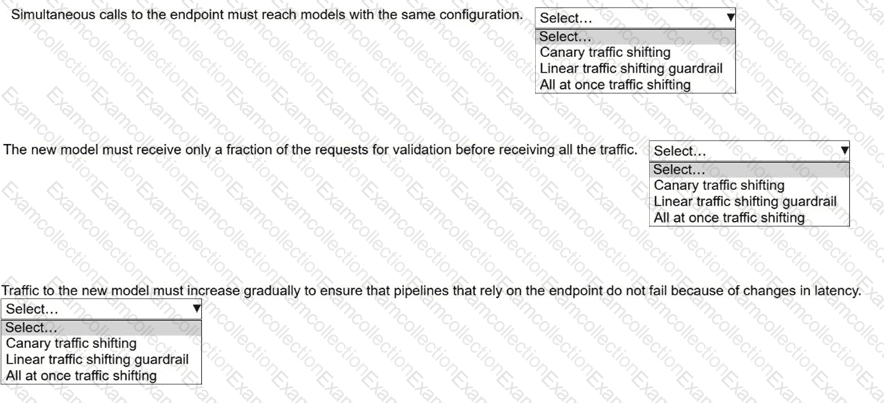
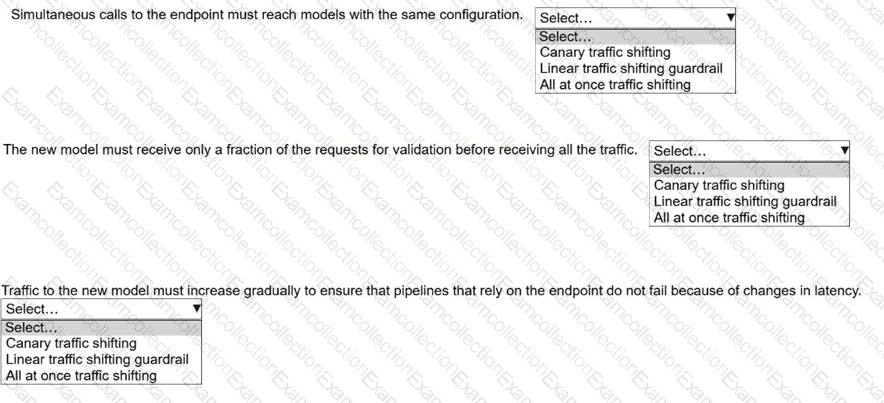
A company has multiple models that are hosted on Amazon SageMaker Al. The models need to be re-trained. The requirements for each model are different, so the company needs to choose different deployment strategies to transfer all requests to a new model.

Select the correct strategy from the following list for each requirement. Select each strategy one time. (Select THREE.)

. Canary traffic shifting

. Linear traffic shifting guardrail

. All at once traffic shifting
A company ' s dataset for prediction analytics contains duplicate records, missing data, and unusually extreme high or low values. The company needs a solution to resolve the data quality issues quickly. The solution must maintain data integrity and have the LEAST operational overhead.

Which solution will meet these requirements?

A.

Use AWS Glue DataBrew to delete duplicate records, fill missing values with medians, and replace extreme values with values in a normal range.

B.

Configure an AWS Glue job to identify records with missing values and extreme measurements and delete them.

C.

Create an Amazon EMR Spark job to replace missing values with zeros and merge duplicate records.

D.

Use Amazon SageMaker Data Wrangler to delete duplicates, apply statistical modeling for missing values, and apply outlier detection algorithms.