Cyber Monday Sale Special Limited Time 70% Discount Offer - Ends in 0d 00h 00m 00s - Coupon code: xmas50

Salesforce MuleSoft-Integration-Architect-I - Salesforce Certified MuleSoft Platform Integration Architect (Mule-Arch-202)

A corporation has deployed Mule applications to different customer-hosted Mule runtimes. Mule applications deployed to these Mule runtimes are managed by Anypoint Platform.

What needs to be installed or configured (if anything) to monitor these Mule applications from Anypoint Monitoring, and how is monitoring data from each Mule application sent to Anypoint Monitoring?

A.

Enable monitoring of individual Mule applications from the Runtime Managerapplication settings.Runtime Manager sends monitoring data to Anypoint Monitoring for each deployed Mule application.

B.

Install a Runtime Manager agent on each Mule runtime.Each Runtime Manager agent sends monitoring data from the Mule applicationsrunning in its Mule runtime to Runtime Manager, then Runtime Manager sendsmonitoring data to Anypoint Monitoring.

C.

Leave the out-of-the-box Anypoint Monitoring agent unchanged in its default Muleruntime installation.Each Anypoint Monitoring agent sends monitoring data from the Mule applicationsrunning in its Mule runtime to Runtime Manager, then Runtime Manager sendsmonitoring data to Anypoint Monitoring.

D.

Install an Anypoint Monitoring agent on each Mule runtime.Each Anypoint Monitoring agent sends monitoring data from the Mule applicationsrunning in its Mule runtime to Anypoint Monitoring.

An organization is designing Mule application which connects to a legacy backend. It has been reported that backend services are not highly available and experience downtime quite often. As an integration architect which of the below approach you would propose to achieve high reliability goals?

A.

Alerts can be configured in Mule runtime so that backend team can be communicated when services are down

B.

Until Successful scope can be implemented while calling backend API's

C.

On Error Continue scope to be used to call in case of error again

D.

Create a batch job with all requests being sent to backend using that job as per the availability of backend API's

A Mule application is synchronizing customer data between two different database systems.

What is the main benefit of using XA transaction over local transactions to synchronize these two database system?

A.

Reduce latency

B.

Increase throughput

C.

Simplifies communincation

D.

Ensure consistency

A Mule application currently writes to two separate SQL Server database instances across the internet using a single XA transaction. It is 58. proposed to split this one transaction into two separate non-XA transactions with no other changes to the Mule application.

What non-functional requirement can be expected to be negatively affected when implementing this change?

A.

Throughput

B.

Consistency

C.

Response time

D.

Availability

49 of A popular retailer is designing a public API for its numerous business partners. Each business partner will invoke the API at the URL 58. https://api.acme.com/partnefs/vl. The API implementation is estimated to require deployment to 5 CloudHub workers.

The retailer has obtained a public X.509 certificate for the name apl.acme.com, signed by a reputable CA, to be used as the server certificate.

Where and how should the X.509 certificate and Mule applications be used to configure load balancing among the 5 CloudHub workers, and what DNS entries should be configured in order for the retailer to support its numerous business partners?

A.

Add the X.509 certificate to the Mule application's deployable archive, then configure a CloudHub Dedicated Load Balancer (DLB) for each of the Mule application's CloudHub workersCreate a CNAME for api.acme.com pointing to the DLB's A record

B.

Add the X.509 certificate to the CloudHub Shared Load Balancer (SLB), not to the Mule applicationCreate a CNAME for api.acme.com pointing to the SLB's A record

C.

Add the X.509 certificate to a CloudHub Dedicated Load Balancer (DLB), not to the Mule applicationCreate a CNAME for api.acme.com pointing to the DLB's A record

D.

Add the x.509 certificate to the Mule application's deployable archive, then configure the CloudHub Shared Load Balancer (SLB)for each of the Mule application's CloudHub workersCreate a CNAME for api.acme.com pointing to the SLB's A record

According to MuleSoft, what is a major distinguishing characteristic of an application network in relation to the integration of systems, data, and devices?

A.

It uses a well-organized monolithic approach with standards

B.

It is built for change and self-service

C.

It leverages well-accepted internet standards like HTTP and JSON

D.

It uses CI/CD automation for real-time project delivery

A Mule application uses the Database connector.

What condition can the Mule application automatically adjust to or recover from without needing to restart or redeploy the Mule application?

A.

One of the stored procedures being called by the Mule application has been renamed

B.

The database server was unavailable for four hours due to a major outage but is now fully operational again

C.

The credentials for accessing the database have been updated and the previous credentials are no longer valid

D.

The database server has been updated and hence the database driver library/JAR needs a minor version upgrade

Which Anypoint Platform component helps integration developers discovers and share reusable APIs, connectors, and templates?

A.

Anypoint Exchange

B.

API Manager

C.

Anypoint Studio

D.

Design Center

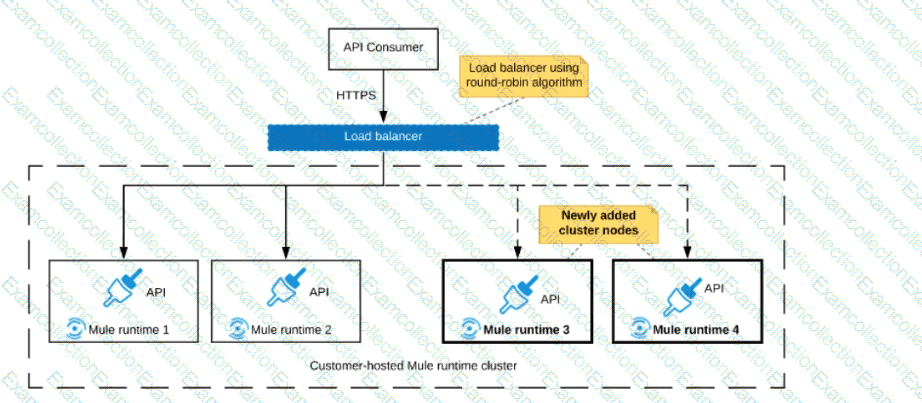
Refer to the exhibit.

An organization uses a 2-node Mute runtime cluster to host one stateless API implementation. The API is accessed over HTTPS through a load balancer that uses round-robin for load distribution.

Two additional nodes have been added to the cluster and the load balancer has been configured to recognize the new nodes with no other change to the load balancer.

What average performance change is guaranteed to happen, assuming all cluster nodes are fully operational?

A.

50% reduction in the response time of the API

B.

100% increase in the throughput of the API

C.

50% reduction In the JVM heap memory consumed by each node

D.

50% reduction In the number of requests being received by each node

An organization has decided on a cloudhub migration strategy that aims to minimize the organizations own IT resources. Currently, the organizational has all of its Mule applications running on its own premises and uses an premises load balancer that exposes all APIs under the base URL https://api.acme.com

As part of the migration strategy, the organization plans to migrate all of its Mule applications and load balancer to cloudhub

What is the most straight-forward and cost effective approach to the Mule applications deployment and load balancing that preserves the public URLs?

A.

Deploy the Mule applications to CloudhubUpdate the CNAME record for an api.acme.com in the organizations DNS server pointing to the A record of a cloudhub dedicated load balancer(DLB)Apply mapping rules in the DLB to map URLs to their corresponding Mule applications

B.

For each migrated Mule application, deploy an API proxy Mule application to Cloudhub with all applications under the control of a dedicated load balancer(CLB)Update the CNAME record for api.acme.com in the organization DNS server pointing to the A record of a cloudhub dedicated load balancer(DLB)Apply mapping rules in the DLB to map each API proxy application to its corresponding Mule applications

C.

Deploy the Mule applications to CloudhubCreate CNAME record for api.acme.com in the Cloudhub Shared load balancer (SLB) pointing to the A record of the on-premise load balancerApply mapping rules in the SLB to map URLs to their corresponding Mule applications

D.

Deploy the Mule applications to CloudhubUpdate the CNAME record for api.acme.com in the organization DNS server pointing to the A record of the cloudhub shared load balancer(SLB)Apply mapping rules in the SLB to map URLs to their corresponding Mule applications.