


Salesforce MuleSoft-Integration-Architect-I - Salesforce Certified MuleSoft Platform Integration Architect (Mule-Arch-202)
Total 273 questions
How does timeout attribute help inform design decisions while using JMS connector listening for incoming messages in an extended architecture (XA) transaction?
An insurance company has an existing API which is currently used by customers. API is deployed to customer hosted Mule runtime cluster. The load balancer that is used to access any APIs on the mule cluster is only configured to point to applications hosted on the server at port 443.
Mule application team of a company attempted to deploy a second API using port 443 but the application will not start and checking logs shows an error indicating the address is already in use.
Which steps must the organization take to resolve this error and allow customers to access both the API's?
An automation engineer needs to write scripts to automate the steps of the API lifecycle, including steps to create, publish, deploy and manage APIs and their implementations in Anypoint Platform.
What Anypoint Platform feature can be used to automate the execution of all these actions in scripts in the easiest way without needing to directly invoke the Anypoint Platform REST APIs?
Which component of Anypoint platform belongs to the platform control plane?
According to MuleSoft's IT delivery and operating model, which approach can an organization adopt in order to reduce the frequency of IT project delivery failures?
Refer to the exhibit.
A Mule application is deployed to a multi-node Mule runtime cluster. The Mule application uses the competing consumer pattern among its cluster replicas to receive JMS messages from a JMS queue. To process each received JMS message, the following steps are performed in a flow:
Step l: The JMS Correlation ID header is read from the received JMS message.
Step 2: The Mule application invokes an idempotent SOAP webservice over HTTPS, passing the JMS Correlation ID as one parameter in the SOAP request.
Step 3: The response from the SOAP webservice also returns the same JMS Correlation ID.
Step 4: The JMS Correlation ID received from the SOAP webservice is validated to be identical to the JMS Correlation ID received in Step 1.
Step 5: The Mule application creates a response JMS message, setting the JMS Correlation ID message header to the validated JMS Correlation ID and publishes that message to a response JMS queue.
Where should the Mule application store the JMS Correlation ID values received in Step 1 and Step 3 so that the validation in Step 4 can be performed, while also making the overall Mule application highly available, fault-tolerant, performant, and maintainable?
An organization has strict unit test requirement that mandate every mule application must have an MUnit test suit with a test case defined for each flow and a minimum test coverage of 80%.
A developer is building Munit test suit for a newly developed mule application that sends API request to an external rest API.
What is the effective approach for successfully executing the Munit tests of this new application while still achieving the required test coverage for the Munit tests?
Mule applications need to be deployed to CloudHub so they can access on-premises database systems. These systems store sensitive and hence tightly protected data, so are not accessible over the internet.
What network architecture supports this requirement?
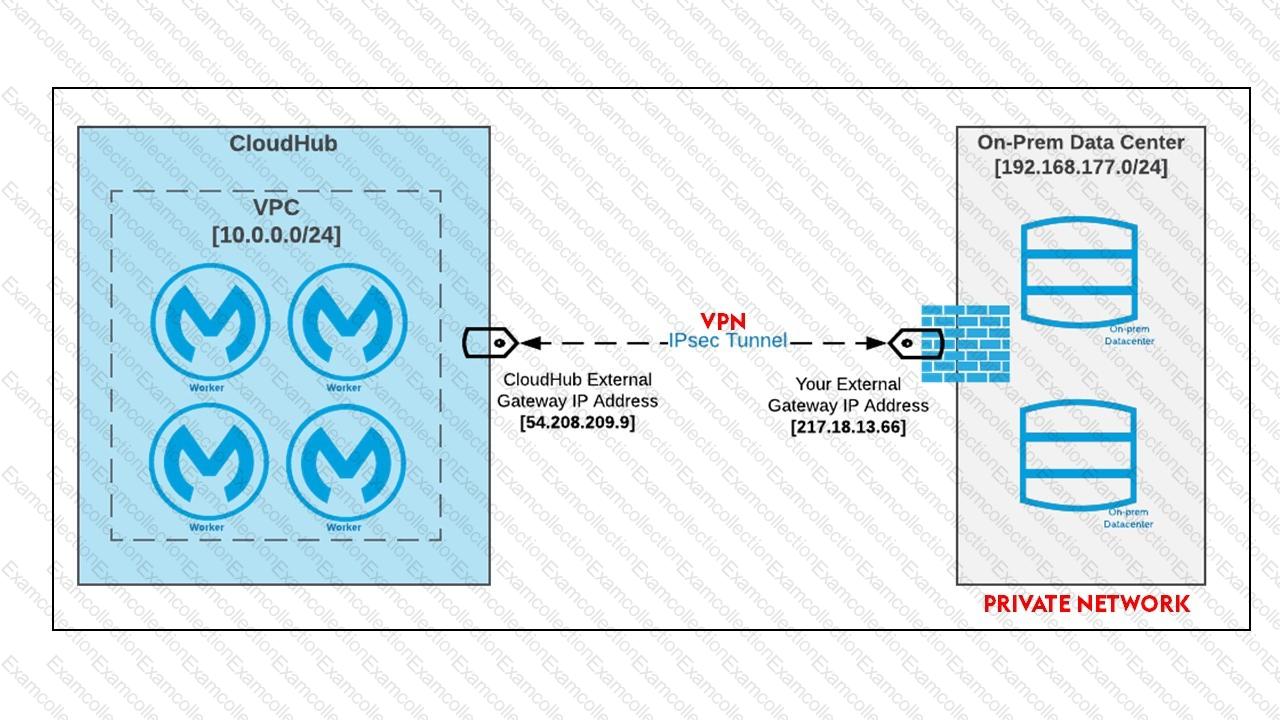 Diagram Description automatically generated
An organization is creating a Mule application that will be deployed to CloudHub. The Mule application has a property named dbPassword that stores a database user’s password.
The organization's security standards indicate that the dbPassword property must be hidden from every Anypoint Platform user after the value is set in the Runtime Manager Properties tab.
What configuration in the Mule application helps hide the dbPassword property value in Runtime Manager?
According to MuleSoft, which major benefit does a Center for Enablement (C4E) provide for an enterprise and its lines of business?
