


Salesforce MuleSoft-Integration-Architect-I - Salesforce Certified MuleSoft Platform Integration Architect (Mule-Arch-202)
Total 273 questions
A global, high-volume shopping Mule application is being built and will be deployed to CloudHub. To improve performance, the Mule application uses a Cache scope that maintains cache state in a CloudHub object store. Web clients will access the Mule application over HTTP from all around the world, with peak volume coinciding with business hours in the web client's geographic location. To achieve optimal performance, what Anypoint Platform region should be chosen for the CloudHub object store?
Refer to the exhibit.
A shopping cart checkout process consists of a web store backend sending a sequence of API invocations to an Experience API, which in turn invokes a Process API. All API invocations are over HTTPS POST. The Java web store backend executes in a Java EE application server, while all API implementations are Mule applications executing in a customer -hosted Mule runtime.
End-to-end correlation of all HTTP requests and responses belonging to each individual checkout Instance is required. This is to be done through a common correlation ID, so that all log entries written by the web store backend, Experience API implementation, and Process API implementation include the same correlation ID for all requests and responses belonging to the same checkout instance.
What is the most efficient way (using the least amount of custom coding or configuration) for the web store backend and the implementations of the Experience API and Process API to participate in end-to-end correlation of the API invocations for each checkout instance?
A)
The web store backend, being a Java EE application, automatically makes use of the thread-local correlation ID generated by the Java EE application server and automatically transmits that to the Experience API using HTTP-standard headers
No special code or configuration is included in the web store backend, Experience API, and Process API implementations to generate and manage the correlation ID
B)
The web store backend generates a new correlation ID value at the start of checkout and sets it on the X-CORRELATlON-lt HTTP request header In each API invocation belonging to that checkout
No special code or configuration is included in the Experience API and Process API implementations to generate and manage the correlation ID
C)
The Experience API implementation generates a correlation ID for each incoming HTTP request and passes it to the web store backend in the HTTP response, which includes it in all subsequent API invocations to the Experience API.
The Experience API implementation must be coded to also propagate the correlation ID to the Process API in a suitable HTTP request header
D)
The web store backend sends a correlation ID value in the HTTP request body In the way required by the Experience API
The Experience API and Process API implementations must be coded to receive the custom correlation ID In the HTTP requests and propagate It in suitable HTTP request headers
What is an advantage that Anypoint Platform offers by providing universal API management and Integration-Platform-as-a-Service (iPaaS) capabilities in a unified platform?
A Kubernetes controller automatically adds another pod replica to the resource pool in response to increased application load.
Which scalability option is the controller implementing?
What is the MuleSoft-recommended best practice to share the connector and configuration information among the APIs?
Following MuleSoft best practices, what MuleSoft runtime deployment option best meets the company's goals to begin its digital transformation journey?
A company is planning to extend its Mule APIs to the Europe region. Currently all new applications are deployed to Cloudhub in the US region following this naming convention
{API name}-{environment}. for example, Orders-SAPI-dev, Orders-SAPI-prod etc.
Considering there is no network restriction to block communications between API's, what strategy should be implemented in order to apply the same new API's running in the EU region of CloudHub as well to minimize latency between API's and target users and systems in Europe?
Refer to the exhibit.
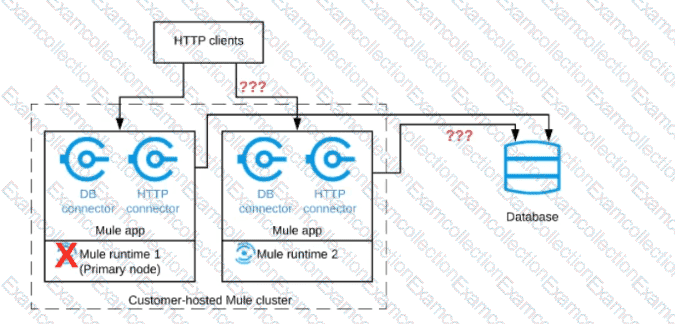
A Mule application is deployed to a cluster of two customer-hosted Mute runtimes. The Mute application has a flow that polls a database and another flow with an HTTP Listener.
HTTP clients send HTTP requests directly to individual cluster nodes.
What happens to database polling and HTTP request handling in the time after the primary (master) node of the cluster has railed, but before that node is restarted?
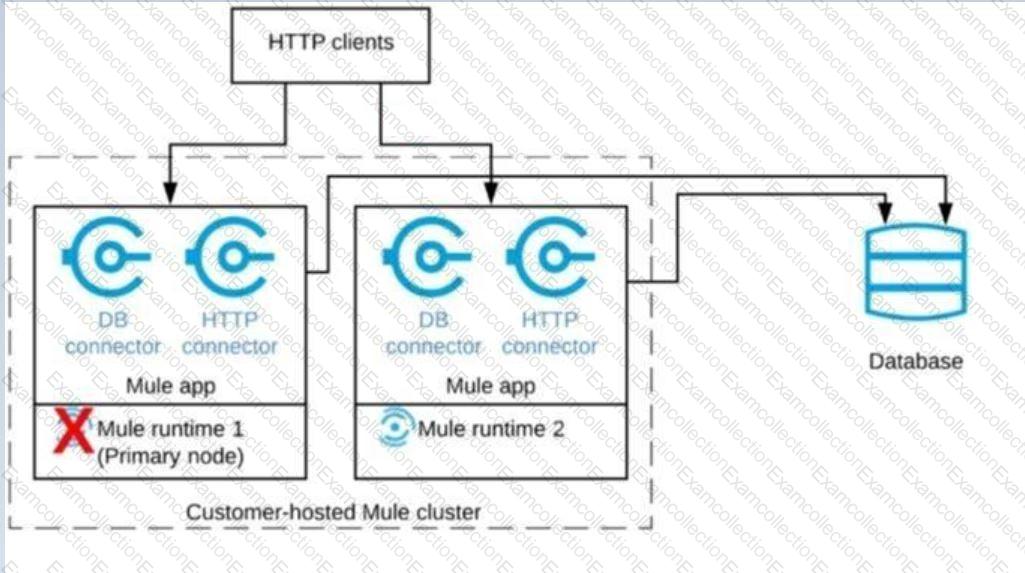 Diagram Description automatically generated
An API has been unit tested and is ready for integration testing. The API is governed by a Client ID Enforcement policy in all environments.
What must the testing team do before they can start integration testing the API in the Staging environment?
An organization has chosen Mulesoft for their integration and API platform.
According to the Mulesoft catalyst framework, what would an integration architect do to create achievement goals as part of their business outcomes?