


Salesforce MuleSoft-Integration-Architect-I - Salesforce Certified MuleSoft Platform Integration Architect (Mule-Arch-202)
Total 273 questions
An organization has several APIs that accept JSON data over HTTP POST. The APIs are all publicly available and are associated with several mobile applications and web applications. The organization does NOT want to use any authentication or compliance policies for these APIs, but at the same time, is worried that some bad actor could send payloads that could somehow compromise the applications or servers running the API implementations. What out-of-the-box Anypoint Platform policy can address exposure to this threat?
A finance giant is planning to migrate all its Mule applications to Runtime fabric (RTF). Currently all Mule applications are deployed cloud hub using automated CI/CD scripts.
As an integration architect, which of the below step would you suggest to ensure that the applications from cloudhub are migrated properly to Runtime Fabric (RTF) with an assumption that organization is keen on keeping the same deployment strategy.
Refer to the exhibit.
A Mule 4 application has a parent flow that breaks up a JSON array payload into 200 separate items, then sends each item one at a time inside an Async scope to a VM queue.
A second flow to process orders has a VM Listener on the same VM queue. The rest of this flow processes each received item by writing the item to a database.
This Mule application is deployed to four CloudHub workers with persistent queues enabled.
What message processing guarantees are provided by the VM queue and the CloudHub workers, and how are VM messages routed among the CloudHub workers for each invocation of the parent flow under normal operating conditions where all the CloudHub workers remain online?
When using Anypoint Platform across various lines of business with their own Anypoint Platform business groups, what configuration of Anypoint Platform is always performed at the organization level as opposed to at the business group level?
A mule application designed to fulfil two requirements
a) Processing files are synchronously from an FTPS server to a back-end database using VM intermediary queues for load balancing VM events
b) Processing a medium rate of records from a source to a target system using batch job scope
Considering the processing reliability requirements for FTPS files, how should VM queues be configured for processing files as well as for the batch job scope if the application is deployed to Cloudhub workers?
An organization is designing a mule application to support an all or nothing transaction between serval database operations and some other connectors so that they all roll back if there is a problem with any of the connectors
Besides the database connector , what other connector can be used in the transaction.
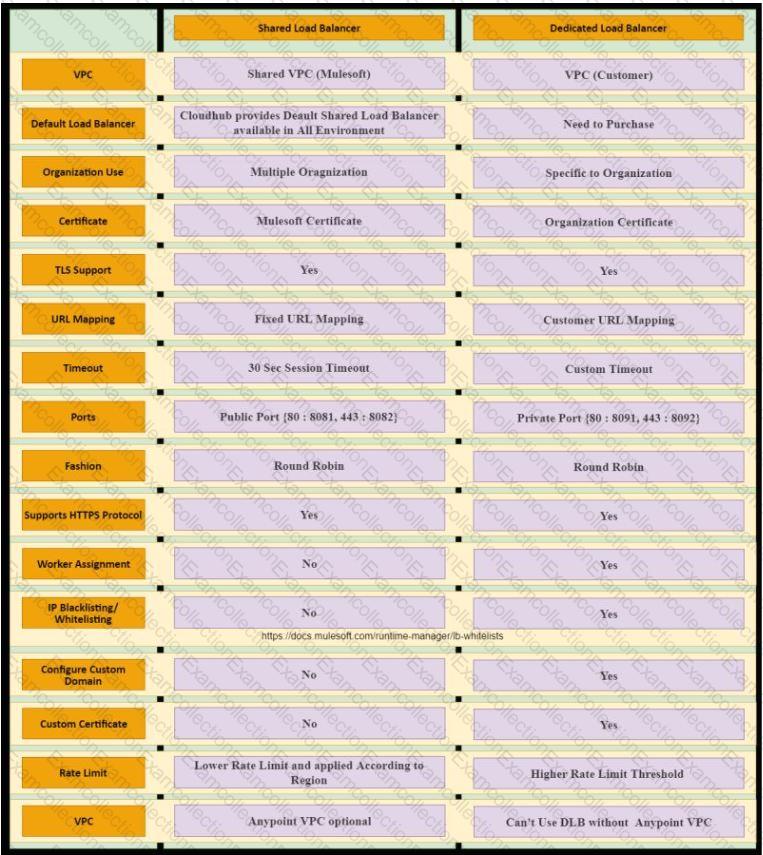 Table Description automatically generated
A platform architect includes both an API gateway and a service mesh in the architect of a distributed application for communication management.
Which type of communication management does a service mesh typically perform in this architecture?
What requires configuration of both a key store and a trust store for an HTTP Listener?
What requirement prevents using Anypoint MQ as the messaging broker for a Mule application?
Mule application is deployed to Customer Hosted Runtime. Asynchronous logging was implemented to improved throughput of the system. But it was observed over the period of time that few of the important exception log messages which were used to rollback transactions are not working as expected causing huge loss to the Organization. Organization wants to avoid these losses. Application also has constraints due to which they cant compromise on throughput much. What is the possible option in this case?
