Month End Sale Special Limited Time 70% Discount Offer - Ends in 0d 00h 00m 00s - Coupon code: xmas50

Fortinet NSE6_SDW_AD-7.6 - Fortinet NSE 6 - SD-WAN 7.6 Enterprise Administrator

Page: 2 / 3
Total 95 questions

(In the context of SD-WAN, the terms underlay and overlay are commonly used to categorize links.

Which two statements about underlay and overlay links are correct? Choose two answers.)

A.

A VLAN is a type of overlay link.

B.

Overlay links provide routing flexibility.

C.

FortiLink interface is considered an underlay link.

D.

Wireless connections can be used to build overlay links.

E.

Only wired connections can be used as underlay links.

You have configured the performance SLA with the probe mode as Prefer Passive.

What are two observable impacts of this configuration? (Choose two.)

A.

FortiGate passively monitors the member if TCP traffic is passing through the member.

B.

After FortiGate switches to active mode, the SLA performance rule falls back to passive monitoring after 3 minutes.

C.

FortiGate passively monitors the member if ICMP traffic is passing through the member.

D.

During passive monitoring, the SLA performance rule cannot detect dead members.

E.

FortiGate can offload the traffic that is subject to passive monitoring to hardware.

(You want FortiGate to use SD-WAN rules to steer ping local-out traffic.

Which two constraints should you consider? Choose two answers.)

A.

You can steer local-out traffic only with SD-WAN rules that use the manual strategy.

B.

By default, FortiGate uses SD-WAN rules only for local-out traffic that corresponds to ping and traceroute.

C.

By default, local-out traffic does not use SD-WAN.

D.

You must configure each local-out feature individually to use SD-WAN.

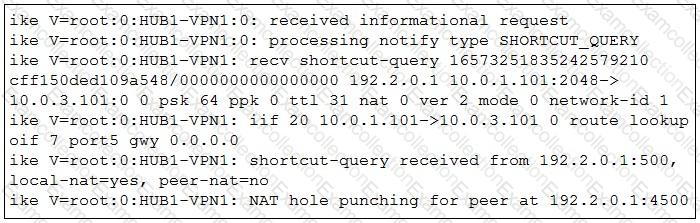
Refer to the exhibit.

Which statement best describe the role of the ADVPN device in handling traffic?

A.

This is a spoke that has received a direct shortcut query from a remote spoke.

B.

This is a hub, and two spokes, 192.2.0.1 and 10.0.3.101, establish a shortcut.

C.

This is a hub that has received a shortcut query from a spoke and has forwarded it to another spoke.

D.

This is a spoke that has received a shortcut query from a remote hub.

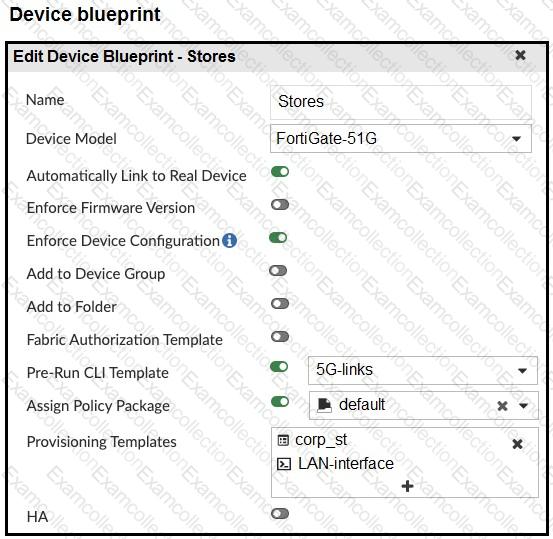
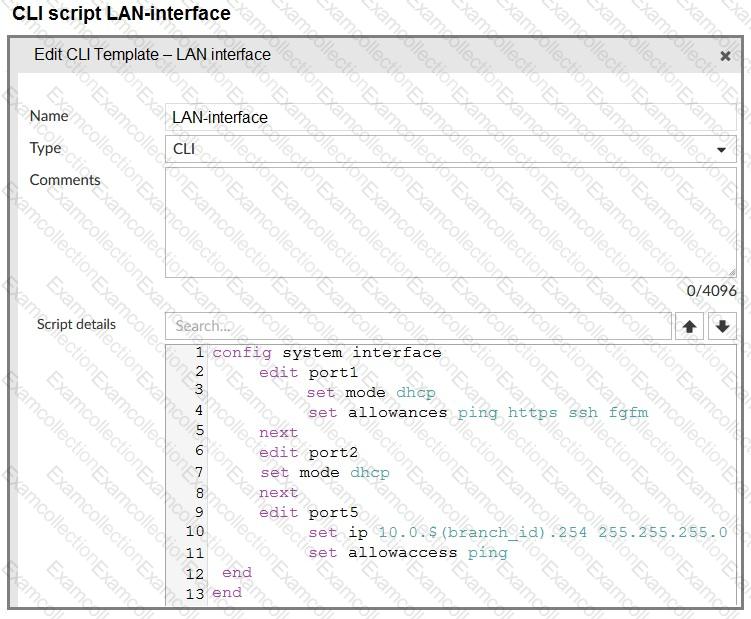
Refer to the exhibits.

The administrator configured a device blueprint and CLI scripts as shown in the exhibits, to prepare for onboarding FortiGate devices in the company’s stores. Later, a technician prepares a FortiGate 51G with a basic configuration and connects it to the network. The basic configuration contains the port1 configuration and the minimal configuration required to allow the device to connect to FortiManager.

After the device first connects to FortiManager, FortiManager updates the device configuration.

Based on the exhibits, which actions does FortiManager perform?

A.

FortiManager updates the device configuration according to the selected templates. It applies the corp_st template first.

B.

FortiManager does not update the port1 configuration because FortiManager does not change the configuration of interfaces with fgfm access.

C.

FortiManager updates access rights only for port1. FortiManager cannot update the IP address because it was already set manually.

D.

FortiManager updates the configuration of port1, port2, and port5. The three ports might get new IP addresses.

An SD-WAN member is no longer used to steer SD-WAN traffic. The administrator updated the SD-WAN configuration and deleted the unused member. After the configuration update, users report that some destinations are unreachable. You confirm that the affected flow does not match an SD-WAN rule.

What could be a possible cause of the traffic interruption?

A.

FortiGate, with SD-WAN enabled, cannot route traffic through interfaces that are not SD-WAN members.

B.

FortiGate can remove some static routes associated with an interface when the member is removed from SD-WAN.

C.

FortiGate removes the layer 3 settings for interfaces that are removed from the SD-WAN configuration.

D.

FortiGate administratively brings down interfaces when they are removed from the SD-WAN configuration.

Your FortiGate is in production. To optimize WAN link use and improve redundancy, you enable and configure SD-WAN.

What must you do as part of this configuration update process?

A.

Replace references to interfaces used as SD-WAN members in the routing configuration.

B.

Purchase and install the SD-WAN license, and reboot the FortiGate device.

C.

Replace references to interfaces used as SD-WAN members in the firewall policies.

D.

Disable the interface that you want to use as an SD-WAN member.

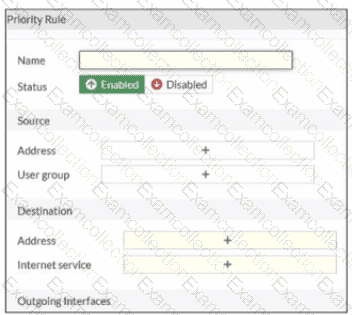
Refer to the exhibit.

An administrator configures SD-WAN rules for a DIA setup using the FortiGate GUI. The page to configure the source and destination part of the rule looks as shown in the exhibit. The GUI page shows no option to configure an application as the destination of the SD-WAN rule Why?

A.

You cannot use applications as the destination when FortiGate is used for a DIA setup.

B.

FortiGate allows the configuration of applications as the destination of SD-WAN rules only on the CLI.

C.

You must enable the feature on the CLI.

D.

You must enable the feature first using the GUI menu System > Feature Visibility.

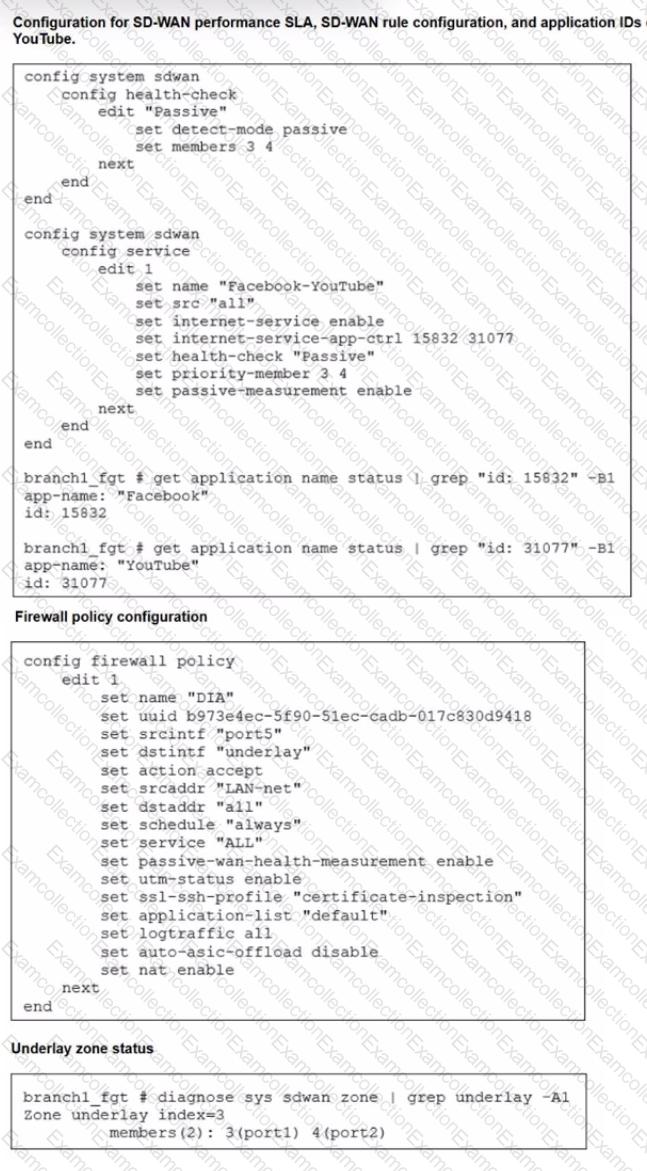
Refer to the exhibits.

The exhibits show the configuration for SD-WAN performance. SD-WAN rule, the application IDs of Facebook and YouTube along with the firewall policy configuration and the underlay zone status.

Which two statements are true about the health and performance of SD-WAN members 3 and 4? (Choose two.)

A.

Only related TCP traffic is used for performance measurement.

B.

The performance is an average of the metrics measured for Facebook and YouTube traffic passing through the member.

C.

Encrypted traffic is not used for the performance measurement.

D.

FortiGate identifies the member as dead when there is no Facebook and YouTube traffic passing through the member.

Refer to the exhibit that shows a diagnose output on FortiGate.
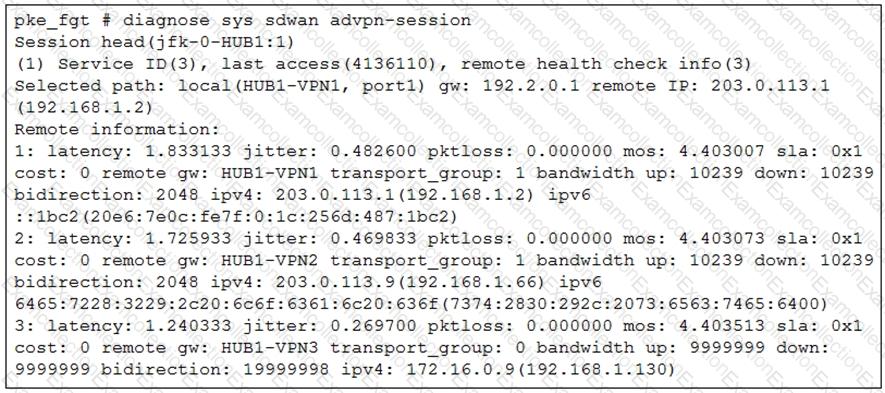
Based on the output shown in the exhibit, what can you say about the device role and how it handles health checks?

A.

The device is a spoke. It receives health-check measures for the tunnels of another spoke.

B.

The device is a hub. It receives embedded health-check measures for each tunnel from the spoke.

C.

The device is a spoke. It provides embedded health-check measures for each tunnel to the hub.

D.

The device is a hub. It receives health-check measures for the tunnels of a spoke.