Month End Sale Special Limited Time 70% Discount Offer - Ends in 0d 00h 00m 00s - Coupon code: xmas50

Fortinet NSE6_SDW_AD-7.6 - Fortinet NSE 6 - SD-WAN 7.6 Enterprise Administrator

Page: 3 / 3
Total 95 questions

An administrator is configuring SD-WAN to load balance their network traffic. Which two things should they consider when setting up SD-WAN? (Choose two.)

A.

You can select the outbandwidth hash mode with all strategies that allow load balancing.

B.

Only the manual and best-quality strategies allow SD-WAN load balancing.

C.

When applicable. FortiGate load balances the traffic through all members that meet the SLA target.

D.

SD-WAN load balancing is possible only using the best quality and lowest cost (SLA) strategies.

(Which two features must you configure before FortiGate can steer traffic according to SD-WAN rules? Choose two answers.)

A.

Security profiles

B.

Underlay links

C.

Overlay links

D.

Traffic shaping

E.

Firewall policies

As an IT manager for a healthcare company, you want to delegate the installation and management of your SD-WAN deployment to a managed security service provider (MSSP). Each site must maintain direct internet access and ensure that it is secure. You expected significant traffic flow between the sites and want to delegate as much of the network administration and management as possible to the MSSP.

Which two MSSP deployment blueprints best address the customer’s requirements? (Choose two.)

A.

Use a shared hub at the MSSP premises with a dedicated VDOM for the new customer, and install the spokes at the customer premises.

B.

Use a shared hub at the MSSP premises and a dedicated hub at the customer premises and install the spokes at the customer premises.

C.

Install a dedicated hub at the MSSP premises for the new customer, and install the spokes at the customer premises.

D.

Install the hub and spokes at the customer premises and enable the MSSP to manage the SD-WAN deployment using FortiManager with a dedicated ADOM.

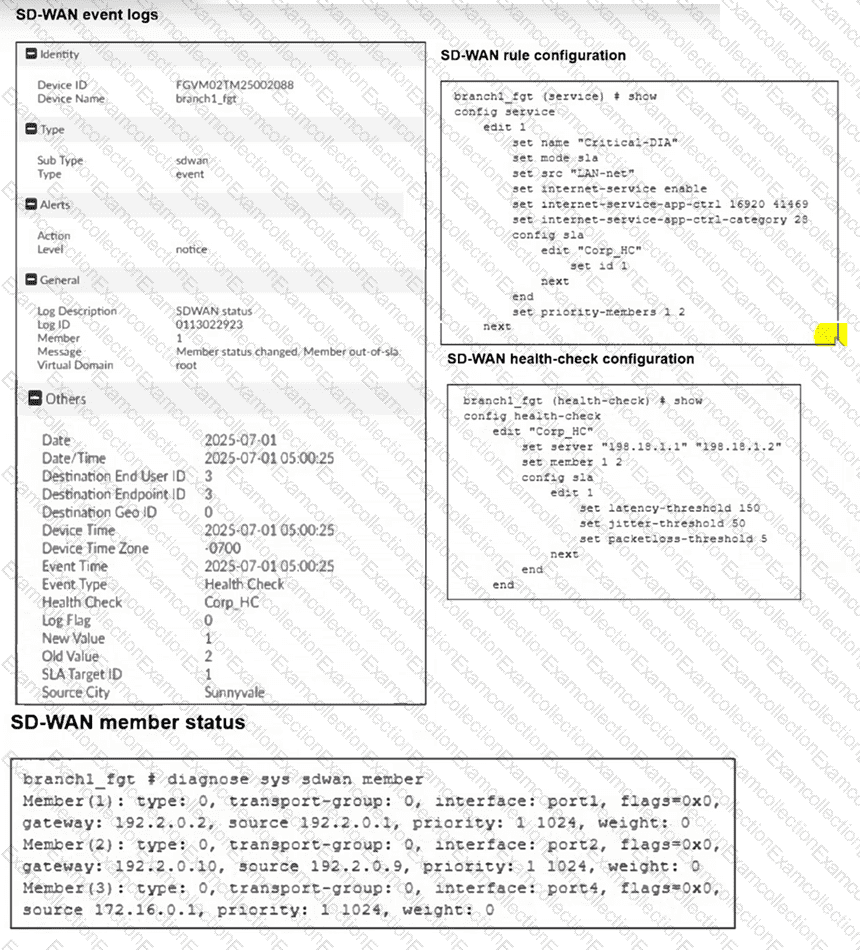
(Refer to the exhibits.

Two SD-WAN event logs, the member status, the SD-WAN rule configuration, and the health-check configuration for a FortiGate device are shown.

Immediately after the log messages are displayed, how will the FortiGate steer the traffic based on the information shown in the exhibits? Choose one answer.)

A.

FortiGate skips SD-WAN rule ID 1.

B.

FortiGate uses port2 to steer the traffic for SD-WAN rule ID 1.

C.

FortiGate uses port1 to steer the traffic for SD-WAN rule ID 1.

D.

FortiGate uses port1 or port2 to steer the traffic for SD-WAN rule ID 1.

Exhibit.

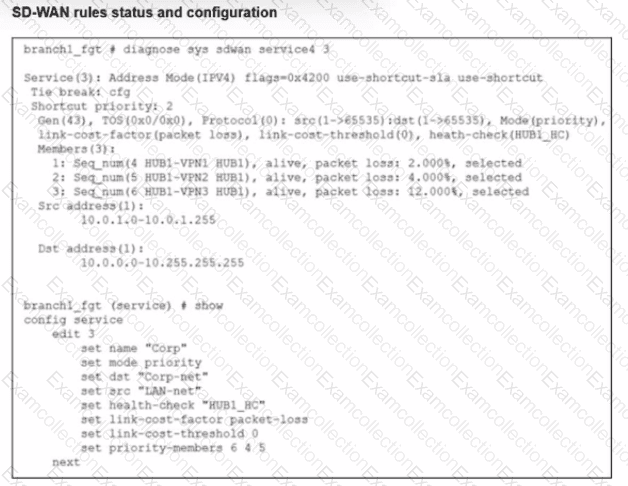
Refer to the exhibit, which shows the SD-WAN rule status and configuration.

Based on the exhibit, which change in the measured packet loss will make HUB1-VPN3 the new preferred member?

A.

When HUB1-VPN1 has 4% packet loss

B.

When HUB1-VPN1 has 12% packet loss

C.

When HUB1-VPN3 has 4% packet loss

D.

When all three members have the same packet loss

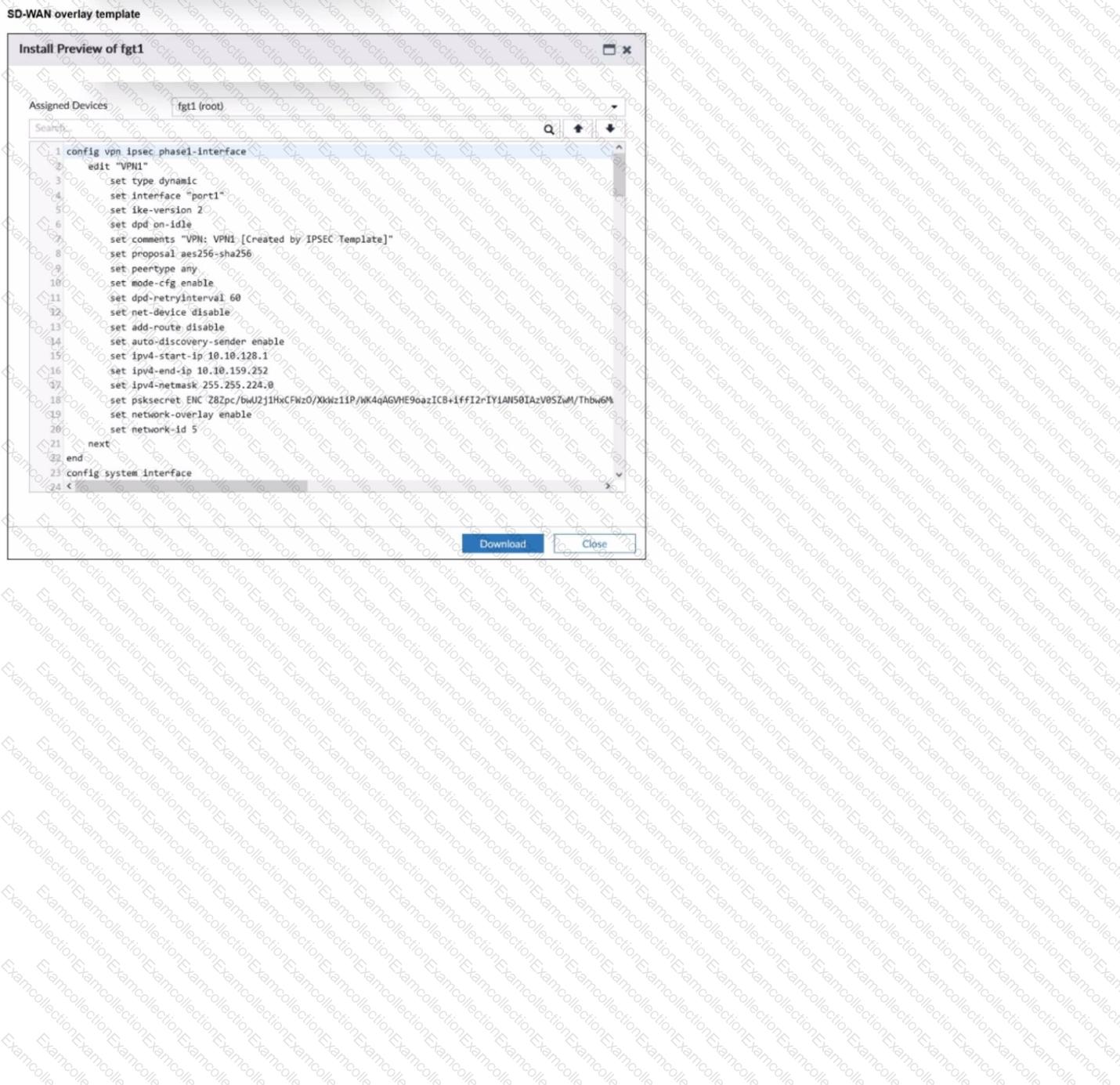
Refer to the exhibit.

The administrator used the SD-WAN overlay template to prepare an IPsec tunnels configuration for a hub-and-spoke SD-WAN topology. The exhibit shows the FortiManager installation preview for one FortiGate device.

Based on the exhibit, which statement best describes the configuration applied to the FortiGate device?

A.

It is a spoke device that establishes dynamic IPsec tunnels to the hub. The local subnet range is 10.10.128.0/23.

B.

It is a hub device. It can send ADVPN shortcut offers.

C.

It is a hub device. It will automatically discover the spoke devices and add them to the SD-WAN topology.

D.

It is a spoke device that establishes dynamic IPsec tunnels to the hub It can send ADVPN shortcut requests.

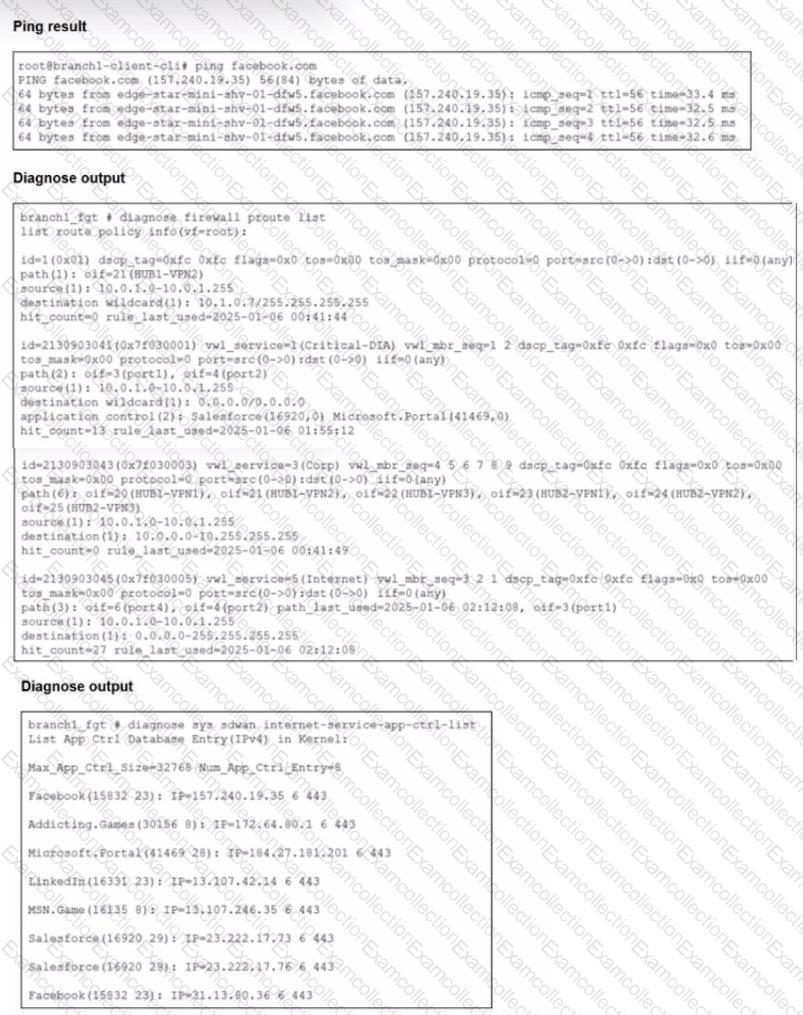
Refer to the exhibits.

You connect to a device behind a branch FortiGate device and initiate a ping test. The device is part of the LAN subnet and its IP address is 10.0.1.101.

Based on the exhibits, which interface uses branch 1_fgt to steer the test traffic?

A.

port4

B.

HUB1-VPN1

C.

port1

D.

port2

(You configure the overlay tunnels for an SD-WAN hub-and-spoke topology defined with IPsec tunnels, BGP on loopback, and dynamic BGP.

Which are two recommended IPsec settings for this topology? Choose two answers.)

A.

On the spoke, set the parameter net-device to enable.

B.

On the spoke, configure the parameter localid.

C.

On the hub, set the parameter mode-cfg to enable.

D.

On the hub, set the tunnel type to static.