Summer Sale Special Limited Time 70% Discount Offer - Ends in 0d 00h 00m 00s - Coupon code: xmas50

Fortinet NSE7_SSE_AD-25 - Fortinet NSE 7 - FortiSASE 25 Enterprise Administrator

Page: 1 / 3
Total 88 questions

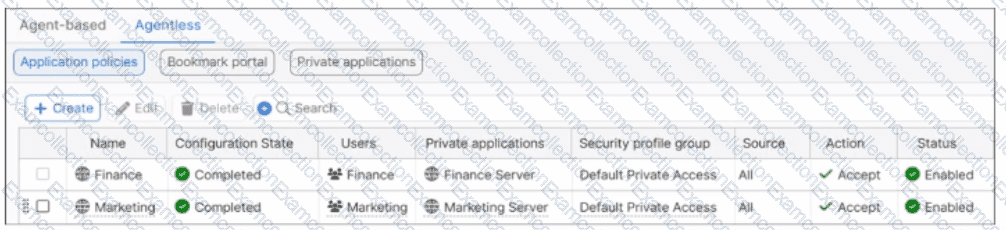
Refer to the exhibit.

Which two prerequisites must be met to use the feature shown in the exhibit? (Choose two.)

A.

FordClient must be installed on the users device to access the private application.

B.

The proxy and proxy user single sign-on (SSO) features must be configured in FortiSASE

C.

The secure private access (SPA) feature must be configured in FortiSASE.

D.

The relevant FortiGate ZTNA application gateway must be configured.

To complete their day-to-day operations, remote users require access to a TCP-based application that is hosted on a private web server. Which FortiSASE deployment use case provides the most efficient and secure method for meeting the remote users ' requirements?

A.

SD-WAN private access

B.

inline-CASB

C.

zero trust network access (ZTNA) private access

D.

next generation firewall (NGFW)

What are the key differences between the FortiSASE BGP per overlay and BGP on loopback routing design methods? (Choose one answer)

A.

BGP per overlay can use separate iBGP sessions for each spoke-to-hub tunnel with mode-cfg enabled for IP address assignment, while BGP on loopback uses a single iBGP session per hub terminating on a loopback interface to simplify configuration and reduce advertised routes.

B.

BGP per overlay establishes a single iBGP session per hub on a loopback interface, while BGP on loopback requires mode-cfg for IP address assignment and uses multiple iBGP sessions per tunnel.

C.

BGP per overlay is used for loopback interfaces to reduce routes, while BGP on loopback is the default method requiring separate iBGP sessions for each spoke.

D.

BGP per overlay simplifies hub configuration without mode-cfg, while BGP on loopback establishes multiple iBGP sessions for each tunnel to increase advertised routes.

Which role does FortiSASE play in supporting zero trust network access (ZTNA) principles9

A.

It offers hardware-based firewalls for network segmentation.

B.

It integrates with software-defined network (SDN) solutions.

C.

It can identify attributes on the endpoint for security posture check.

D.

It enables VPN connections for remote employees.

A customer configured the On/off-net detection rule to disable FortiSASE VPN auto-connect when users are inside the corporate network. The rule is set to Connects with a known public IP using the company’s public IP address. However, when the users are on the corporate network, the FortiSASE VPN still auto-connects. The customer has confirmed that traffic is going to the internet with the correct IP address.
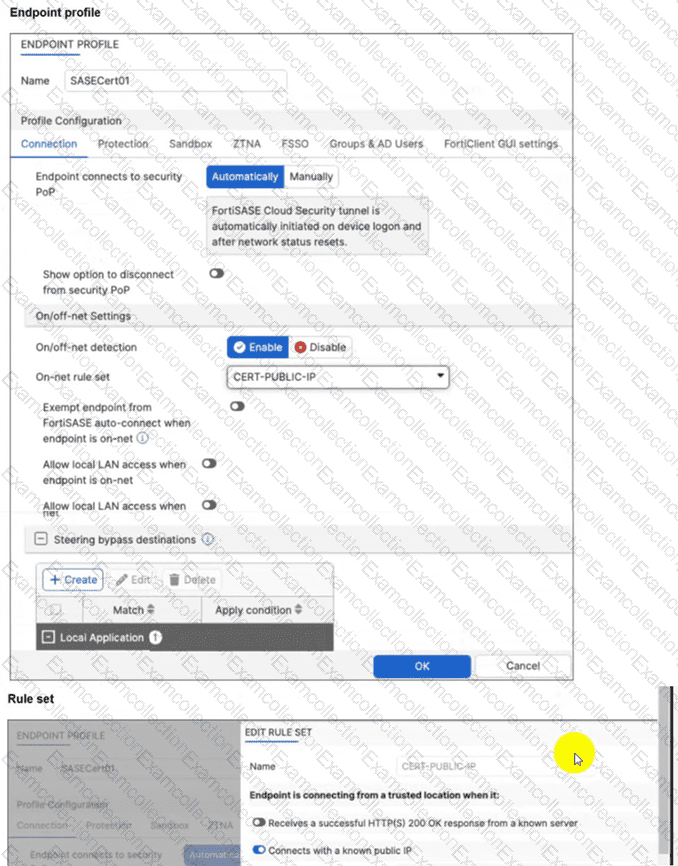
Which configuration is causing the issue? (Choose one answer)

A.

The On-net rule set configuration is incorrect.

B.

Allow local LAN access when endpoint is on-net is disabled when it should be enabled.

C.

Exempt endpoint from FortiSASE auto-connect is disabled when it should be enabled.

D.

Is connected to a known DNS server should be enabled and configured.

When accessing the FortiSASE portal for the first time, an administrator must select data center locations for which three FortiSASE components? (Choose three.)

A.

Endpoint management

B.

Points of presence

C.

SD-WAN hub

D.

Logging

E.

Authentication

You are designing a new network, and the cybersecurity policy mandates that all remote users working from home must always be connected and protected. Which FortiSASE component facilitates this always-on security measure? (Choose one answer)

A.

Unified FortiClient

B.

SDWAN on-ramp2

C.

Secure web gateway

D.

Thin-branch SASE extension

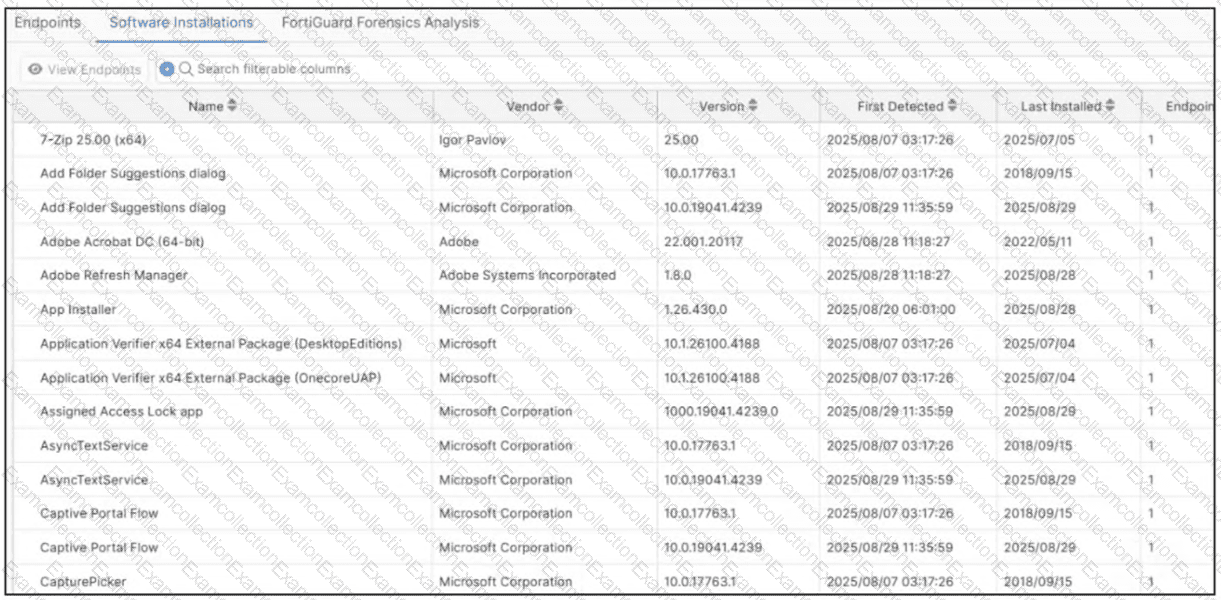
Refer to the exhibit.

Which type of information or actions are available to a FortiSASE administrator from the following output? (Choose one answer)

A.

Administrators can view and configure endpoint profiles and ZTNA tags.

B.

Administrators can view and configure automatic patching of endpoints, and first detected date for applications.

C.

Administrators can view latest application version available and push updates to managed endpoints.

D.

Administrators can view application details, such as vendor, version, and installation dates to identify unwanted or outdated software.

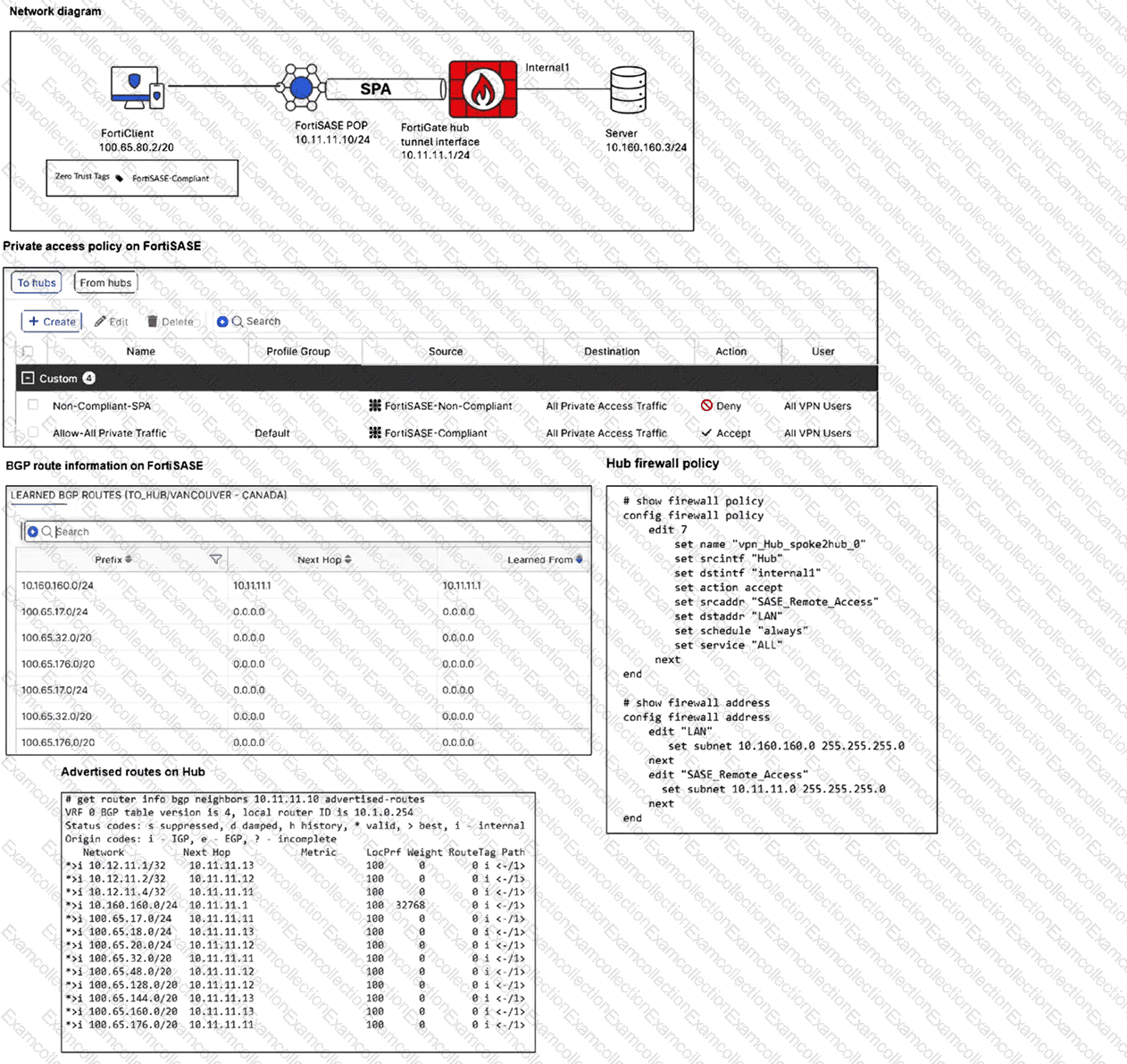
Refer to the exhibits.

A FortiSASE administrator has configured FortiSASE as a spoke to a FortiGate hub. The tunnel is up to the FortiGate hub. However, the remote FortiClient is not able to access the web server hosted behind the FortiGate hub. What is the reason for the access failure? (Choose one answer)

A.

The hub is not advertising the required routes.

B.

A private access policy has denied the traffic because of failed compliance.

C.

The hub firewall policy does not include the FortiClient address range.

D.

The server subnet BGP route was not received on FortiSASE.

An organization needs to resolve internal hostnames using its internal rather than public DNS servers for remotely connected endpoints. Which two components must be configured on FortiSASE to achieve this? (Choose two.)

A.

SSL deep inspection

B.

Split DNS rules

C.

Split tunnelling destinations

D.

DNS filter