

Halloween Sale Special - 75% Discount Offer - Ends in 0d 00h 00m 00s - Coupon code: newyear

Fortinet NSEI_OTS_AR-7.6 - Fortinet NSE I - OT Security 7.6 Architect

Page: 1 / 2
Total 56 questions

You want to improve the security of your OT network and therefore deploy a FortiGate device with the OT signatures database. Which two statements about this database are true? (Choose two answers)

A.

You must install a valid OT security service license.

B.

You must import the OT signatures database manually.

C.

The OT signatures database is enabled by default.

D.

You must set exclude-signatures to none in the console line interface.

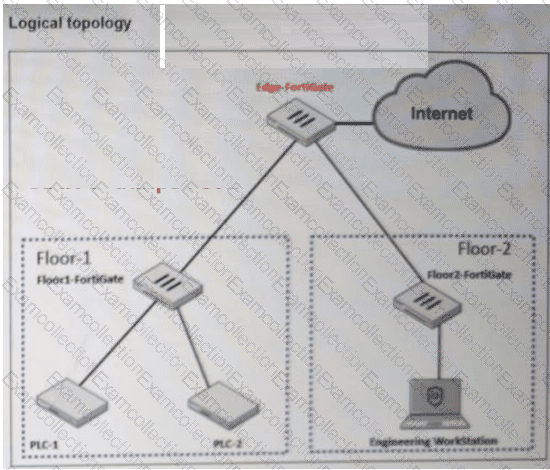
Refer to the exhibit.

A partial OT network is shown. You have encountered many disconnections in the links and want to improve the availability of this network. Which action can you perform? (Choose one answer)

A.

You can implement HA clusters.

B.

You can implement SD-WAN at Floor-1-FortiGate and Floor-2-FortiGate.

C.

You can implement parallel redundancy protocol.

D.

You can implement VDOMs in Edge-FortiGate.

According to the IEC 62443 standard, your security level is 4 . What is your OT environment defending against? (Choose one answer)

A.

Intentional cyberthreats posed by skilled malicious users

B.

An intentional attack with low resources

C.

A syndicate of cyber extortion with extensive resources

D.

A casual exposure

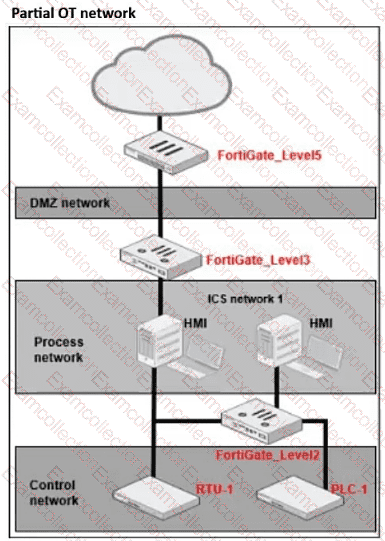
Refer to the exhibit.

A partial OT network is shown.

PLC-1 has a known critical vulnerability, but you cannot update it.

What must you configure to protect PLC-1?

A.

OT signatures on FortiGate_Level3

B.

IPS on FortiGate_Level5

C.

Virtual patching on FortiGate_Level2

D.

OT application control on all FortiGate devices

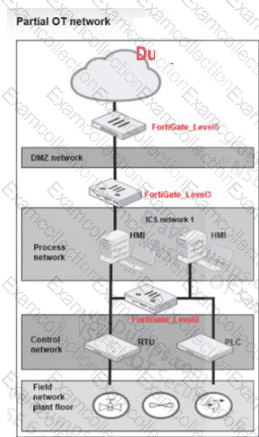
Refer to the exhibit.

A partial OT network is shown. In this OT network, you must add additional security measures to detect OT protocols and, therefore, increase the traffic visibility. Which security sensor must you implement to detect the OT protocols in this network? (Choose one answer)

A.

Device detection on all the FortiGate interfaces.

B.

Inline IDS on FortiGate_Level3.

C.

Application sensor set to monitor on all the FortiGate devices.

D.

IPS sensor on FortiGate_Level5.

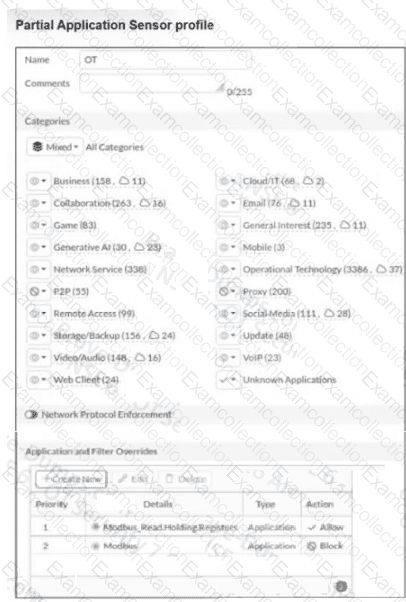
Refer to the exhibit.

A partial Application Sensor profile is shown. When you apply this profile in firewall policy, which two statements are correct? (Choose two answers)

A.

OT signatures are enabled.

B.

All OT protocols are monitored.

C.

Modbus write commands are blocked.

D.

A log is provided for each Modbus read holding registers command.

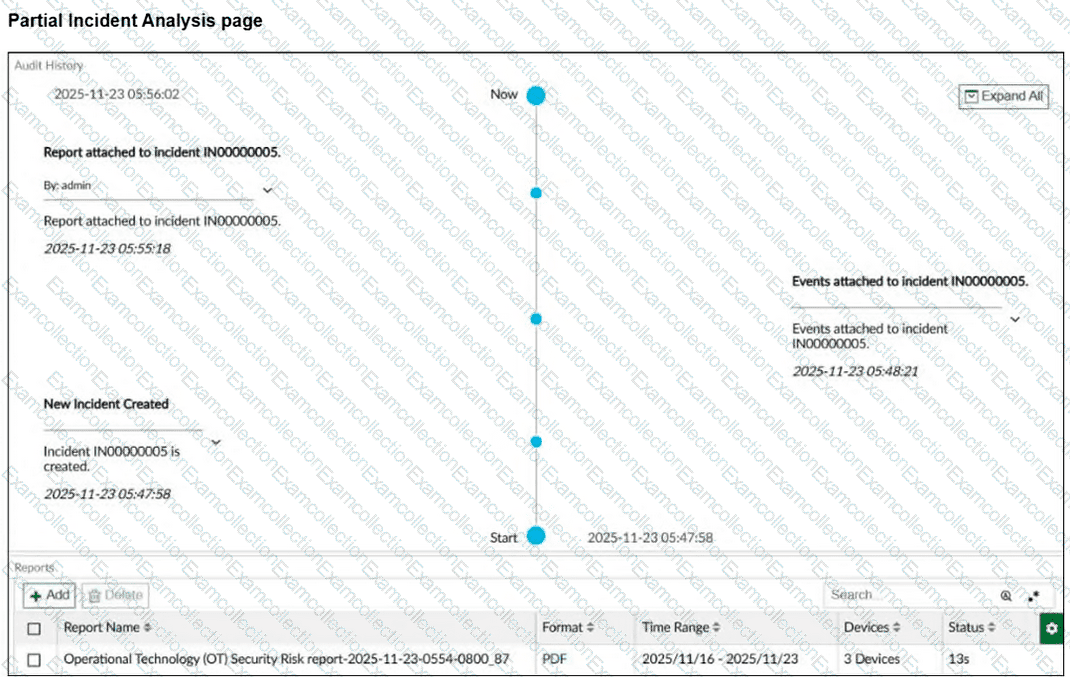
Refer to the exhibit.

A partial Incident Analysis page is shown. How was the 360-Degree Security Review OT report attached to the incident? (Choose one answer)

A.

Automatically by a stitch

B.

Automatically by an event handler

C.

Automatically by a playbook

D.

Manually by an administrator

You want to gain complete visibility of the entire attack surface using FortiAnalyzer.

Which two views must you use to achieve this result? (Choose two.)

A.

Risk Summary Dashboard

B.

Resources Reports

C.

MITRE ATT & CK® Attack

D.

Analytics Search

E.

SOC Dashboard

In your OT environment, you want to detect the devices passively. Which two methods must you implement? (Choose two answers)

A.

SSH

B.

SNMP

C.

Vendor OUI

D.

Network traffic

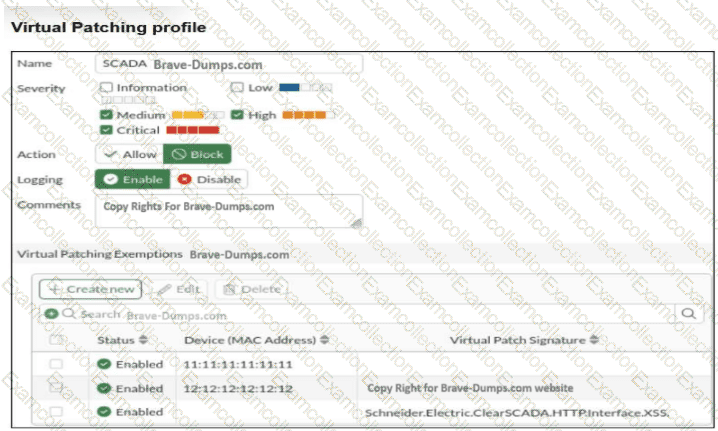
Refer to the exhibit.

A Virtual Patching profile is shown. You have recently updated your SCADA system and would like to apply the SCADA virtual patching profile. Which two statements about this profile are correct? (Choose two answers)

A.

Only the vulnerability Schneider.Electric.ClearSCADA.HTTP.Interface.XSS is still present.

B.

Low severity signatures are not blocked for the device with the MAC address 12:12:12:12:12.

C.

This profile blocks critical severity signatures for all the devices.

D.

The device with the MAC address 11:11:11:11:11 is considered to have no vulnerabilities.