


PMI PMP - Project Management Professional (PMP) July 2026 Update
A new, highly innovative project just started and the customer is already complaining that the software company is not delivering as agreed. What should the project manager have done before starting the project?
Health Records Modernization at Hospital Case Study
A project manager led a health records modernization project at a hospital with a project budget of $US5 million and an 18-month timeline. The project involved multiple stakeholder groups including medical, administrative, and IT staff; board members; patients; insurance companies; external vendors; regulatory bodies; and union representatives.
Stakeholder management was complex and a major undertaking for the project manager, but it was critical to achieve a positive project outcome. When the project started, the project manager conducted stakeholder analysis, using the information to create both a power/interest and an influence/impact matrix. The analysis showed that while the hospital board members and regulatory bodies had high power but moderate interest, the medical staff (doctors and nurses) had both high influence and high impact on the project. Administrative staff showed high interest but lower power, while patients and insurance companies had moderate interest and varying levels of influence. Based on the analysis, the project manager created a stakeholder engagement strategy that documented expectations, communication preferences, and influence levels in a stakeholder register. The project manager also made a RACI (responsible, accountable, consulted, informed) chart to show roles and responsibilities; and created communication channels and frequency for each stakeholder group, an issue escalation system, and a feedback system for continuous stakeholder input.
To execute the modernization process of health records, the project manager realized that medical staff members would need to change their daily workflows. To facilitate change management for these stakeholders, the project manager created a clinical advisory committee, appointed department-specific “champions,†created focus groups for requirements gathering, started a training program, and developed key performance indicators (KPIs) to measure satisfaction.
During project execution, several challenges emerged. The doctors expressed concerns about the system’s impact on patient care, the nurses’ union raised workload concerns, the IT department faced resource constraints, the insurance companies requested additional features, and the administrative staff worried about data security. The project manager responded to these challenges by increasing the frequency of stakeholder meetings, implementing a change management program, creating a beta system for stakeholder testing, developing contingency plans for various stakeholder scenarios, and establishing an issue resolution process.
Despite these mitigation efforts, the medical staff required additional training, leading to a change request for a 2-month extension and a 10% budget increase. The board of directors approved this to help ensure high adoption and satisfaction rates among staff members. The project helped establish new good practices in future programs for stakeholder management in the organization’s project management office (PMO). The documented lessons learned became a reference for future projects of similar scope and complexity.
How should the project manager address the administrative staff’s data security concerns related to project scope implementation?
(Refer to the Health Records Modernization at Hospital Case Study exhibit.)
A project to upgrade high-voltage transmission lines, towers, and substations in a remote mountainous area is 50% complete at the end of April.
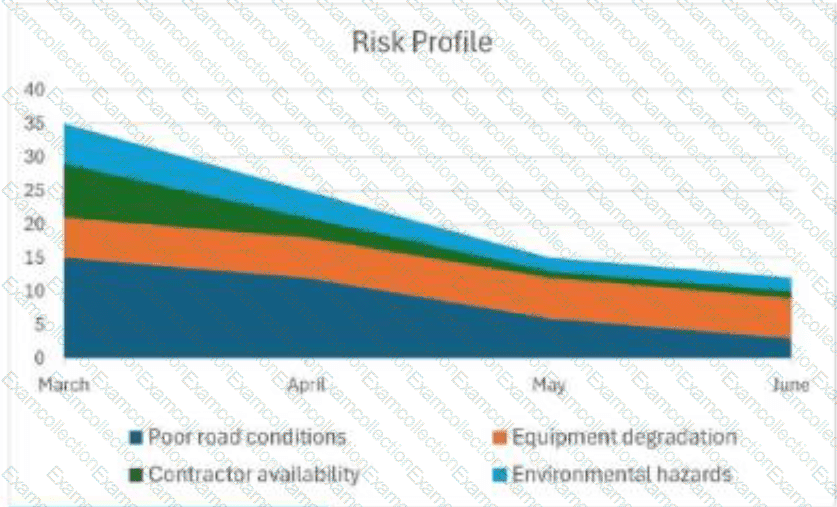
The risk manager has implemented risk responses and is projecting the probability and impact for the remainder of the project. At a monthly risk meeting, the risk manager presents the chart shown above.
What two conclusions can be determined from this chart? (Choose 2)
A project team is visualizing the value resulting from their project throughout the project life cycle. What should the project manager advise the team to do to keep the momentum?
Midway through a product launch, a major supplier announces a three-week shutdown due to a warehouse fire. This supplier provides hardware that is critical to integration testing.
What should the project manager do?
Alarge company is planning on automating their current manual processes. The project manager wishes to assess whether there are monetary benefits to be gained
by automating these processes.
What should the project manager do?
A project team had been developing their deliverables on a 2-week sprint. The deliverables were tested and proven to be functional. However, during the sprint
review, they were rejected because they failed to meet the end-user requirements.
What actions should the project manager have done?
A digital health development team is tasked with designing a new product, which is a pioneering effort for the organization and one of the few available in a
‘competitive market. The planning and auditing processes have been notably time-consuming. The development team has reported limited rework and minimal
customer complaints; however, the current budget significantly exceeds the typical project baselines for previous product development initiatives within the
organization. The project manager is currently analyzing the total cost of quality for the project.
What should the project manager do?
A team member regularly interrupts the virtual project status meeting with new recommendations. This action prevents other team members from providing their detailed status information.
What should the project manager do?
A project team is gathering requirements for a commercial off-the-shelf technology product. The project manager is not sure if the requirements gathered was
complete.
What should the project manager do?
