


PMI PMP - Project Management Professional (PMP) July 2026 Update
A project team is in the process of selecting a module for the upcoming iteration. They have identified three potential modules as candidates. Despite several rounds
of review, the team remains undecided on which module to select.
What should the project manager do?
During the planning phase of a project, the local project team presents a task to the project manager. This task will require several months to complete, and the
duration will affect the expected timeline.
What should the project manager do first?
During a daily coordination meeting, the team reports that due to considerable challenges with the infrastructure, the planned tasks are now blocked and cannot move
forward. What should the project manager do?
The project manager could not get the estimated initial budget for an infrastructure project, leaving the team uncertain about which part of the project should be
‘started. What should the project manager do?
During the execution of an Al project, the different teams responsible for developing deliverables are consistently delayed. The teams do not have access to shared
resources or are dependent on other teams to complete tasks.
What should the project manager do first?
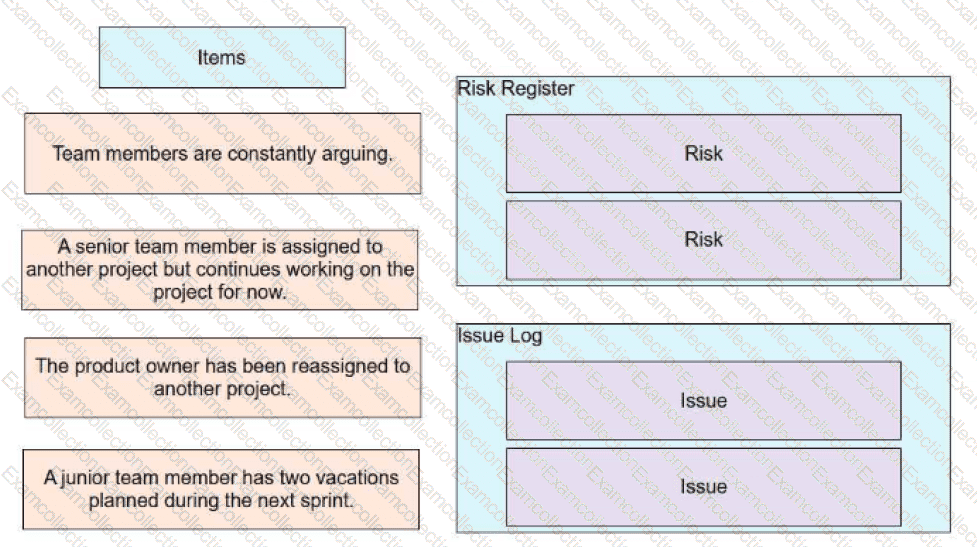
A logistics project is anticipating significant delays in the next few months. The project manager makes a list of the causes of the delays before thinking about how to minimize them.
How should the project manager prioritize which delays to take action on? (Select each box from the Items list and drag and drop it into either the Risk Register or Issue Log box.)

A project manager is engaged in a process improvement project. The business analyst working with the team has been instructed to interact with line production team
members in an efficient manner. Since process duplication would affect their reaction time, line production team members have a significant interest in process
improvement to improve quality.
How should the project manager advise the business analyst to improve interaction with the line production team?
Health Records Modernization at Hospital Case Study
A project manager led a health records modernization project at a hospital with a project budget of $US5 million and an 18-month timeline. The project involved multiple stakeholder groups including medical, administrative, and IT staff; board members; patients; insurance companies; external vendors; regulatory bodies; and union representatives.
Stakeholder management was complex and a major undertaking for the project manager, but it was critical to achieve a positive project outcome. When the project started, the project manager conducted stakeholder analysis, using the information to create both a power/interest and an influence/impact matrix. The analysis showed that while the hospital board members and regulatory bodies had high power but moderate interest, the medical staff (doctors and nurses) had both high influence and high impact on the project. Administrative staff showed high interest but lower power, while patients and insurance companies had moderate interest and varying levels of influence. Based on the analysis, the project manager created a stakeholder engagement strategy that documented expectations, communication preferences, and influence levels in a stakeholder register. The project manager also made a RACI (responsible, accountable, consulted, informed) chart to show roles and responsibilities; and created communication channels and frequency for each stakeholder group, an issue escalation system, and a feedback system for continuous stakeholder input.
To execute the modernization process of health records, the project manager realized that medical staff members would need to change their daily workflows. To facilitate change management for these stakeholders, the project manager created a clinical advisory committee, appointed department-specific “champions,†created focus groups for requirements gathering, started a training program, and developed key performance indicators (KPIs) to measure satisfaction.
During project execution, several challenges emerged. The doctors expressed concerns about the system’s impact on patient care, the nurses’ union raised workload concerns, the IT department faced resource constraints, the insurance companies requested additional features, and the administrative staff worried about data security. The project manager responded to these challenges by increasing the frequency of stakeholder meetings, implementing a change management program, creating a beta system for stakeholder testing, developing contingency plans for various stakeholder scenarios, and establishing an issue resolution process.
Despite these mitigation efforts, the medical staff required additional training, leading to a change request for a 2-month extension and a 10% budget increase. The board of directors approved this to help ensure high adoption and satisfaction rates among staff members. The project helped establish new good practices in future programs for stakeholder management in the organization’s project management office (PMO). The documented lessons learned became a reference for future projects of similar scope and complexity.
How should the project manager handle the IT department’s resource constraints while at the same time maintaining project momentum?
(Refer to the Health Records Modernization at Hospital Case Study exhibit.)
An agile project manager is responsible for keeping the project vision updated and in line with the business stakeholders’ goals to continue creating value for the
project. How should the project manager achieve this?
A project manager is leading an ongoing project for a highly reputable international client. A few hours before the final review meeting, during which the client is expected to accept the project and authorize a substantial payment, the project manager’s company suffers a cyberattack. The client is very strict and maintains that any missed deadlines will result in a considerable penalty.
What should the project manager do?