


Microsoft SC-500 - Microsoft Certified: Cloud and AI Security Engineer Associate
You need to delegate a user to implement the planned change for Defender for Cloud. The solution must follow the principle of least privilege.
Which user should you choose?
Note: This section contains one or more sets of questions with the same scenario and problem. Each question presents a unique solution to the problem. You must determine whether the solution meets the stated goals. More than one solution in the set might solve the problem. It is also possible that none of the solutions in the set solve the problem.
After you answer a question in this section, you will NOT be able to return. As a result, these questions do not appear on the Review Screen.
You have an Azure subscription that contains two virtual machines named VM1 and VM2. Each virtual machine has system-assigned managed identity enabled.
You have an Azure Storage account named storage1. Public access from all networks is enabled for storage1.
You need to ensure that VM1 and VM2 can access storage1.
Solution: You create a user-assigned managed identity, assign the identity to each virtual machine, and then add each managed identity to a role on storage1.
Does this meet the goal?
You use Microsoft Security Copilot.
Users are assigned either the Security Copilot Contributor role or the Security Copilot Owner role.
A contributor enables a custom plugin that is NOT approved, and some Security Copilot features in embedded experiences no longer function.
You need to ensure that plugins affecting all users can only be added by owners.
What should you do in the Plugin settings?
You have an Azure subscription named Sub1. Sub1 contains 20 virtual machines that run Windows Server.
Sub1 has the Microsoft Defender for Cloud Defender Cloud Security Posture Management (CSPM) plan enabled.
You need to ensure that all the virtual machines are scanned automatically for known security flaws and misconfigurations.
What should you use?
You have an Azure Storage account named storage1 that hosts a blob container named container1.
You have an Azure Functions app named app1 that uses a managed identity.
You need to configure app1 to read, write, and delete blobs in container1. The solution must follow the principle of least privilege.
What should you do?
You have an Azure subscription named Sub1 that contains multiple virtual machines. Sub1 has the Microsoft Defender Cloud Security Posture Management (CSPM) plan enabled.
You discover that Defender for Cloud fails to identify plaintext connection strings and SSH keys stored on the virtual machines.
You need to ensure that secrets can be identified on the virtual machines.
What should you do?
You have an Azure subscription.
You have the following custom role-based access control (RBAC) role definition
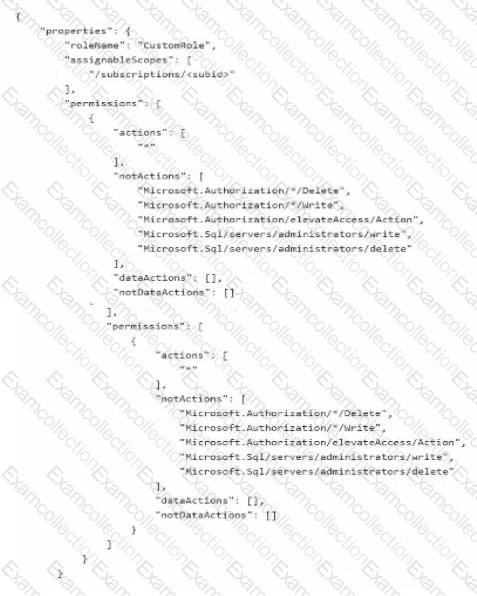
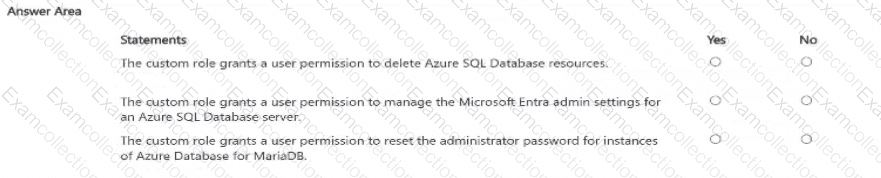
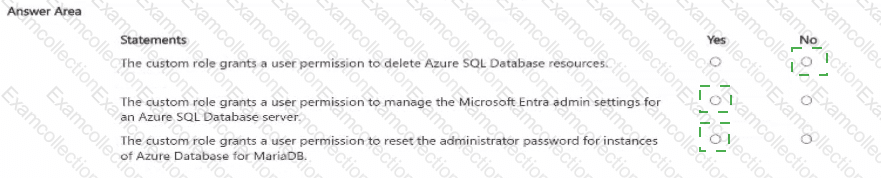
You need to implement the planned change for SQLdb1
Which two actions should you perform? Each correct answer presents part of the solution.
NOTE: Each correct selection is worth one point
Note: This section contains one or more sets of questions with the same scenario and problem. Each question presents a unique solution to the problem. You must determine whether the solution meets the stated goals. More than one solution in the set might solve the problem. It is also possible that none of the solutions in the set solve the problem.
After you answer a question in this section, you will NOT be able to return. As a result, these questions do not appear on the Review Screen.
You have an Azure subscription that contains two virtual machines named VM1 and VM2. Each virtual machine has system-assigned managed identity enabled.
You have an Azure Storage account named storage1. Public access from all networks is enabled for storage1.
You need to ensure that VM1 and VM2 can access storage1.
Solution: You add each virtual machine to a role on storage1.
Does this meet the goal?
For which storage accounts can you implement the planned changes for storage?
